
BuddhistCatholicContemplativeEvangelicalGeneral ChristianHinduJewishLatter-day SaintMuslimNew VisionsProgressive Christian
Beliefs
- Buddhist
- Catholic
- Contemplative
- Evangelical
- General Christian
- Hindu
- Jewish
- Latter-day Saint
- More Voices
- Muslim
- New Visions
- Pagan
- Progressive Christian
Topics
- Religion News
- Food and Religion
- Sports and Religion
- Religious Art
- Religious Music and Entertainment
- Religious Events
- History and Religion
- Style and Religion
- Politics and Religion
- Women in Religion
- Recreation Outdoors and Religion
- Business Finance and Religion
- Careers Workplace and Religion
- Education and Religion
- Family Parenting and Religion
- Health Fitness and Religion
- Home and Religion
- Relationships and Religion
- Technology and Religion
- Travel and Religion
Columnists
- Buddhist Columnists
- Business Finance and Religion Columnists
- Careers Workplace and Religion Columnists
- Catholic Columnists
- Contemplative Columnists
- Education and Religion Columnists
- Evangelists Columnists
- Family Parenting and Religion Columnists
- General Christian Columnists
- Health Fitness and Religion Columnists
- Hindu Columnists
- History and Religion Columnists
- Home and Religion Columnists
- Jewish Columnists
- More Voices Columnists
- Latter Day Columnists
- Muslim Columnists
- New Visions Columnists
- Nonreligious Columnists
- Pagan Columnists
- Politics and Religion Columnists
- Progressive Columnists
- Recreation Outdoors and Religion Columnists
- Relationships and Religion Columnists
- Religion News Columnists
- Religious Art Columnists
- Religious Events Columnists
- Religious Music and Entertainment Columnists
- Sports and Religion Columnists
- Style and Religion Columnists
- Technology and Religion Columnists
- Travel and Religion Columnists
- Women in Religion Columnists
Resource Library
- 2026 Calendar
- Library of World Religions
- The 100 Most Holy Places on Earth
- Patheos Answers
- Podcasts
- Videos
- Faith Leaders Database
- Anglican Episcopalian
- Bahai
- Baptist
- Buddhism
- Christianity
- Confucianism
- Eastern Orthodoxy
- Hinduism
- Holiness and Pentecostal
- ISKCON
- Islam
- Judaism
- Lutheran
- Methodist
- The Church of Jesus Christ of Latter-day Saints
- New Age
- Paganism
- Presbytarian and Reformed
- Protestantism
- Religion Behind the Scenes
- Roman Catholic
- Scientology
- Shia Islam
- Sikhism
- Sufism
- Sunni Islam
- Taoism
- Zen
- See all religions
Research Tools
 Ad-Free & Subscriber Log-In Subscription Support
Ad-Free & Subscriber Log-In Subscription Support
Follow Patheos 

- Trending:
- Forgiveness
- |
- Marriage
- |
- Consciousness
- |
- Death Penalty
- |
- Election
- |
- Halloween

- Home
- Progressive Christian
- How Atheists and Theists Can Get Along
How Atheists and Theists Can Get Along
Last updated on: March 8, 2018 at 7:00 am by Vance Morgan
How Atheists and Theists Can Get Along 2018-03-07T12:11:34-04:00 Vance Morgan
Patheos Explore the world's faith through different perspectives on religion and spirituality! Patheos has the views of the prevalent religions and spiritualities of the world.
This coming week I will be starting a unit with my General Ethics students called “Does God Have Anything To Do With Ethics?” Among other things, I will be exposing my predominantly Catholic students to essays by atheists; they will be amazed to find how much they share in common .
One of the texts we will be considering is from a series of interviews published by The New York Times a few years ago on its “Opinionator” blog. In these interviews Gary Gutting, a professor of philosophy at the University of Notre Dame, explores the topic of whether belief in something greater than ourselves is rational with several contemporary academics whose work intersects with such questions.
One of these interviews is with Louise Antony, a professor of philosophy at the University of Massachusetts at Amherst. She is the editor of Philosophers without Gods: Meditations on Atheism and the Secular Life and represents the hardcore atheist position among Gutting’s six interviewees.
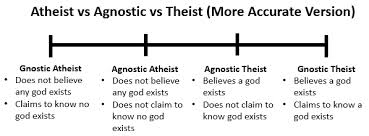
In response to Gutting’s query as to why she is an atheist, going beyond the agnostic position that we cannot know whether God exists or not to the more definitive position that one can know that God does not exist, Anthony explains:
When I claim to know that there is no God, I mean that the question is settled to my satisfaction. I don’t have any doubts. I don’t say that I am agnostic, because I disagree with those who say it’s not possible to know whether or not God exists. I think it’s possible to know. And I think the balance of evidence and argument has a definite tilt. . . . The main issue is supernaturalism—I deny that there are beings or phenomena outside the scope of natural law.
I must confess that I found much of the following conversation to be tiresome and spinning its wheels in bottomless intellectual ruts. Antony will only accept a specific type of evidence—that which can be verified within the parameters of the laws of nature. The theist makes a serious mistake when she or he agrees to play the “does God exist?” game by these rules. In truth, Antony’s belief that “everything is the product of mindless natural laws acting on mindless matter” operating according to the inexorable laws of nature is as much an act of faith as the theist’s belief that there is at least one being—God—that transcends those laws.
Of greater interest is her claim that “the question is settled to my satisfaction,” because this raises the threshold of conviction question. Just how convinced does someone have to be of the truth of something before further investigation is stopped? Is the threshold of conviction different from person to person? And if so, how can a person with a low threshold of conviction fruitfully converse with the doubter or skeptic whose threshold is significantly higher?
Gutting and Antony’s conversation shifts in this direction when it moves its focus from scientific to experiential evidence. Gutting asks What do you make of the claim from many theists that the best evidence for the existence of something greater than us is direct religious experience? After denying that she has had such experiences, Antony offers a connective bridge that many atheists refuse to consider.
O.K., if you hold my feet to the fire, I’ll admit that I believe I know what sort of experiences the theists are talking about, that I’ve had such experiences, but I don’t think they have the content the theists assign to them. I’ve certainly had experiences I would call “profound.” . . . I’ve been tremendously moved by demonstrations of personal courage (not mine!), generosity, sympathy. I’ve had profound experiences of solidarity, when I feel I’m really together with other people working for some common goal. These are very exhilarating and inspiring experiences, but they are very clearly about human beings—human beings at their best.
Shifting the conversation from the ways in which we describe our experiences to the content of those experiences offers an opportunity for new understanding.
Antony’s comments remind me of a long-standing problem that I had with my father well into my adulthood. From my earliest memories, he peppered his conversations with phrases like “God told me that . . .,” “the Lord directed me to . . .,” and “I was going to do ___, but God told me not to,” giving the impression that he and the Divine had a direct line of communication others did not have access to. Knowing that I had no such direct line, I had no idea what the experience of talking directly to God was like.
After many years of first thinking I was my father’s spiritual inferior, then thinking that he was simply nuts, one day in my early thirties in response to yet another “God told me that” pronouncement I confronted him. “You say that all the time—what exactly does it feel or sound like when God says something to you?”
Taken aback by what he perceived as an attack from his passive, introverted son he grew a bit defensive. “Well, you know, it’s a strong feeling, an intuition, a sense that I should do this rather than that.” “It’s not a voice?” I asked. “No—it hasn’t been yet, at least,” he replied. “I know what those sorts of experiences are like,” I sputtered—“I just don’t call them God talking to me!” And for the first time we had come to at least a partial truce. Our failure to communicate was the result of vastly different language, not vastly different experiences.
In a moment of the sort that is all too rare in conversations between atheists and theists, Antony suggests that we focus our attention on the experiences that all human beings share, not on the various sorts of descriptions and explanations that divide them. Because after all, just how important is it, in the larger scheme of things, to be absolutely right about something that is ultimately beyond the reach of our usual sorts of evidence?
Why do theists care so much about belief in God? [And, I might add, why do atheists care so much about not believing in God?] Disagreement over that question is really no more than a difference in philosophical opinion. Specifically, it’s just a disagreement about ontology—about what kinds of things exist. Why should a disagreement like that bear any moral significance? Why shouldn’t theists just look for allies among us atheists in the battles that matter—the ones concerned with justice, civil rights, peace, etc.—and forget about our differences with respect to such arcane matters as the origins of the universe?
This strikes me as wise advice. As Anne Cavidge says in Iris Murdoch’s Nuns and Soldiers,
What do my thoughts matter, what do their details matter, what does it matter whether Jesus Christ redeemed the world or not, it doesn’t matter, our minds can’t grasp such things, it’s all too obscure, too vague, the whole matrix shifts and we shift with it. What does anything matter except helping one or two people who are nearby, doing what’s obvious? We can see so little of the great game.
At the very least, Louise Antony suggests, theists and atheists should practice basic charity when involved in their seemingly interminable debates.
I believe I have reasons for my position, and I expect that theists believe they have reasons for theirs. Let’s agree to pay each other the courtesy of attending to the particulars.
Previous Post

March 6, 2018
A Few Things That I Know To Be True
Next Post

March 9, 2018 Do I (Still) Really Hate Donald Trump?
Browse Our Archives
Select a Category abortion Advent AI Angels Artificial intelligence atheism attention baptism Baptists beauty belief Benedictines Bible bicycling Big Bird books Bovina Camaldoli hermitage Canada Catholicism cats certainty change Christianity Christmas Collegeville Covid-19 creativity Development of Western Civilization dogs doubt Easter Enneagram Epiphany Episcopal ethics Eucharist evil extroverts Facebook faith family fear flowers forgiveness freedom friends God goodness grace happiness heaven hell history Holy Spirit Holy Week hope human nature humility humor idolatry incarnation introverts irreverence Islam Jeanne Jesus Joe Biden joy Judaism justice Kamala Harris knowledge Lent listen literature liturgy love Marsue Memorial Day miracles movies music mystery mythology NPR Old Testament optimism paradox peace Penguins philosophy piano podcast politics power prayer Protestantism Providence College Religion Rhode Island sabbatical sacrament science seeing silence Simone Weil Socrates soul sports St. John's College stories suffering tattoo teaching technology television theology thinking time tolerance transcendence travel trees trust truth Uncategorized Vermont wisdom wonder writing
Select a Month May 2026 April 2026 March 2026 February 2026 January 2026 December 2025 November 2025 October 2025 September 2025 August 2025 July 2025 June 2025 May 2025 April 2025 March 2025 February 2025 January 2025 December 2024 November 2024 October 2024 September 2024 August 2024 July 2024 June 2024 May 2024 April 2024 March 2024 February 2024 January 2024 December 2023 November 2023 October 2023 September 2023 August 2023 July 2023 June 2023 May 2023 April 2023 March 2023 February 2023 January 2023 December 2022 November 2022 October 2022 September 2022 August 2022 July 2022 June 2022 May 2022 April 2022 March 2022 February 2022 January 2022 December 2021 November 2021 October 2021 September 2021 August 2021 July 2021 June 2021 May 2021 April 2021 March 2021 February 2021 January 2021 December 2020 November 2020 October 2020 September 2020 August 2020 July 2020 June 2020 May 2020 April 2020 March 2020 February 2020 January 2020 December 2019 November 2019 October 2019 September 2019 August 2019 July 2019 June 2019 May 2019 April 2019 March 2019 February 2019 January 2019 December 2018 November 2018 October 2018 September 2018 August 2018 July 2018 June 2018 May 2018 April 2018 March 2018 February 2018 January 2018 December 2017 November 2017 October 2017 September 2017 August 2017 July 2017 June 2017 May 2017 April 2017 March 2017 February 2017 January 2017 December 2016 November 2016 October 2016 September 2016 August 2016 July 2016 June 2016 May 2016 April 2016 March 2016 February 2016 January 2016 December 2015 November 2015 October 2015 September 2015 August 2015 July 2015 June 2015 May 2015 April 2015 March 2015 February 2015 January 2015 December 2014 November 2014 October 2014 September 2014 August 2014 July 2014 June 2014 May 2014 April 2014 March 2014 February 2014 January 2014 December 2013 November 2013 October 2013 September 2013 August 2013 July 2013 June 2013 May 2013 April 2013 March 2013 February 2013 January 2013 December 2012 November 2012 October 2012 September 2012
Follow Us!
TAKE THE
Religious Wisdom Quiz
True or False: Paul wrote to the Philippians while he was imprisoned.
Select your answer to see how you score.
TRUE FALSE
Books by This Author Books by Vance G. Morgan
Related posts from Freelance Christianity

The Lonely Pawn: On Faith, Doubt, and Meaning


AI and Love: When a Chatbot Becomes a...

TRENDING AT PATHEOS Progressive Christian

Why Christians Have a Sacred Duty to Vote:...
The Bible offers strong support for the sacred duty to vote. Here...

What Being a Modern-Day Apostle Means to Me
In my last column, I discussed the ins and outs of modern-day...

Did Ancient China Once Worship the God of...
Across human history, a common thread weaves through the origins of the...

Love Your Neighbor – Including Earth-Kin: Lev. 19,...
God’s command to love your neighbor means acting in an ethical and...

Lead a Church Study of “Jesus and Lao...
Guest writer Jack Thomas (The Irreverent Reverend) reflects on leading his church...

Principles for Understanding the Apostolic Ministry Today
Whenever people discover that my formal ministry title is "apostle," as in...
view all Progressive Christian blogs
Ad-Free & Subscriber Log-In Subscription Support
- About Us
- 2026 Calendar
- Videos
- Podcasts
- Library of World Religions
- Faith In Media Tracker
- Advertise With Us
- Write for Us
- Privacy Policy
- Terms of Service
- Do Not Sell My Data
- Contact Us
- Radiant Digital
- Manage Newsletter Subscriptions
- Unsubscribe From Notifications
- Sitemap
Copyright 2008-2026, Patheos. All rights reserved.
Subscription Support Ad-Free & Subscriber Log-In
Follow Patheos