
BuddhistCatholicContemplativeEvangelicalGeneral ChristianHinduJewishLatter-day SaintMuslimNew VisionsProgressive Christian
Beliefs
- Buddhist
- Catholic
- Contemplative
- Evangelical
- General Christian
- Hindu
- Jewish
- Latter-day Saint
- More Voices
- Muslim
- New Visions
- Pagan
- Progressive Christian
Topics
- Religion News
- Food and Religion
- Sports and Religion
- Religious Art
- Religious Music and Entertainment
- Religious Events
- History and Religion
- Style and Religion
- Politics and Religion
- Women in Religion
- Recreation Outdoors and Religion
- Business Finance and Religion
- Careers Workplace and Religion
- Education and Religion
- Family Parenting and Religion
- Health Fitness and Religion
- Home and Religion
- Relationships and Religion
- Technology and Religion
- Travel and Religion
Columnists
- Buddhist Columnists
- Business Finance and Religion Columnists
- Careers Workplace and Religion Columnists
- Catholic Columnists
- Contemplative Columnists
- Education and Religion Columnists
- Evangelists Columnists
- Family Parenting and Religion Columnists
- General Christian Columnists
- Health Fitness and Religion Columnists
- Hindu Columnists
- History and Religion Columnists
- Home and Religion Columnists
- Jewish Columnists
- More Voices Columnists
- Latter Day Columnists
- Muslim Columnists
- New Visions Columnists
- Nonreligious Columnists
- Pagan Columnists
- Politics and Religion Columnists
- Progressive Columnists
- Recreation Outdoors and Religion Columnists
- Relationships and Religion Columnists
- Religion News Columnists
- Religious Art Columnists
- Religious Events Columnists
- Religious Music and Entertainment Columnists
- Sports and Religion Columnists
- Style and Religion Columnists
- Technology and Religion Columnists
- Travel and Religion Columnists
- Women in Religion Columnists
Resource Library
- 2026 Calendar
- Library of World Religions
- The 100 Most Holy Places on Earth
- Patheos Answers
- Podcasts
- Videos
- Faith Leaders Database
- Anglican Episcopalian
- Bahai
- Baptist
- Buddhism
- Christianity
- Confucianism
- Eastern Orthodoxy
- Hinduism
- Holiness and Pentecostal
- ISKCON
- Islam
- Judaism
- Lutheran
- Methodist
- The Church of Jesus Christ of Latter-day Saints
- New Age
- Paganism
- Presbytarian and Reformed
- Protestantism
- Religion Behind the Scenes
- Roman Catholic
- Scientology
- Shia Islam
- Sikhism
- Sufism
- Sunni Islam
- Taoism
- Zen
- See all religions
Research Tools
 Ad-Free & Subscriber Log-In Subscription Support
Ad-Free & Subscriber Log-In Subscription Support
Follow Patheos 

- Trending:
- Forgiveness
- |
- Marriage
- |
- Consciousness
- |
- Death Penalty
- |
- Election
- |
- Halloween

- Home
- Progressive Christian
- Time, Like an Ever-Rolling Stream
Time, Like an Ever-Rolling Stream
Last updated on: July 18, 2022 at 1:37 pm by Vance Morgan
Time, Like an Ever-Rolling Stream 2022-07-18T13:37:33-04:00 Vance Morgan
Patheos Explore the world's faith through different perspectives on religion and spirituality! Patheos has the views of the prevalent religions and spiritualities of the world.
I’ve been thinking a lot about end of life issues lately. Really. They seem to be showing up everywhere–on the television show we are currently binge-watching, in my readings in the Psalms, in Montaigne’s Essais that I taught last year, in a lead article in the Atlantic that just came in the mail, in a novel I am rereading that will be the first assignment in my ethics class in the fall. It may also have to do with a significant bike accident that I had a month ago. You know who never talks about end of life issues? Political candidates. Everyone’s clear about their position concerning abortion, but when’s the last time you heard any candidate of any political persuasion talk about death with dignity, physician-assisted dying, or aid-in-dying legislation? I thought so. Never.
After ten years of blogging, I’ve learned to pay attention to issues and ideas that come my way, even when unsolicited, using them as material for my ongoing writing efforts. And it’s not as if end of life issues are unimportant. After all, we all are going to die–as Qohelet reminds us in Ecclsiastes (I wrote about this a couple of Sundays ago).
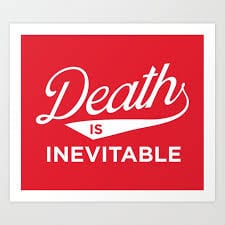 Death is not optional. One of my most effective attention-getters in any given class is to point out to a bunch of 18-21 years olds that unless there is a major breakthrough in medical technology in the next few decades, we know one thing to be true with certainty. Within 100 years, everyone in this classroom will be dead. Put the coronavirus pandemic into the mix, and even the healthiest and youngest of us are bumping into our mortality and short shelf life more frequently than usual.
One of the few remaining vestiges of my Baptist upbringing, one that I will carry with me until I die, is my love of traditional hymns. We sang them with gusto in four parts in my little church, accompanied by my mother on an out-of-tune upright piano. I first learned to appreciate poetry through the lyrics of these old Protestant standards, learning far more about Christian belief and doctrine from their eighteenth and nineteenth century authors than anything I ever heard from the pulpit.
Last Sunday was my second of two Sundays pinch-hitting on the organ at the Episcopal church I attend. Last Sunday was also the day before Independence Day, a Sunday that some folks expect a patriotic music extravaganza at some point. Not when I’m on the organ bench–I hate patriotic music in church with a passion. I did give a nod, however, to God and country by selecting one of my favorites for the processional hymn: “O God, Our Help In Ages Past” by Isaac Watts. It has a great bass line, and it’s a lot of fun to play on the organ. It was also the entrance hymn at the September 14, 2001 National Prayer Service at the National Cathedral in Washington, DC, three days after the 9/11 terrorist attacks. It puts tears in my eyes every time.
The older I get, the more meaningful two of the later verses become:
A thousand ages in thy sight
Are like an evening gone,
Short as the watch that ends the night
Before the rising sun.
Time, like an ever-rolling stream,
Bears all our years away;
They fly forgotten, as a dream
Dies at the opening day.
Watts’ hymn is a setting of Psalm 90, a powerful text in the Jewish scriptures that establishes unflinchingly a truth that most of us would just as soon ignore. We are all going to die. I heard this psalm read beautifully at a philosophy conference I attended a few years ago in Ottawa. It was the annual get-together of the one academic society in which I am very active; one of our long standing and regular members had passed away during the previous year.
The founder and former President of the society, an ordained Presbyterian minister, gave a several minute remembrance/eulogy of our colleague, capped by a powerful reading of Psalm 90. In addition to reminding us of our mortality, the Psalmist develops another inescapable truth: God is God, and you’re not. God is eternal, and you’re not. No punches are pulled. Verses 5 and 6: “You sweep us away like a dream; we fade away suddenly like the grass. In the morning it is green and flourishes; in the evening it is dried up and withered.” Verse 10: “The span of our life is seventy years, perhaps in strength even eighty; yet the sum of them is but labor and sorrow, for they pass away quickly and we are gone.”
True, but certainly not comforting. Jean-Paul Sartre or Albert Camus could have written verse 12: “So teach us to number our days that we may apply our hearts to wisdom.” On a bad day, none of this sounds any better than “Life’s a bitch and then you die.” I am reminded of what an eighty-something Benedictine monk (now in his nineties) told me during a sabbatical semester several years ago as we walked slowly together across the green to noon prayer at the Abbey where he had spent his last six decades and more. “Vance, sabbatical is God’s best idea. And getting old is God’s worst idea.”
My wife, who simply says that “getting old sucks,” would entirely agree. Jeanne and I are in our sixties, mere youngsters in many people’s estimation, I’m sure. But the swift passage of time is difficult to ignore when my sons, 8 and 5 when Jeanne and I first met, are now 43 and 40, when I can’t quite match the times and distances on my daily bike ride that I established five years ago, and when the face looking back at me from the mirror looks more and more like my father’s face did in his later years (he died in his early seventies). Talk about planned obsolescence.
When I introduce the existentialists in various classes, my students often wonder why Sartre, de Beauvoir, Camus, and others are so morbid and obsessed with death. My response is that they are trying to counter our human conviction that we are immortal. Oh, we don’t say that, but we live our lives as if we have all the time in the world, as if we will never die. We “know” that we are short-term creatures, that we have a shockingly short shelf life, but we don’t want to hear about it. As Tolstoy reminds us in The Death of Ivan Ilyich, it’s one thing to intellectually affirm the familiar syllogism that
All men will die.
Socrates is a man.
Therefore, Socrates will die.
It’s another thing entirely to realize what this means:
All men will die.
I am a man.
Therefore, I will die.
Although Isaac Watts’ setting of Psalm 90 asks God to be “our shelter from the stormy blast, and our eternal home,” the psalm itself says nothing about eternal life or bliss in heaven. That’s a New Testament concept. And to be honest, I’m not attracted to the idea that this life is just practice for eternity, even though that often seemed to be the only reason to be a Christian in my youth.
Perhaps I’m too influenced by the existentialists—I want to live my life at least trying to stay conscious of being a short-term creature. And the psalmist provides the proper daily attitude focus, with just a hint of wishful thinking thrown in:
In the morning, fill us with your love.
We shall exult and rejoice all our days.
Give us joy to balance our affliction,
For the years when we knew misfortune.
Show forth your work in your servants,
Let your glory shine on their children.
May the graciousness of the Lord our God be upon us;
Prosper the work of our hands,
Prosper our handiwork.
There’s no guarantee that joy and affliction will balance out at the end of my life. But rejoicing is a verb and a choice, even for a short-term creature.

Next Post

July 20, 2022 The Webb Telescope Images and Confirmation Bias
Browse Our Archives
Select a Category abortion Advent AI Angels Artificial intelligence atheism attention baptism Baptists beauty belief Benedictines Bible bicycling Big Bird books Bovina Camaldoli hermitage Canada Catholicism cats certainty change Christianity Christmas Collegeville Covid-19 creativity Development of Western Civilization dogs doubt Easter Enneagram Epiphany Episcopal ethics Eucharist evil extroverts Facebook faith family fear flowers forgiveness freedom friends God goodness grace happiness heaven hell history Holy Spirit Holy Week hope human nature humility humor idolatry incarnation introverts irreverence Islam Jeanne Jesus Joe Biden joy Judaism justice Kamala Harris knowledge Lent listen literature liturgy love Marsue Memorial Day miracles movies music mystery mythology NPR Old Testament optimism paradox peace Penguins philosophy piano podcast politics power prayer Protestantism Providence College Religion Rhode Island sabbatical sacrament science seeing silence Simone Weil Socrates soul sports St. John's College stories suffering tattoo teaching technology television theology thinking time tolerance transcendence travel trees trust truth Uncategorized Vermont wisdom wonder writing
Select a Month May 2026 April 2026 March 2026 February 2026 January 2026 December 2025 November 2025 October 2025 September 2025 August 2025 July 2025 June 2025 May 2025 April 2025 March 2025 February 2025 January 2025 December 2024 November 2024 October 2024 September 2024 August 2024 July 2024 June 2024 May 2024 April 2024 March 2024 February 2024 January 2024 December 2023 November 2023 October 2023 September 2023 August 2023 July 2023 June 2023 May 2023 April 2023 March 2023 February 2023 January 2023 December 2022 November 2022 October 2022 September 2022 August 2022 July 2022 June 2022 May 2022 April 2022 March 2022 February 2022 January 2022 December 2021 November 2021 October 2021 September 2021 August 2021 July 2021 June 2021 May 2021 April 2021 March 2021 February 2021 January 2021 December 2020 November 2020 October 2020 September 2020 August 2020 July 2020 June 2020 May 2020 April 2020 March 2020 February 2020 January 2020 December 2019 November 2019 October 2019 September 2019 August 2019 July 2019 June 2019 May 2019 April 2019 March 2019 February 2019 January 2019 December 2018 November 2018 October 2018 September 2018 August 2018 July 2018 June 2018 May 2018 April 2018 March 2018 February 2018 January 2018 December 2017 November 2017 October 2017 September 2017 August 2017 July 2017 June 2017 May 2017 April 2017 March 2017 February 2017 January 2017 December 2016 November 2016 October 2016 September 2016 August 2016 July 2016 June 2016 May 2016 April 2016 March 2016 February 2016 January 2016 December 2015 November 2015 October 2015 September 2015 August 2015 July 2015 June 2015 May 2015 April 2015 March 2015 February 2015 January 2015 December 2014 November 2014 October 2014 September 2014 August 2014 July 2014 June 2014 May 2014 April 2014 March 2014 February 2014 January 2014 December 2013 November 2013 October 2013 September 2013 August 2013 July 2013 June 2013 May 2013 April 2013 March 2013 February 2013 January 2013 December 2012 November 2012 October 2012 September 2012
Follow Us!
TAKE THE
Religious Wisdom Quiz
According to Philippians, whose name is above every name?
Select your answer to see how you score.
Christ God Jesus The Lord
Books by This Author Books by Vance G. Morgan
Related posts from Freelance Christianity

The Lonely Pawn: On Faith, Doubt, and Meaning


AI and Love: When a Chatbot Becomes a...

TRENDING AT PATHEOS Progressive Christian

Why Christians Have a Sacred Duty to Vote:...
The Bible offers strong support for the sacred duty to vote. Here...

What Being a Modern-Day Apostle Means to Me
In my last column, I discussed the ins and outs of modern-day...

Did Ancient China Once Worship the God of...
Across human history, a common thread weaves through the origins of the...

Love Your Neighbor – Including Earth-Kin: Lev. 19,...
God’s command to love your neighbor means acting in an ethical and...

Lead a Church Study of “Jesus and Lao...
Guest writer Jack Thomas (The Irreverent Reverend) reflects on leading his church...

Principles for Understanding the Apostolic Ministry Today
Whenever people discover that my formal ministry title is "apostle," as in...
view all Progressive Christian blogs
Ad-Free & Subscriber Log-In Subscription Support
- About Us
- 2026 Calendar
- Videos
- Podcasts
- Library of World Religions
- Faith In Media Tracker
- Advertise With Us
- Write for Us
- Privacy Policy
- Terms of Service
- Do Not Sell My Data
- Contact Us
- Radiant Digital
- Manage Newsletter Subscriptions
- Unsubscribe From Notifications
- Sitemap
Copyright 2008-2026, Patheos. All rights reserved.
Subscription Support Ad-Free & Subscriber Log-In
Follow Patheos