
BuddhistCatholicContemplativeEvangelicalGeneral ChristianHinduJewishLatter-day SaintMuslimNew VisionsProgressive Christian
Beliefs
- Buddhist
- Catholic
- Contemplative
- Evangelical
- General Christian
- Hindu
- Jewish
- Latter-day Saint
- More Voices
- Muslim
- New Visions
- Pagan
- Progressive Christian
Topics
- Religion News
- Food and Religion
- Sports and Religion
- Religious Art
- Religious Music and Entertainment
- Religious Events
- History and Religion
- Style and Religion
- Politics and Religion
- Women in Religion
- Recreation Outdoors and Religion
- Business Finance and Religion
- Careers Workplace and Religion
- Education and Religion
- Family Parenting and Religion
- Health Fitness and Religion
- Home and Religion
- Relationships and Religion
- Technology and Religion
- Travel and Religion
Columnists
- Buddhist Columnists
- Business Finance and Religion Columnists
- Careers Workplace and Religion Columnists
- Catholic Columnists
- Contemplative Columnists
- Education and Religion Columnists
- Evangelists Columnists
- Family Parenting and Religion Columnists
- General Christian Columnists
- Health Fitness and Religion Columnists
- Hindu Columnists
- History and Religion Columnists
- Home and Religion Columnists
- Jewish Columnists
- More Voices Columnists
- Latter Day Columnists
- Muslim Columnists
- New Visions Columnists
- Nonreligious Columnists
- Pagan Columnists
- Politics and Religion Columnists
- Progressive Columnists
- Recreation Outdoors and Religion Columnists
- Relationships and Religion Columnists
- Religion News Columnists
- Religious Art Columnists
- Religious Events Columnists
- Religious Music and Entertainment Columnists
- Sports and Religion Columnists
- Style and Religion Columnists
- Technology and Religion Columnists
- Travel and Religion Columnists
- Women in Religion Columnists
Resource Library
- 2026 Calendar
- Library of World Religions
- The 100 Most Holy Places on Earth
- Patheos Answers
- Podcasts
- Videos
- Faith Leaders Database
- Anglican Episcopalian
- Bahai
- Baptist
- Buddhism
- Christianity
- Confucianism
- Eastern Orthodoxy
- Hinduism
- Holiness and Pentecostal
- ISKCON
- Islam
- Judaism
- Lutheran
- Methodist
- The Church of Jesus Christ of Latter-day Saints
- New Age
- Paganism
- Presbytarian and Reformed
- Protestantism
- Religion Behind the Scenes
- Roman Catholic
- Scientology
- Shia Islam
- Sikhism
- Sufism
- Sunni Islam
- Taoism
- Zen
- See all religions
Research Tools
 Ad-Free & Subscriber Log-In Subscription Support
Ad-Free & Subscriber Log-In Subscription Support
Follow Patheos 

- Trending:
- Forgiveness
- |
- Marriage
- |
- Consciousness
- |
- Death Penalty
- |
- Election
- |
- Halloween

- Home
- Progressive Christian
- This Book Changed My Life: Kathleen Norris’ “The Cloister Walk”
This Book Changed My Life: Kathleen Norris’ “The Cloister Walk”
Last updated on: September 15, 2022 at 8:12 am by Vance Morgan
This Book Changed My Life: Kathleen Norris’ “The Cloister Walk” 2022-09-15T08:12:35-04:00 Vance Morgan
Patheos Explore the world's faith through different perspectives on religion and spirituality! Patheos has the views of the prevalent religions and spiritualities of the world.
I asked my Facebook friends at the beginning of the summer to list three or four books that changed their lives. Not necessarily books that belong in the Great Books curriculum, but books that came just at the right time and spoke to them in a particular and memorable way. I’ve written about two of mine over the past couple of months–here’s another one.
A year from now, I will be on sabbatical for the Fall 2023 semester (the fourth, and perhaps final, sabbatical of my career). It’s hard to believe, given the way that time flies, but fifteen years ago I was in exactly the same situation—a sabbatical semester (the second of my career) on the horizon. During my first sabbatical, all the way back in 2002, I didn’t go anywhere; instead, I holed up in my office and wrote the first draft of an academic book that was published two years later. As I began to think about my second sabbatical, I knew that I wanted to go somewhere for at least part of the semester (that’s what normal academics on sabbatical do), but my career has been shaped to fit the campus where I have now taught for twenty-eight years. I didn’t even know where to begin.
A few months earlier I had picked up a book called The Cloister Walk while wandering around Borders. I liked the picture on the cover, which announced that the book was a New York Times Notable Book of the Year and contained the following review excerpt from The Boston Globe:
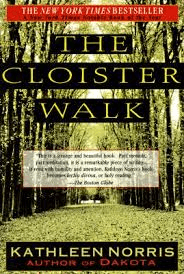 This is a strange and beautiful book . . . If read with humility and attention, Kathleen Norris’s book becomes lectio divina, or holy reading.
The Cloister Walk became my bedtime reading—a book that defies description or summary. Following Norris’s quirky faith through the liturgical year was both strange and beautiful just as the NYT reviewer promised; as another reviewer wrote, “she writes about religion with the imagination of a poet.” I had no idea before I picked the book up that this was exactly what some unknown part of me had been looking for, nor did I know that on a practical level it would point me toward where I would spend my sabbatical semester a year later.
Kathleen’s experiences that frame The Cloister Walk occurred during two separate residencies at the Collegeville Institute for Ecumenical and Cultural Research on the campus of St. John’s University in Collegeville, Minnesota. While there, she immersed herself in the daily Liturgy of the Hours with the Benedictine monks at St. John’s Abbey about a ten minute hike up the hill to campus. She writes that the Benedictines refer to their daily office as “the sanctification of time.” The Cloister Walk is the fruit of that liturgical immersion—a “strange and beautiful book” written by a woman who I would come to know as equally strange and beautiful. As I read, I unexpectedly resonated with the eclectic spiritual vision of a fellow traveler steeped in the Protestant tradition as I am—except that she was strangely attracted to the Benedictines and their ancient Rule.
An important aspect of monastic life has been described as “attentive waiting.” A spark is struck; an event inscribed with a message—this is important, pay attention—and a poet scatters a few words like seeds in a notebook.
Kathleen describes in The Cloister Walk the frustration that her fellow resident scholars at the Institute felt with the poetic and decidedly non-academic energies she brought to their collective work, a frustration that I must confess I as an academic also occasionally felt when wandering through the intuitively organized labyrinth of her book. But then, those who seek God must learn that there are as many paths to the divine as there are persons seeking a path.
When it comes to faith . . . there is no one right way to do it. Flannery O’Connor once wisely remarked that “most of us come to the church by a means the church does not allow,” and Martin Buber implies that discovering that means might constitute our life’s work. He states that “All [of us] have access to God, but each has a different access. God’s all-inclusiveness manifests itself in the infinite multiplicity of the ways that lead to him, each of which is open to one [person].”
I had no idea at the time just how badly I needed to hear that. On a deep level I had ceased hoping to find my unique spiritual path over the years, weary of running head on into what a monk described to Kathleen as “the well-worn idol named ‘but we’ve never done it that way before!’ And people wonder how dogmas get started!”
At the time I did not trust my ability to hear a possible word from God—I entirely relied on my intuitively and spiritually attuned wife to do that for me. But as I worked my way through The Cloister Walk I realized that something more than my usual resonance with a fine writer’s craft was going on—I wanted what she was writing about. Literally. I contacted the Collegeville Institute for Ecumenical and Cultural Research and applied to be a resident scholar for my sabbatical semester during the first five months of 2009. They accepted me.
 On the day that Barack Obama was inaugurated as our 44th President, a crystal clear Minnesota January day with a high temperature of zero degrees, I found myself in a tiny apartment situated in the very same complex on the shores of the very same lake I had read about eighteen months earlier. What on earth was I doing here away from Jeanne and my dachshund Frieda, all alone surrounded by a bunch of people I didn’t know? The only good answer was that I wanted what I had read about. And the rest is (my recent) history.
Professionally, what I carried from that sabbatical was a new way of writing (that three years later turned into this blog) and a bunch of academic essays that were never published (because I never sent them out). But I was changed from the inside out. While at Collegeville, I immediately tested the waters of daily noon prayer with the monks up the hill at the Abbey, a commitment that within a few weeks became a three-times-a-day habit. The prayers were important, but inhabiting the Psalms as a collective body opened a “deepest me” space that I have come to recognize as the place where the divine in me hangs out. Every possible human emotion and every possible encounter with the divine is in those ancient poems.
[The Psalms’] true theme is a desire for the holy that, whatever form it takes, seems to be a part of the human condition, a desire easily forgotten in the pull and tug of daily life, where groans of despair can predominate.
One day at noon prayer, one of my friends from the Institute directed my attention toward the row behind us. “That’s Kathleen Norris!” my friend whispered in a slightly too-loud-for-noon-prayer voice. That evening Kathleen—on campus for a university board meeting—visited the Institute for dinner. For the current Resident Scholars, it was like a visit from the Beatles. Like any groupie, I made sure Kathleen signed my copies of her books (I had them all in my apartment) and we spent three or four minutes in one-on-one conversation (which I was sure she would not remember). But just meeting the person whose book had brought me to this wonderful place in the middle of nowhere was enough.
A year and a half later, while I was back in Collegeville for a writer’s workshop at the Institute. Unexpectedly, Kathleen and I were both staying at the Abbey Guesthouse (she was not part of the workshop–I forget why she was on campus). 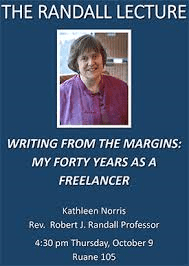 We had several breakfasts and lunches together, enjoyed some conversation on the guesthouse patio overlooking the lake, and a friendship was formed. I particularly enjoyed the envious looks on my workshop colleagues’ faces when they observed me lunching with a world-famous author in the cafeteria one day. Several years later, Kathleen was an endowed scholar on campus for an academic year and inhabited the office across the hall from me. I’m proud to say that I’m the one who suggested her to the scholar-in-residence selection committee.
For my birthday during that academic year, Jeanne and I took Kathleen out to dinner—she’s a great conversationalist and we had a wonderful time. It’s strange how things work out. In August just just a few days before the beginning of that new academic year, I was sitting in the atrium of our student center minding my own business when I heard a voice from the stairs behind me—“I know you!” It was Kathleen. “And I know you too,” I thought. “You wrote the book that changed my life.”
Previous Post

September 13, 2022
When Atheism Turns Evangelical
Next Post

September 18, 2022 How Many of Your Gods are Dead?
Browse Our Archives
Select a Category abortion Advent AI Angels Artificial intelligence atheism attention baptism Baptists beauty belief Benedictines Bible bicycling Big Bird books Bovina Camaldoli hermitage Canada Catholicism cats certainty change Christianity Christmas Collegeville Covid-19 creativity Development of Western Civilization dogs doubt Easter Enneagram Epiphany Episcopal ethics Eucharist evil extroverts Facebook faith family fear flowers forgiveness freedom friends God goodness grace happiness heaven hell history Holy Spirit Holy Week hope human nature humility humor idolatry incarnation introverts irreverence Islam Jeanne Jesus Joe Biden joy Judaism justice Kamala Harris knowledge Lent listen literature liturgy love Marsue Memorial Day miracles movies music mystery mythology NPR Old Testament optimism paradox peace Penguins philosophy piano podcast politics power prayer Protestantism Providence College Religion Rhode Island sabbatical sacrament science seeing silence Simone Weil Socrates soul sports St. John's College stories suffering tattoo teaching technology television theology thinking time tolerance transcendence travel trees trust truth Uncategorized Vermont wisdom wonder writing
Select a Month May 2026 April 2026 March 2026 February 2026 January 2026 December 2025 November 2025 October 2025 September 2025 August 2025 July 2025 June 2025 May 2025 April 2025 March 2025 February 2025 January 2025 December 2024 November 2024 October 2024 September 2024 August 2024 July 2024 June 2024 May 2024 April 2024 March 2024 February 2024 January 2024 December 2023 November 2023 October 2023 September 2023 August 2023 July 2023 June 2023 May 2023 April 2023 March 2023 February 2023 January 2023 December 2022 November 2022 October 2022 September 2022 August 2022 July 2022 June 2022 May 2022 April 2022 March 2022 February 2022 January 2022 December 2021 November 2021 October 2021 September 2021 August 2021 July 2021 June 2021 May 2021 April 2021 March 2021 February 2021 January 2021 December 2020 November 2020 October 2020 September 2020 August 2020 July 2020 June 2020 May 2020 April 2020 March 2020 February 2020 January 2020 December 2019 November 2019 October 2019 September 2019 August 2019 July 2019 June 2019 May 2019 April 2019 March 2019 February 2019 January 2019 December 2018 November 2018 October 2018 September 2018 August 2018 July 2018 June 2018 May 2018 April 2018 March 2018 February 2018 January 2018 December 2017 November 2017 October 2017 September 2017 August 2017 July 2017 June 2017 May 2017 April 2017 March 2017 February 2017 January 2017 December 2016 November 2016 October 2016 September 2016 August 2016 July 2016 June 2016 May 2016 April 2016 March 2016 February 2016 January 2016 December 2015 November 2015 October 2015 September 2015 August 2015 July 2015 June 2015 May 2015 April 2015 March 2015 February 2015 January 2015 December 2014 November 2014 October 2014 September 2014 August 2014 July 2014 June 2014 May 2014 April 2014 March 2014 February 2014 January 2014 December 2013 November 2013 October 2013 September 2013 August 2013 July 2013 June 2013 May 2013 April 2013 March 2013 February 2013 January 2013 December 2012 November 2012 October 2012 September 2012
Follow Us!
TAKE THE
Religious Wisdom Quiz
What does "Haggai" mean in Hebrew?
Select your answer to see how you score.
God's Messenger The Lord Saves Festive The Rock
Books by This Author Books by Vance G. Morgan
Related posts from Freelance Christianity

The Lonely Pawn: On Faith, Doubt, and Meaning


AI and Love: When a Chatbot Becomes a...

TRENDING AT PATHEOS Progressive Christian

Why Christians Have a Sacred Duty to Vote:...
The Bible offers strong support for the sacred duty to vote. Here...

What Being a Modern-Day Apostle Means to Me
In my last column, I discussed the ins and outs of modern-day...

Did Ancient China Once Worship the God of...
Across human history, a common thread weaves through the origins of the...

Love Your Neighbor – Including Earth-Kin: Lev. 19,...
God’s command to love your neighbor means acting in an ethical and...

Lead a Church Study of “Jesus and Lao...
Guest writer Jack Thomas (The Irreverent Reverend) reflects on leading his church...

Principles for Understanding the Apostolic Ministry Today
Whenever people discover that my formal ministry title is "apostle," as in...
view all Progressive Christian blogs
Ad-Free & Subscriber Log-In Subscription Support
- About Us
- 2026 Calendar
- Videos
- Podcasts
- Library of World Religions
- Faith In Media Tracker
- Advertise With Us
- Write for Us
- Privacy Policy
- Terms of Service
- Do Not Sell My Data
- Contact Us
- Radiant Digital
- Manage Newsletter Subscriptions
- Unsubscribe From Notifications
- Sitemap
Copyright 2008-2026, Patheos. All rights reserved.
Subscription Support Ad-Free & Subscriber Log-In
Follow Patheos