
BuddhistCatholicContemplativeEvangelicalGeneral ChristianHinduJewishLatter-day SaintMuslimNew VisionsProgressive Christian
Beliefs
- Buddhist
- Catholic
- Contemplative
- Evangelical
- General Christian
- Hindu
- Jewish
- Latter-day Saint
- More Voices
- Muslim
- New Visions
- Pagan
- Progressive Christian
Topics
- Religion News
- Food and Religion
- Sports and Religion
- Religious Art
- Religious Music and Entertainment
- Religious Events
- History and Religion
- Style and Religion
- Politics and Religion
- Women in Religion
- Recreation Outdoors and Religion
- Business Finance and Religion
- Careers Workplace and Religion
- Education and Religion
- Family Parenting and Religion
- Health Fitness and Religion
- Home and Religion
- Relationships and Religion
- Technology and Religion
- Travel and Religion
Columnists
- Buddhist Columnists
- Business Finance and Religion Columnists
- Careers Workplace and Religion Columnists
- Catholic Columnists
- Contemplative Columnists
- Education and Religion Columnists
- Evangelists Columnists
- Family Parenting and Religion Columnists
- General Christian Columnists
- Health Fitness and Religion Columnists
- Hindu Columnists
- History and Religion Columnists
- Home and Religion Columnists
- Jewish Columnists
- More Voices Columnists
- Latter Day Columnists
- Muslim Columnists
- New Visions Columnists
- Nonreligious Columnists
- Pagan Columnists
- Politics and Religion Columnists
- Progressive Columnists
- Recreation Outdoors and Religion Columnists
- Relationships and Religion Columnists
- Religion News Columnists
- Religious Art Columnists
- Religious Events Columnists
- Religious Music and Entertainment Columnists
- Sports and Religion Columnists
- Style and Religion Columnists
- Technology and Religion Columnists
- Travel and Religion Columnists
- Women in Religion Columnists
Resource Library
- 2026 Calendar
- Library of World Religions
- The 100 Most Holy Places on Earth
- Patheos Answers
- Podcasts
- Videos
- Faith Leaders Database
- Anglican Episcopalian
- Bahai
- Baptist
- Buddhism
- Christianity
- Confucianism
- Eastern Orthodoxy
- Hinduism
- Holiness and Pentecostal
- ISKCON
- Islam
- Judaism
- Lutheran
- Methodist
- The Church of Jesus Christ of Latter-day Saints
- New Age
- Paganism
- Presbytarian and Reformed
- Protestantism
- Religion Behind the Scenes
- Roman Catholic
- Scientology
- Shia Islam
- Sikhism
- Sufism
- Sunni Islam
- Taoism
- Zen
- See all religions
Research Tools
 Ad-Free & Subscriber Log-In Subscription Support
Ad-Free & Subscriber Log-In Subscription Support
Follow Patheos 

- Trending:
- Forgiveness
- |
- Marriage
- |
- Consciousness
- |
- Death Penalty
- |
- Election
- |
- Halloween

- Home
- Progressive Christian
- The Vision Thing
The Vision Thing
Last updated on: April 20, 2015 at 7:30 am by Vance Morgan
The Vision Thing 2015-04-20T07:30:30-04:00 Vance Morgan
Patheos Explore the world's faith through different perspectives on religion and spirituality! Patheos has the views of the prevalent religions and spiritualities of the world.
 In 1987, as Vice President George H. W. Bush prepared to step out of Ronald Reagan’s shadow and run for the Presidency, he was occasionally urged to step back and take a large view of the America he wanted his possible Presidency to help create. This, as it turned out, was not particularly easy for the Vice President to do. Colleagues reported then and later that while Bush understood thoroughly the complexities of issues, he did not easily or naturally fit them into larger themes or frameworks. This led to the reputation, deserved or not, that Bush lacked vision. It rankled him. At one point, the story goes, he asked a friend to help him identify some cutting issues for the upcoming Presidential campaign. Instead, the friend suggested that Bush go alone to Camp David for a few days to figure out where he wanted to take the country, urging the VP to think about a bigger picture beyond the small pieces of his legislative agenda.
  “Oh,” said Bush in clear exasperation, “the vision thing.”
The vision thing has been front and center for me over the past few weeks. Last month I spent a day on the campus of a state university in Connecticut as one of two outside reviewers of their liberal arts core curriculum. As one of several state universities, this one’s “brand,” established more than a decade earlier, was claiming to be Connecticut’s state liberal arts university. The core curriculum, created with that vision in mind, was a rather complicated three-tiered system that all students are required to navigate through steps from familiarity to expertise in a diverse range of skills and classroom experiences. Six years after its inception, it was time for both self-study and external review.
The good will and commitment of everyone my colleague and I met on our visit, from students through faculty to administrators, was clear. It was also evident that the core was the result of a few years’ worth of debate and compromise in the early 2000s, a process of negotiation and give-and-take that I am very familiar with from my own campus. 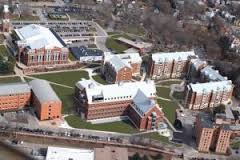 What was not clear in the self-study, nor in our campus visit, was the original vision behind the core program. Clearly someone, more likely several persons, originally provided the reasoning behind the core, the evidence that this new system of required courses, undoubtedly risky on a public university campus, would over time in practice embody the university’s public commitment to the liberal arts.
But no procedure for “keeping the vision alive” was established at the outset, and now several years later many of the original visionaries have retired. My colleague and I met with one of them, a professor emeritus who confided that the core curriculum as it exists not “isn’t what we had in mind.” 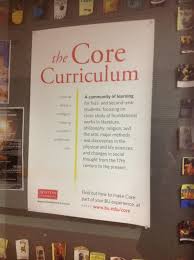 Professors hired in the last decade told us that they had received no orientation to the core curriculum upon being hired—they had just picked up what they knew about it on the fly. The students had nothing to say when asked about the value of the liberal arts education they were in the process of receiving—as far as they knew, the core so carefully planned several years ago was just a bunch of courses to “get out of the way” so they could get to the real purpose of their being at the university—their major courses which they perceived as being their direct vehicle to a good job upon graduation. There was no system for assessment in place, because no one really knew what the core was supposed to be accomplishing. And now it is just something everyone does—and no one can really explain why. The report that is due from my colleague and me in couple of days is writing itself.
As I live out the final weeks of my four-year stint directing my college’s large interdisciplinary, team-taught humanities program required of all students during their first four semesters, regardless of their major, my outside evaluator experience has been a reminder and warning. Don’t let the vision die. 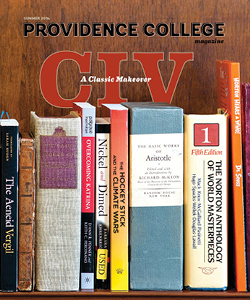 After a number of years of debate, starts and stops, and hard work we are in the third year of a new core curriculum, a new core of which the program I direct—in a re-energized and exciting form—is the centerpiece. I was an active participant in the creating of the new core, but my real task has been to steer the program I direct from the old to the new, to urge, force, and seduce the faculty to “buy in” to this new thing that is replacing what we had been doing for more than thirty years. And this requires, first, knowing what the vision behind the new program is (I do) and, second and most importantly, creating systems and methods to keep that vision alive as we original establishers and keepers of the vision fade away like the
 Cheshire Cat (I’ve been working on it). I imposed the vision largely by force of my own enthusiasm for it, assisted by faculty who shared the vision and enthusiasm, in the first couple of years as director, but realized eventually that a transition had to begin that would move the program from personality to vision-driven.
If this program and the core curriculum on my campus is to avoid becoming the program I evaluated two weeks ago across the state border, succeeding waves and generations of faculty and administrators must keep the vision alive. The other day a good friend and colleague told me at lunch that the most hated colleagues on campus from the perspective of the faculty in his department are the members of the committee whose charge is to approve (or deny) courses proposed as satisfying various elements of our complicated new core curriculum. I agreed with my friend that these committee members, all of whom are our faculty colleagues, do indeed draw the ire of many faculty on campus. Why? Because they often say “no.” They are responsible for making sure that the objectives of our new core are adhered to. They are, in other words, the committee charged with “keeping the vision alive.” And that makes them very unpopular. “Why can’t we just keep doing what we’ve always done, perhaps with a minor nod toward the new core objectives?” many faculty want to know. The answer is that there’s a new vision in town. This committee’s job is to make sure that the energy and creativity infusing the new core at its inception is not lost in the daily grind of getting shit done. It’s not an enviable task, but someone’s got to do it. Really. The alternative is to find ourselves not many years down the line just cranking out bunch of courses, organized somewhat differently than they used to be, having lost any awareness of why we made the change.
According to the Book of Proverbs, “Where there is no vision, the people perish.” And so, I would add, do programs, curricula, plans, hopes and dreams.  One of the most important continuing lessons I have been learning over the past few years is “Be where you are and do what you are doing.” Make a point of paying attention to the trees instead of obsessing about the forest, in other words. The vision thing is the flip side of that. I could spend so much energy and time with the trees that I might forget that there is a bigger picture. As Thoreau wrote, it would suck at the end of my life to find out that I hadn’t lived. The rather boring but absolutely true thing is that it’s a matter of balance. The vision thing helps me to remember the difference between living and living well, as Socrates described shortly before his execution. But the vision thing has to be lived out incrementally and daily. After all, this forest is made up of trees.
Development of Western Civilization
Development of Western Civilization
Previous Post

April 17, 2015
We Are the Champions!
Next Post
April 22, 2015 Pleasure and Joy in the Work
Browse Our Archives
Select a Category abortion Advent AI Angels Artificial intelligence atheism attention baptism Baptists beauty belief Benedictines Bible bicycling Big Bird books Bovina Camaldoli hermitage Canada Catholicism cats certainty change Christianity Christmas Collegeville Covid-19 creativity Development of Western Civilization dogs doubt Easter Enneagram Epiphany Episcopal ethics Eucharist evil extroverts Facebook faith family fear flowers forgiveness freedom friends God goodness grace happiness heaven hell history Holy Spirit Holy Week hope human nature humility humor idolatry incarnation introverts irreverence Islam Jeanne Jesus Joe Biden joy Judaism justice Kamala Harris knowledge Lent listen literature liturgy love Marsue Memorial Day miracles movies music mystery mythology NPR Old Testament optimism paradox peace Penguins philosophy piano podcast politics power prayer Protestantism Providence College Religion Rhode Island sabbatical sacrament science seeing silence Simone Weil Socrates soul sports St. John's College stories suffering tattoo teaching technology television theology thinking time tolerance transcendence travel trees trust truth Uncategorized Vermont wisdom wonder writing
Select a Month May 2026 April 2026 March 2026 February 2026 January 2026 December 2025 November 2025 October 2025 September 2025 August 2025 July 2025 June 2025 May 2025 April 2025 March 2025 February 2025 January 2025 December 2024 November 2024 October 2024 September 2024 August 2024 July 2024 June 2024 May 2024 April 2024 March 2024 February 2024 January 2024 December 2023 November 2023 October 2023 September 2023 August 2023 July 2023 June 2023 May 2023 April 2023 March 2023 February 2023 January 2023 December 2022 November 2022 October 2022 September 2022 August 2022 July 2022 June 2022 May 2022 April 2022 March 2022 February 2022 January 2022 December 2021 November 2021 October 2021 September 2021 August 2021 July 2021 June 2021 May 2021 April 2021 March 2021 February 2021 January 2021 December 2020 November 2020 October 2020 September 2020 August 2020 July 2020 June 2020 May 2020 April 2020 March 2020 February 2020 January 2020 December 2019 November 2019 October 2019 September 2019 August 2019 July 2019 June 2019 May 2019 April 2019 March 2019 February 2019 January 2019 December 2018 November 2018 October 2018 September 2018 August 2018 July 2018 June 2018 May 2018 April 2018 March 2018 February 2018 January 2018 December 2017 November 2017 October 2017 September 2017 August 2017 July 2017 June 2017 May 2017 April 2017 March 2017 February 2017 January 2017 December 2016 November 2016 October 2016 September 2016 August 2016 July 2016 June 2016 May 2016 April 2016 March 2016 February 2016 January 2016 December 2015 November 2015 October 2015 September 2015 August 2015 July 2015 June 2015 May 2015 April 2015 March 2015 February 2015 January 2015 December 2014 November 2014 October 2014 September 2014 August 2014 July 2014 June 2014 May 2014 April 2014 March 2014 February 2014 January 2014 December 2013 November 2013 October 2013 September 2013 August 2013 July 2013 June 2013 May 2013 April 2013 March 2013 February 2013 January 2013 December 2012 November 2012 October 2012 September 2012
Follow Us!
TAKE THE
Religious Wisdom Quiz
What principle about debt is found in Proverbs?
Select your answer to see how you score.
Never lend Debt is always good Ignore money The borrower is slave to the lender
Books by This Author Books by Vance G. Morgan
Related posts from Freelance Christianity

The Lonely Pawn: On Faith, Doubt, and Meaning


AI and Love: When a Chatbot Becomes a...

TRENDING AT PATHEOS Progressive Christian

What Being a Modern-Day Apostle Means to Me
In my last column, I discussed the ins and outs of modern-day...

Did Ancient China Once Worship the God of...
Across human history, a common thread weaves through the origins of the...

Love Your Neighbor – Including Earth-Kin: Lev. 19,...
God’s command to love your neighbor means acting in an ethical and...

Lead a Church Study of “Jesus and Lao...
Guest writer Jack Thomas (The Irreverent Reverend) reflects on leading his church...

Pastoral Wisdom for Responding to Sermon Pushback
Getting sermon pushback on your social justice sermon? Learn practical, Proverbs-based strategies...

Principles for Understanding the Apostolic Ministry Today
Whenever people discover that my formal ministry title is "apostle," as in...
view all Progressive Christian blogs
Ad-Free & Subscriber Log-In Subscription Support
- About Us
- 2026 Calendar
- Videos
- Podcasts
- Library of World Religions
- Faith In Media Tracker
- Advertise With Us
- Write for Us
- Privacy Policy
- Terms of Service
- Do Not Sell My Data
- Contact Us
- Radiant Digital
- Manage Newsletter Subscriptions
- Unsubscribe From Notifications
- Sitemap
Copyright 2008-2026, Patheos. All rights reserved.
Subscription Support Ad-Free & Subscriber Log-In
Follow Patheos