
BuddhistCatholicContemplativeEvangelicalGeneral ChristianHinduJewishLatter-day SaintMuslimNew VisionsProgressive Christian
Beliefs
- Buddhist
- Catholic
- Contemplative
- Evangelical
- General Christian
- Hindu
- Jewish
- Latter-day Saint
- More Voices
- Muslim
- New Visions
- Pagan
- Progressive Christian
Topics
- Religion News
- Food and Religion
- Sports and Religion
- Religious Art
- Religious Music and Entertainment
- Religious Events
- History and Religion
- Style and Religion
- Politics and Religion
- Women in Religion
- Recreation Outdoors and Religion
- Business Finance and Religion
- Careers Workplace and Religion
- Education and Religion
- Family Parenting and Religion
- Health Fitness and Religion
- Home and Religion
- Relationships and Religion
- Technology and Religion
- Travel and Religion
Columnists
- Buddhist Columnists
- Business Finance and Religion Columnists
- Careers Workplace and Religion Columnists
- Catholic Columnists
- Contemplative Columnists
- Education and Religion Columnists
- Evangelists Columnists
- Family Parenting and Religion Columnists
- General Christian Columnists
- Health Fitness and Religion Columnists
- Hindu Columnists
- History and Religion Columnists
- Home and Religion Columnists
- Jewish Columnists
- More Voices Columnists
- Latter Day Columnists
- Muslim Columnists
- New Visions Columnists
- Nonreligious Columnists
- Pagan Columnists
- Politics and Religion Columnists
- Progressive Columnists
- Recreation Outdoors and Religion Columnists
- Relationships and Religion Columnists
- Religion News Columnists
- Religious Art Columnists
- Religious Events Columnists
- Religious Music and Entertainment Columnists
- Sports and Religion Columnists
- Style and Religion Columnists
- Technology and Religion Columnists
- Travel and Religion Columnists
- Women in Religion Columnists
Resource Library
- 2026 Calendar
- Library of World Religions
- The 100 Most Holy Places on Earth
- Patheos Answers
- Podcasts
- Videos
- Faith Leaders Database
- Anglican Episcopalian
- Bahai
- Baptist
- Buddhism
- Christianity
- Confucianism
- Eastern Orthodoxy
- Hinduism
- Holiness and Pentecostal
- ISKCON
- Islam
- Judaism
- Lutheran
- Methodist
- The Church of Jesus Christ of Latter-day Saints
- New Age
- Paganism
- Presbytarian and Reformed
- Protestantism
- Religion Behind the Scenes
- Roman Catholic
- Scientology
- Shia Islam
- Sikhism
- Sufism
- Sunni Islam
- Taoism
- Zen
- See all religions
Research Tools
 Ad-Free & Subscriber Log-In Subscription Support
Ad-Free & Subscriber Log-In Subscription Support
Follow Patheos 

- Trending:
- Forgiveness
- |
- Marriage
- |
- Consciousness
- |
- Death Penalty
- |
- Election
- |
- Halloween

- Home
- Progressive Christian
- The Sun and the Other Stars
The Sun and the Other Stars
Last updated on: January 4, 2017 at 7:30 am by Vance Morgan
The Sun and the Other Stars 2017-01-04T07:30:12-04:00 Vance Morgan
Patheos Explore the world's faith through different perspectives on religion and spirituality! Patheos has the views of the prevalent religions and spiritualities of the world.
 On the west side of the stone entryway to the beautiful humanities center on my campus, in only its fourth year of operation, is carved a memorable saying from the Gospel of John: You will know the truth, and the truth will set you free. On the top of the opposite east side of the entryway is the equally memorable closing line from Paridiso, the final book of Dante’s The Divine Comedy:
 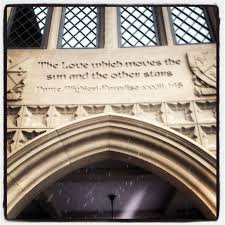 The Love which moves the sun and the other stars. In my estimation the choice of this passage for such an exalted position on the building is controversial; when the building was still in the planning stage, I made the tongue-in-cheek argument that nothing more appropriate could be inscribed on the front of a classroom building than what is written over the gates of Hell in Canto III of Inferno, the first book in Dante’s masterwork: Abandon hope, all ye who enter here. But I lost the argument and had to settle for printing that line off and taping it on my office door. It must have worked, because very few students come to visit me in my office.
Dante’s vision at the end of Paridiso is the climax of an agonizing journey through Hell, then Purgatory, and finally Heaven. This capstone experience, strangely enough for a guy who is never at a loss for words, is one that he struggles mightily to convey.  One gets the impression that words fail him and his linear thought process is dissolved as he is subsumed into his long-awaited encounter with the Divine. But I’ve never found Dante’s vision compelling, simply because it’s just that. A vision. And it’s so Catholic, with multitudes of saints, angels, and Mary swirling around in a choreographed dance. I actually resonate more fully with Dante and his guide Virgil as they pick their way through the horrors of Hell and the trials of Purgatory—these portions of the journey I can resonate with because they remind me of the world I actually live in with all of its contradictory beauty and ugliness. That’s the world in which I will be embedded this coming semester that begins in two weeks with a bunch of sophomore students as we explore grace, truth and freedom in the Nazi era, finding glimmers of hope and nuggets of wisdom in the middle of the worst that humanity can devise.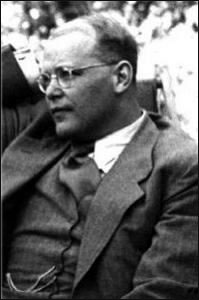
We will spend some of the semester with Dietrich Bonhoeffer, a German Protestant pastor and theologian who, imprisoned in Berlin’s Tegel Prison for more than a year because of his involvement in a failed attempt to assassinate Adolf Hitler, found himself in his isolation fending off despair and realizing that whatever God is, God is none of the things he had always thought and taught. In letters to his best friend Eberhard Bethge, Bonhoeffer put his fears, his concerns, his hopes, and his life itself on display in language that is shocking and disturbing in its directness. We will consider two passage in a letter from Bonhoeffer to Bethge both in class and in on-line discussion forums  .
.
What is bothering me incessantly is the question of what Christianity really is, or indeed who Christ really is, for us today. The time when people could be told everything by means of words, whether theological or pious, is over, and so is the time of inwardness and conscience—and that means the time of religion in general.
Later in the letter, he repeats that “the time of Christianity is over.” Students in past versions of this course have been shocked that a Protestant pastor could write such a thing. But Bonhoeffer’s point is that none of the old formulas or descriptions work anymore, not in a world in which millions of human beings are disappearing as smoke and ashes from death camp chimneys. In a second letter a few weeks later to Bethge, Bonhoeffer continues the theme.
So our coming of age leads us to a true recognition of our situation before God. God would have us know that we must live as people who manage our lives without God. The God who is with us is the God who forsakes us. The God who lets us live in the world without the working hypothesis of God is the God before whom we stand continually.
God wants us to live in the world as if God does not exist, Bonhoeffer writes. What can this possibly mean? Once a student commented in our discussion forum how sad it was that Bonhoeffer had lost his faith. To which I replied, “This is not a man who has lost his faith.  This is a man for whom faith has come to mean something entirely different from what you are accustomed to.”
A few short months after he wrote this letter, Dietrich Bonhoeffer was executed in Flossenburg Prison, just a handful of weeks before Germany surrendered to the Allies. Far from losing his faith, Bonhoeffer exemplifies a willingness to let faith evolve rather than crumble in the face of the greatest and most intense challenges. Shortly before his death he wrote a poem entitled “Who Am I?” in his notebook which ends in a place that provides hope for all persons of faith.
Weary and empty at praying, at thinking, at making,
Faint, and ready to say farewell to it all. . . .
Who am I? They mock me, these lonely questions of mine.
Whoever I am, you know, O God, I am yours!
Not long ago as I was driving to the 8:00 early show at church I caught a few minutes of Krista Tippett’s show “On Being” on NPR. Her guest was Margaret Wertheim, a physicist described in the promo as “a passionate translator of the beauty and relevance of scientific questions.”
http://onbeing.org/program/margaretwertheim-the-grandeur-and-limits-of-science/7472
Toward the end of the conversation Tippett notes that Wertheim, who was raised Catholic, has been described in the media as an atheist. “Are you an atheist?” Tippett asked.  Wertheim’s response brings us full circle back to Dante.
I’d like to put it this way: I don’t know that I believe in the existence of God in the Catholic sense. But my favorite book is the Divine Comedy. And at the end of the Divine Comedy, Dante pierces the skin of the universe and comes face to face with the love that moves the sun and the other stars. I believe that there is a love that moves the sun and the other stars. I believe in Dante’s vision. And so, in some sense, perhaps I could be said to believe in God. And I think part of the problem with the concept of, “Are you an atheist or not?” is that our conception of what divinity means has become so trivialized and banal that I think it’s almost impossible to answer the question without dogma.
I love Wertheim’s answer because it is infused with Bonhoeffer’s energy. Dogmas and religious formulas will always fail because God is bigger than that. Seeking the love that moves the sun and the other stars will always take us to places we do not expect, places of beauty and darkness, a search energized by a faith that cannot be lost.
Development of Western Civilization
Development of Western Civilization
Previous Post

December 30, 2016
What's Next?
Next Post
January 6, 2017 Religionless Christianity
Browse Our Archives
Select a Category abortion Advent AI Angels Artificial intelligence atheism attention baptism Baptists beauty belief Benedictines Bible bicycling Big Bird books Bovina Camaldoli hermitage Canada Catholicism cats certainty change Christianity Christmas Collegeville Covid-19 creativity Development of Western Civilization dogs doubt Easter Enneagram Epiphany Episcopal ethics Eucharist evil extroverts Facebook faith family fear flowers forgiveness freedom friends God goodness grace happiness heaven hell history Holy Spirit Holy Week hope human nature humility humor idolatry incarnation introverts irreverence Islam Jeanne Jesus Joe Biden joy Judaism justice Kamala Harris knowledge Lent listen literature liturgy love Marsue Memorial Day miracles movies music mystery mythology NPR Old Testament optimism paradox peace Penguins philosophy piano podcast politics power prayer Protestantism Providence College Religion Rhode Island sabbatical sacrament science seeing silence Simone Weil Socrates soul sports St. John's College stories suffering tattoo teaching technology television theology thinking time tolerance transcendence travel trees trust truth Uncategorized Vermont wisdom wonder writing
Select a Month May 2026 April 2026 March 2026 February 2026 January 2026 December 2025 November 2025 October 2025 September 2025 August 2025 July 2025 June 2025 May 2025 April 2025 March 2025 February 2025 January 2025 December 2024 November 2024 October 2024 September 2024 August 2024 July 2024 June 2024 May 2024 April 2024 March 2024 February 2024 January 2024 December 2023 November 2023 October 2023 September 2023 August 2023 July 2023 June 2023 May 2023 April 2023 March 2023 February 2023 January 2023 December 2022 November 2022 October 2022 September 2022 August 2022 July 2022 June 2022 May 2022 April 2022 March 2022 February 2022 January 2022 December 2021 November 2021 October 2021 September 2021 August 2021 July 2021 June 2021 May 2021 April 2021 March 2021 February 2021 January 2021 December 2020 November 2020 October 2020 September 2020 August 2020 July 2020 June 2020 May 2020 April 2020 March 2020 February 2020 January 2020 December 2019 November 2019 October 2019 September 2019 August 2019 July 2019 June 2019 May 2019 April 2019 March 2019 February 2019 January 2019 December 2018 November 2018 October 2018 September 2018 August 2018 July 2018 June 2018 May 2018 April 2018 March 2018 February 2018 January 2018 December 2017 November 2017 October 2017 September 2017 August 2017 July 2017 June 2017 May 2017 April 2017 March 2017 February 2017 January 2017 December 2016 November 2016 October 2016 September 2016 August 2016 July 2016 June 2016 May 2016 April 2016 March 2016 February 2016 January 2016 December 2015 November 2015 October 2015 September 2015 August 2015 July 2015 June 2015 May 2015 April 2015 March 2015 February 2015 January 2015 December 2014 November 2014 October 2014 September 2014 August 2014 July 2014 June 2014 May 2014 April 2014 March 2014 February 2014 January 2014 December 2013 November 2013 October 2013 September 2013 August 2013 July 2013 June 2013 May 2013 April 2013 March 2013 February 2013 January 2013 December 2012 November 2012 October 2012 September 2012
Follow Us!
TAKE THE
Religious Wisdom Quiz
What did Paul say was the purpose of the Law?
Select your answer to see how you score.
To separate Israel from the nations To lead us to Christ To make us righteous To keep order
Books by This Author Books by Vance G. Morgan
Related posts from Freelance Christianity

The Lonely Pawn: On Faith, Doubt, and Meaning


AI and Love: When a Chatbot Becomes a...

TRENDING AT PATHEOS Progressive Christian

Why Christians Have a Sacred Duty to Vote:...
The Bible offers strong support for the sacred duty to vote. Here...

What Being a Modern-Day Apostle Means to Me
In my last column, I discussed the ins and outs of modern-day...

Did Ancient China Once Worship the God of...
Across human history, a common thread weaves through the origins of the...

Love Your Neighbor – Including Earth-Kin: Lev. 19,...
God’s command to love your neighbor means acting in an ethical and...

Lead a Church Study of “Jesus and Lao...
Guest writer Jack Thomas (The Irreverent Reverend) reflects on leading his church...

Principles for Understanding the Apostolic Ministry Today
Whenever people discover that my formal ministry title is "apostle," as in...
view all Progressive Christian blogs
Ad-Free & Subscriber Log-In Subscription Support
- About Us
- 2026 Calendar
- Videos
- Podcasts
- Library of World Religions
- Faith In Media Tracker
- Advertise With Us
- Write for Us
- Privacy Policy
- Terms of Service
- Do Not Sell My Data
- Contact Us
- Radiant Digital
- Manage Newsletter Subscriptions
- Unsubscribe From Notifications
- Sitemap
Copyright 2008-2026, Patheos. All rights reserved.
Subscription Support Ad-Free & Subscriber Log-In
Follow Patheos