
BuddhistCatholicContemplativeEvangelicalGeneral ChristianHinduJewishLatter-day SaintMuslimNew VisionsProgressive Christian
Beliefs
- Buddhist
- Catholic
- Contemplative
- Evangelical
- General Christian
- Hindu
- Jewish
- Latter-day Saint
- More Voices
- Muslim
- New Visions
- Pagan
- Progressive Christian
Topics
- Religion News
- Food and Religion
- Sports and Religion
- Religious Art
- Religious Music and Entertainment
- Religious Events
- History and Religion
- Style and Religion
- Politics and Religion
- Women in Religion
- Recreation Outdoors and Religion
- Business Finance and Religion
- Careers Workplace and Religion
- Education and Religion
- Family Parenting and Religion
- Health Fitness and Religion
- Home and Religion
- Relationships and Religion
- Technology and Religion
- Travel and Religion
Columnists
- Buddhist Columnists
- Business Finance and Religion Columnists
- Careers Workplace and Religion Columnists
- Catholic Columnists
- Contemplative Columnists
- Education and Religion Columnists
- Evangelists Columnists
- Family Parenting and Religion Columnists
- General Christian Columnists
- Health Fitness and Religion Columnists
- Hindu Columnists
- History and Religion Columnists
- Home and Religion Columnists
- Jewish Columnists
- More Voices Columnists
- Latter Day Columnists
- Muslim Columnists
- New Visions Columnists
- Nonreligious Columnists
- Pagan Columnists
- Politics and Religion Columnists
- Progressive Columnists
- Recreation Outdoors and Religion Columnists
- Relationships and Religion Columnists
- Religion News Columnists
- Religious Art Columnists
- Religious Events Columnists
- Religious Music and Entertainment Columnists
- Sports and Religion Columnists
- Style and Religion Columnists
- Technology and Religion Columnists
- Travel and Religion Columnists
- Women in Religion Columnists
Resource Library
- 2026 Calendar
- Library of World Religions
- The 100 Most Holy Places on Earth
- Patheos Answers
- Podcasts
- Videos
- Faith Leaders Database
- Anglican Episcopalian
- Bahai
- Baptist
- Buddhism
- Christianity
- Confucianism
- Eastern Orthodoxy
- Hinduism
- Holiness and Pentecostal
- ISKCON
- Islam
- Judaism
- Lutheran
- Methodist
- The Church of Jesus Christ of Latter-day Saints
- New Age
- Paganism
- Presbytarian and Reformed
- Protestantism
- Religion Behind the Scenes
- Roman Catholic
- Scientology
- Shia Islam
- Sikhism
- Sufism
- Sunni Islam
- Taoism
- Zen
- See all religions
Research Tools
 Ad-Free & Subscriber Log-In Subscription Support
Ad-Free & Subscriber Log-In Subscription Support
Follow Patheos 

- Trending:
- Forgiveness
- |
- Marriage
- |
- Consciousness
- |
- Death Penalty
- |
- Election
- |
- Halloween

- Home
- Progressive Christian
- The Sausage Sisters
The Sausage Sisters
Last updated on: June 26, 2017 at 2:08 pm by Vance Morgan
The Sausage Sisters 2017-06-26T14:08:53-04:00 Vance Morgan
Patheos Explore the world's faith through different perspectives on religion and spirituality! Patheos has the views of the prevalent religions and spiritualities of the world.
It has been a rough ten days at our house. Not because Jeanne had knee replacement surgery a week ago Tuesday and has been rehabbing, first in the hospital then in a short-term facility, until returning home yesterday afternoon. Not because I have been worried about her, about the piles of grading that never seem to get any smaller, and about overcoming my visceral dislike of health-care facilities as I visit her every day.  No, it’s been a rough ten days because the girls at home, our three four-legged daughters, have been missing Mom more and more as their suspicion that Dad is a sub-par canine care provider is confirmed more fully as each day passes. Why doesn’t Dad do things—feed us, entertain us, talk to us, sit on the couch with all three of us, give us treats because we are breathing properly—in the manner to which we have become accustomed? What the hell is Dad’s purpose, anyways?
Our three daughters—Frieda, Winnie, and Bean—have shared the space a foot or two above the floor with each other in our house for the past six years. Frieda came first, nine years ago, with Bean and Winnie joining the pack about eight months apart in 2008-09. And it is definitely a pack.  Frieda, a late-middle-aged dachshund with perhaps a bit of chihuahua thrown in (don’t tell her we noticed) is clearly the alpha dog—indeed she is the alpha living creature in the house, trumping not only her sisters but her parents in both will and importance when necessary. Bean (Boston Terrier) and Winnie (another dachshund—pure bred) are still trying to figure out who is second in the pack; after six years under the same roof they still fight over who gets to sit closest to Mom and who gets to drag the most raggedy toys around.
  Winnie and Bean are both rescue dogs, with all the personality peculiarities and peccadilloes that accompany such a start in life. Bean’s need for serious therapy is so great that she will get her own blog post soon. This one’s about Frieda and Winnie—the “Sausage Sisters,” as my oldest son has named them—and how my years of observing and loving them gave me unexpected insights into Plato’s Republic.
When I unexpectedly took on a Philosophy of the Human Person course as an overload just a few weeks before the beginning of the current semester because of a colleague’s unexpected illness, I decided that this was my opportunity to do something I’ve wanted to do for many years—teach an entire introductory philosophy class with no text other than Plato’s Republic. 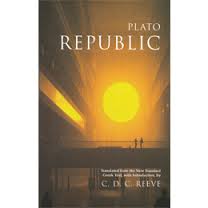 Now, a few days from the end of the semester, twenty-five students and I have pulled it off—our text for today’s penultimate class is the final ten pages of the dialogue, and my students will join the ranks of the .01% of human beings alive who have read this greatest of all philosophical works in the Western tradition from cover to cover. The overall question of Republic is What is justice?—a question Plato investigates from various angles, including the comparison of justice in various communities as large projections of justice in similarly structured individuals. Over the past few weeks, as we compared Plato’s favored form of governance—aristocracy (“rule of the best”)—with his next-to-least favorite—democracy (“rule of the many”)—while also contrasting individuals with aristocratic and democratic souls, I thought “I know these people. They live in my house.” And I brought my illustrative tale of two dachshunds to class.
Although it takes three hundred pages for Plato to fully answer the What is justice? question, he provides his definition of justice just a little more than a third of the way through the dialogue. Justice in a community arises when the various classes of rulers, soldiers, artisans and providers play their differing assigned roles effectively without striving to be anything other than what they are. 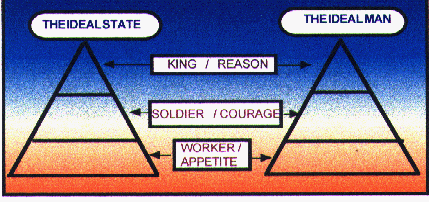 The hallmark of justice, in other words, is harmony between the factions and each group knowing its place in the pecking order. Social classes in a less-than-just society would be at odds and in competitive conflict with each other. Similarly in the just and “best” (aristos) individual, the various parts of the soul are in harmony, ruled by reason, energized by directed passion, and served appropriately by the satisfaction of the appetites. The person with the just, aristocratic soul, in other words, has her priorities straight, in proper ranking, and does not stray from them.
Frieda is a case in point. “Herself,” as Jeanne and I often refer to her, has three  priorities—food, sleep, and affection. In that order. And she does not waver from them. Frieda is obsessed with food—there are apocryphal stories of her eating a whole pie when she was a young thing—and she will materialize immediately in the kitchen from anywhere in the house if she hears or intuits a promising food-related vibration. She eats Bean’s and Winnie’s food if she gets the chance, often before her own, just because she’s the alpha dog and she can. She gets a heart pill once every morning, an event starred on her daily calendar because she receives it embedded in a piece of human food (hot dog, banana, anything handy that’s edible).
  Frieda sleeps at the top of the bed between Jeanne’s and my heads, a location that has been “hers” since time immemorial. And her affection requirements are specific and unwavering. She loves to be rubbed under her chin, often leaving her snout pointing at the sky after such a chin rub if it hasn’t lasted long enough, frozen in position until the person doing the rubbing picks up the cue and continues. She has specific locations that she must occupy when sharing a piece of furniture with a human—on my right side in the recliner (even though I prefer her on my left) and behind Jeanne on the couch (although Jeanne would prefer her to be anywhere but behind her). Frieda has shown interest in only one toy in her life, the “piggy” that dissolved from overuse some time ago—playing with toys or playing at all, for that matter, is beneath her.
  She is the alpha dog, the queen of all she surveys, and she has her priorities straight. The embodiment of Plato’s aristocratic soul.
Plato’s regard for and opinion of both democracy and those with democratic souls is, shall we say, rather low. We love democracy for its freedom, for its theoretical commitment to egalitarianism and the equal value of all human beings, its openness to variety and new ideas, and for its facilitation of choice. And these are all reasons that Plato rates democracy toward the bottom of his types of government.  His primary critique is that democracy is selling itself and others a lie by pretending that everyone is the same and that all human concerns are equally valuable, when deep down we know that none of this is true. In the soul of a democratic person, all things are equally valuable—the democratic person flits from interest to interest, from idea to appetite, from today’s passion to tomorrow’s obsession, while lacking the ability to prioritize, to rank, or to place the details of her or his life in proper order. It’s interesting, it’s attractive, it’s chaotic, and it’s a recipe for disaster. Democracy is no way to run a society or a life.
 Consider Winnie, for instance. Winnie is cute, loveable, a classically marked black-and-tan dachshund who loves affection and biting strangers on the foot or ankle for no apparent reason. Winnie loves to eat, but also loves toys with squeakers in them, following Mom around about a foot behind her heels, burrowing under blankets, barking at nothing, and endless affection. Just like the democratic person, Winnie has many interests and obsessions. And just as the democratic person, they all are equally important.
 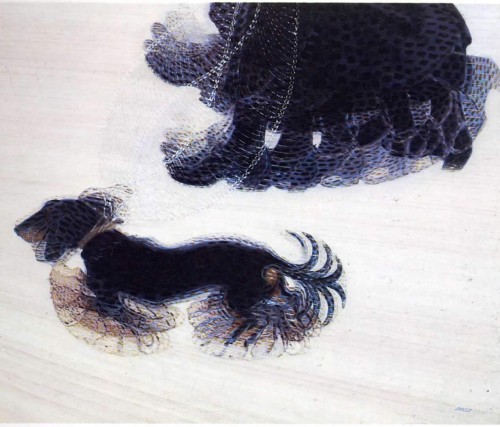 Winnie has a difficult time walking a straight line because her attention can so easily be attracted by the slightest thing. We sometimes describe her as “skittish,” but she’s really just a democratic soul incapable of prioritizing. Food, toys, attention, barking, simultaneous fear of and aggression toward strangers (and Dad walking in the back door after having been gone for thirty seconds throwing out the trash) occasionally send Winnie into sensory overload, marked by running around the house frantically squeaking a raggedy toy until she collapses flat on her back with all four legs straight up.
 It is amusing to watch, just as it is amusing to observe on Facebook the inability of many people to prioritize in terms of importance between sharing a picture of their latest meal and participating in a discussion about global warming. Democratic souls in action.
Some years ago books like “All I Really Need to Know I Learned in Kindergarten” were all the rage. “All I Really Need to Know about Plato I Learned from My Dachshunds” is not quite as catchy, but I’ll bet it would attract philosophy majors. Now if the Sausage Sisters could just help me with Hegel or Heidegger.
Previous Post

July 25, 2016
Believing What I Think
Next Post
July 29, 2016 Those Effing Blue Jays
Browse Our Archives
Select a Category abortion Advent AI Angels Artificial intelligence atheism attention baptism Baptists beauty belief Benedictines Bible bicycling Big Bird books Bovina Camaldoli hermitage Canada Catholicism cats certainty change Christianity Christmas Collegeville Covid-19 creativity Development of Western Civilization dogs doubt Easter Enneagram Epiphany Episcopal ethics Eucharist evil extroverts Facebook faith family fear flowers forgiveness freedom friends God goodness grace happiness heaven hell history Holy Spirit Holy Week hope human nature humility humor idolatry incarnation introverts irreverence Islam Jeanne Jesus Joe Biden joy Judaism justice Kamala Harris knowledge Lent listen literature liturgy love Marsue Memorial Day miracles movies music mystery mythology NPR Old Testament optimism paradox peace Penguins philosophy piano podcast politics power prayer Protestantism Providence College Religion Rhode Island sabbatical sacrament science seeing silence Simone Weil Socrates soul sports St. John's College stories suffering tattoo teaching technology television theology thinking time tolerance transcendence travel trees trust truth Uncategorized Vermont wisdom wonder writing
Select a Month May 2026 April 2026 March 2026 February 2026 January 2026 December 2025 November 2025 October 2025 September 2025 August 2025 July 2025 June 2025 May 2025 April 2025 March 2025 February 2025 January 2025 December 2024 November 2024 October 2024 September 2024 August 2024 July 2024 June 2024 May 2024 April 2024 March 2024 February 2024 January 2024 December 2023 November 2023 October 2023 September 2023 August 2023 July 2023 June 2023 May 2023 April 2023 March 2023 February 2023 January 2023 December 2022 November 2022 October 2022 September 2022 August 2022 July 2022 June 2022 May 2022 April 2022 March 2022 February 2022 January 2022 December 2021 November 2021 October 2021 September 2021 August 2021 July 2021 June 2021 May 2021 April 2021 March 2021 February 2021 January 2021 December 2020 November 2020 October 2020 September 2020 August 2020 July 2020 June 2020 May 2020 April 2020 March 2020 February 2020 January 2020 December 2019 November 2019 October 2019 September 2019 August 2019 July 2019 June 2019 May 2019 April 2019 March 2019 February 2019 January 2019 December 2018 November 2018 October 2018 September 2018 August 2018 July 2018 June 2018 May 2018 April 2018 March 2018 February 2018 January 2018 December 2017 November 2017 October 2017 September 2017 August 2017 July 2017 June 2017 May 2017 April 2017 March 2017 February 2017 January 2017 December 2016 November 2016 October 2016 September 2016 August 2016 July 2016 June 2016 May 2016 April 2016 March 2016 February 2016 January 2016 December 2015 November 2015 October 2015 September 2015 August 2015 July 2015 June 2015 May 2015 April 2015 March 2015 February 2015 January 2015 December 2014 November 2014 October 2014 September 2014 August 2014 July 2014 June 2014 May 2014 April 2014 March 2014 February 2014 January 2014 December 2013 November 2013 October 2013 September 2013 August 2013 July 2013 June 2013 May 2013 April 2013 March 2013 February 2013 January 2013 December 2012 November 2012 October 2012 September 2012
Follow Us!
TAKE THE
Religious Wisdom Quiz
I stood on a wooden platform and read the Law from daybreak till noon, and the people wept. Who am I?
Select your answer to see how you score.
Ezra Nehemiah Joshua Moses
Books by This Author Books by Vance G. Morgan
Related posts from Freelance Christianity

The Lonely Pawn: On Faith, Doubt, and Meaning


AI and Love: When a Chatbot Becomes a...

TRENDING AT PATHEOS Progressive Christian

What Being a Modern-Day Apostle Means to Me
In my last column, I discussed the ins and outs of modern-day...

Did Ancient China Once Worship the God of...
Across human history, a common thread weaves through the origins of the...

Love Your Neighbor – Including Earth-Kin: Lev. 19,...
God’s command to love your neighbor means acting in an ethical and...

Lead a Church Study of “Jesus and Lao...
Guest writer Jack Thomas (The Irreverent Reverend) reflects on leading his church...

Pastoral Wisdom for Responding to Sermon Pushback
Getting sermon pushback on your social justice sermon? Learn practical, Proverbs-based strategies...

Principles for Understanding the Apostolic Ministry Today
Whenever people discover that my formal ministry title is "apostle," as in...
view all Progressive Christian blogs
Ad-Free & Subscriber Log-In Subscription Support
- About Us
- 2026 Calendar
- Videos
- Podcasts
- Library of World Religions
- Faith In Media Tracker
- Advertise With Us
- Write for Us
- Privacy Policy
- Terms of Service
- Do Not Sell My Data
- Contact Us
- Radiant Digital
- Manage Newsletter Subscriptions
- Unsubscribe From Notifications
- Sitemap
Copyright 2008-2026, Patheos. All rights reserved.
Subscription Support Ad-Free & Subscriber Log-In
Follow Patheos