
BuddhistCatholicContemplativeEvangelicalGeneral ChristianHinduJewishLatter-day SaintMuslimNew VisionsProgressive Christian
Beliefs
- Buddhist
- Catholic
- Contemplative
- Evangelical
- General Christian
- Hindu
- Jewish
- Latter-day Saint
- More Voices
- Muslim
- New Visions
- Pagan
- Progressive Christian
Topics
- Religion News
- Food and Religion
- Sports and Religion
- Religious Art
- Religious Music and Entertainment
- Religious Events
- History and Religion
- Style and Religion
- Politics and Religion
- Women in Religion
- Recreation Outdoors and Religion
- Business Finance and Religion
- Careers Workplace and Religion
- Education and Religion
- Family Parenting and Religion
- Health Fitness and Religion
- Home and Religion
- Relationships and Religion
- Technology and Religion
- Travel and Religion
Columnists
- Buddhist Columnists
- Business Finance and Religion Columnists
- Careers Workplace and Religion Columnists
- Catholic Columnists
- Contemplative Columnists
- Education and Religion Columnists
- Evangelists Columnists
- Family Parenting and Religion Columnists
- General Christian Columnists
- Health Fitness and Religion Columnists
- Hindu Columnists
- History and Religion Columnists
- Home and Religion Columnists
- Jewish Columnists
- More Voices Columnists
- Latter Day Columnists
- Muslim Columnists
- New Visions Columnists
- Nonreligious Columnists
- Pagan Columnists
- Politics and Religion Columnists
- Progressive Columnists
- Recreation Outdoors and Religion Columnists
- Relationships and Religion Columnists
- Religion News Columnists
- Religious Art Columnists
- Religious Events Columnists
- Religious Music and Entertainment Columnists
- Sports and Religion Columnists
- Style and Religion Columnists
- Technology and Religion Columnists
- Travel and Religion Columnists
- Women in Religion Columnists
Resource Library
- 2026 Calendar
- Library of World Religions
- The 100 Most Holy Places on Earth
- Patheos Answers
- Podcasts
- Videos
- Faith Leaders Database
- Anglican Episcopalian
- Bahai
- Baptist
- Buddhism
- Christianity
- Confucianism
- Eastern Orthodoxy
- Hinduism
- Holiness and Pentecostal
- ISKCON
- Islam
- Judaism
- Lutheran
- Methodist
- The Church of Jesus Christ of Latter-day Saints
- New Age
- Paganism
- Presbytarian and Reformed
- Protestantism
- Religion Behind the Scenes
- Roman Catholic
- Scientology
- Shia Islam
- Sikhism
- Sufism
- Sunni Islam
- Taoism
- Zen
- See all religions
Research Tools
 Ad-Free & Subscriber Log-In Subscription Support
Ad-Free & Subscriber Log-In Subscription Support
Follow Patheos 

- Trending:
- Forgiveness
- |
- Marriage
- |
- Consciousness
- |
- Death Penalty
- |
- Election
- |
- Halloween

- Home
- Progressive Christian
- The Nihilist Penguin
The Nihilist Penguin
Last updated on: January 29, 2026 at 7:46 am by Vance Morgan
The Nihilist Penguin 2026-01-28T22:48:11-04:00 Vance Morgan
Patheos Explore the world's faith through different perspectives on religion and spirituality! Patheos has the views of the prevalent religions and spiritualities of the world.
During finals week in December, a student from my Early Modern Philosophy course showed up for his final oral exam. He asked “Do you remember a student named _____________? You had him in class eight or nine years ago.” I admitted that although the name sounded vaguely familiar, I did not remember the student. “He’s my older brother,” the student replied. “When I told him I was having an oral exam today in your office, he said ‘check out the penguins.'” The student looked around. “This is a lot of penguins.”
My office is indeed filled with a great deal of penguin paraphernalia.  Penguin figurines, penguin calendars, penguin stuffed animals of various sizes, penguin slippers (really), a penguin tissue dispenser, penguin pictures and posters. Not long ago a student stopped by during office hours. About ten minutes into his visit, he observed “I guess you must like penguins.” “What do you mean?” I asked.
Penguins spend a lot of time on the ice, but are sea birds as graceful in the ocean as they are clumsy on land. Penguins have few natural predators on land, but are a favorite meal for any number of water creatures, including leopard seals and sharks. 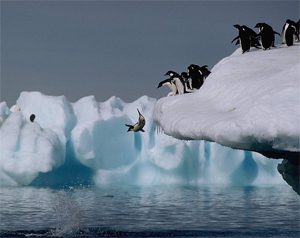 When penguins want to take a swim, they will collectively crowd toward the edge of an ice cliff overhanging the water, pushing and pushing closer to the edge, sort of like a human crowd preparing to board an approaching subway, until one or two penguins fall off the edge into the sea. If these unfortunates do not surface, it is clearly not safe to swim there. If their heads bob above the surface, a virtual waterfall of penguins follows them for a safe swimming and feeding event.
Once a guy from Institutional Advancement dropped by my office. He poked his head in, we exchanged brief pleasantries, and he surveyed my office. “What’s with the penguins?” he asked. “I love penguins,” I replied. “I’ve loved penguins ever since I was a little kid.” Silence for fifteen seconds. “I don’t get it,” he finally admitted. “Dude, if ‘I love penguins’ isn’t good enough for you, I’ve got nothing else,” I replied. Some obsessions (like penguins and wild orchids) do not require supporting argumentation.
My love of penguins is a classic example of what Aristotle means by a “first principle.” Aristotle advocates vigorous dialogue and debate, challenging everyone to support their arguments with reasons. But eventually one hits bedrock, a belief or principle that is foundational and has no deeper explanation. As I might have said, “Dude, if you don’t get my love of penguins, we’ve got nothing else to talk about.”
Emperor Penguin couples spend their lives apart from each other and meet once a year in late March, after traveling as far as 70 miles inland—on foot or sliding on their bellies—to reach the breeding site. Once there, penguins look for their mates by making a bugling call. Male penguins generally stay in one place, lower their head to their chest and call out to the females. Once they find one another, they stand breast to breast, repeatedly bow to each other and bugle penguin songs. Penguins are “serially monogamous.” Each penguin couple is an item for a single breeding season, but if they can’t find each other the next breeding season (and they usually can’t), they will hook up with someone new.
I learned from a colleague at the gym a couple of days ago about a clip from Werner Herzog’s 2007 documentary “Encounters at the End of the World” about a penguin who, against all odds, decides that he’s had enough. He leaves the penguin colony and walks off into the interior of Antarctica on his own.
Google “Nihilist penguin” and you’ll find dozens of interpretations of this phenomenon. Apparently the video has gone viral over the last month, becoming a symbol for modern burnout and existential dread. What does this penguin’s death march mean? Interpretations and opinions abound.
- Nihilism: Many view the penguin as an “active nihilist” who rejects the meaningless routine of the colony to embrace the void and create its own destiny, even if it ends in oblivion.
- The one who has had enough and leaves: The penguin is a metaphor for walking away from the rat race or societal expectations that no longer are meaningful or fulfilling.
- The Nietzschean Uberpenguin: This is Nietzsche’s philosophy in action, the overcoming of biological hardwiring and herd (colony) mentality by risking individual choice.
Of course, all of these interpretations are undoubtedly examples of out-of-control anthropomorphizing, essentially saying “if I did this, this would be the reason why,’ then projecting that reason onto the penguin. We love doing that, projecting our own intentions and purposes where they don’t fit, from inanimate objects to God.
Which brings me where I usually end up in this blog–what are the faith implications and lessons to be learned from the nihilistic penguin? Penguins are group and colony birds, so this solitary penguin’s break with the usual, even in the face of likely death, is risky to say the least. But his is a commitment which allows no return. As Herzog says narrating the documentary, if someone tries to return the wandering penguin to his natural habitat, he will leave and continue on his solitary journey.
This is a familar aspect of faith–it is both inescable once it has its hooks in you, and it doesn’t make any sense. It is a mystery that is anything but certain. But it is also unavoidable. Once one is on the path, one can’t go back.
Previous Post

January 25, 2026
He said "Follow me"--and they did
Next Post
February 1, 2026 The Beatitudes: A Call to Change the World
Recent Comments
"Mary did have a choice. And she was able to make it before the Holy ..."
"i cannot read beyond your recommendations for the books since i like to have a ..."
"AI will never be able to utter with honesty, feeling, or humility, the greeting: "Namaste".It ..."
"They do. I'm sure you could find discussions of the same topic from any of ..."
Browse Our Archives
Select a Category abortion Advent AI Angels Artificial intelligence atheism attention baptism Baptists beauty belief Benedictines Bible bicycling Big Bird books Bovina Camaldoli hermitage Canada Catholicism cats certainty change Christianity Christmas Collegeville Covid-19 creativity Development of Western Civilization dogs doubt Easter Enneagram Epiphany Episcopal ethics Eucharist evil extroverts Facebook faith family fear flowers forgiveness freedom friends God goodness grace happiness heaven hell history Holy Spirit Holy Week hope human nature humility humor idolatry incarnation introverts irreverence Islam Jeanne Jesus Joe Biden joy Judaism justice Kamala Harris knowledge Lent listen literature liturgy love Marsue Memorial Day miracles movies music mystery mythology NPR Old Testament optimism paradox peace Penguins philosophy piano podcast politics power prayer Protestantism Providence College Religion Rhode Island sabbatical sacrament science seeing silence Simone Weil Socrates soul sports St. John's College stories suffering tattoo teaching technology television theology thinking time tolerance transcendence travel trees trust truth Uncategorized Vermont wisdom wonder writing
Select a Month May 2026 April 2026 March 2026 February 2026 January 2026 December 2025 November 2025 October 2025 September 2025 August 2025 July 2025 June 2025 May 2025 April 2025 March 2025 February 2025 January 2025 December 2024 November 2024 October 2024 September 2024 August 2024 July 2024 June 2024 May 2024 April 2024 March 2024 February 2024 January 2024 December 2023 November 2023 October 2023 September 2023 August 2023 July 2023 June 2023 May 2023 April 2023 March 2023 February 2023 January 2023 December 2022 November 2022 October 2022 September 2022 August 2022 July 2022 June 2022 May 2022 April 2022 March 2022 February 2022 January 2022 December 2021 November 2021 October 2021 September 2021 August 2021 July 2021 June 2021 May 2021 April 2021 March 2021 February 2021 January 2021 December 2020 November 2020 October 2020 September 2020 August 2020 July 2020 June 2020 May 2020 April 2020 March 2020 February 2020 January 2020 December 2019 November 2019 October 2019 September 2019 August 2019 July 2019 June 2019 May 2019 April 2019 March 2019 February 2019 January 2019 December 2018 November 2018 October 2018 September 2018 August 2018 July 2018 June 2018 May 2018 April 2018 March 2018 February 2018 January 2018 December 2017 November 2017 October 2017 September 2017 August 2017 July 2017 June 2017 May 2017 April 2017 March 2017 February 2017 January 2017 December 2016 November 2016 October 2016 September 2016 August 2016 July 2016 June 2016 May 2016 April 2016 March 2016 February 2016 January 2016 December 2015 November 2015 October 2015 September 2015 August 2015 July 2015 June 2015 May 2015 April 2015 March 2015 February 2015 January 2015 December 2014 November 2014 October 2014 September 2014 August 2014 July 2014 June 2014 May 2014 April 2014 March 2014 February 2014 January 2014 December 2013 November 2013 October 2013 September 2013 August 2013 July 2013 June 2013 May 2013 April 2013 March 2013 February 2013 January 2013 December 2012 November 2012 October 2012 September 2012
Follow Us!
TAKE THE
Religious Wisdom Quiz
Which prophet was commanded to buy a field during a siege?
Select your answer to see how you score.
Obadiah Habakkuk Isaiah Jeremiah
Books by This Author Books by Vance G. Morgan
Related posts from Freelance Christianity

The Lonely Pawn: On Faith, Doubt, and Meaning


AI and Love: When a Chatbot Becomes a...

TRENDING AT PATHEOS Progressive Christian

What Being a Modern-Day Apostle Means to Me
In my last column, I discussed the ins and outs of modern-day...

Did Ancient China Once Worship the God of...
Across human history, a common thread weaves through the origins of the...

Love Your Neighbor – Including Earth-Kin: Lev. 19,...
God’s command to love your neighbor means acting in an ethical and...

Lead a Church Study of “Jesus and Lao...
Guest writer Jack Thomas (The Irreverent Reverend) reflects on leading his church...

Pastoral Wisdom for Responding to Sermon Pushback
Getting sermon pushback on your social justice sermon? Learn practical, Proverbs-based strategies...

Principles for Understanding the Apostolic Ministry Today
Whenever people discover that my formal ministry title is "apostle," as in...
view all Progressive Christian blogs
What Are Your Thoughts?leave a comment
Ad-Free & Subscriber Log-In Subscription Support
- About Us
- 2026 Calendar
- Videos
- Podcasts
- Library of World Religions
- Faith In Media Tracker
- Advertise With Us
- Write for Us
- Privacy Policy
- Terms of Service
- Do Not Sell My Data
- Contact Us
- Radiant Digital
- Manage Newsletter Subscriptions
- Unsubscribe From Notifications
- Sitemap
Copyright 2008-2026, Patheos. All rights reserved.
Subscription Support Ad-Free & Subscriber Log-In
Follow Patheos