
BuddhistCatholicContemplativeEvangelicalGeneral ChristianHinduJewishLatter-day SaintMuslimNew VisionsProgressive Christian
Beliefs
- Buddhist
- Catholic
- Contemplative
- Evangelical
- General Christian
- Hindu
- Jewish
- Latter-day Saint
- More Voices
- Muslim
- New Visions
- Pagan
- Progressive Christian
Topics
- Religion News
- Food and Religion
- Sports and Religion
- Religious Art
- Religious Music and Entertainment
- Religious Events
- History and Religion
- Style and Religion
- Politics and Religion
- Women in Religion
- Recreation Outdoors and Religion
- Business Finance and Religion
- Careers Workplace and Religion
- Education and Religion
- Family Parenting and Religion
- Health Fitness and Religion
- Home and Religion
- Relationships and Religion
- Technology and Religion
- Travel and Religion
Columnists
- Buddhist Columnists
- Business Finance and Religion Columnists
- Careers Workplace and Religion Columnists
- Catholic Columnists
- Contemplative Columnists
- Education and Religion Columnists
- Evangelists Columnists
- Family Parenting and Religion Columnists
- General Christian Columnists
- Health Fitness and Religion Columnists
- Hindu Columnists
- History and Religion Columnists
- Home and Religion Columnists
- Jewish Columnists
- More Voices Columnists
- Latter Day Columnists
- Muslim Columnists
- New Visions Columnists
- Nonreligious Columnists
- Pagan Columnists
- Politics and Religion Columnists
- Progressive Columnists
- Recreation Outdoors and Religion Columnists
- Relationships and Religion Columnists
- Religion News Columnists
- Religious Art Columnists
- Religious Events Columnists
- Religious Music and Entertainment Columnists
- Sports and Religion Columnists
- Style and Religion Columnists
- Technology and Religion Columnists
- Travel and Religion Columnists
- Women in Religion Columnists
Resource Library
- 2026 Calendar
- Library of World Religions
- The 100 Most Holy Places on Earth
- Patheos Answers
- Podcasts
- Videos
- Faith Leaders Database
- Anglican Episcopalian
- Bahai
- Baptist
- Buddhism
- Christianity
- Confucianism
- Eastern Orthodoxy
- Hinduism
- Holiness and Pentecostal
- ISKCON
- Islam
- Judaism
- Lutheran
- Methodist
- The Church of Jesus Christ of Latter-day Saints
- New Age
- Paganism
- Presbytarian and Reformed
- Protestantism
- Religion Behind the Scenes
- Roman Catholic
- Scientology
- Shia Islam
- Sikhism
- Sufism
- Sunni Islam
- Taoism
- Zen
- See all religions
Research Tools
 Ad-Free & Subscriber Log-In Subscription Support
Ad-Free & Subscriber Log-In Subscription Support
Follow Patheos 

- Trending:
- Forgiveness
- |
- Marriage
- |
- Consciousness
- |
- Death Penalty
- |
- Election
- |
- Halloween

- Home
- Progressive Christian
- The National Cathedral Speaks Truth to Donald Trump
The National Cathedral Speaks Truth to Donald Trump
Last updated on: August 4, 2019 at 6:00 am by Vance Morgan
The National Cathedral Speaks Truth to Donald Trump 2019-08-01T16:55:59-04:00 Vance Morgan
Patheos Explore the world's faith through different perspectives on religion and spirituality! Patheos has the views of the prevalent religions and spiritualities of the world.
“Christians Tired of Being Misrepresented.” “I’m Not That Kind of Christian.” “The Christian Left.” These are the names of a few of the Facebook pages on which I am grateful that my blog posts regularly get shared. The names of these sites raise important questions. What kind of Christian are you not? In what ways have Christians been misrepresented? The answers to such questions all point in the same direction.
A certain Christian demographic has, over the past few decades, been so successful in promoting their interpretation of Christianity (as well as its accompanying social and political implications) that their way of “being Christian”—one among many possibilities—has become synonymous in American culture and the media with Christianity without remainder. Just as “Islam” has come for many to be synonymous with religiously fueled terrorism, “Christianity” has come to be identified with a conservative social and political agenda fueled by a religion of anger, suspicion, fear, and judgment—all in the name of a God of all-encompassing love. It’s a shame, a disgrace, and a scandal to the Christian faith.
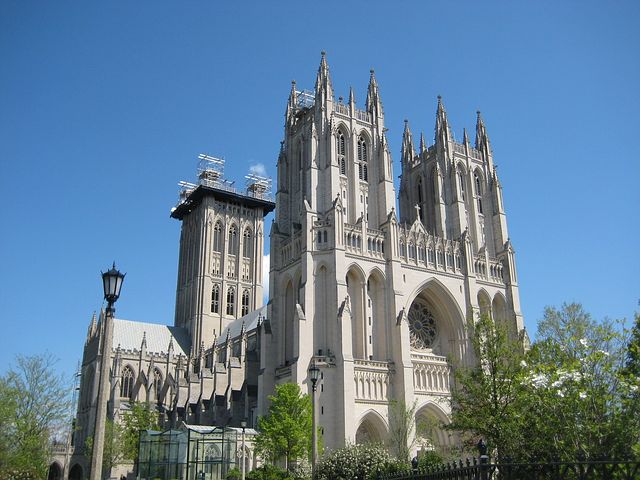
That’s why I so appreciated a public statement released last Tuesday from the faith leadership at the Washington National Cathedral. “Have We No Decency? A Response to President Trump,” a joint statement from the Bishop of the Episcopal Diocese of Washington along with the Dean and the Canon Theologian of the Cathedral, made me proud to be an Episcopalian and is a reminder of how faith can speak to power rather than join it in an unholy alliance or be silent.
Statement from Washington National Cathedral
The statement, of course, was in response to a couple weeks’ worth of odious and racist tweets and statements from the President, first aimed at four House members who are women of color, then at Representative Elijah Cummings. Although promulgated from a national house of worship, “the sacred space where America gathers at moments of national significance,” the content of the statement is something that all persons with a moral compass—whether persons of faith or not—can affirm. But as I usually do in this blog, I write from the perspective of a person of Christian faith.
The title of the essay is derived from U.S. Army attorney Joseph Welch’s exasperated question for Senator Joe McCarthy at a hearing in 1954.
Until this moment, Senator, I think I never really gauged your cruelty or your recklessness . . . You have done enough. Have you no sense of decency?
Welch’s question is often identified as the point where the tide definitively turned against McCarthy’s bullying and fear-mongering in the name of rooting out Communist influences. As the authors of the Cathedral statement point out, it was also a question for the nation—a question that is as relevant at this moment in our history as it was sixty-five summers ago. Have you had enough of this crap? When is enough enough? When does decency demand a response?
The National Cathedral statement begins its statement with a clear description of where we are in our national “conversation.”
Make no mistake about it, words matter. And, Mr. Trump’s words are dangerous. These words are more than a “dog whistle.” When such violent, dehumanizing words come from the President of the United States, they are a clarion call, and give cover, to white supremacists who consider people of color a sub-human “infestation” in America. They serve as a call to action from those people to keep America great by ridding it of such infestation. Violent words lead to violent actions.
Don’t be distracted by debates about whether the President is a racist, in other words. Whether he is a racist or not, his words are enabling, giving cover and comfort to people who are racist. We know who the President is; we know who and what these people are. The question is not “have they have no decency?” The question is, “have we no decency?”
The heart of the National Cathedral statement is eloquent and straightforward, cutting straight through the obfuscation, tentativeness, and qualifying that have become so familiar when engaging with moral absolutes.
As leaders of faith who believe in the sacredness of every single human being, the time for silence is over. We must boldly stand witness against the bigotry, hatred, intolerance, and xenophobia that is hurled at us, especially when it comes from the highest offices of this nation. We must say that this will not be tolerated. To stay silent in the face of such rhetoric is for us to tacitly condone the violence of these words. We are compelled to take every opportunity to oppose the indecency and dehumanization that is racism, whether it comes to us through words or actions.
There is nothing here that requires any particular faith commitment, or any faith commitment at all. It is perfectly possible for a person with no religious faith commitment to believe in the equal value of all human beings, regardless of surface level characteristics that we tend to use as defining and morally important distinguishing factors.
But for people professing a Christian faith commitment, the above statement is a no-brainer. Or so one might think. I’ve written frequently on this blog over the past three years or so about white evangelical Christian support for Donald Trump; if (God forbid) he is re-elected as President, the white evangelical constituency will be a large part of the reason. In a recent article in The Atlantic, evangelical Christian Peter Wehner digs into this phenomenon.
Wehner begins by quoting Ralph Reed, the founder and chairman of the Faith and Freedom Coalition, who told the Coalition’s gathering recently that “There has never been anyone who has defended us and who has fought for us, who we have loved more than Donald J. Trump. No one!” An anonymous pro-Trump evangelical friend told Wehner that “I have never witnessed the kind of excitement and enthusiasm for a political figure in my life. I honestly couldn’t believe the unwavering support they have for Trump.”
Wehner’s analysis traces this unwavering support to a sense of being wronged, to a perception that Christians are discriminated against, and—primarily—to fear. Fear that their own particular and peculiar understanding of their faith, along with the moral framework and political/social agenda that accompany it, is in danger of being overwhelmed by “Others,” people who do not share their vision of how the world should look and be. In a recent Time article, David French provides a similar analysis.
Talk to engaged evangelicals, and fear is all too often a dominant theme of their political life. The church is under siege from a hostile culture. Religious institutions are under legal attack from progressives. The left wants nuns to facilitate access to abortifacients and contraceptives, it wants Christian adoption agencies to compromise their conscience or close, and it even casts into doubt the tax exemptions of religious education institutions if they adhere to traditional Christian sexual ethics.
French responds with something he (and presumably these fear-filled evangelicals) learned in Sunday School.
The evangelical church is called to be a source of light in a darkening world . . . Indeed, of all the groups in American life who believe they have the least to fear from American politics, Christians should top the list. The faithful should reject fear. This is made plain to young Christians from the early days of Sunday school. There, many millions of young believers are taught the biblical verse: “For God gave us not a spirit of fear but of power and love and self-control.
Both articles are well worth your time. But for the moment, I simply appreciate the clarity of the statement from the National Cathedral as it speaks truth to both power and fear. This is why I am a person of Christian faith. I am in Washington D. C. this weekend tagging along with my wife Jeanne as she works at a convention. Google Maps tells me that the National Cathedral is 3.5 miles from our hotel—that’s a bit of a hike. But if it’s not too hot, I might head there today, sort of as a pilgrimage. A pilgrimage to a place that reminds me that the heart of my Christian faith is both simple enough to be stated in a sentence or two—beginning with the sacredness of all human beings—but also strong enough to speak truth to power that is abused in front of our eyes on a daily basis.
The National Cathedral statement ends by reminding us that on inauguration day in January, 2017, the Cathedral hosted an interfaith prayer service for the new administration, a service in which “We prayed for the President and his young Administration to have ‘wisdom and grace in the exercise of their duties that they may serve all people of this nation, and promote the dignity and freedom of every person.’” I’ve seen little to no evidence over the past two and a half years that the President has resonated with any of these prayers. But I can. And so can you.
Previous Post

August 1, 2019
Facing the Greatest Fear of All
Next Post

August 6, 2019 Are We Tending Toward Justice?
Browse Our Archives
Select a Category abortion Advent AI Angels Artificial intelligence atheism attention baptism Baptists beauty belief Benedictines Bible bicycling Big Bird books Bovina Camaldoli hermitage Canada Catholicism cats certainty change Christianity Christmas Collegeville Covid-19 creativity Development of Western Civilization dogs doubt Easter Enneagram Epiphany Episcopal ethics Eucharist evil extroverts Facebook faith family fear flowers forgiveness freedom friends God goodness grace happiness heaven hell history Holy Spirit Holy Week hope human nature humility humor idolatry incarnation introverts irreverence Islam Jeanne Jesus Joe Biden joy Judaism justice Kamala Harris knowledge Lent listen literature liturgy love Marsue Memorial Day miracles movies music mystery mythology NPR Old Testament optimism paradox peace Penguins philosophy piano podcast politics power prayer Protestantism Providence College Religion Rhode Island sabbatical sacrament science seeing silence Simone Weil Socrates soul sports St. John's College stories suffering tattoo teaching technology television theology thinking time tolerance transcendence travel trees trust truth Uncategorized Vermont wisdom wonder writing
Select a Month May 2026 April 2026 March 2026 February 2026 January 2026 December 2025 November 2025 October 2025 September 2025 August 2025 July 2025 June 2025 May 2025 April 2025 March 2025 February 2025 January 2025 December 2024 November 2024 October 2024 September 2024 August 2024 July 2024 June 2024 May 2024 April 2024 March 2024 February 2024 January 2024 December 2023 November 2023 October 2023 September 2023 August 2023 July 2023 June 2023 May 2023 April 2023 March 2023 February 2023 January 2023 December 2022 November 2022 October 2022 September 2022 August 2022 July 2022 June 2022 May 2022 April 2022 March 2022 February 2022 January 2022 December 2021 November 2021 October 2021 September 2021 August 2021 July 2021 June 2021 May 2021 April 2021 March 2021 February 2021 January 2021 December 2020 November 2020 October 2020 September 2020 August 2020 July 2020 June 2020 May 2020 April 2020 March 2020 February 2020 January 2020 December 2019 November 2019 October 2019 September 2019 August 2019 July 2019 June 2019 May 2019 April 2019 March 2019 February 2019 January 2019 December 2018 November 2018 October 2018 September 2018 August 2018 July 2018 June 2018 May 2018 April 2018 March 2018 February 2018 January 2018 December 2017 November 2017 October 2017 September 2017 August 2017 July 2017 June 2017 May 2017 April 2017 March 2017 February 2017 January 2017 December 2016 November 2016 October 2016 September 2016 August 2016 July 2016 June 2016 May 2016 April 2016 March 2016 February 2016 January 2016 December 2015 November 2015 October 2015 September 2015 August 2015 July 2015 June 2015 May 2015 April 2015 March 2015 February 2015 January 2015 December 2014 November 2014 October 2014 September 2014 August 2014 July 2014 June 2014 May 2014 April 2014 March 2014 February 2014 January 2014 December 2013 November 2013 October 2013 September 2013 August 2013 July 2013 June 2013 May 2013 April 2013 March 2013 February 2013 January 2013 December 2012 November 2012 October 2012 September 2012
Follow Us!
TAKE THE
Religious Wisdom Quiz
Which Christian denomination is known for emphasizing predestination?
Select your answer to see how you score.
Catholicism Methodism Lutheranism Calvinism
Books by This Author Books by Vance G. Morgan
Related posts from Freelance Christianity

The Lonely Pawn: On Faith, Doubt, and Meaning


AI and Love: When a Chatbot Becomes a...

TRENDING AT PATHEOS Progressive Christian

Why Christians Have a Sacred Duty to Vote:...
The Bible offers strong support for the sacred duty to vote. Here...

What Being a Modern-Day Apostle Means to Me
In my last column, I discussed the ins and outs of modern-day...

Did Ancient China Once Worship the God of...
Across human history, a common thread weaves through the origins of the...

Love Your Neighbor – Including Earth-Kin: Lev. 19,...
God’s command to love your neighbor means acting in an ethical and...

Lead a Church Study of “Jesus and Lao...
Guest writer Jack Thomas (The Irreverent Reverend) reflects on leading his church...

Principles for Understanding the Apostolic Ministry Today
Whenever people discover that my formal ministry title is "apostle," as in...
view all Progressive Christian blogs
Ad-Free & Subscriber Log-In Subscription Support
- About Us
- 2026 Calendar
- Videos
- Podcasts
- Library of World Religions
- Faith In Media Tracker
- Advertise With Us
- Write for Us
- Privacy Policy
- Terms of Service
- Do Not Sell My Data
- Contact Us
- Radiant Digital
- Manage Newsletter Subscriptions
- Unsubscribe From Notifications
- Sitemap
Copyright 2008-2026, Patheos. All rights reserved.
Subscription Support Ad-Free & Subscriber Log-In
Follow Patheos