
BuddhistCatholicContemplativeEvangelicalGeneral ChristianHinduJewishLatter-day SaintMuslimNew VisionsProgressive Christian
Beliefs
- Buddhist
- Catholic
- Contemplative
- Evangelical
- General Christian
- Hindu
- Jewish
- Latter-day Saint
- More Voices
- Muslim
- New Visions
- Pagan
- Progressive Christian
Topics
- Religion News
- Food and Religion
- Sports and Religion
- Religious Art
- Religious Music and Entertainment
- Religious Events
- History and Religion
- Style and Religion
- Politics and Religion
- Women in Religion
- Recreation Outdoors and Religion
- Business Finance and Religion
- Careers Workplace and Religion
- Education and Religion
- Family Parenting and Religion
- Health Fitness and Religion
- Home and Religion
- Relationships and Religion
- Technology and Religion
- Travel and Religion
Columnists
- Buddhist Columnists
- Business Finance and Religion Columnists
- Careers Workplace and Religion Columnists
- Catholic Columnists
- Contemplative Columnists
- Education and Religion Columnists
- Evangelists Columnists
- Family Parenting and Religion Columnists
- General Christian Columnists
- Health Fitness and Religion Columnists
- Hindu Columnists
- History and Religion Columnists
- Home and Religion Columnists
- Jewish Columnists
- More Voices Columnists
- Latter Day Columnists
- Muslim Columnists
- New Visions Columnists
- Nonreligious Columnists
- Pagan Columnists
- Politics and Religion Columnists
- Progressive Columnists
- Recreation Outdoors and Religion Columnists
- Relationships and Religion Columnists
- Religion News Columnists
- Religious Art Columnists
- Religious Events Columnists
- Religious Music and Entertainment Columnists
- Sports and Religion Columnists
- Style and Religion Columnists
- Technology and Religion Columnists
- Travel and Religion Columnists
- Women in Religion Columnists
Resource Library
- 2026 Calendar
- Library of World Religions
- The 100 Most Holy Places on Earth
- Patheos Answers
- Podcasts
- Videos
- Faith Leaders Database
- Anglican Episcopalian
- Bahai
- Baptist
- Buddhism
- Christianity
- Confucianism
- Eastern Orthodoxy
- Hinduism
- Holiness and Pentecostal
- ISKCON
- Islam
- Judaism
- Lutheran
- Methodist
- The Church of Jesus Christ of Latter-day Saints
- New Age
- Paganism
- Presbytarian and Reformed
- Protestantism
- Religion Behind the Scenes
- Roman Catholic
- Scientology
- Shia Islam
- Sikhism
- Sufism
- Sunni Islam
- Taoism
- Zen
- See all religions
Research Tools
 Ad-Free & Subscriber Log-In Subscription Support
Ad-Free & Subscriber Log-In Subscription Support
Follow Patheos 

- Trending:
- Forgiveness
- |
- Marriage
- |
- Consciousness
- |
- Death Penalty
- |
- Election
- |
- Halloween

- Home
- Progressive Christian
- The Gospel According to Compost
The Gospel According to Compost
Last updated on: May 3, 2022 at 6:00 am by Vance Morgan
The Gospel According to Compost 2022-05-01T20:30:11-04:00 Vance Morgan
Patheos Explore the world's faith through different perspectives on religion and spirituality! Patheos has the views of the prevalent religions and spiritualities of the world.
Alas, and did my Savior bleed,
and did my Sovereign die?
Would He devote that sacred head
for such a worm as I? Isaac Watts
When I recall the words to some of the hymns we regularly sang in church during my youth, I’m amazed that anyone survived intact psychologically. I am told that in recent hymnbooks the question in the last line has been changed to “for sinners such as I?” but the sentiment remains the same. And it’s not as if Isaac Watts was way out of bounds when he likened himself (and us) to a worm in this text—human beings are compared to worms frequently in the Bible, particularly in the Jewish scriptures. Job talks about worms a lot while sitting on his ash heap (can you blame him?), and the Psalmist calls himself a worm on many occasions.
The worminess of human nature has caught on over the centuries as a cornerstone of some versions of Christianity, particularly some Protestant varieties. John Calvin wrote about “man who is but rottenness and a worm,” regularly, and Martin Luther likened God’s grace to a fresh layer of snow covering a pile of shit, the sort of pile where worms invariably like to hang out. As a youngster who had a particular aversion to legless crawling things like worms and snakes, learning that I am no more than a worm in my natural state was a particularly depressing lesson. When Simone Weil likens an afflicted person, someone whose identity and dignity have been stripped away by forces beyond their control, as a “victim writhing on the ground like a half-crushed worm,” the image is gut-wrenching.
As you might have gathered, I don’t like worms. So why am I writing about them in this essay? Because I am paying attention to the sort of “coincidence” that I used to ignore but have learned over the past decade or so to pay attention to. Last Saturday, as Jeanne and I returned from taking Bovina to a dog park for the first time (it was a success), we were listening to NPR’s “Wait, Wait, Don’t Tell Me” on the drive home. WWDTM is a “must listen” for us each week; this episode was taped before a live audience in Buffalo, NY. The celebrity guest of the day was a famous person for Buffalonians (I Googled that one)—vermiculturist Myles Stubblefield, affectionately known as “The Worm King.”
A vermiculturist is someone who is a worm farmer and uses the worms to convert waste products such as uneaten food, feces, grass clippings, and spoiled fruit and vegetables into healthy, nutrient-rich soil and organic fertilizer. Myles Stubblefield started down the worm farming path when seeking the best ways to deal with the piles of dog poop he was responsible for getting rid of as he worked over several years at “almost every dog kennel and boarding facility in the Buffalo area.”
Eventually Stubblefield landed on composting, which led him to worms. Purchasing worms at anywhere from $65-$80 per pound from Amazon Prime, delivered to his door, Stubblefield got started. He now estimates that there are slightly more than one million worms in his composting factory; they just sold their first one-ton shipment of dog-poop-and-worm-generated compost to one of the many organic farmers in western New York.
The WWDTM crew had great fun with all of this of course—I was just glad that it was a radio rather than a television show. I don’t have any interest in seeing one million worms in one location. But worms weren’t done with me yet. The next morning as I drove a friend to catch a plane at the airport, then on to church, I listened on a podcast to Jeff Chu’s talk from the 2018 inaugural “Evolving Faith” conference. The conference was the brainchild of Rachel Held Evans (about whom I’ve written recently) and Sarah Bessey; Chu, a close friend of Evans, was invited to be one of the speakers. I first learned about Chu because he completed Rachel Held Evans’ final book, Wholehearted Faith, from Evans’ incomplete manuscript and other unpublished notes after her untimely and tragic death at age 37 in 2019. Wholehearted Faith was one of the texts we read and discussed in my “Faith and Doubt” colloquium this semester.
Jeff Chu is Chinese-American, an author and journalist whose memoir, Does Jesus Really Love Me? A Gay Christian’s Pilgrimage in Search of God in America, was published in 2014. Chu is currently studying at Princeton Theological Seminary “because I had to find a less lucrative career than journalism.” He grew up Southern Baptist and is the grandson and nephew of preachers. His talk at “Evolving Faith” was entitled “The Theology of Compost.” Compost on two consecutive days? Something told me I should pay attention.
So what do seminary and composting have to do with each other? Chu tells the story.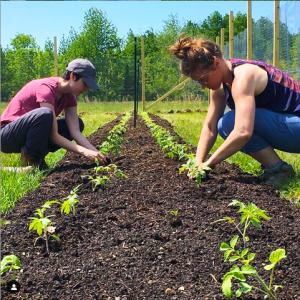
When I got to Princeton, I unexpectedly landed at the Farminary, which is 21 acres where we dig in the dirt and introverts don’t have to talk and it still counts as class. You come down this long gravel driveway . . . And to the right is our garden . . .We need compost to enrich the soil and we’re making it. It’s being made on our compost pile, which is, to me, the most beautiful place on the farm. I didn’t know much about compost before. But now I know that it preaches a hundred Sundays of sermons about death becoming new life, about God’s abundance, about how these things that seem useless—moldy fruit, onion skins, eggshells, coffee grounds—these become rich soil.
From his time at the Farminary and learning about composting, Chu has concluded that Christians need “a robust theology of compost,” because the story of compost is “really just the story of God. Turning fear to courage, sorrow to joy, death to life.” The next time someone tells you, or you tell yourself, that you are no better than a worm, remember that “Worms can be magic. Worms can be engines of redemption. Worms devour things of death and poop out life. And God gave their poop that power.” Here are some other elements of a theology of the compost:
- Death and the things of death, our sin, our suffering, the ways we hurt each other, the ways we harm ourselves— These things are never the end of God’s story.
- We are still in the process of becoming, and God has written redemption into the story of creation itself.
- God has empowered us, lowly worms, to turn what is ugly and festering and dying into what is lovely and beautiful and life-giving.
- We can’t do this alone, but we need others, because a single worm can’t do very much but in community they have such tremendous power.
- We who have been told by society that we are worthless can act in the confidence of the knowledge that we are worthy.
- A robust theology of the compost testifies that God urges those of us who have been shamed not to shame, but instead to love. Because in our acts of love, we participate in preparing the soil in which God’s reign of love and justice can take root.
“Would He devote that sacred head for such a worm as I?” A theology of the compost affirms that “God sure as hell would.” Imagine being empowered to transform decaying shit into abundant and fertile life. Once again we are reminded that God’s way of getting into the world is through human beings. For a model of how to do that, look to the worm.
Previous Post

May 1, 2022
Is God a Silent Partner?

Browse Our Archives
Select a Category abortion Advent AI Angels Artificial intelligence atheism attention baptism Baptists beauty belief Benedictines Bible bicycling Big Bird books Bovina Camaldoli hermitage Canada Catholicism cats certainty change Christianity Christmas Collegeville Covid-19 creativity Development of Western Civilization dogs doubt Easter Enneagram Epiphany Episcopal ethics Eucharist evil extroverts Facebook faith family fear flowers forgiveness freedom friends God goodness grace happiness heaven hell history Holy Spirit Holy Week hope human nature humility humor idolatry incarnation introverts irreverence Islam Jeanne Jesus Joe Biden joy Judaism justice Kamala Harris knowledge Lent listen literature liturgy love Marsue Memorial Day miracles movies music mystery mythology NPR Old Testament optimism paradox peace Penguins philosophy piano podcast politics power prayer Protestantism Providence College Religion Rhode Island sabbatical sacrament science seeing silence Simone Weil Socrates soul sports St. John's College stories suffering tattoo teaching technology television theology thinking time tolerance transcendence travel trees trust truth Uncategorized Vermont wisdom wonder writing
Select a Month May 2026 April 2026 March 2026 February 2026 January 2026 December 2025 November 2025 October 2025 September 2025 August 2025 July 2025 June 2025 May 2025 April 2025 March 2025 February 2025 January 2025 December 2024 November 2024 October 2024 September 2024 August 2024 July 2024 June 2024 May 2024 April 2024 March 2024 February 2024 January 2024 December 2023 November 2023 October 2023 September 2023 August 2023 July 2023 June 2023 May 2023 April 2023 March 2023 February 2023 January 2023 December 2022 November 2022 October 2022 September 2022 August 2022 July 2022 June 2022 May 2022 April 2022 March 2022 February 2022 January 2022 December 2021 November 2021 October 2021 September 2021 August 2021 July 2021 June 2021 May 2021 April 2021 March 2021 February 2021 January 2021 December 2020 November 2020 October 2020 September 2020 August 2020 July 2020 June 2020 May 2020 April 2020 March 2020 February 2020 January 2020 December 2019 November 2019 October 2019 September 2019 August 2019 July 2019 June 2019 May 2019 April 2019 March 2019 February 2019 January 2019 December 2018 November 2018 October 2018 September 2018 August 2018 July 2018 June 2018 May 2018 April 2018 March 2018 February 2018 January 2018 December 2017 November 2017 October 2017 September 2017 August 2017 July 2017 June 2017 May 2017 April 2017 March 2017 February 2017 January 2017 December 2016 November 2016 October 2016 September 2016 August 2016 July 2016 June 2016 May 2016 April 2016 March 2016 February 2016 January 2016 December 2015 November 2015 October 2015 September 2015 August 2015 July 2015 June 2015 May 2015 April 2015 March 2015 February 2015 January 2015 December 2014 November 2014 October 2014 September 2014 August 2014 July 2014 June 2014 May 2014 April 2014 March 2014 February 2014 January 2014 December 2013 November 2013 October 2013 September 2013 August 2013 July 2013 June 2013 May 2013 April 2013 March 2013 February 2013 January 2013 December 2012 November 2012 October 2012 September 2012
Follow Us!
TAKE THE
Religious Wisdom Quiz
What does "Beersheba" mean in Hebrew?
Select your answer to see how you score.
City of Peace Dwelling of the Lord Well of the Oath Place of Bread
Books by This Author Books by Vance G. Morgan
Related posts from Freelance Christianity

The Lonely Pawn: On Faith, Doubt, and Meaning


AI and Love: When a Chatbot Becomes a...

TRENDING AT PATHEOS Progressive Christian

Why Christians Have a Sacred Duty to Vote:...
The Bible offers strong support for the sacred duty to vote. Here...

What Being a Modern-Day Apostle Means to Me
In my last column, I discussed the ins and outs of modern-day...

Did Ancient China Once Worship the God of...
Across human history, a common thread weaves through the origins of the...

Love Your Neighbor – Including Earth-Kin: Lev. 19,...
God’s command to love your neighbor means acting in an ethical and...

Lead a Church Study of “Jesus and Lao...
Guest writer Jack Thomas (The Irreverent Reverend) reflects on leading his church...

Principles for Understanding the Apostolic Ministry Today
Whenever people discover that my formal ministry title is "apostle," as in...
view all Progressive Christian blogs
Ad-Free & Subscriber Log-In Subscription Support
- About Us
- 2026 Calendar
- Videos
- Podcasts
- Library of World Religions
- Faith In Media Tracker
- Advertise With Us
- Write for Us
- Privacy Policy
- Terms of Service
- Do Not Sell My Data
- Contact Us
- Radiant Digital
- Manage Newsletter Subscriptions
- Unsubscribe From Notifications
- Sitemap
Copyright 2008-2026, Patheos. All rights reserved.
Subscription Support Ad-Free & Subscriber Log-In
Follow Patheos