
BuddhistCatholicContemplativeEvangelicalGeneral ChristianHinduJewishLatter-day SaintMuslimNew VisionsProgressive Christian
Beliefs
- Buddhist
- Catholic
- Contemplative
- Evangelical
- General Christian
- Hindu
- Jewish
- Latter-day Saint
- More Voices
- Muslim
- New Visions
- Pagan
- Progressive Christian
Topics
- Religion News
- Food and Religion
- Sports and Religion
- Religious Art
- Religious Music and Entertainment
- Religious Events
- History and Religion
- Style and Religion
- Politics and Religion
- Women in Religion
- Recreation Outdoors and Religion
- Business Finance and Religion
- Careers Workplace and Religion
- Education and Religion
- Family Parenting and Religion
- Health Fitness and Religion
- Home and Religion
- Relationships and Religion
- Technology and Religion
- Travel and Religion
Columnists
- Buddhist Columnists
- Business Finance and Religion Columnists
- Careers Workplace and Religion Columnists
- Catholic Columnists
- Contemplative Columnists
- Education and Religion Columnists
- Evangelists Columnists
- Family Parenting and Religion Columnists
- General Christian Columnists
- Health Fitness and Religion Columnists
- Hindu Columnists
- History and Religion Columnists
- Home and Religion Columnists
- Jewish Columnists
- More Voices Columnists
- Latter Day Columnists
- Muslim Columnists
- New Visions Columnists
- Nonreligious Columnists
- Pagan Columnists
- Politics and Religion Columnists
- Progressive Columnists
- Recreation Outdoors and Religion Columnists
- Relationships and Religion Columnists
- Religion News Columnists
- Religious Art Columnists
- Religious Events Columnists
- Religious Music and Entertainment Columnists
- Sports and Religion Columnists
- Style and Religion Columnists
- Technology and Religion Columnists
- Travel and Religion Columnists
- Women in Religion Columnists
Resource Library
- 2026 Calendar
- Library of World Religions
- The 100 Most Holy Places on Earth
- Patheos Answers
- Podcasts
- Videos
- Faith Leaders Database
- Anglican Episcopalian
- Bahai
- Baptist
- Buddhism
- Christianity
- Confucianism
- Eastern Orthodoxy
- Hinduism
- Holiness and Pentecostal
- ISKCON
- Islam
- Judaism
- Lutheran
- Methodist
- The Church of Jesus Christ of Latter-day Saints
- New Age
- Paganism
- Presbytarian and Reformed
- Protestantism
- Religion Behind the Scenes
- Roman Catholic
- Scientology
- Shia Islam
- Sikhism
- Sufism
- Sunni Islam
- Taoism
- Zen
- See all religions
Research Tools
 Ad-Free & Subscriber Log-In Subscription Support
Ad-Free & Subscriber Log-In Subscription Support
Follow Patheos 

- Trending:
- Forgiveness
- |
- Marriage
- |
- Consciousness
- |
- Death Penalty
- |
- Election
- |
- Halloween

- Home
- Progressive Christian
- The Full Garden Story
The Full Garden Story
Last updated on: February 22, 2026 at 7:45 am by Vance Morgan
The Full Garden Story 2026-02-22T07:45:22-04:00 Vance Morgan
Patheos Explore the world's faith through different perspectives on religion and spirituality! Patheos has the views of the prevalent religions and spiritualities of the world.
Today is the first Sunday of Lent; the gospel reading is always one a treatment of Jesus’ temptation in the desert. This year we get Matthew’s version. But today I’m particularly interested in the first reading from the Jewish scriptures–an edited version of Adam and Eve’s fall in the Garden of Eden from Genesis 2 and 3. It’s a story that lose some of its power if the whole context and narrative is not considered.
I am not overstating the case when I say that I was raised on original sin. I feel that now, close to my 70th birthday, the grip of this pernicious doctrine has largely lost its power over me. There are many reasons for this positive development, not the least being that I have learned the power of unconditional love from a few people who have embraced me over the years—and continue to do so—warts and all. I also have learned over the years the story in which the whole idea of original sin is rooted actually doesn’t say anything about original sin at all. Rather, this iconic story can be read in ways that are both liberating and empowering.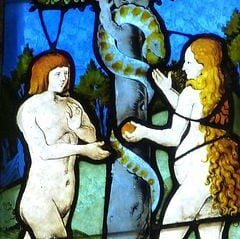
In Wholehearted Faith, the late Rachel Held Evans takes delight in retelling stories from the Bible that those who were raised in certain circles that take the Bible literally, as Rachel and I were, were given as a fait accompli in terms of meaning and interpretation. Consider Adam and Even in the Garden of Eden. This story of temptations, disobedience, shame, guilt, female gullibility and unreliability, as well as original sin was central to my understanding of human beings, God, and myself. Everything that is wrong with humanity and that causes us to need salvation and redemption is embedded in Genesis 3.
Yet as Evans points out, there are several things wrong with the traditional story of the Fall.
- Genesis does not describe the Garden of Eden as “perfect,” but rather as “very good,” just as everything else is God created in Genesis 1 is described.
- Nowhere in the text is it suggested that death is anything other than part of the natural cycle of living things. In other words, Adam and Eve were not promised immortality if they obeyed.
- Significantly, the word “sin” is never mentioned in the story. Evans notes that “nothing in the first three chapters of Genesis, or in the rest of Hebrew Scripture, for that matter, suggests that the choice made by Adam and Even in the Garden of Eden permanently and negatively altered their nature.” Or ours, for that matter.
If this is not a story of original sin and destruction of original goodness, then what is the takeaway?
Rachel Held Evans suggests that rather than being a cautionary tale about disobedience and original sin, this is a story about the difference between wisdom and knowledge. Evans notes that in the Edenic landscape,
The Tree of Knowledge must always grow next to the Tree of Life, their roots intertwining, lest in our striving for comprehension we forget to honor the sacredness of our connection—to God, to one another, and to all of life.
By seeking knowledge apart from wisdom, by separating themselves from their connectedness both to God and to everything around them, Adam and Eve had chosen independence over interdependence. Evans reads this as a story of loss of innocence, seeking to gain wisdom through a shortcut that does not involve God. Evans quotes Barbara Shroyer, who writes that when interpreting this story, “sin nature” should be replaced with “human nature.”
We’re born human, and within us lies the potential for both creation and destruction, both blessing and curse. To be human is to be capable of both incredible good and terrifying evil. If we deny either side of that potential, we’re living unaware.
I’m reminded of Death’s soliloquy about human beings in Marcus Zusek’s The Book Thief. “
I wanted to explain that I am constantly overestimating and underestimating the human race—that rarely do I ever simply estimate it. I wanted to ask her how the same thing could be so ugly and so glorious, and its words and stories so damning and brilliant . . . I am haunted by humans.
During the fall semester for many years, I often have had the opportunity and privilege in a team-taught course to introduce freshman students to the Bible as literature rather than as sacred text. To demonstrate that seminal texts from the Jewish Scriptures and the New Testament can be read in many ways that diverge from traditional interpretations, I often begin with the very same story that Rachel Held Evans explores: The Garden of Eden.
Noting that, as most everyone knows, Adam and Even have been told not to eat of the Tree of the Knowledge of Good and Evil “lest they die,” I ask my students “why do you think is prohibited?” As discussion develops, someone invariably observes that the knowledge of good and evil is apparently something that Adam and Eve lack, something that God does not want them to have. The serpent in the story plays on this observation, suggesting to Eve that the reason this knowledge has been denied her and her mate is that **“**God knows that in the day that you eat of it your eyes will be opened, and you will be like God, knowing good and evil.” As it turns out, the serpent is right. Later in the chapter, after things have gone bad, God complains to God’s self, “Behold, the man has become like one of Us (!), to know good and evil.”
“What would you call a person who doesn’t know the difference between good and evil?” I ask my students. “Childlike,” “innocent,” “immature” are some of the responses. But what would we call a grown human being who doesn’t know the difference? “A sociopath.” “A problem.” When I ask students to rate, on a scale of 1-10, how important moral awareness is to their understanding of what it means to be human, everyone says “10.” Moral awareness is essential to full-fledged humanity.
If so, then Adam and Eve prior to eating of the fruit of the Tree of the Knowledge of Good and Evil are not fully human. Gaining moral awareness is a necessary part of becoming human. Given the rest of the story, one of the essential points is that by becoming fully human, a distance is established between human beings and the divine. By exercising their divinely given ability to choose and by gaining moral awareness, Adam and Eve have established—for better and for worse—their independence from God. This distance from and tension with what created them is both central to many seminal stories from the sacred texts and definitive of being human.
How one deals with this distance and tension is a central feature of the human story. And, as we all know, stories are far more interesting and profound than facts.
Previous Post
February 18, 2026
An Ash Wednesday and Lenten Tale
Next Post

February 26, 2026 Be Like the Dunkers
Recent Comments
"Mary did have a choice. And she was able to make it before the Holy ..."
"i cannot read beyond your recommendations for the books since i like to have a ..."
"AI will never be able to utter with honesty, feeling, or humility, the greeting: "Namaste".It ..."
"They do. I'm sure you could find discussions of the same topic from any of ..."
Browse Our Archives
Select a Category abortion Advent AI Angels Artificial intelligence atheism attention baptism Baptists beauty belief Benedictines Bible bicycling Big Bird books Bovina Camaldoli hermitage Canada Catholicism cats certainty change Christianity Christmas Collegeville Covid-19 creativity Development of Western Civilization dogs doubt Easter Enneagram Epiphany Episcopal ethics Eucharist evil extroverts Facebook faith family fear flowers forgiveness freedom friends God goodness grace happiness heaven hell history Holy Spirit Holy Week hope human nature humility humor idolatry incarnation introverts irreverence Islam Jeanne Jesus Joe Biden joy Judaism justice Kamala Harris knowledge Lent listen literature liturgy love Marsue Memorial Day miracles movies music mystery mythology NPR Old Testament optimism paradox peace Penguins philosophy piano podcast politics power prayer Protestantism Providence College Religion Rhode Island sabbatical sacrament science seeing silence Simone Weil Socrates soul sports St. John's College stories suffering tattoo teaching technology television theology thinking time tolerance transcendence travel trees trust truth Uncategorized Vermont wisdom wonder writing
Select a Month May 2026 April 2026 March 2026 February 2026 January 2026 December 2025 November 2025 October 2025 September 2025 August 2025 July 2025 June 2025 May 2025 April 2025 March 2025 February 2025 January 2025 December 2024 November 2024 October 2024 September 2024 August 2024 July 2024 June 2024 May 2024 April 2024 March 2024 February 2024 January 2024 December 2023 November 2023 October 2023 September 2023 August 2023 July 2023 June 2023 May 2023 April 2023 March 2023 February 2023 January 2023 December 2022 November 2022 October 2022 September 2022 August 2022 July 2022 June 2022 May 2022 April 2022 March 2022 February 2022 January 2022 December 2021 November 2021 October 2021 September 2021 August 2021 July 2021 June 2021 May 2021 April 2021 March 2021 February 2021 January 2021 December 2020 November 2020 October 2020 September 2020 August 2020 July 2020 June 2020 May 2020 April 2020 March 2020 February 2020 January 2020 December 2019 November 2019 October 2019 September 2019 August 2019 July 2019 June 2019 May 2019 April 2019 March 2019 February 2019 January 2019 December 2018 November 2018 October 2018 September 2018 August 2018 July 2018 June 2018 May 2018 April 2018 March 2018 February 2018 January 2018 December 2017 November 2017 October 2017 September 2017 August 2017 July 2017 June 2017 May 2017 April 2017 March 2017 February 2017 January 2017 December 2016 November 2016 October 2016 September 2016 August 2016 July 2016 June 2016 May 2016 April 2016 March 2016 February 2016 January 2016 December 2015 November 2015 October 2015 September 2015 August 2015 July 2015 June 2015 May 2015 April 2015 March 2015 February 2015 January 2015 December 2014 November 2014 October 2014 September 2014 August 2014 July 2014 June 2014 May 2014 April 2014 March 2014 February 2014 January 2014 December 2013 November 2013 October 2013 September 2013 August 2013 July 2013 June 2013 May 2013 April 2013 March 2013 February 2013 January 2013 December 2012 November 2012 October 2012 September 2012
Follow Us!
TAKE THE
Religious Wisdom Quiz
In 1 Thessalonians, what does Paul say about the dead in Christ when the Lord returns?
Select your answer to see how you score.
They will be caught up in glory They will rise first They will rise last They will be judged
Books by This Author Books by Vance G. Morgan
Related posts from Freelance Christianity

The Lonely Pawn: On Faith, Doubt, and Meaning


AI and Love: When a Chatbot Becomes a...

TRENDING AT PATHEOS Progressive Christian

What Being a Modern-Day Apostle Means to Me
In my last column, I discussed the ins and outs of modern-day...

Did Ancient China Once Worship the God of...
Across human history, a common thread weaves through the origins of the...

Love Your Neighbor – Including Earth-Kin: Lev. 19,...
God’s command to love your neighbor means acting in an ethical and...

Lead a Church Study of “Jesus and Lao...
Guest writer Jack Thomas (The Irreverent Reverend) reflects on leading his church...

Pastoral Wisdom for Responding to Sermon Pushback
Getting sermon pushback on your social justice sermon? Learn practical, Proverbs-based strategies...

Principles for Understanding the Apostolic Ministry Today
Whenever people discover that my formal ministry title is "apostle," as in...
view all Progressive Christian blogs
What Are Your Thoughts?leave a comment
Ad-Free & Subscriber Log-In Subscription Support
- About Us
- 2026 Calendar
- Videos
- Podcasts
- Library of World Religions
- Faith In Media Tracker
- Advertise With Us
- Write for Us
- Privacy Policy
- Terms of Service
- Do Not Sell My Data
- Contact Us
- Radiant Digital
- Manage Newsletter Subscriptions
- Unsubscribe From Notifications
- Sitemap
Copyright 2008-2026, Patheos. All rights reserved.
Subscription Support Ad-Free & Subscriber Log-In
Follow Patheos