
BuddhistCatholicContemplativeEvangelicalGeneral ChristianHinduJewishLatter-day SaintMuslimNew VisionsProgressive Christian
Beliefs
- Buddhist
- Catholic
- Contemplative
- Evangelical
- General Christian
- Hindu
- Jewish
- Latter-day Saint
- More Voices
- Muslim
- New Visions
- Pagan
- Progressive Christian
Topics
- Religion News
- Food and Religion
- Sports and Religion
- Religious Art
- Religious Music and Entertainment
- Religious Events
- History and Religion
- Style and Religion
- Politics and Religion
- Women in Religion
- Recreation Outdoors and Religion
- Business Finance and Religion
- Careers Workplace and Religion
- Education and Religion
- Family Parenting and Religion
- Health Fitness and Religion
- Home and Religion
- Relationships and Religion
- Technology and Religion
- Travel and Religion
Columnists
- Buddhist Columnists
- Business Finance and Religion Columnists
- Careers Workplace and Religion Columnists
- Catholic Columnists
- Contemplative Columnists
- Education and Religion Columnists
- Evangelists Columnists
- Family Parenting and Religion Columnists
- General Christian Columnists
- Health Fitness and Religion Columnists
- Hindu Columnists
- History and Religion Columnists
- Home and Religion Columnists
- Jewish Columnists
- More Voices Columnists
- Latter Day Columnists
- Muslim Columnists
- New Visions Columnists
- Nonreligious Columnists
- Pagan Columnists
- Politics and Religion Columnists
- Progressive Columnists
- Recreation Outdoors and Religion Columnists
- Relationships and Religion Columnists
- Religion News Columnists
- Religious Art Columnists
- Religious Events Columnists
- Religious Music and Entertainment Columnists
- Sports and Religion Columnists
- Style and Religion Columnists
- Technology and Religion Columnists
- Travel and Religion Columnists
- Women in Religion Columnists
Resource Library
- 2026 Calendar
- Library of World Religions
- The 100 Most Holy Places on Earth
- Patheos Answers
- Podcasts
- Videos
- Faith Leaders Database
- Anglican Episcopalian
- Bahai
- Baptist
- Buddhism
- Christianity
- Confucianism
- Eastern Orthodoxy
- Hinduism
- Holiness and Pentecostal
- ISKCON
- Islam
- Judaism
- Lutheran
- Methodist
- The Church of Jesus Christ of Latter-day Saints
- New Age
- Paganism
- Presbytarian and Reformed
- Protestantism
- Religion Behind the Scenes
- Roman Catholic
- Scientology
- Shia Islam
- Sikhism
- Sufism
- Sunni Islam
- Taoism
- Zen
- See all religions
Research Tools
 Ad-Free & Subscriber Log-In Subscription Support
Ad-Free & Subscriber Log-In Subscription Support
Follow Patheos 

- Trending:
- Forgiveness
- |
- Marriage
- |
- Consciousness
- |
- Death Penalty
- |
- Election
- |
- Halloween

- Home
- Progressive Christian
- AI and Human Dignity
AI and Human Dignity
Last updated on: May 6, 2026 at 6:00 am by Vance Morgan
AI and Human Dignity 2026-05-05T20:26:38-04:00 Vance Morgan
Patheos Explore the world's faith through different perspectives on religion and spirituality! Patheos has the views of the prevalent religions and spiritualities of the world.
Last Sunday I set the stage for my next several posts by engaging with a lecture by Notre Dame professor Meghan Sullivan on the topic “Ethics, AI, and Human Flourishing.” During that lecture she introduces a framework for thinking about AI in the context of Christian values and virtue ethics that goes by the acronym “DELTA,” ans described in the following short video:
Over the next few posts I’ll be exploring the various parts of this framework. Up first: “D” is for Dignity
Sullivan notes that in the Christian worldview, every single human being is created in the image of God; accordingly, each human being has inherent worth and value. So what is it about being human that reflects the divine? One of the most common answers, particularly since the Scientific Revolution and the Enlightenment, is that it is our possession of reason that makes us unique–“Godlike,” if you will. Logical thought, problem solving–these are signs of our rationality and specialness.
The problem is that AI can do that better that humans can. If there is something sacred about us, it cannot simply be our rationality, since AI can out produce our rational output with ease. Whatever reflects the divine within us, it must be something more sacred and more basic than that. But if we are going to protect human dignity from AI specifically and technology broadly construed, we need to have a better sense of what exactly such dignity amounts to.
I frequently run a rough draft definition of “human being” past my students early in the semester. “A human beings is a physical thing plus something more.” Virtually every hand goes up to indicate intuitive affirmation of that simple definition. Or I might ask “How many of you believe that every human being equally possesses something of profound moral value simply because they are human?” Just about all hands go up for that one too. Roughly speaking, the “something more” and “something of profound moral value” are pointing to the same thing.
It is not surprising that I have consistently received these responses over the years from my students, given that I teach at a private Catholic college. But believing in human specialness that depends simply on what we are, not what we do, does not require an exclusively religious foundation. Such a belief is at the heart of a commitment to the “certain inalienable rights” that are highlighted at the beginning of the Declaration of Independence. If human rights are inherent rather than gifts that can be given or taken away at whim, then there must be something at the heart of being human that endows us with such rights. All of the above is gathered together under one umbrella that we call “human dignity.”
What exactly is the “something more,” the “something of profound moral value” that is at the heart of human dignity? To use what seemed to be my favorite word this past semester, such phrases point toward seomthing “ineffable.” Something “irreducible” that excapes definition and logic. This is when I always turn to stories and analogies.
Simone Weil lived and worked in the middle of the horros of both World Wars of the 20th century. She believed that attentive listening, what she calls “attention,” is the first step to bringing those who are “afflicted,” persons whose identity has been stripped from them either by chance or deliberately by others, back toward healing and a restoration of their humanity. This has much to do with both the existence of and respect for human dignity.
Think of the emaciated, skeletal prisoners of Auschwitz on the day that Allied soldiers liberated the death camp. I’m sure you’ve seen the pictures or film footage. These are people from whom every shred of dignity, identity, and humanity has been stripped. They are the walking dead. And, to use Simone Weil’s word, they are “afflicted.” The temptation, of course, is to seek to address the most obvious physical needs of such persons—food, clothing, shelter, medical care, and so on. But, Weil suggests, there is something more profound and immediate than physical help that those who are afflicted need. She writes that
Those who are unhappy have no need for anything in this world but people capable of giving them their attention. The capacity to give one’s attention to a sufferer is a very rare and difficult thing; it is almost a miracle; it is a miracle . . . The love of our neighbor in all its fullness simply means being able to say to him: “What are you going through?” It is a recognition that the sufferer exists, not only as a unit in a collection, or a specimen from the social category labeled “unfortunate,” but as a man, exactly like us, who was one day stamped with a special mark by affliction.
How do I begin to restore the humanity and dignity of one from whom those things have been violently stripped away? Not by addressing their physical needs as one would solve a mathematical equation, but rather by saying “tell me your story.” In this way, Simone Weil argues, I tell the afflicted person—to use a current popular phrase—“I see you. At the core of this starving, filthy, corpse-like creature in front of me I recognize a fellow human being. What are you going through?” And in that way, through the simple but profound recognition of another’s personhood, the restoration of human dignity begins.
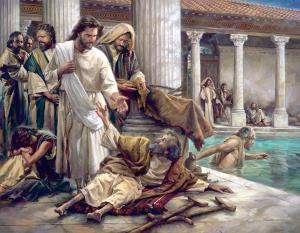 One of my favorite tales of respect for human dignity comes from the gospel of John in the New Testament. It is the story of of a crippled man who has been waiting by the Pool of Bethesda in Jerusalem for thirty-eight years for someone to help him into the healing waters of the pool when they are “stirred up.” Jesus aproaches the man–those famliar with Jesus wait with expectation for the healing miracle they are sure is to come. But instead, Jesus asks the oddest question: Do you want to be made well? Why does Jesus ask this? Perhaps Jesus wants to know if the lame man is truly prepared for the consequences of no longer being lame. How will he support himself if he can no longer beg for money as a disabled person?
But I think something deeper is going on. Jesus is exhibiting the attentiveness described by Simone Weil. By asking for the man’s consent, Jesus shows that he does not consider the lame man as a problem to be solved, a disease to be cured, or another opportunity to perform a miracle, but considers him rather as a person, a human being with dignity, whose permission is needed simply because he is a human being equal in dignity to the one who is asking him the question.
The scene is striking in its simplicity. Jesus asks the question because he wants the man to know that, despite his affliction, his poverty, his bitterness, and his pain, Jesus recognizes in him the beauty and dignity of a human being. And Jesus will not presume to invade this man’s world without his consent. There is nothing more profound contained in the story of Christianity than that God became human—and that this was not so much a reflection of how far God had to descend, but rather of how infinitely valuable human beings are.
Human dignity has nothing to do with output, productivity, or anything a human being does. Human dignity points toward the ineffable, sacred core of what it means to be human, to be a bearer of the image of the divine. The fact that we struggle to put our finger on exactly what this sacred aspect of being human is should tell us something. Not everything is reducible to data or measurable productivity. Some things are more valuable than what can be measured.
Previous Post
May 3, 2026
AI and the Life of Faith
Next Post

May 10, 2026 AI and Embodiment
Recent Comments
"Mary did have a choice. And she was able to make it before the Holy ..."
"i cannot read beyond your recommendations for the books since i like to have a ..."
"AI will never be able to utter with honesty, feeling, or humility, the greeting: "Namaste".It ..."
"They do. I'm sure you could find discussions of the same topic from any of ..."
Browse Our Archives
Select a Category abortion Advent AI Angels Artificial intelligence atheism attention baptism Baptists beauty belief Benedictines Bible bicycling Big Bird books Bovina Camaldoli hermitage Canada Catholicism cats certainty change Christianity Christmas Collegeville Covid-19 creativity Development of Western Civilization dogs doubt Easter Enneagram Epiphany Episcopal ethics Eucharist evil extroverts Facebook faith family fear flowers forgiveness freedom friends God goodness grace happiness heaven hell history Holy Spirit Holy Week hope human nature humility humor idolatry incarnation introverts irreverence Islam Jeanne Jesus Joe Biden joy Judaism justice Kamala Harris knowledge Lent listen literature liturgy love Marsue Memorial Day miracles movies music mystery mythology NPR Old Testament optimism paradox peace Penguins philosophy piano podcast politics power prayer Protestantism Providence College Religion Rhode Island sabbatical sacrament science seeing silence Simone Weil Socrates soul sports St. John's College stories suffering tattoo teaching technology television theology thinking time tolerance transcendence travel trees trust truth Uncategorized Vermont wisdom wonder writing
Select a Month May 2026 April 2026 March 2026 February 2026 January 2026 December 2025 November 2025 October 2025 September 2025 August 2025 July 2025 June 2025 May 2025 April 2025 March 2025 February 2025 January 2025 December 2024 November 2024 October 2024 September 2024 August 2024 July 2024 June 2024 May 2024 April 2024 March 2024 February 2024 January 2024 December 2023 November 2023 October 2023 September 2023 August 2023 July 2023 June 2023 May 2023 April 2023 March 2023 February 2023 January 2023 December 2022 November 2022 October 2022 September 2022 August 2022 July 2022 June 2022 May 2022 April 2022 March 2022 February 2022 January 2022 December 2021 November 2021 October 2021 September 2021 August 2021 July 2021 June 2021 May 2021 April 2021 March 2021 February 2021 January 2021 December 2020 November 2020 October 2020 September 2020 August 2020 July 2020 June 2020 May 2020 April 2020 March 2020 February 2020 January 2020 December 2019 November 2019 October 2019 September 2019 August 2019 July 2019 June 2019 May 2019 April 2019 March 2019 February 2019 January 2019 December 2018 November 2018 October 2018 September 2018 August 2018 July 2018 June 2018 May 2018 April 2018 March 2018 February 2018 January 2018 December 2017 November 2017 October 2017 September 2017 August 2017 July 2017 June 2017 May 2017 April 2017 March 2017 February 2017 January 2017 December 2016 November 2016 October 2016 September 2016 August 2016 July 2016 June 2016 May 2016 April 2016 March 2016 February 2016 January 2016 December 2015 November 2015 October 2015 September 2015 August 2015 July 2015 June 2015 May 2015 April 2015 March 2015 February 2015 January 2015 December 2014 November 2014 October 2014 September 2014 August 2014 July 2014 June 2014 May 2014 April 2014 March 2014 February 2014 January 2014 December 2013 November 2013 October 2013 September 2013 August 2013 July 2013 June 2013 May 2013 April 2013 March 2013 February 2013 January 2013 December 2012 November 2012 October 2012 September 2012
Follow Us!
TAKE THE
Religious Wisdom Quiz
Who was Deborah's military commander?
Select your answer to see how you score.
Samson Jephthah Barak Gideon
Books by This Author Books by Vance G. Morgan
Related posts from Freelance Christianity

The Lonely Pawn: On Faith, Doubt, and Meaning


AI and Love: When a Chatbot Becomes a...

TRENDING AT PATHEOS Progressive Christian

What Being a Modern-Day Apostle Means to Me
In my last column, I discussed the ins and outs of modern-day...

Did Ancient China Once Worship the God of...
Across human history, a common thread weaves through the origins of the...

Love Your Neighbor – Including Earth-Kin: Lev. 19,...
God’s command to love your neighbor means acting in an ethical and...

Lead a Church Study of “Jesus and Lao...
Guest writer Jack Thomas (The Irreverent Reverend) reflects on leading his church...

Pastoral Wisdom for Responding to Sermon Pushback
Getting sermon pushback on your social justice sermon? Learn practical, Proverbs-based strategies...

Principles for Understanding the Apostolic Ministry Today
Whenever people discover that my formal ministry title is "apostle," as in...
view all Progressive Christian blogs
What Are Your Thoughts?leave a comment
Ad-Free & Subscriber Log-In Subscription Support
- About Us
- 2026 Calendar
- Videos
- Podcasts
- Library of World Religions
- Faith In Media Tracker
- Advertise With Us
- Write for Us
- Privacy Policy
- Terms of Service
- Do Not Sell My Data
- Contact Us
- Radiant Digital
- Manage Newsletter Subscriptions
- Unsubscribe From Notifications
- Sitemap
Copyright 2008-2026, Patheos. All rights reserved.
Subscription Support Ad-Free & Subscriber Log-In
Follow Patheos