
BuddhistCatholicContemplativeEvangelicalGeneral ChristianHinduJewishLatter-day SaintMuslimNew VisionsProgressive Christian
Beliefs
- Buddhist
- Catholic
- Contemplative
- Evangelical
- General Christian
- Hindu
- Jewish
- Latter-day Saint
- More Voices
- Muslim
- New Visions
- Pagan
- Progressive Christian
Topics
- Religion News
- Food and Religion
- Sports and Religion
- Religious Art
- Religious Music and Entertainment
- Religious Events
- History and Religion
- Style and Religion
- Politics and Religion
- Women in Religion
- Recreation Outdoors and Religion
- Business Finance and Religion
- Careers Workplace and Religion
- Education and Religion
- Family Parenting and Religion
- Health Fitness and Religion
- Home and Religion
- Relationships and Religion
- Technology and Religion
- Travel and Religion
Columnists
- Buddhist Columnists
- Business Finance and Religion Columnists
- Careers Workplace and Religion Columnists
- Catholic Columnists
- Contemplative Columnists
- Education and Religion Columnists
- Evangelists Columnists
- Family Parenting and Religion Columnists
- General Christian Columnists
- Health Fitness and Religion Columnists
- Hindu Columnists
- History and Religion Columnists
- Home and Religion Columnists
- Jewish Columnists
- More Voices Columnists
- Latter Day Columnists
- Muslim Columnists
- New Visions Columnists
- Nonreligious Columnists
- Pagan Columnists
- Politics and Religion Columnists
- Progressive Columnists
- Recreation Outdoors and Religion Columnists
- Relationships and Religion Columnists
- Religion News Columnists
- Religious Art Columnists
- Religious Events Columnists
- Religious Music and Entertainment Columnists
- Sports and Religion Columnists
- Style and Religion Columnists
- Technology and Religion Columnists
- Travel and Religion Columnists
- Women in Religion Columnists
Resource Library
- 2026 Calendar
- Library of World Religions
- The 100 Most Holy Places on Earth
- Patheos Answers
- Podcasts
- Videos
- Faith Leaders Database
- Anglican Episcopalian
- Bahai
- Baptist
- Buddhism
- Christianity
- Confucianism
- Eastern Orthodoxy
- Hinduism
- Holiness and Pentecostal
- ISKCON
- Islam
- Judaism
- Lutheran
- Methodist
- The Church of Jesus Christ of Latter-day Saints
- New Age
- Paganism
- Presbytarian and Reformed
- Protestantism
- Religion Behind the Scenes
- Roman Catholic
- Scientology
- Shia Islam
- Sikhism
- Sufism
- Sunni Islam
- Taoism
- Zen
- See all religions
Research Tools
 Ad-Free & Subscriber Log-In Subscription Support
Ad-Free & Subscriber Log-In Subscription Support
Follow Patheos 

- Trending:
- Forgiveness
- |
- Marriage
- |
- Consciousness
- |
- Death Penalty
- |
- Election
- |
- Halloween

- Home
- Progressive Christian
- The Burden of LIght
The Burden of LIght
Last updated on: July 9, 2017 at 7:02 am by Vance Morgan
The Burden of LIght 2017-07-09T07:02:45-04:00 Vance Morgan
Patheos Explore the world's faith through different perspectives on religion and spirituality! Patheos has the views of the prevalent religions and spiritualities of the world.
Teaching for close to twenty years in an interdisciplinary program with colleagues from a multitude of disciplines has provided me with the best that academe can offer a professor—a continuing education. In an academic world which so often demands narrower and narrower research focus and specialization from its members, it has been a gift to spend the majority of my career thus far at a place that welcomes breadth and encourages—and sometimes requires—its faculty to regularly wander outside their comfort zone in the classroom. I have learned more about history, theology, music, art, and literature through my participation in this program than I could have in any number of graduate courses.
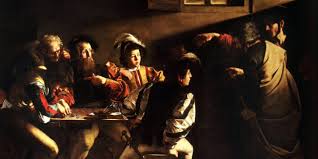
I learned, for instance, about chiaroscuro from the art lectures offered regularly by a colleague from the history department who was frequently a member of my teaching team during my early years in the program. Chiaroscuro is a painting technique that uses strong contrasts between light and dark, bold contrasts that affect the whole composition. Many Renaissance artists used the technique; my colleague’s preferred examples came from the work of Caravaggio. My colleague’s go-to illustration of Caravaggio’s chiaroscuro was “The Calling of Saint Matthew.”
There is some debate concerning who Matthew is in this painting. Is he the guy with the beard pointing at himself (“Who, me?”)? Or is he the young counting money and not paying attention, to whom the guy with the beard is pointing (“Who, him?”)? I prefer the latter interpretation, but there is no debate about the power of light and shadow in this painting. The light shining from a window outside the top right of the canvas illuminates just enough of Jesus’ modest halo to make clear who he is, as well as the expressions on the faces of everyone at the table. But this light also makes the shadows even darker and more pronounced. Light does not dispel the darkness, but it changes everything. This light has transformed the life of the man on whom it is directed—for better and for worse.
According to today’s gospel reading from Matthew, Jesus once said that “my yoke is easy, and my burden is light.” My wife Jeanne told me recently of an “aha!” moment she had not long ago related to this “burden is light” business. She (and probably everyone else aware of the passage and its context) always assumed that Jesus meant that the burden of following him is not heavy—it’s light. And I’m sure that’s what the Greek text implies as well.
But thanks to the wonders of the English language, this passage can mean something entirely different and much more interesting. What if Jesus means that it is our burden—our duty—to illuminate the darkness, to bring light into a world that badly needs it? What if we read “light” in “my burden is light” as a noun rather than as an adjective? There are all sorts of light-related references attributed to Jesus, including that we are “the light of the world.” And yet Caravaggio and others show us through their skillful use of chiaroscuro that being a light-bearer comes with a built-in price—illuminating the darkness also involves revealing the shadows, both in oneself and in others. Sometimes commitment and faithfulness come with a cost.
Jeanne went on to say that her new reading of “my burden is light” reminded her of an important scene from one of her favorite movies. “Freedom Writers” is the story of Erin Gruwell, played in the movie by Hilary Swank, a young, idealistic teacher in south Los Angeles in the 1990s who finds her enthusiasm and creativity stretched to the breaking point by students divided into gangs along racial lines and an administration who refuses to let Gruwell give the students books to read because the books might be stolen or damaged. Her unorthodox teaching methods incrementally have a positive impact on her students, but there is a price to be paid.
Toward the end of the movie Erin is having dinner with her father and breaks into tears. Her husband has left her, due to her 24/7 dedication to her job and a lack of time for him and their marriage. She sits, weeping, asking her father “Has any of this been worth it? Does it even matter? Have I made any difference?” Her father, who up to this point has been less than supportive of Erin’s commitment, looks at her and says, “You have been blessed with a burden, my daughter. I envy and admire that.”
Jesus told his followers that “You are the light of the world.” Persons of faith are also blessed with a burden—a burden of light. This is not a burden of things to do, actions to perform, positions to take, any more than light considers illumination to be its job. Many centuries ago, Aristotle resonated with this insight when he argued that the moral life is far less about what a person does than it is about that person’s character, about who that person is. Just as light changes everything it comes into contact just by being what it is, so the person of character reveals herself and introduces light into the darkness simply by being, by showing up.
And this is the call to persons of faith. Be there; show up; remember that we have the divine within us. The light may be dim, flickering, all but invisible, but it is the way in which the divine invades the darkness. It doesn’t simply remove darkness; indeed, it reveals new shadows and dark places that could not be seen before the light arrived. But our burden, shadows and all, is to be what we have chosen to be—divine light bearers.
Development of Western Civilization
Development of Western Civilization
Previous Post

July 7, 2017
An Exploding Heart
Next Post
July 11, 2017 The Virtues of Atheism
Browse Our Archives
Select a Category abortion Advent AI Angels Artificial intelligence atheism attention baptism Baptists beauty belief Benedictines Bible bicycling Big Bird books Bovina Camaldoli hermitage Canada Catholicism cats certainty change Christianity Christmas Collegeville Covid-19 creativity Development of Western Civilization dogs doubt Easter Enneagram Epiphany Episcopal ethics Eucharist evil extroverts Facebook faith family fear flowers forgiveness freedom friends God goodness grace happiness heaven hell history Holy Spirit Holy Week hope human nature humility humor idolatry incarnation introverts irreverence Islam Jeanne Jesus Joe Biden joy Judaism justice Kamala Harris knowledge Lent listen literature liturgy love Marsue Memorial Day miracles movies music mystery mythology NPR Old Testament optimism paradox peace Penguins philosophy piano podcast politics power prayer Protestantism Providence College Religion Rhode Island sabbatical sacrament science seeing silence Simone Weil Socrates soul sports St. John's College stories suffering tattoo teaching technology television theology thinking time tolerance transcendence travel trees trust truth Uncategorized Vermont wisdom wonder writing
Select a Month May 2026 April 2026 March 2026 February 2026 January 2026 December 2025 November 2025 October 2025 September 2025 August 2025 July 2025 June 2025 May 2025 April 2025 March 2025 February 2025 January 2025 December 2024 November 2024 October 2024 September 2024 August 2024 July 2024 June 2024 May 2024 April 2024 March 2024 February 2024 January 2024 December 2023 November 2023 October 2023 September 2023 August 2023 July 2023 June 2023 May 2023 April 2023 March 2023 February 2023 January 2023 December 2022 November 2022 October 2022 September 2022 August 2022 July 2022 June 2022 May 2022 April 2022 March 2022 February 2022 January 2022 December 2021 November 2021 October 2021 September 2021 August 2021 July 2021 June 2021 May 2021 April 2021 March 2021 February 2021 January 2021 December 2020 November 2020 October 2020 September 2020 August 2020 July 2020 June 2020 May 2020 April 2020 March 2020 February 2020 January 2020 December 2019 November 2019 October 2019 September 2019 August 2019 July 2019 June 2019 May 2019 April 2019 March 2019 February 2019 January 2019 December 2018 November 2018 October 2018 September 2018 August 2018 July 2018 June 2018 May 2018 April 2018 March 2018 February 2018 January 2018 December 2017 November 2017 October 2017 September 2017 August 2017 July 2017 June 2017 May 2017 April 2017 March 2017 February 2017 January 2017 December 2016 November 2016 October 2016 September 2016 August 2016 July 2016 June 2016 May 2016 April 2016 March 2016 February 2016 January 2016 December 2015 November 2015 October 2015 September 2015 August 2015 July 2015 June 2015 May 2015 April 2015 March 2015 February 2015 January 2015 December 2014 November 2014 October 2014 September 2014 August 2014 July 2014 June 2014 May 2014 April 2014 March 2014 February 2014 January 2014 December 2013 November 2013 October 2013 September 2013 August 2013 July 2013 June 2013 May 2013 April 2013 March 2013 February 2013 January 2013 December 2012 November 2012 October 2012 September 2012
Follow Us!
TAKE THE
Religious Wisdom Quiz
I stood on a wooden platform and read the Law from daybreak till noon, and the people wept. Who am I?
Select your answer to see how you score.
Ezra Nehemiah Joshua Moses
Books by This Author Books by Vance G. Morgan
Related posts from Freelance Christianity

The Lonely Pawn: On Faith, Doubt, and Meaning


AI and Love: When a Chatbot Becomes a...

TRENDING AT PATHEOS Progressive Christian

What Being a Modern-Day Apostle Means to Me
In my last column, I discussed the ins and outs of modern-day...

Did Ancient China Once Worship the God of...
Across human history, a common thread weaves through the origins of the...

Love Your Neighbor – Including Earth-Kin: Lev. 19,...
God’s command to love your neighbor means acting in an ethical and...

Lead a Church Study of “Jesus and Lao...
Guest writer Jack Thomas (The Irreverent Reverend) reflects on leading his church...

Pastoral Wisdom for Responding to Sermon Pushback
Getting sermon pushback on your social justice sermon? Learn practical, Proverbs-based strategies...

Principles for Understanding the Apostolic Ministry Today
Whenever people discover that my formal ministry title is "apostle," as in...
view all Progressive Christian blogs
Ad-Free & Subscriber Log-In Subscription Support
- About Us
- 2026 Calendar
- Videos
- Podcasts
- Library of World Religions
- Faith In Media Tracker
- Advertise With Us
- Write for Us
- Privacy Policy
- Terms of Service
- Do Not Sell My Data
- Contact Us
- Radiant Digital
- Manage Newsletter Subscriptions
- Unsubscribe From Notifications
- Sitemap
Copyright 2008-2026, Patheos. All rights reserved.
Subscription Support Ad-Free & Subscriber Log-In
Follow Patheos