
BuddhistCatholicContemplativeEvangelicalGeneral ChristianHinduJewishLatter-day SaintMuslimNew VisionsProgressive Christian
Beliefs
- Buddhist
- Catholic
- Contemplative
- Evangelical
- General Christian
- Hindu
- Jewish
- Latter-day Saint
- More Voices
- Muslim
- New Visions
- Pagan
- Progressive Christian
Topics
- Religion News
- Food and Religion
- Sports and Religion
- Religious Art
- Religious Music and Entertainment
- Religious Events
- History and Religion
- Style and Religion
- Politics and Religion
- Women in Religion
- Recreation Outdoors and Religion
- Business Finance and Religion
- Careers Workplace and Religion
- Education and Religion
- Family Parenting and Religion
- Health Fitness and Religion
- Home and Religion
- Relationships and Religion
- Technology and Religion
- Travel and Religion
Columnists
- Buddhist Columnists
- Business Finance and Religion Columnists
- Careers Workplace and Religion Columnists
- Catholic Columnists
- Contemplative Columnists
- Education and Religion Columnists
- Evangelists Columnists
- Family Parenting and Religion Columnists
- General Christian Columnists
- Health Fitness and Religion Columnists
- Hindu Columnists
- History and Religion Columnists
- Home and Religion Columnists
- Jewish Columnists
- More Voices Columnists
- Latter Day Columnists
- Muslim Columnists
- New Visions Columnists
- Nonreligious Columnists
- Pagan Columnists
- Politics and Religion Columnists
- Progressive Columnists
- Recreation Outdoors and Religion Columnists
- Relationships and Religion Columnists
- Religion News Columnists
- Religious Art Columnists
- Religious Events Columnists
- Religious Music and Entertainment Columnists
- Sports and Religion Columnists
- Style and Religion Columnists
- Technology and Religion Columnists
- Travel and Religion Columnists
- Women in Religion Columnists
Resource Library
- 2026 Calendar
- Library of World Religions
- The 100 Most Holy Places on Earth
- Patheos Answers
- Podcasts
- Videos
- Faith Leaders Database
- Anglican Episcopalian
- Bahai
- Baptist
- Buddhism
- Christianity
- Confucianism
- Eastern Orthodoxy
- Hinduism
- Holiness and Pentecostal
- ISKCON
- Islam
- Judaism
- Lutheran
- Methodist
- The Church of Jesus Christ of Latter-day Saints
- New Age
- Paganism
- Presbytarian and Reformed
- Protestantism
- Religion Behind the Scenes
- Roman Catholic
- Scientology
- Shia Islam
- Sikhism
- Sufism
- Sunni Islam
- Taoism
- Zen
- See all religions
Research Tools
 Ad-Free & Subscriber Log-In Subscription Support
Ad-Free & Subscriber Log-In Subscription Support
Follow Patheos 

- Trending:
- Forgiveness
- |
- Marriage
- |
- Consciousness
- |
- Death Penalty
- |
- Election
- |
- Halloween

- Home
- Progressive Christian
- The Bible and Penguins
The Bible and Penguins
Last updated on: April 11, 2025 at 6:00 am by Vance Morgan
The Bible and Penguins 2025-04-10T17:25:44-04:00 Vance Morgan
Patheos Explore the world's faith through different perspectives on religion and spirituality! Patheos has the views of the prevalent religions and spiritualities of the world.
In my American Philosophy class, a class that I am enjoying greatly because I have not had the privilege of teaching it in eight years, we are spending the last few classes of the semester with the work of Richard Rorty, one of the most important American philosophers of the late 20th and early 21st century. Our introduction to Rorty was his autobiographical essay “Trotsky and the Wild Orchids” in which he tracks the evolution of his thought and philosophical commitments from early childhood to mature adulthood.
Rorty was an atheist, partially because he was born (1931) into a family of dedicated Marxists who treated the primary texts of Communism in a manner similar to how dedicated persons of montheistic faith treat the sacred texts of their traditions. As he describes his childhood, he makes sure to mention that despite being raised as a budding Marxist, he also developed the same sorts of eclectic interests and preferences that all human beings develop over time. He loved orchids–not the ones grown in greenhouses and sold in grocery stores–but wild orchids. He learned their official names and how to find them in the “wild” (he was raised in the Chicago area). The title of his essay reflects his conviction that each of us is a messy conglomeration of central commitments that were fashioned early in life (Trotsky) and eclectic preferences and attractions for which can make no systematic argument (wild orchids).
As we discussed this essay in class yesterday, I encouraged the students to do a similar self-analysis, using myself as an example. Each of us has a central perspective shaped by text or experience that is central to how we see the world. Regular readers of this blog will not be surprised that mine is the Bible. I was raised in a world in which the Bible was treated as the literal, inerrant word of God. I was brainwashed in it from an early age. But what are my eclectic obsessions that shape who I am but for which I feel no obligation to make an argued case? The Providence College Friars? The Boston Red Sox? Classical music? British police shows on Acorn or BritBox? Corgis? Dachshunds? All worthy candidates, but my most eclectic and important obsession is penguins. If I wrote a similar essay to Rorty’s, it would be titled “The Bible and Penguins.”
Students who visit my office on campus are immediately faced with a plethora of penguin paraphernalia. 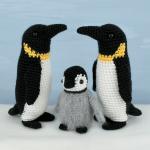 Penguin figurines, penguin calendars, penguin stuffed animals of various sizes, penguin slippers (really), a penguin tissue dispenser, penguin pictures and posters. Not long ago a student stopped by during office hours. About ten minutes into his visit, he observed “I guess you must like penguins.” “What do you mean?” I asked.
Penguins spend a lot of time on the ice, but are sea birds as graceful in the ocean as they are clumsy on land. Penguins have few natural predators on land, but are a favorite meal for any number of water creatures, including leopard seals and sharks. 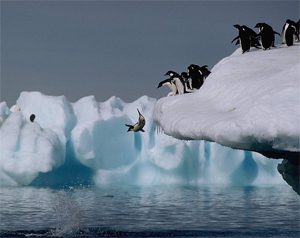 When penguins want to take a swim, they will collectively crowd toward the edge of an ice cliff overhanging the water, pushing and pushing closer to the edge, sort of like a human crowd preparing to board an approaching subway, until one or two penguins fall off the edge into the sea. If these unfortunates do not surface, it is clearly not safe to swim there. If their heads bob above the surface, a virtual waterfall of penguins follows them for a safe swimming and feeding event.
Once a guy from Institutional Advancement dropped by my office. He poked his head in, we exchanged brief pleasantries, and he surveyed my office. “What’s with the penguins?” he asked. “I love penguins,” I replied. “I’ve loved penguins ever since I was a little kid.” Silence for fifteen seconds. “I don’t get it,” he finally admitted. “Dude, if ‘I love penguins’ isn’t good enough for you, I’ve got nothing else,” I replied. Some obsessions (like penguins and wild orchids) do not require supporting argumentation.
My love of penguins is a classic example of what Aristotle means by a “first principle.” Aristotle advocates vigorous dialogue and debate, challenging everyone to support their arguments with reasons. But eventually one hits bedrock, a belief or principle that is foundational and has no deeper explanation. As I might have said, “Dude, if you don’t get my love of penguins, we’ve got nothing else to talk about.”
Emperor Penguin couples spend their lives apart from each other and meet once a year in late March, after traveling as far as 70 miles inland—on foot or sliding on their bellies—to reach the breeding site. Once there, penguins look for their mates by making a bugling call. Male penguins generally stay in one place, lower their head to their chest and call out to the females. Once they find one another, they stand breast to breast, repeatedly bow to each other and bugle penguin songs. Penguins are “serially monogamous.” Each penguin couple is an item for a single breeding season, but if they can’t find each other the next breeding season (and they usually can’t), they will hook up with someone new.
My obsession with penguins goes farther back than I can remember. I had a vast menagerie of stuffed animals as a young child ranging from bears to monkeys, but was most attached to a small penguin that eventually wore out from being carried everywhere, from bedroom to bathroom to dining room, during my waking hours. When asked by various and sundry adults why I liked penguins, I usually said “because they are always well dressed.” And they are.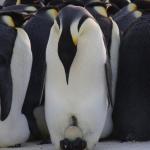
Once the egg is laid, it is transferred by the female Emperor Penguin very carefully to her mate (if the egg touches the ice, it will freeze and die), who then keeps the egg warm by holding it on top of his feet and tucking it under a large fold of skin until it hatches. The female penguin immediately returns to the sea to feed, leaving the male without food for about two months. The male penguins huddle together in large groups to conserve body heat in the cold and harsh environment, where winds can reach up to 120 miles per hour. When the female returns, she finds her mate (and chick) by listening to one particular bugle over thousands of others.
 Jeanne fully understands my penguin obsession. She should, since she has a similar obsession with Holstein cows. Our house is full of Holstein reminders. Our main bathroom has white walls with black Holstein spots and a pink ceiling (in honor of the udders). It’s a good thing we don’t ever plan to move, or some repainting of the bathroom would be in order.
Once many years ago my birthday present from Jeanne was a behind-the-scenes visit to the penguin exhibit at Mystic Aquarium, forty-five minutes south of Providence. Along with a dozen or so other privileged penguin enthusiasts, I found out about the breeding and feeding habits of African penguins in captivity and actually got to touch one.  My colleagues and I sat in a circle in the middle of the floor, and the penguin-meister brought in a two-foot tall penguin, setting her down in the middle of the circle. Her name was “Yellow-Yellow,” after the colors of the two identifying bands on her flipper. I swear that Yellow-Yellow liked me best. She waddled right over to me, ignoring the woman on my left and the kid on my right. Or at least that’s my story and I’m sticking to it.
By now, regular readers of this blog are asking “Okay, what has your penguin obsession taught you about God?” Nothing, as far as I know. “How has your penguin fetish informed your teaching over the years?” Not at all. I’m sure there is something important in the facts that I am obsessed with black and white birds, Jeanne loves black and white bovines, and the official colors of the place I teach are black and white. But maybe not. Don’t tell me you don’t have at least one obsession that you can’t explain other than that you have it. Bottom line, I love penguins because penguins are cool. It’s a first principle.
Previous Post

April 8, 2025
How Facts and Faith Can Work Together
Next Post

April 13, 2025 Palm Sunday and the Tongue of a Teacher
Recent Comments
"Mary did have a choice. And she was able to make it before the Holy ..."
"i cannot read beyond your recommendations for the books since i like to have a ..."
"AI will never be able to utter with honesty, feeling, or humility, the greeting: "Namaste".It ..."
"They do. I'm sure you could find discussions of the same topic from any of ..."
Browse Our Archives
Select a Category abortion Advent AI Angels Artificial intelligence atheism attention baptism Baptists beauty belief Benedictines Bible bicycling Big Bird books Bovina Camaldoli hermitage Canada Catholicism cats certainty change Christianity Christmas Collegeville Covid-19 creativity Development of Western Civilization dogs doubt Easter Enneagram Epiphany Episcopal ethics Eucharist evil extroverts Facebook faith family fear flowers forgiveness freedom friends God goodness grace happiness heaven hell history Holy Spirit Holy Week hope human nature humility humor idolatry incarnation introverts irreverence Islam Jeanne Jesus Joe Biden joy Judaism justice Kamala Harris knowledge Lent listen literature liturgy love Marsue Memorial Day miracles movies music mystery mythology NPR Old Testament optimism paradox peace Penguins philosophy piano podcast politics power prayer Protestantism Providence College Religion Rhode Island sabbatical sacrament science seeing silence Simone Weil Socrates soul sports St. John's College stories suffering tattoo teaching technology television theology thinking time tolerance transcendence travel trees trust truth Uncategorized Vermont wisdom wonder writing
Select a Month May 2026 April 2026 March 2026 February 2026 January 2026 December 2025 November 2025 October 2025 September 2025 August 2025 July 2025 June 2025 May 2025 April 2025 March 2025 February 2025 January 2025 December 2024 November 2024 October 2024 September 2024 August 2024 July 2024 June 2024 May 2024 April 2024 March 2024 February 2024 January 2024 December 2023 November 2023 October 2023 September 2023 August 2023 July 2023 June 2023 May 2023 April 2023 March 2023 February 2023 January 2023 December 2022 November 2022 October 2022 September 2022 August 2022 July 2022 June 2022 May 2022 April 2022 March 2022 February 2022 January 2022 December 2021 November 2021 October 2021 September 2021 August 2021 July 2021 June 2021 May 2021 April 2021 March 2021 February 2021 January 2021 December 2020 November 2020 October 2020 September 2020 August 2020 July 2020 June 2020 May 2020 April 2020 March 2020 February 2020 January 2020 December 2019 November 2019 October 2019 September 2019 August 2019 July 2019 June 2019 May 2019 April 2019 March 2019 February 2019 January 2019 December 2018 November 2018 October 2018 September 2018 August 2018 July 2018 June 2018 May 2018 April 2018 March 2018 February 2018 January 2018 December 2017 November 2017 October 2017 September 2017 August 2017 July 2017 June 2017 May 2017 April 2017 March 2017 February 2017 January 2017 December 2016 November 2016 October 2016 September 2016 August 2016 July 2016 June 2016 May 2016 April 2016 March 2016 February 2016 January 2016 December 2015 November 2015 October 2015 September 2015 August 2015 July 2015 June 2015 May 2015 April 2015 March 2015 February 2015 January 2015 December 2014 November 2014 October 2014 September 2014 August 2014 July 2014 June 2014 May 2014 April 2014 March 2014 February 2014 January 2014 December 2013 November 2013 October 2013 September 2013 August 2013 July 2013 June 2013 May 2013 April 2013 March 2013 February 2013 January 2013 December 2012 November 2012 October 2012 September 2012
Follow Us!
TAKE THE
Religious Wisdom Quiz
Which Christian denomination is known for its General Conference and global missions, and for promoting health practices like vegetarianism?
Select your answer to see how you score.
Methodist Catholic Seventh-day Adventist Baptist
Books by This Author Books by Vance G. Morgan
Related posts from Freelance Christianity

The Lonely Pawn: On Faith, Doubt, and Meaning



TRENDING AT PATHEOS Progressive Christian

What Being a Modern-Day Apostle Means to Me
In my last column, I discussed the ins and outs of modern-day...

Did Ancient China Once Worship the God of...
Across human history, a common thread weaves through the origins of the...

Love Your Neighbor – Including Earth-Kin: Lev. 19,...
God’s command to love your neighbor means acting in an ethical and...

Lead a Church Study of “Jesus and Lao...
Guest writer Jack Thomas (The Irreverent Reverend) reflects on leading his church...

Pastoral Wisdom for Responding to Sermon Pushback
Getting sermon pushback on your social justice sermon? Learn practical, Proverbs-based strategies...

Principles for Understanding the Apostolic Ministry Today
Whenever people discover that my formal ministry title is "apostle," as in...
view all Progressive Christian blogs
What Are Your Thoughts?leave a comment
Ad-Free & Subscriber Log-In Subscription Support
- About Us
- 2026 Calendar
- Videos
- Podcasts
- Library of World Religions
- Faith In Media Tracker
- Advertise With Us
- Write for Us
- Privacy Policy
- Terms of Service
- Do Not Sell My Data
- Contact Us
- Radiant Digital
- Manage Newsletter Subscriptions
- Unsubscribe From Notifications
- Sitemap
Copyright 2008-2026, Patheos. All rights reserved.
Subscription Support Ad-Free & Subscriber Log-In
Follow Patheos