
BuddhistCatholicContemplativeEvangelicalGeneral ChristianHinduJewishLatter-day SaintMuslimNew VisionsProgressive Christian
Beliefs
- Buddhist
- Catholic
- Contemplative
- Evangelical
- General Christian
- Hindu
- Jewish
- Latter-day Saint
- More Voices
- Muslim
- New Visions
- Pagan
- Progressive Christian
Topics
- Religion News
- Food and Religion
- Sports and Religion
- Religious Art
- Religious Music and Entertainment
- Religious Events
- History and Religion
- Style and Religion
- Politics and Religion
- Women in Religion
- Recreation Outdoors and Religion
- Business Finance and Religion
- Careers Workplace and Religion
- Education and Religion
- Family Parenting and Religion
- Health Fitness and Religion
- Home and Religion
- Relationships and Religion
- Technology and Religion
- Travel and Religion
Columnists
- Buddhist Columnists
- Business Finance and Religion Columnists
- Careers Workplace and Religion Columnists
- Catholic Columnists
- Contemplative Columnists
- Education and Religion Columnists
- Evangelists Columnists
- Family Parenting and Religion Columnists
- General Christian Columnists
- Health Fitness and Religion Columnists
- Hindu Columnists
- History and Religion Columnists
- Home and Religion Columnists
- Jewish Columnists
- More Voices Columnists
- Latter Day Columnists
- Muslim Columnists
- New Visions Columnists
- Nonreligious Columnists
- Pagan Columnists
- Politics and Religion Columnists
- Progressive Columnists
- Recreation Outdoors and Religion Columnists
- Relationships and Religion Columnists
- Religion News Columnists
- Religious Art Columnists
- Religious Events Columnists
- Religious Music and Entertainment Columnists
- Sports and Religion Columnists
- Style and Religion Columnists
- Technology and Religion Columnists
- Travel and Religion Columnists
- Women in Religion Columnists
Resource Library
- 2026 Calendar
- Library of World Religions
- The 100 Most Holy Places on Earth
- Patheos Answers
- Podcasts
- Videos
- Faith Leaders Database
- Anglican Episcopalian
- Bahai
- Baptist
- Buddhism
- Christianity
- Confucianism
- Eastern Orthodoxy
- Hinduism
- Holiness and Pentecostal
- ISKCON
- Islam
- Judaism
- Lutheran
- Methodist
- The Church of Jesus Christ of Latter-day Saints
- New Age
- Paganism
- Presbytarian and Reformed
- Protestantism
- Religion Behind the Scenes
- Roman Catholic
- Scientology
- Shia Islam
- Sikhism
- Sufism
- Sunni Islam
- Taoism
- Zen
- See all religions
Research Tools
 Ad-Free & Subscriber Log-In Subscription Support
Ad-Free & Subscriber Log-In Subscription Support
Follow Patheos 

- Trending:
- Forgiveness
- |
- Marriage
- |
- Consciousness
- |
- Death Penalty
- |
- Election
- |
- Halloween

- Home
- Progressive Christian
- Step back, be quiet, and be at peace
Step back, be quiet, and be at peace
Last updated on: April 16, 2021 at 1:26 pm by Vance Morgan
Step back, be quiet, and be at peace 2021-04-16T13:26:23-04:00 Vance Morgan
Patheos Explore the world's faith through different perspectives on religion and spirituality! Patheos has the views of the prevalent religions and spiritualities of the world.
My friend Mitch, who is the priest-in-charge at the Episcopal church I attend, has asked me provide a short reflection this morning as Trinity Episcopal does “virtual church” on Facebook Live for the second consecutive week. Here’s what I’ll say:
In the early days of Christianity, the desert monks had a saying, a divine directive that explained their calling: Fuge, Pace, et Quiesce. Loosely translated: Step back. Be quiet. And be at peace. It strikes me that this is a good directive for us as well. “Fuge” literally means to “flee,” but served as the call for the “social distancing” necessary for the solitary monastic life. “Quiesce” calls for silence and solitude, and “Pace,” peace, is perhaps the fruit of the spirit that is most essential in the brave new world in which we find ourselves. I’d like to talk for a few moments about peace.
My father, a Baptist minister who was a bit of a rock star in his specific niche of Christianity during my youth, frequently closed his final sermon in a week’s series at a Bible conference with Aaron’s blessing from the book of Numbers in the Hebrew scriptures.
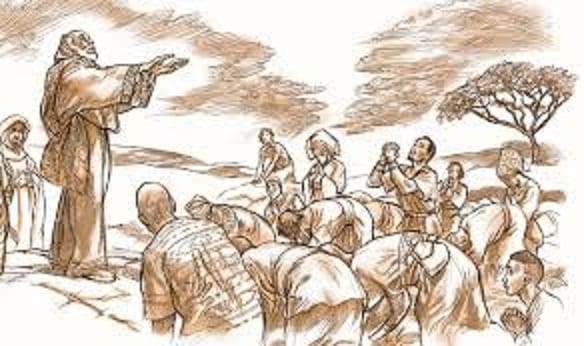
The Lord bless you and keep you.
The Lord make his face to shine upon you, and be gracious unto you.
The Lord lift up his countenance upon you, and give you peace.
My father was one of the least naturally peaceful human beings I have ever met, but his favorite blessings from the Bible all involved the divine invocation of peace—I’ll give you another one at the end of my remarks.
The three synoptic gospels—Matthew, Mark, and Luke—include a story that greatly amused me when I was a child. After a demanding and exhausting day of teaching and healing people, Jesus is crossing the sea of Galilee at night in a boat with his disciples, many of whom were fishermen by trade. A storm blows in; the ship starts taking on water and begins to sink. Jesus is asleep in the rear of the boat with his head on a pillow, oblivious to the danger. The disciples wake him up in a panic: “Master, don’t you care that we perish?” Contemporary translation: “Jesus! Dude! We’re drowning here? What the hell??”
As a child, I imagined the newly awakened and still groggy from sleep Jesus sighing, rolling his eyes, and saying the magic words. “Peace, be still.” Immediately everything is calm and Jesus, slightly annoyed, says to his companions “Oh you of little faith, why are you afraid?” Then, I suspect, he returned to the rear of the boat and falls back to sleep. The disciples, talking among themselves, understandably say “Who is this guy? Even the wind and sea obey him.”
A few days ago, Jeanne and I were listening to Graham Cooke, a minister that she enjoys and introduced me to some time ago, in a Facebook Live event; his topic was peace in times of chaos and trouble. His reflection on the story of Jesus calming the storm included some insights that are directly relevant to the disruption, change, and unpredictability that are currently central to our daily lives. While asleep in the back of the boat, Jesus was providing his companions with the opportunity to practice peace, an invitation to make the presence of God tangible in the midst of chaos.
Every panic-stricken environment is a practice ground for peace. Peace involves a quiet state of mind. Viewing ourselves from a perspective of rest and confidence. Freedom from disturbance. Recognizing and believing that by simply entering a troubled situation you bring divine peace with you. Peace, as Graham Cooke says, can overwhelm an atmosphere of panic. Each of us, as individuals bringing God into the world through our daily lives, can seek out ways to “be peace” in our chaotic world.
For example, every time I teach a class on Zoom, as I look at anywhere from seven to thirty-two faces arranged in a grid on my computer screen, I am reminded that any number of these students may be living lives infected with panic and disturbance. They may be afraid. I can bring peace into their lives, not so much by what I say, but by simply remembering that this is yet another practice ground for me to “be peace” for others—to calm some storms that I may not even be aware of. Just before I enter the virtual classroom, I say aloud the verses from Psalm 131 that, while on sabbatical more than ten years ago, jumped off the page as I read them with dozens of Benedictine monks at noon prayer. They have become a centering mantra for me.
Surely, I have set my soul in silence and in peace. As a weaned child at its mother’s breast, so is my soul.
It even works virtually and at a distance.
The disciples, of course, failed miserably at bringing peace into their storm. They interpreted Jesus’ slumber as indicating that he didn’t care. Instead, after calming the storm, he reminded them that they already had within them what they thought they needed him for. “Why would you doubt, when all you need is a little faith?” he asked. Not faith in something separate from us, but faith in our empowerment to bring divine peace into the world just by being who we are. As Graham Cooke concluded, “That’s Jesus—happy to be with us, happy to give us opportunities to practice, happy to comfort us when we fail and ask us what we learned.” So, let’s practice “being peace” this week, even as we continue to physically distance and secure ourselves at home. Peace is not hindered by time or space.
I close with my father’s other “go to” benediction and blessing, this one from the end of his favorite New Testament book—the book of Hebrews:
Now may the God of peace, who raised from the dead our Lord Jesus, that great Shepherd of the sheep, through the blood of the everlasting covenant, make you perfect in every good work to do His will, working in you what is well-pleasing in His sight.
Remember the desert monks. Step back. Be quiet. And above all, be at peace.
Previous Post

March 26, 2020
Loving Yourself During Coronavirus Seclusion (and Lent)
Next Post

March 31, 2020 Don't Be Afraid to Die
Browse Our Archives
Select a Category abortion Advent AI Angels Artificial intelligence atheism attention baptism Baptists beauty belief Benedictines Bible bicycling Big Bird books Bovina Camaldoli hermitage Canada Catholicism cats certainty change Christianity Christmas Collegeville Covid-19 creativity Development of Western Civilization dogs doubt Easter Enneagram Epiphany Episcopal ethics Eucharist evil extroverts Facebook faith family fear flowers forgiveness freedom friends God goodness grace happiness heaven hell history Holy Spirit Holy Week hope human nature humility humor idolatry incarnation introverts irreverence Islam Jeanne Jesus Joe Biden joy Judaism justice Kamala Harris knowledge Lent listen literature liturgy love Marsue Memorial Day miracles movies music mystery mythology NPR Old Testament optimism paradox peace Penguins philosophy piano podcast politics power prayer Protestantism Providence College Religion Rhode Island sabbatical sacrament science seeing silence Simone Weil Socrates soul sports St. John's College stories suffering tattoo teaching technology television theology thinking time tolerance transcendence travel trees trust truth Uncategorized Vermont wisdom wonder writing
Select a Month May 2026 April 2026 March 2026 February 2026 January 2026 December 2025 November 2025 October 2025 September 2025 August 2025 July 2025 June 2025 May 2025 April 2025 March 2025 February 2025 January 2025 December 2024 November 2024 October 2024 September 2024 August 2024 July 2024 June 2024 May 2024 April 2024 March 2024 February 2024 January 2024 December 2023 November 2023 October 2023 September 2023 August 2023 July 2023 June 2023 May 2023 April 2023 March 2023 February 2023 January 2023 December 2022 November 2022 October 2022 September 2022 August 2022 July 2022 June 2022 May 2022 April 2022 March 2022 February 2022 January 2022 December 2021 November 2021 October 2021 September 2021 August 2021 July 2021 June 2021 May 2021 April 2021 March 2021 February 2021 January 2021 December 2020 November 2020 October 2020 September 2020 August 2020 July 2020 June 2020 May 2020 April 2020 March 2020 February 2020 January 2020 December 2019 November 2019 October 2019 September 2019 August 2019 July 2019 June 2019 May 2019 April 2019 March 2019 February 2019 January 2019 December 2018 November 2018 October 2018 September 2018 August 2018 July 2018 June 2018 May 2018 April 2018 March 2018 February 2018 January 2018 December 2017 November 2017 October 2017 September 2017 August 2017 July 2017 June 2017 May 2017 April 2017 March 2017 February 2017 January 2017 December 2016 November 2016 October 2016 September 2016 August 2016 July 2016 June 2016 May 2016 April 2016 March 2016 February 2016 January 2016 December 2015 November 2015 October 2015 September 2015 August 2015 July 2015 June 2015 May 2015 April 2015 March 2015 February 2015 January 2015 December 2014 November 2014 October 2014 September 2014 August 2014 July 2014 June 2014 May 2014 April 2014 March 2014 February 2014 January 2014 December 2013 November 2013 October 2013 September 2013 August 2013 July 2013 June 2013 May 2013 April 2013 March 2013 February 2013 January 2013 December 2012 November 2012 October 2012 September 2012
Follow Us!
TAKE THE
Religious Wisdom Quiz
Which Christian denomination is known for its General Conference and global missions, and for promoting health practices like vegetarianism?
Select your answer to see how you score.
Methodist Catholic Seventh-day Adventist Baptist
Books by This Author Books by Vance G. Morgan
Related posts from Freelance Christianity

The Lonely Pawn: On Faith, Doubt, and Meaning


AI and Love: When a Chatbot Becomes a...

TRENDING AT PATHEOS Progressive Christian

What Being a Modern-Day Apostle Means to Me
In my last column, I discussed the ins and outs of modern-day...

Did Ancient China Once Worship the God of...
Across human history, a common thread weaves through the origins of the...

Love Your Neighbor – Including Earth-Kin: Lev. 19,...
God’s command to love your neighbor means acting in an ethical and...

Lead a Church Study of “Jesus and Lao...
Guest writer Jack Thomas (The Irreverent Reverend) reflects on leading his church...

Pastoral Wisdom for Responding to Sermon Pushback
Getting sermon pushback on your social justice sermon? Learn practical, Proverbs-based strategies...

Principles for Understanding the Apostolic Ministry Today
Whenever people discover that my formal ministry title is "apostle," as in...
view all Progressive Christian blogs
Ad-Free & Subscriber Log-In Subscription Support
- About Us
- 2026 Calendar
- Videos
- Podcasts
- Library of World Religions
- Faith In Media Tracker
- Advertise With Us
- Write for Us
- Privacy Policy
- Terms of Service
- Do Not Sell My Data
- Contact Us
- Radiant Digital
- Manage Newsletter Subscriptions
- Unsubscribe From Notifications
- Sitemap
Copyright 2008-2026, Patheos. All rights reserved.
Subscription Support Ad-Free & Subscriber Log-In
Follow Patheos