
BuddhistCatholicContemplativeEvangelicalGeneral ChristianHinduJewishLatter-day SaintMuslimNew VisionsProgressive Christian
Beliefs
- Buddhist
- Catholic
- Contemplative
- Evangelical
- General Christian
- Hindu
- Jewish
- Latter-day Saint
- More Voices
- Muslim
- New Visions
- Pagan
- Progressive Christian
Topics
- Religion News
- Food and Religion
- Sports and Religion
- Religious Art
- Religious Music and Entertainment
- Religious Events
- History and Religion
- Style and Religion
- Politics and Religion
- Women in Religion
- Recreation Outdoors and Religion
- Business Finance and Religion
- Careers Workplace and Religion
- Education and Religion
- Family Parenting and Religion
- Health Fitness and Religion
- Home and Religion
- Relationships and Religion
- Technology and Religion
- Travel and Religion
Columnists
- Buddhist Columnists
- Business Finance and Religion Columnists
- Careers Workplace and Religion Columnists
- Catholic Columnists
- Contemplative Columnists
- Education and Religion Columnists
- Evangelists Columnists
- Family Parenting and Religion Columnists
- General Christian Columnists
- Health Fitness and Religion Columnists
- Hindu Columnists
- History and Religion Columnists
- Home and Religion Columnists
- Jewish Columnists
- More Voices Columnists
- Latter Day Columnists
- Muslim Columnists
- New Visions Columnists
- Nonreligious Columnists
- Pagan Columnists
- Politics and Religion Columnists
- Progressive Columnists
- Recreation Outdoors and Religion Columnists
- Relationships and Religion Columnists
- Religion News Columnists
- Religious Art Columnists
- Religious Events Columnists
- Religious Music and Entertainment Columnists
- Sports and Religion Columnists
- Style and Religion Columnists
- Technology and Religion Columnists
- Travel and Religion Columnists
- Women in Religion Columnists
Resource Library
- 2026 Calendar
- Library of World Religions
- The 100 Most Holy Places on Earth
- Patheos Answers
- Podcasts
- Videos
- Faith Leaders Database
- Anglican Episcopalian
- Bahai
- Baptist
- Buddhism
- Christianity
- Confucianism
- Eastern Orthodoxy
- Hinduism
- Holiness and Pentecostal
- ISKCON
- Islam
- Judaism
- Lutheran
- Methodist
- The Church of Jesus Christ of Latter-day Saints
- New Age
- Paganism
- Presbytarian and Reformed
- Protestantism
- Religion Behind the Scenes
- Roman Catholic
- Scientology
- Shia Islam
- Sikhism
- Sufism
- Sunni Islam
- Taoism
- Zen
- See all religions
Research Tools
 Ad-Free & Subscriber Log-In Subscription Support
Ad-Free & Subscriber Log-In Subscription Support
Follow Patheos 

- Trending:
- Forgiveness
- |
- Marriage
- |
- Consciousness
- |
- Death Penalty
- |
- Election
- |
- Halloween

- Home
- Progressive Christian
- Spending Time with my Favorite Disciple and my Favorite Philosopher
Spending Time with my Favorite Disciple and my Favorite Philosopher
Last updated on: April 16, 2023 at 6:00 am by Vance Morgan
Spending Time with my Favorite Disciple and my Favorite Philosopher 2023-04-07T12:39:09-04:00 Vance Morgan
Patheos Explore the world's faith through different perspectives on religion and spirituality! Patheos has the views of the prevalent religions and spiritualities of the world.
The opposite of faith is not doubt, but certainty Anne Lamott
As is our custom, Jeanne and I watched Franco Zefferelli’s classic “Jesus of Nazareth”–all six hours of it–during the recently ended Holy Week. Jesus’ disciple Thomas, the focus of today’s gospel reading, is presented as the servant of Jairus, the wealthy man whose daughter Jesus raises from the dead. Since he is the one who sent word to Jairus that his daughter has died, Thomas takes great umbrage when Jesus, upon arrival at Jairus’ house, says that the little girl is “only sleeping,” but then is thoroughly nonplussed when, a few minutes later, Jesus carries the obviously alive little girl out of the bedroom in which she had died a short time earlier. With Jairus’ permission Thomas, clearly both blown away and confused by what just happens, becomes one of Jesus’ followers
In the first season of “The Chosen,” Thomas is one of the caterers behind the scene at the wedding at Cana. He is clearly a no-nonsense numbers sort of guy, and is increasingly concerned when many more people show up at the wedding than were invited (largely because it is rumored that Jesus will attend). The wine runs out just as the celebration is at its height, setting the stage for Jesus’ first big time miracle–making several vats of water into the best wine anyone has ever tasted.
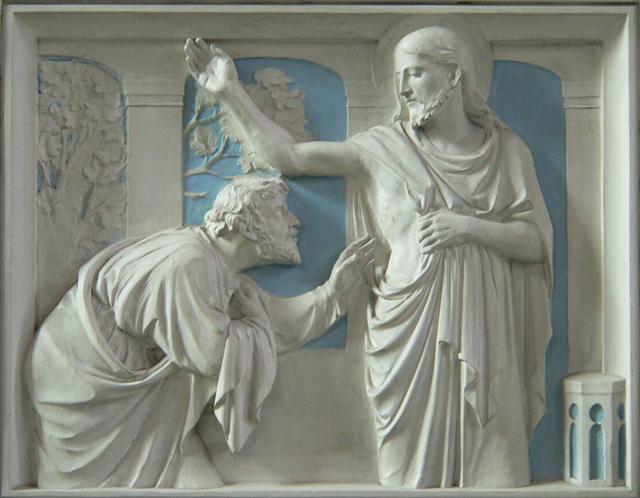
In the lectionary, the Second Sunday of Easter is “Doubting Thomas Sunday,” our annual reminder that Thomas was absent when the risen Jesus appeared to his fellow disciples for the first time. Thomas refused to believe their story. I was taught in my youth that Thomas was a loser because he would not believe reports of Jesus’ resurrection until he had seen and handled the man himself. But over the years, Thomas has become one of my spiritual heroes, and doubt (along with irreverence) has become my favorite virtue. Here’s why.
Consider another of history’s great skeptics and doubters. A couple of years ago, I taught an Honors colloquium on the work of Michel de Montaigne, a “dream” course that I had wanted to teach for many years. Despite the coronavirus pushing this colloquium, as well as my other classes, onto Zoom for the second half of the spring semester, I thoroughly enjoyed a deep dive into Montaigne’s essays with seven gifted and motivated honors students.
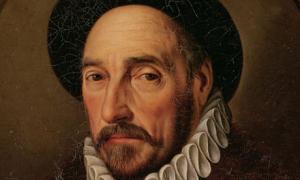 Montaigne’s world was filled with religious fervor and piety. It was also filled with hatred and violence. Sixteenth-century France was not a pretty place—in the aftermath of the Protestant Reformation, Christians were killing each other with regularity and abandon, all in the name of Christ. Catholics and Protestants each were certain that they were right; energized by such certainty, each was willing to kill the other in the name of truth and right belief.
Michel was an upper-class landowner and occasional politician—he was mayor of Bordeaux for two terms as well as a trusted diplomat and liaison. Sensitive and melancholy by nature, Montaigne was appalled by the violence that was tearing his country, his town, his neighborhood, even his own family apart. Accordingly, in his middle years he did what any introverted, sensitive, melancholy guy would have done. He withdrew to his turret library in the small castle on his family estate and wrote—for the rest of his life.
The result, Montaigne’s Essais, consists of fascinating and brilliant bite-sized essays on every topic imaginable, from cannibals and sexual preferences to Michel’s favorite food, his kidney stones, and his cat. And in the midst of this loosely organized jumble of creativity and insight, Michel frequently sounds like Rodney King in the midst of the Los Angeles riots so many years ago—“Can’t we all just get along?”
Montaigne writes that “there is no hostility so extreme as that of the Christian. Our zeal works marvels when it seconds our inclination toward hatred, cruelty, ambition, greed, slander, and rebellion.” This was the world in which he lived. Michel’s antidote? Let’s stop claiming to be certain about what we believe and try some healthy doubt and skepticism on for size. Certainty is vastly overrated and is frequently dangerous, especially when claimed in matters that are far beyond the reach of human capacities. Montaigne is convinced that for the most part, human beings are not designed for the rarified air of certainty. He directly challenges those who “claim to know the frontiers and bounds of the will of God,” observing that “there is nothing in the whole world madder than bringing matters down to the measure of our own capacities.”
Is there anything more ludicrous, Montaigne asks, than our propensity to believe most firmly about matters of which we know least, and to be most sure of ourselves when we are farthest from what we can verify? Human beings claiming certainty about the will and nature of God would be humorous, and Michel often presents it that way, were it not that such claims are often the basis for the worse of what human beings are capable of, including prejudice, violence, and killing. Even as we seek preposterously to elevate ourselves to the level of the divine, Montaigne reminds us that we remain rooted in our humanity. “There is no use our mounting on stilts, for on stilts we must still walk on our own legs. And on the loftiest throne in the world we are still sitting only on our own ass.”
Because of his willingness to embrace messiness and uncertainty as part of the human experience, because of his willingness to call chaos what it is and not something else, Montaigne is one of my heroes. And so is the star of today’s gospel—Thomas. “Doubting Thomas,” as he almost always is described, occupies a unique place in the line-up of disciples. Thomas was always brought to our attention in Sunday School as someone not to be like; indeed, Jesus’ put down of Thomas after Thomas finally believes—“Blessed are those who have not seen and yet have come to believe”—provides us two thousand years later with something to be proud of. We, not having seen, are the blessed ones while Thomas (the loser) gets in by the skin of his teeth.
But there is another way to read this account, a way in which Thomas turns out not to be a spiritual weakling, but rather to be a model of how to approach the spiritual life. Movie and miniseries treatments notwithstanding, we don’t know much about Thomas apart from this story. He is included in the list of disciples in the first three gospels, but John is the only gospel in which Thomas makes an actual appearance. He’s not one of the inner circle, but he occasionally makes appropriate comments and asks good questions.
In John 20, John’s account of the resurrection and its aftermath, we find the disciples, minus Thomas, hiding in a room with the doors locked “for fear of the Jews.” Peter and John have already seen the empty tomb, but there is an atmosphere of confusion, uncertainty and fear in the room. Jesus appears to them, and all uncertainty vanishes. But Thomas was not there.
Where was he? Perhaps he wasn’t as afraid as the other disciples and was out and about on that first day of the week, as were the women who first saw the empty tomb. Perhaps he was on a food run for the rest of the disciples who were too frightened to emerge from their safe house. But he misses the big event. When the other disciples report that “we have seen the Lord,” Thomas’ response places him forever in the disciples’ hall of shame: “Unless I see the mark of the nails in his hands, and put my finger in the mark of the nails and my hand in his side, I will not believe.”
Fair enough, I say. Remember that the other disciples apparently did not believe until Jesus appeared to them. Next Sunday’s gospel tells us that the disciples on the road to Emmaus did not recognize that Jesus was with them until he emerged from the pages of prophecies from the Jewish scriptures that he was pontificating about and broke bread with them. Why should Thomas not be cut the same slack? Embedded in the middle of this misunderstood story is a fundamental truth: A true encounter with the divine is never second-hand. Hearing about someone else’s experiences, trying to find God through the haze of various religious and doctrinal filters, is not a replacement for the real thing.
Doubt and uncertainty are central threads in the human fabric; both play a fundamental role in belief. Unfounded claims of certainty undermine this. Don’t believe on the cheap. Better to remain uncertain and in doubt one’s whole life, doggedly tracking what glimmers of light one sees, than to settle for a cheap knock-off or a counterfeit. As Annie Dillard writes, “Doubt and dedication often go hand in hand.” Thomas’s—and Michel’s—insight is captured well by the remainder of the passage from Anne Lamott with which I began this post:
The opposite of faith is not doubt, but certainty. Certainty is missing the point entirely. Faith includes noticing the mess, the emptiness and discomfort, and letting it be there until some light returns.
Thomas was right. We should save “My Lord and my God” for the real thing.
Previous Post

April 13, 2023
Jesus, Death, and Taxes
Next Post

April 17, 2023 Drops Upon the Heart
Recent Comments
"Mary did have a choice. And she was able to make it before the Holy ..."
"i cannot read beyond your recommendations for the books since i like to have a ..."
"AI will never be able to utter with honesty, feeling, or humility, the greeting: "Namaste".It ..."
"They do. I'm sure you could find discussions of the same topic from any of ..."
Browse Our Archives
Select a Category abortion Advent AI Angels Artificial intelligence atheism attention baptism Baptists beauty belief Benedictines Bible bicycling Big Bird books Bovina Camaldoli hermitage Canada Catholicism cats certainty change Christianity Christmas Collegeville Covid-19 creativity Development of Western Civilization dogs doubt Easter Enneagram Epiphany Episcopal ethics Eucharist evil extroverts Facebook faith family fear flowers forgiveness freedom friends God goodness grace happiness heaven hell history Holy Spirit Holy Week hope human nature humility humor idolatry incarnation introverts irreverence Islam Jeanne Jesus Joe Biden joy Judaism justice Kamala Harris knowledge Lent listen literature liturgy love Marsue Memorial Day miracles movies music mystery mythology NPR Old Testament optimism paradox peace Penguins philosophy piano podcast politics power prayer Protestantism Providence College Religion Rhode Island sabbatical sacrament science seeing silence Simone Weil Socrates soul sports St. John's College stories suffering tattoo teaching technology television theology thinking time tolerance transcendence travel trees trust truth Uncategorized Vermont wisdom wonder writing
Select a Month May 2026 April 2026 March 2026 February 2026 January 2026 December 2025 November 2025 October 2025 September 2025 August 2025 July 2025 June 2025 May 2025 April 2025 March 2025 February 2025 January 2025 December 2024 November 2024 October 2024 September 2024 August 2024 July 2024 June 2024 May 2024 April 2024 March 2024 February 2024 January 2024 December 2023 November 2023 October 2023 September 2023 August 2023 July 2023 June 2023 May 2023 April 2023 March 2023 February 2023 January 2023 December 2022 November 2022 October 2022 September 2022 August 2022 July 2022 June 2022 May 2022 April 2022 March 2022 February 2022 January 2022 December 2021 November 2021 October 2021 September 2021 August 2021 July 2021 June 2021 May 2021 April 2021 March 2021 February 2021 January 2021 December 2020 November 2020 October 2020 September 2020 August 2020 July 2020 June 2020 May 2020 April 2020 March 2020 February 2020 January 2020 December 2019 November 2019 October 2019 September 2019 August 2019 July 2019 June 2019 May 2019 April 2019 March 2019 February 2019 January 2019 December 2018 November 2018 October 2018 September 2018 August 2018 July 2018 June 2018 May 2018 April 2018 March 2018 February 2018 January 2018 December 2017 November 2017 October 2017 September 2017 August 2017 July 2017 June 2017 May 2017 April 2017 March 2017 February 2017 January 2017 December 2016 November 2016 October 2016 September 2016 August 2016 July 2016 June 2016 May 2016 April 2016 March 2016 February 2016 January 2016 December 2015 November 2015 October 2015 September 2015 August 2015 July 2015 June 2015 May 2015 April 2015 March 2015 February 2015 January 2015 December 2014 November 2014 October 2014 September 2014 August 2014 July 2014 June 2014 May 2014 April 2014 March 2014 February 2014 January 2014 December 2013 November 2013 October 2013 September 2013 August 2013 July 2013 June 2013 May 2013 April 2013 March 2013 February 2013 January 2013 December 2012 November 2012 October 2012 September 2012
Follow Us!
TAKE THE
Religious Wisdom Quiz
True or False: The Year of Jubilee occurred every fifty years.
Select your answer to see how you score.
TRUE FALSE
Books by This Author Books by Vance G. Morgan
Related posts from Freelance Christianity

The Lonely Pawn: On Faith, Doubt, and Meaning



AI and Love: When a Chatbot Becomes a...
TRENDING AT PATHEOS Progressive Christian

What Being a Modern-Day Apostle Means to Me
In my last column, I discussed the ins and outs of modern-day...

Did Ancient China Once Worship the God of...
Across human history, a common thread weaves through the origins of the...

Love Your Neighbor – Including Earth-Kin: Lev. 19,...
God’s command to love your neighbor means acting in an ethical and...

Lead a Church Study of “Jesus and Lao...
Guest writer Jack Thomas (The Irreverent Reverend) reflects on leading his church...

Pastoral Wisdom for Responding to Sermon Pushback
Getting sermon pushback on your social justice sermon? Learn practical, Proverbs-based strategies...

Principles for Understanding the Apostolic Ministry Today
Whenever people discover that my formal ministry title is "apostle," as in...
view all Progressive Christian blogs
What Are Your Thoughts?leave a comment
Ad-Free & Subscriber Log-In Subscription Support
- About Us
- 2026 Calendar
- Videos
- Podcasts
- Library of World Religions
- Faith In Media Tracker
- Advertise With Us
- Write for Us
- Privacy Policy
- Terms of Service
- Do Not Sell My Data
- Contact Us
- Radiant Digital
- Manage Newsletter Subscriptions
- Unsubscribe From Notifications
- Sitemap
Copyright 2008-2026, Patheos. All rights reserved.
Subscription Support Ad-Free & Subscriber Log-In
Follow Patheos