
BuddhistCatholicContemplativeEvangelicalGeneral ChristianHinduJewishLatter-day SaintMuslimNew VisionsProgressive Christian
Beliefs
- Buddhist
- Catholic
- Contemplative
- Evangelical
- General Christian
- Hindu
- Jewish
- Latter-day Saint
- More Voices
- Muslim
- New Visions
- Pagan
- Progressive Christian
Topics
- Religion News
- Food and Religion
- Sports and Religion
- Religious Art
- Religious Music and Entertainment
- Religious Events
- History and Religion
- Style and Religion
- Politics and Religion
- Women in Religion
- Recreation Outdoors and Religion
- Business Finance and Religion
- Careers Workplace and Religion
- Education and Religion
- Family Parenting and Religion
- Health Fitness and Religion
- Home and Religion
- Relationships and Religion
- Technology and Religion
- Travel and Religion
Columnists
- Buddhist Columnists
- Business Finance and Religion Columnists
- Careers Workplace and Religion Columnists
- Catholic Columnists
- Contemplative Columnists
- Education and Religion Columnists
- Evangelists Columnists
- Family Parenting and Religion Columnists
- General Christian Columnists
- Health Fitness and Religion Columnists
- Hindu Columnists
- History and Religion Columnists
- Home and Religion Columnists
- Jewish Columnists
- More Voices Columnists
- Latter Day Columnists
- Muslim Columnists
- New Visions Columnists
- Nonreligious Columnists
- Pagan Columnists
- Politics and Religion Columnists
- Progressive Columnists
- Recreation Outdoors and Religion Columnists
- Relationships and Religion Columnists
- Religion News Columnists
- Religious Art Columnists
- Religious Events Columnists
- Religious Music and Entertainment Columnists
- Sports and Religion Columnists
- Style and Religion Columnists
- Technology and Religion Columnists
- Travel and Religion Columnists
- Women in Religion Columnists
Resource Library
- 2026 Calendar
- Library of World Religions
- The 100 Most Holy Places on Earth
- Patheos Answers
- Podcasts
- Videos
- Faith Leaders Database
- Anglican Episcopalian
- Bahai
- Baptist
- Buddhism
- Christianity
- Confucianism
- Eastern Orthodoxy
- Hinduism
- Holiness and Pentecostal
- ISKCON
- Islam
- Judaism
- Lutheran
- Methodist
- The Church of Jesus Christ of Latter-day Saints
- New Age
- Paganism
- Presbytarian and Reformed
- Protestantism
- Religion Behind the Scenes
- Roman Catholic
- Scientology
- Shia Islam
- Sikhism
- Sufism
- Sunni Islam
- Taoism
- Zen
- See all religions
Research Tools
 Ad-Free & Subscriber Log-In Subscription Support
Ad-Free & Subscriber Log-In Subscription Support
Follow Patheos 

- Trending:
- Forgiveness
- |
- Marriage
- |
- Consciousness
- |
- Death Penalty
- |
- Election
- |
- Halloween

- Home
- Progressive Christian
- “You are the Man”: Speaking Truth to Power
“You are the Man”: Speaking Truth to Power
Last updated on: January 29, 2019 at 8:45 am by Vance Morgan
“You are the Man”: Speaking Truth to Power 2019-01-29T08:45:03-04:00 Vance Morgan
Patheos Explore the world's faith through different perspectives on religion and spirituality! Patheos has the views of the prevalent religions and spiritualities of the world.
Not long ago, my wife Jeanne decided to audit a graduate theology course on campus taught by a good friend who is an emeritus professor of theology. The course was “The Prophetic Faith,” described as a study of “the prophetic writings of Ancient Israel, examining both their original message and their relevance for contemporary readers.” After looking over the syllabus, I thought it would be fun to sit in on this class as well. I’m glad I did, at least for a few sessions–it immersed me in texts that, in many cases, I had not encountered for decades.
As I started reading the assigned pages for the first class, I was reminded of the role that prophets played during the relatively brief period during which Israel had kings. Prophets not only anointed kings, they also often were the only persons who spoke truth to power, the moral compass who told the king when he was in danger of violating, or already had violated, the moral demands of God’s law. The most famous king of Israel, of course, was David. 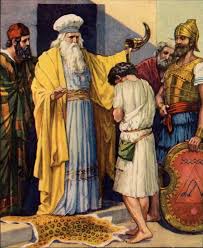 David was anointed king by the prophet Samuel after Saul, the first king of Israel, ran afoul of God’s commandments one too many times.
By the time David secured his throne after more than a decade of warfare, Samuel had died and a new prophet, Nathan, stepped into Samuel’s role. A well-known story from Second Samuel illustrates how one of the prophet’s most important roles was to speak truth to power—especially when that truth was something the king did not want anyone to know.
The sordid tale of David and Bathsheba is one of the most familiar stories from the Jewish scriptures. David is at the height of his power and, as many who find themselves in such a position, is of the opinion that this entitles him to anything that he wants. Including the beautiful wife of one of his top generals. When Bathsheba becomes pregnant due to their affair, David’s attempts to cover it up quickly escalate, culminating in the death of her husband, Uriah, when David has him placed on the front lines of battle where he is sure to be killed. After a suitable period of mourning, David marries Bathsheba (she joins his group of several wives) and all seems quiet on the home front.
Then one day Nathan tells David a story, a time-worn tale of the rich exploiting the poor.  A rich man, who had everything—including more sheep than he could count—had a unexpected visitor for whom he wanted to host a memorable dinner. Down the road lived a poor man with only one little sheep who was more of a pet than anything else. Any animal lover will resonate with this passage: “The ewe lamb grew up together with him and with his children. It ate of his own food and drank from his own cup and lay in his bosom; and it was like a daughter to him.” The rich man, wanting to serve mutton at the banquet for his guest, instead of selecting an appropriate sheep from his substantial flock, took the poor man’s only lamb and served it to his guest for dinner. The bastard.
Not surprisingly, David’s sense of justice and fairness is scandalized by Nathan’s story. “WTF!!!” David yelled. “As the LORD lives, the man who has done this shall surely die! And he shall restore fourfold for the lamb, because he did this thing and because he had no pity.” And in four of the most effective words ever spoken to power, Nathan springs his trap: You are the man! Because, of course, David is the rich man in the story, Uriah is the poor man, and Bathsheba is the poor man’s only ewe lamb.
The kingdom is not taken from David, but David pays a price for the rest of his life. The child Bathsheba is bearing dies, and over time three of David’s sons from different mothers seek to take the throne from David and die in their unsuccessful attempts. There is no peace in David’s house for the rest of his life, although his second child with Bathsheba—Solomon—follows him as king upon David’s death. But most important is David’s reaction when he finds out the true meaning of Nathan’s story. David is crushed, realizes that he has violated and ignored any number of moral principles, and he repents—accepting God’s judgment as communicated through Nathan and as borne out over the following years.
There are any number of contemporary applications of Nathan’s story, including how the one percent regularly succeed at the expense of the ninety-nine percent, as well as proposed budgets that favor the rich among us at the expense of the poor. The story Nathan tells David came to mind the other day when, during the partial government shutdown, Commerce Secretary Wilbur Ross wondered why out-of-work federal employees might need governmental assistance and food pantries just to eat. But today I am thinking of another obvious application. As I have watched the constant shit show surrounding the Trump presidency over his first two years in office, I have occasionally (when I was not screaming at the television) wondered “What does this guy need? What could possibly set this on the right, or at least a less dysfunctional, path?”
As I read one of my favorite stories from the Jewish scriptures for the first time in many years, it was crystal clear to me what Trump needs. He needs an Old Testament prophet in his life. He needs a Nathan. He needs someone who will, when necessary, tell him the unvarnished truth. Tell him when he’s not thinking clearly. Take his phone away so he can’t tweet anymore. Tell him when he’s being a jerk. Tell him that being elected President does not entitle him to do or say anything he wants. Tell him that a person is not a loser just because that person disagrees with him.
This, of course, is old news Any number of people have cycled through the White House who could have played this role–some even have tried to play the role–only to be ignored, then belittled, then shown the door. The President has shown himself on a daily basis to be immune to or incapable of even the most rudimentary moral checks and balances. This does not, however, mean that the moral of Nathan’s story does not apply to our contemporary world. As we begin to consider a better alternative in the White House than its current occupant, we should regularly ask: Does this candidate for the most powerful office in the world show any interest in listening to and being influenced by truth? Does she or he have the capacity to receive the truth and adjust going forward?
In ancient Israel, the prophet served, among other things, as a reminder to the king that there is a lot more going on than just our day-to-day human reality. No one is the center of the universe, not even the most powerful person. All of us are answerable to standards and principles that we neither invented nor are immune to. There are things greater than any individual. David knew this; hence, he repented in the wake of Nathan’s story. Our current President does not know this. There seems to be no other touchstone of authority in his life than himself. And this is not only sad, it is dangerous. As things continue to devolve over the coming weeks and months, as they inexorably will, Trump will continue to look for any number of persons to blame as he circles down the drain. Perhaps, hopefully, circumstances and reality will make the truth clear even to him: You are the man.
Previous Post

January 26, 2019
When it Comes to Prayer, Stop Talking and Start Relating
Next Post

January 30, 2019 Sacred Spaces and Dunkin Donuts
Browse Our Archives
Select a Category abortion Advent AI Angels Artificial intelligence atheism attention baptism Baptists beauty belief Benedictines Bible bicycling Big Bird books Bovina Camaldoli hermitage Canada Catholicism cats certainty change Christianity Christmas Collegeville Covid-19 creativity Development of Western Civilization dogs doubt Easter Enneagram Epiphany Episcopal ethics Eucharist evil extroverts Facebook faith family fear flowers forgiveness freedom friends God goodness grace happiness heaven hell history Holy Spirit Holy Week hope human nature humility humor idolatry incarnation introverts irreverence Islam Jeanne Jesus Joe Biden joy Judaism justice Kamala Harris knowledge Lent listen literature liturgy love Marsue Memorial Day miracles movies music mystery mythology NPR Old Testament optimism paradox peace Penguins philosophy piano podcast politics power prayer Protestantism Providence College Religion Rhode Island sabbatical sacrament science seeing silence Simone Weil Socrates soul sports St. John's College stories suffering tattoo teaching technology television theology thinking time tolerance transcendence travel trees trust truth Uncategorized Vermont wisdom wonder writing
Select a Month May 2026 April 2026 March 2026 February 2026 January 2026 December 2025 November 2025 October 2025 September 2025 August 2025 July 2025 June 2025 May 2025 April 2025 March 2025 February 2025 January 2025 December 2024 November 2024 October 2024 September 2024 August 2024 July 2024 June 2024 May 2024 April 2024 March 2024 February 2024 January 2024 December 2023 November 2023 October 2023 September 2023 August 2023 July 2023 June 2023 May 2023 April 2023 March 2023 February 2023 January 2023 December 2022 November 2022 October 2022 September 2022 August 2022 July 2022 June 2022 May 2022 April 2022 March 2022 February 2022 January 2022 December 2021 November 2021 October 2021 September 2021 August 2021 July 2021 June 2021 May 2021 April 2021 March 2021 February 2021 January 2021 December 2020 November 2020 October 2020 September 2020 August 2020 July 2020 June 2020 May 2020 April 2020 March 2020 February 2020 January 2020 December 2019 November 2019 October 2019 September 2019 August 2019 July 2019 June 2019 May 2019 April 2019 March 2019 February 2019 January 2019 December 2018 November 2018 October 2018 September 2018 August 2018 July 2018 June 2018 May 2018 April 2018 March 2018 February 2018 January 2018 December 2017 November 2017 October 2017 September 2017 August 2017 July 2017 June 2017 May 2017 April 2017 March 2017 February 2017 January 2017 December 2016 November 2016 October 2016 September 2016 August 2016 July 2016 June 2016 May 2016 April 2016 March 2016 February 2016 January 2016 December 2015 November 2015 October 2015 September 2015 August 2015 July 2015 June 2015 May 2015 April 2015 March 2015 February 2015 January 2015 December 2014 November 2014 October 2014 September 2014 August 2014 July 2014 June 2014 May 2014 April 2014 March 2014 February 2014 January 2014 December 2013 November 2013 October 2013 September 2013 August 2013 July 2013 June 2013 May 2013 April 2013 March 2013 February 2013 January 2013 December 2012 November 2012 October 2012 September 2012
Follow Us!
TAKE THE
Religious Wisdom Quiz
Why was Daniel thrown into the lion’s den?
Select your answer to see how you score.
He prayed to God He stole from the treasury He spoke against the king He refused to bow to the king
Books by This Author Books by Vance G. Morgan
Related posts from Freelance Christianity

The Lonely Pawn: On Faith, Doubt, and Meaning


AI and Love: When a Chatbot Becomes a...

TRENDING AT PATHEOS Progressive Christian

What Being a Modern-Day Apostle Means to Me
In my last column, I discussed the ins and outs of modern-day...

Did Ancient China Once Worship the God of...
Across human history, a common thread weaves through the origins of the...

Love Your Neighbor – Including Earth-Kin: Lev. 19,...
God’s command to love your neighbor means acting in an ethical and...

Lead a Church Study of “Jesus and Lao...
Guest writer Jack Thomas (The Irreverent Reverend) reflects on leading his church...

Pastoral Wisdom for Responding to Sermon Pushback
Getting sermon pushback on your social justice sermon? Learn practical, Proverbs-based strategies...

Principles for Understanding the Apostolic Ministry Today
Whenever people discover that my formal ministry title is "apostle," as in...
view all Progressive Christian blogs
Ad-Free & Subscriber Log-In Subscription Support
- About Us
- 2026 Calendar
- Videos
- Podcasts
- Library of World Religions
- Faith In Media Tracker
- Advertise With Us
- Write for Us
- Privacy Policy
- Terms of Service
- Do Not Sell My Data
- Contact Us
- Radiant Digital
- Manage Newsletter Subscriptions
- Unsubscribe From Notifications
- Sitemap
Copyright 2008-2026, Patheos. All rights reserved.
Subscription Support Ad-Free & Subscriber Log-In
Follow Patheos