
BuddhistCatholicContemplativeEvangelicalGeneral ChristianHinduJewishLatter-day SaintMuslimNew VisionsProgressive Christian
Beliefs
- Buddhist
- Catholic
- Contemplative
- Evangelical
- General Christian
- Hindu
- Jewish
- Latter-day Saint
- More Voices
- Muslim
- New Visions
- Pagan
- Progressive Christian
Topics
- Religion News
- Food and Religion
- Sports and Religion
- Religious Art
- Religious Music and Entertainment
- Religious Events
- History and Religion
- Style and Religion
- Politics and Religion
- Women in Religion
- Recreation Outdoors and Religion
- Business Finance and Religion
- Careers Workplace and Religion
- Education and Religion
- Family Parenting and Religion
- Health Fitness and Religion
- Home and Religion
- Relationships and Religion
- Technology and Religion
- Travel and Religion
Columnists
- Buddhist Columnists
- Business Finance and Religion Columnists
- Careers Workplace and Religion Columnists
- Catholic Columnists
- Contemplative Columnists
- Education and Religion Columnists
- Evangelists Columnists
- Family Parenting and Religion Columnists
- General Christian Columnists
- Health Fitness and Religion Columnists
- Hindu Columnists
- History and Religion Columnists
- Home and Religion Columnists
- Jewish Columnists
- More Voices Columnists
- Latter Day Columnists
- Muslim Columnists
- New Visions Columnists
- Nonreligious Columnists
- Pagan Columnists
- Politics and Religion Columnists
- Progressive Columnists
- Recreation Outdoors and Religion Columnists
- Relationships and Religion Columnists
- Religion News Columnists
- Religious Art Columnists
- Religious Events Columnists
- Religious Music and Entertainment Columnists
- Sports and Religion Columnists
- Style and Religion Columnists
- Technology and Religion Columnists
- Travel and Religion Columnists
- Women in Religion Columnists
Resource Library
- 2026 Calendar
- Library of World Religions
- The 100 Most Holy Places on Earth
- Patheos Answers
- Podcasts
- Videos
- Faith Leaders Database
- Anglican Episcopalian
- Bahai
- Baptist
- Buddhism
- Christianity
- Confucianism
- Eastern Orthodoxy
- Hinduism
- Holiness and Pentecostal
- ISKCON
- Islam
- Judaism
- Lutheran
- Methodist
- The Church of Jesus Christ of Latter-day Saints
- New Age
- Paganism
- Presbytarian and Reformed
- Protestantism
- Religion Behind the Scenes
- Roman Catholic
- Scientology
- Shia Islam
- Sikhism
- Sufism
- Sunni Islam
- Taoism
- Zen
- See all religions
Research Tools
 Ad-Free & Subscriber Log-In Subscription Support
Ad-Free & Subscriber Log-In Subscription Support
Follow Patheos 

- Trending:
- Forgiveness
- |
- Marriage
- |
- Consciousness
- |
- Death Penalty
- |
- Election
- |
- Halloween

- Home
- Progressive Christian
- Sometimes, it just doesn’t matter
Sometimes, it just doesn’t matter
Last updated on: September 26, 2021 at 9:53 am by Vance Morgan
Sometimes, it just doesn’t matter 2021-09-26T09:53:49-04:00 Vance Morgan
Patheos Explore the world's faith through different perspectives on religion and spirituality! Patheos has the views of the prevalent religions and spiritualities of the world.
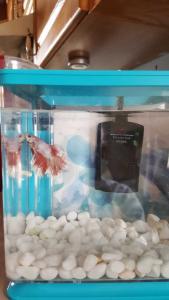 One day, Jeanne said “I want a fish.” This was a rather random request, but Jeanne very seldom asks for anything, so within a few days we went to the pet store and purchased a Betta fish. Jeanne named him “Ezekiel” (more randomness), and he lived on the counter between our kitchen and dining room for well over a year.
Google “Care of Betta fish” and you’ll get all sorts of conflicting advice concerning how often and what to feed your fish, how often to change the water, the proper temperature of said water, and more. The water must be distilled, for instance, but can’t be pristine—the fish needs a certain amount of self-generated bacteria to swim in. But when the water is so cloudy that you can hardly find the fish because of the floating food remnants and fish poop, chances are it needs to be changed. So, one morning Ezekiel was transferred to temporary quarters in a large wine glass while his more permanent home was rinsed thoroughly and filled with distilled water, to which Ezekiel was returned once it was warmed to the proper temperature. I’m sure it was a traumatic morning for him all around, but sometimes drastic measures are called for.
Providing Ezekiel with a cleaner and healthier habitat can serve as a metaphor for what human beings need periodically. All of us occasionally need help moving from unhealthy circumstances into a better and fresher atmosphere of promise and hope. Over the years, for instance, I have sought to provide assistance to any number of colleagues who, for reasons more numerous than can be easily summarized, found themselves stuck in a messy situation created by perceived slights, neglect, betrayal, and misunderstanding. There was little agreement about exactly how their atmosphere got so polluted, but there is always a general consensus that little to none of it is their fault and that it is someone else’s responsibility to get them out of a predicament that they both hate and have become accustomed to.
How does one escape being stuck in an unhealthy situation with no end in sight, particularly when the person(s) who you believe responsible for the situation either deny that they are responsible or seem uninterested in helping craft a way forward? I’ve found a few helpful suggestions in Marilynne Robinson’s Gilead.
Gilead is a love letter from Rev. John Ames, a Congregational minister in the rural Iowa town of Gilead who is in his late seventies, to his eight year old son, a letter in which Ames seeks to pass on some of what he has learned to his son before he dies. Ames’ wife Lila, who is decades younger than Ames, wandered into his church when he was in his sixties, a beautiful but damaged soul to whom Ames was inexplicably but immediately attracted. They married soon after; Lila and their son are the joys of Ames’ life.
Lila is a woman of few words; those she uses have a meaning far beyond what lies on the surface. She frequently responds to possible slights and neglect by simply saying “It don’t matter.”
“It don’t matter.” That was what she said when she forgave someone, but it had a sound of deeper, sadder resignation, as if she were forgiving the whole of the created order, forgiving the Lord Himself.
From a lifetime of pain and sadness Lila has learned that she can move forward, not by pretending that the pain is not real, nor by pretending that devastating loss and crippling neglect are imaginary, but by invoking the power of forgiveness. This is a lesson that Reverend Ames takes to heart.
Ames is a model of goodness—simple, pure, and a light to all in his small community. Yet because he is human, he struggles with all sorts of matters, especially Jack, the prodigal son of Ames’ best friend. Jack has been a source of pain and frustration to everyone throughout his life, leaving unfinished business and broken hearts in his wake. Now in his early forties, Jack has returned to Gilead after many years away and, as always, is disrupting Ames’ life as well as the lives of those Ames loves the most. As a dedicated pastor, committed Christian, and all-around fine person, Ames knows he should love Jack, tries mightily to do so—and fails.
Ames faults Jack for the harm he has done to his father, for his apparent disregard for everything Ames considers to be important, and particularly because Lila and his son form a close friendship with Jack. Everything Jack does annoys Ames; Jack’s presence regularly reminds Ames of the age gap between him and his wife, as well as of harm Jack caused years ago, things that Ames has never forgiven him for. Ames tries to manufacture this forgiveness throughout the story, but it is not until the end of the novel that a breakthrough happens.
Ames bumps into Jack in town and learns that Jack is leaving the area, probably for good, without telling his family. Ames agrees to tell Jack’s father goodbye for him, but then says “the thing I would like, actually, is to bless you.” He lays his hands on Jack’s head, and recites the Aaronic blessing from Leviticus:
The Lord bless you and keep you. The Lord make His face to shine upon you and be gracious unto you: The Lord lift up His countenance upon you, and give you peace.
Jack gets on the bus, and we do not learn–in this novel, at least–whether Ames’ blessing has any effect on him. But it is clear that in Ames the cycle of judgment and unforgiveness has been broken. As Lila might have said, Ames in that moment of blessing decides that, with regard to his past with Jack, “it don’t matter.” Each of us has the power to bless as well as to judge—blessing transforms the murky and dirty water of an unforgiven past into something clear and clean.
Previous Post

September 23, 2021
What if God exists, but isn't very nice?
Next Post
September 28, 2021 Moral Certainty Is Both Overrated and Dangerous
Browse Our Archives
Select a Category abortion Advent AI Angels Artificial intelligence atheism attention baptism Baptists beauty belief Benedictines Bible bicycling Big Bird books Bovina Camaldoli hermitage Canada Catholicism cats certainty change Christianity Christmas Collegeville Covid-19 creativity Development of Western Civilization dogs doubt Easter Enneagram Epiphany Episcopal ethics Eucharist evil extroverts Facebook faith family fear flowers forgiveness freedom friends God goodness grace happiness heaven hell history Holy Spirit Holy Week hope human nature humility humor idolatry incarnation introverts irreverence Islam Jeanne Jesus Joe Biden joy Judaism justice Kamala Harris knowledge Lent listen literature liturgy love Marsue Memorial Day miracles movies music mystery mythology NPR Old Testament optimism paradox peace Penguins philosophy piano podcast politics power prayer Protestantism Providence College Religion Rhode Island sabbatical sacrament science seeing silence Simone Weil Socrates soul sports St. John's College stories suffering tattoo teaching technology television theology thinking time tolerance transcendence travel trees trust truth Uncategorized Vermont wisdom wonder writing
Select a Month May 2026 April 2026 March 2026 February 2026 January 2026 December 2025 November 2025 October 2025 September 2025 August 2025 July 2025 June 2025 May 2025 April 2025 March 2025 February 2025 January 2025 December 2024 November 2024 October 2024 September 2024 August 2024 July 2024 June 2024 May 2024 April 2024 March 2024 February 2024 January 2024 December 2023 November 2023 October 2023 September 2023 August 2023 July 2023 June 2023 May 2023 April 2023 March 2023 February 2023 January 2023 December 2022 November 2022 October 2022 September 2022 August 2022 July 2022 June 2022 May 2022 April 2022 March 2022 February 2022 January 2022 December 2021 November 2021 October 2021 September 2021 August 2021 July 2021 June 2021 May 2021 April 2021 March 2021 February 2021 January 2021 December 2020 November 2020 October 2020 September 2020 August 2020 July 2020 June 2020 May 2020 April 2020 March 2020 February 2020 January 2020 December 2019 November 2019 October 2019 September 2019 August 2019 July 2019 June 2019 May 2019 April 2019 March 2019 February 2019 January 2019 December 2018 November 2018 October 2018 September 2018 August 2018 July 2018 June 2018 May 2018 April 2018 March 2018 February 2018 January 2018 December 2017 November 2017 October 2017 September 2017 August 2017 July 2017 June 2017 May 2017 April 2017 March 2017 February 2017 January 2017 December 2016 November 2016 October 2016 September 2016 August 2016 July 2016 June 2016 May 2016 April 2016 March 2016 February 2016 January 2016 December 2015 November 2015 October 2015 September 2015 August 2015 July 2015 June 2015 May 2015 April 2015 March 2015 February 2015 January 2015 December 2014 November 2014 October 2014 September 2014 August 2014 July 2014 June 2014 May 2014 April 2014 March 2014 February 2014 January 2014 December 2013 November 2013 October 2013 September 2013 August 2013 July 2013 June 2013 May 2013 April 2013 March 2013 February 2013 January 2013 December 2012 November 2012 October 2012 September 2012
Follow Us!
TAKE THE
Religious Wisdom Quiz
In Philippians, what does Paul say he has learned in any and every situation?
Select your answer to see how you score.
To pray without ceasing To give thanks To be content To trust God
Books by This Author Books by Vance G. Morgan
Related posts from Freelance Christianity

The Lonely Pawn: On Faith, Doubt, and Meaning


AI and Love: When a Chatbot Becomes a...

TRENDING AT PATHEOS Progressive Christian

What Being a Modern-Day Apostle Means to Me
In my last column, I discussed the ins and outs of modern-day...

Did Ancient China Once Worship the God of...
Across human history, a common thread weaves through the origins of the...

Love Your Neighbor – Including Earth-Kin: Lev. 19,...
God’s command to love your neighbor means acting in an ethical and...

Lead a Church Study of “Jesus and Lao...
Guest writer Jack Thomas (The Irreverent Reverend) reflects on leading his church...

Pastoral Wisdom for Responding to Sermon Pushback
Getting sermon pushback on your social justice sermon? Learn practical, Proverbs-based strategies...

Principles for Understanding the Apostolic Ministry Today
Whenever people discover that my formal ministry title is "apostle," as in...
view all Progressive Christian blogs
Ad-Free & Subscriber Log-In Subscription Support
- About Us
- 2026 Calendar
- Videos
- Podcasts
- Library of World Religions
- Faith In Media Tracker
- Advertise With Us
- Write for Us
- Privacy Policy
- Terms of Service
- Do Not Sell My Data
- Contact Us
- Radiant Digital
- Manage Newsletter Subscriptions
- Unsubscribe From Notifications
- Sitemap
Copyright 2008-2026, Patheos. All rights reserved.
Subscription Support Ad-Free & Subscriber Log-In
Follow Patheos