
BuddhistCatholicContemplativeEvangelicalGeneral ChristianHinduJewishLatter-day SaintMuslimNew VisionsProgressive Christian
Beliefs
- Buddhist
- Catholic
- Contemplative
- Evangelical
- General Christian
- Hindu
- Jewish
- Latter-day Saint
- More Voices
- Muslim
- New Visions
- Pagan
- Progressive Christian
Topics
- Religion News
- Food and Religion
- Sports and Religion
- Religious Art
- Religious Music and Entertainment
- Religious Events
- History and Religion
- Style and Religion
- Politics and Religion
- Women in Religion
- Recreation Outdoors and Religion
- Business Finance and Religion
- Careers Workplace and Religion
- Education and Religion
- Family Parenting and Religion
- Health Fitness and Religion
- Home and Religion
- Relationships and Religion
- Technology and Religion
- Travel and Religion
Columnists
- Buddhist Columnists
- Business Finance and Religion Columnists
- Careers Workplace and Religion Columnists
- Catholic Columnists
- Contemplative Columnists
- Education and Religion Columnists
- Evangelists Columnists
- Family Parenting and Religion Columnists
- General Christian Columnists
- Health Fitness and Religion Columnists
- Hindu Columnists
- History and Religion Columnists
- Home and Religion Columnists
- Jewish Columnists
- More Voices Columnists
- Latter Day Columnists
- Muslim Columnists
- New Visions Columnists
- Nonreligious Columnists
- Pagan Columnists
- Politics and Religion Columnists
- Progressive Columnists
- Recreation Outdoors and Religion Columnists
- Relationships and Religion Columnists
- Religion News Columnists
- Religious Art Columnists
- Religious Events Columnists
- Religious Music and Entertainment Columnists
- Sports and Religion Columnists
- Style and Religion Columnists
- Technology and Religion Columnists
- Travel and Religion Columnists
- Women in Religion Columnists
Resource Library
- 2026 Calendar
- Library of World Religions
- The 100 Most Holy Places on Earth
- Patheos Answers
- Podcasts
- Videos
- Faith Leaders Database
- Anglican Episcopalian
- Bahai
- Baptist
- Buddhism
- Christianity
- Confucianism
- Eastern Orthodoxy
- Hinduism
- Holiness and Pentecostal
- ISKCON
- Islam
- Judaism
- Lutheran
- Methodist
- The Church of Jesus Christ of Latter-day Saints
- New Age
- Paganism
- Presbytarian and Reformed
- Protestantism
- Religion Behind the Scenes
- Roman Catholic
- Scientology
- Shia Islam
- Sikhism
- Sufism
- Sunni Islam
- Taoism
- Zen
- See all religions
Research Tools
 Ad-Free & Subscriber Log-In Subscription Support
Ad-Free & Subscriber Log-In Subscription Support
Follow Patheos 

- Trending:
- Forgiveness
- |
- Marriage
- |
- Consciousness
- |
- Death Penalty
- |
- Election
- |
- Halloween

- Home
- Progressive Christian
- Returning to the Basics
Returning to the Basics
Last updated on: March 14, 2021 at 7:00 am by Vance Morgan
Returning to the Basics 2021-03-10T14:04:04-04:00 Vance Morgan
Patheos Explore the world's faith through different perspectives on religion and spirituality! Patheos has the views of the prevalent religions and spiritualities of the world.
Today’s lectionary texts take us back to the basics. Sports fans old enough to remember the 70s and 80s will recall that a regular occurrence at baseball or football games either in person or on television was, when the camera panned the stands, to see a person—often wearing a colorful fright wig—holding up a large homemade poster board sign with a cryptic reference that made sense only for initiates: John 3:16.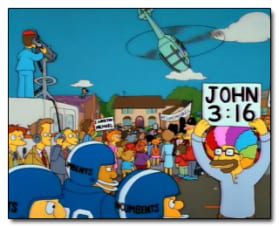
I often imagined the confusion that many might have felt at this ubiquitous, almost subliminal communication, especially in a pre-Google world. John 3:16? What does that mean? But for those in the know, it was no mystery, for John 3:16 is the address of perhaps the most familiar of all Bible verses, one of the verses in today’s gospel reading from John 3, the first one (followed by hundreds more) that I learned as a young Baptist boy.
For God so loved the world, that He gave His only begotten Son, that whosoever believeth in Him should not perish but have everlasting life.
In our fundamentalist, evangelical world, the whole gospel was summed up in this verse, often followed by its less quoted companion John 3:17:
For God sent not His Son into the world to condemn the world, but that the world through Him might be saved.
It really does have it all—a God of salvation rather than condemnation, of love rather than judgment, the incarnation, and—most important in the religious world of my youth—the promise of eternal life, which we interpreted as going to heaven and avoiding hell. It really is the gospel in a nutshell. Really. I remember a crafts event during summer Bible camp when we inserted the text of John 3:16 in tiny print rolled up like a paper towel inside the two halves of a walnut shell which we then glued together with the end of the John 3:16 roll sticking out of a convenient slot. When completed, the text could be rolled out and admired, then snapped back in like a window shade.
Typically, but unfortunately, the textual context of this gospel in a nutshell was usually ignored (as, unfortunately, it is in today’s lectionary reading). John’s gospel is strange and (for me, least) somewhat off-putting. It was written last of the four gospels, at least twenty years later than Matthew and Luke, perhaps thirty years later than Mark. The Jesus of John often sounds more like a theology professor than the no-nonsense man of few words and mighty deeds in Mark’s gospel. In John chapter 3, Jesus is visited secretly at night by Nicodemus, setting up one of the strangest conversations you’ll ever hear.
Nicodemus, described by John as “a ruler of the Jews,” was a Pharisee and a member of the Sanhedrin—a significant player in the religious and political structure that Jesus was clearly challenging. For me Nicodemus will always be the bearded and aging Sir Laurence Olivier as he played the role in Franco Zeffirelli’s Jesus of Nazareth. Nicodemus undoubtedly comes by night because he does not want his colleagues to know of his fascination with Jesus.
Nicodemus gives Jesus an opening which Jesus enters by saying cryptically “Except a man be born again, he cannot see the kingdom of God.” We Baptists took this to mean that “unless you accept Jesus into your heart as your personal savior, you don’t get to go to heaven” (although Jesus doesn’t say this), but the “eternal life” business isn’t what catches Nicodemus’ attention.
Taking the “born again” line literally, he wants to know “How can a man be born when he is old? Can he enter the second time into his mother’s womb and be born”? Debates were raging in Jesus’ world between the Pharisees and the Sadducees about whether resurrection of the dead is possible–Nicodemus, familiar with those debates, thinks Jesus is taking a position. But he’s not. He’s talking about something else entirely.
As the conversation continues, Jesus reminds Nicodemus–in the first verse of today’s selection from John’s gospel–of the strange story from the history of the children of Israel wandering in the desert in today’s reading from Numbers in the Jewish Scriptures. In response to yet another round of blatant disobedience, God sends poisonous snakes into the midst of the children of Israel; many of those bitten by the venomous serpents die. In response to the people’s recognition of their rebellion and their penitence, God instructs Moses to make a serpent of bronze and lift it up on a pole for everyone to see. “And so it was, if a serpent had bitten anyone, when he looked at the bronze serpent, he lived.”
Applying the story to himself thousands of years later, Jesus tells Nicodemus that “as Moses lifted up the serpent in the wilderness, even so must the Son of Man be lifted up.” Which sheds a whole new light on the gospel in a nutshell passage just two verses later. Jesus is not talking about crawling back into your mother’s womb, nor is he talking about going to heaven when you die. He’s talking about the importance of what we choose to look at. Jesus is telling Nicodemus, and is telling us, that the possibility of transformation and renewal is right in front of us—but our attention is usually focused elsewhere.
It’s interesting to note that John 3:16 does not require us to do anything but believe. No deeds need to be performed, no special words need to be said, no special prayers need to be offered, no sins need to be confessed. Just believe. I spent many years trying to figure out what I needed to do in order to earn God’s favor—I suspect I’m not the only one who has tried to figure this out. As it turns out, belief is about focusing my attention on the right thing. Not on my shortcomings and failings, nor on my strengths and what I think I have to offer that God might be able to use.
Jesus’ message to Nicodemus is “don’t act—LOOK.” In our consumer society we want solutions that we can make our own, that we can add to our list of useful things we have consumed. But Simone Weil writes that “To look and to eat are two different things. The only people who have any hope of salvation are those who occasionally stop and look for a time, instead of eating. Looking is what saves us.” The gospel in a nutshell.
Nicodemus’ conversation with Jesus clearly had an impact; we see him two more times in John’s narrative, once when he reminds his brethren in the Sanhedrin that the law requires that a person be heard before being judged, the second time when he assists Joseph of Arimathea in preparing Jesus’ body for burial after the crucifixion. He did not drop everything he was doing and start following Jesus, but he did begin to see things differently.
We would do well to wonder the same things that Nicodemus must have wondered about. Where do I usually focus my attention? What would it mean to shift my gaze toward something different? What would it mean to stop looking at the shortcomings, failures and sins in my own life and the lives of those around me? What would it be like to stop staring a few inches in front of me as I sleepwalk through my days and weeks and look up? What difference would it make if I looked at the promise of life rather than the inevitability of death? The bronze serpent lifted in the wilderness. The Son of Man hanging on a cross. Both are iconic images of God’s love and forgiveness, promising that new life can be ours now, that the kingdom of God is available now, and eternal life begins now. All we need to do is look.
Previous Post

March 13, 2021
I Like Time Changes! So sue me.
Next Post

March 16, 2021 Tomorrow is St. Patrick's Day. Big Deal.
Browse Our Archives
Select a Category abortion Advent AI Angels Artificial intelligence atheism attention baptism Baptists beauty belief Benedictines Bible bicycling Big Bird books Bovina Camaldoli hermitage Canada Catholicism cats certainty change Christianity Christmas Collegeville Covid-19 creativity Development of Western Civilization dogs doubt Easter Enneagram Epiphany Episcopal ethics Eucharist evil extroverts Facebook faith family fear flowers forgiveness freedom friends God goodness grace happiness heaven hell history Holy Spirit Holy Week hope human nature humility humor idolatry incarnation introverts irreverence Islam Jeanne Jesus Joe Biden joy Judaism justice Kamala Harris knowledge Lent listen literature liturgy love Marsue Memorial Day miracles movies music mystery mythology NPR Old Testament optimism paradox peace Penguins philosophy piano podcast politics power prayer Protestantism Providence College Religion Rhode Island sabbatical sacrament science seeing silence Simone Weil Socrates soul sports St. John's College stories suffering tattoo teaching technology television theology thinking time tolerance transcendence travel trees trust truth Uncategorized Vermont wisdom wonder writing
Select a Month May 2026 April 2026 March 2026 February 2026 January 2026 December 2025 November 2025 October 2025 September 2025 August 2025 July 2025 June 2025 May 2025 April 2025 March 2025 February 2025 January 2025 December 2024 November 2024 October 2024 September 2024 August 2024 July 2024 June 2024 May 2024 April 2024 March 2024 February 2024 January 2024 December 2023 November 2023 October 2023 September 2023 August 2023 July 2023 June 2023 May 2023 April 2023 March 2023 February 2023 January 2023 December 2022 November 2022 October 2022 September 2022 August 2022 July 2022 June 2022 May 2022 April 2022 March 2022 February 2022 January 2022 December 2021 November 2021 October 2021 September 2021 August 2021 July 2021 June 2021 May 2021 April 2021 March 2021 February 2021 January 2021 December 2020 November 2020 October 2020 September 2020 August 2020 July 2020 June 2020 May 2020 April 2020 March 2020 February 2020 January 2020 December 2019 November 2019 October 2019 September 2019 August 2019 July 2019 June 2019 May 2019 April 2019 March 2019 February 2019 January 2019 December 2018 November 2018 October 2018 September 2018 August 2018 July 2018 June 2018 May 2018 April 2018 March 2018 February 2018 January 2018 December 2017 November 2017 October 2017 September 2017 August 2017 July 2017 June 2017 May 2017 April 2017 March 2017 February 2017 January 2017 December 2016 November 2016 October 2016 September 2016 August 2016 July 2016 June 2016 May 2016 April 2016 March 2016 February 2016 January 2016 December 2015 November 2015 October 2015 September 2015 August 2015 July 2015 June 2015 May 2015 April 2015 March 2015 February 2015 January 2015 December 2014 November 2014 October 2014 September 2014 August 2014 July 2014 June 2014 May 2014 April 2014 March 2014 February 2014 January 2014 December 2013 November 2013 October 2013 September 2013 August 2013 July 2013 June 2013 May 2013 April 2013 March 2013 February 2013 January 2013 December 2012 November 2012 October 2012 September 2012
Follow Us!
TAKE THE
Religious Wisdom Quiz
What does God question Job about, showing His wisdom in creation?
Select your answer to see how you score.
Religious rituals Battles Animals and nature Kingdoms
Books by This Author Books by Vance G. Morgan
Related posts from Freelance Christianity

The Lonely Pawn: On Faith, Doubt, and Meaning


AI and Love: When a Chatbot Becomes a...

TRENDING AT PATHEOS Progressive Christian

What Being a Modern-Day Apostle Means to Me
In my last column, I discussed the ins and outs of modern-day...

Did Ancient China Once Worship the God of...
Across human history, a common thread weaves through the origins of the...

Love Your Neighbor – Including Earth-Kin: Lev. 19,...
God’s command to love your neighbor means acting in an ethical and...

Lead a Church Study of “Jesus and Lao...
Guest writer Jack Thomas (The Irreverent Reverend) reflects on leading his church...

Pastoral Wisdom for Responding to Sermon Pushback
Getting sermon pushback on your social justice sermon? Learn practical, Proverbs-based strategies...

Principles for Understanding the Apostolic Ministry Today
Whenever people discover that my formal ministry title is "apostle," as in...
view all Progressive Christian blogs
Ad-Free & Subscriber Log-In Subscription Support
- About Us
- 2026 Calendar
- Videos
- Podcasts
- Library of World Religions
- Faith In Media Tracker
- Advertise With Us
- Write for Us
- Privacy Policy
- Terms of Service
- Do Not Sell My Data
- Contact Us
- Radiant Digital
- Manage Newsletter Subscriptions
- Unsubscribe From Notifications
- Sitemap
Copyright 2008-2026, Patheos. All rights reserved.
Subscription Support Ad-Free & Subscriber Log-In
Follow Patheos