
BuddhistCatholicContemplativeEvangelicalGeneral ChristianHinduJewishLatter-day SaintMuslimNew VisionsProgressive Christian
Beliefs
- Buddhist
- Catholic
- Contemplative
- Evangelical
- General Christian
- Hindu
- Jewish
- Latter-day Saint
- More Voices
- Muslim
- New Visions
- Pagan
- Progressive Christian
Topics
- Religion News
- Food and Religion
- Sports and Religion
- Religious Art
- Religious Music and Entertainment
- Religious Events
- History and Religion
- Style and Religion
- Politics and Religion
- Women in Religion
- Recreation Outdoors and Religion
- Business Finance and Religion
- Careers Workplace and Religion
- Education and Religion
- Family Parenting and Religion
- Health Fitness and Religion
- Home and Religion
- Relationships and Religion
- Technology and Religion
- Travel and Religion
Columnists
- Buddhist Columnists
- Business Finance and Religion Columnists
- Careers Workplace and Religion Columnists
- Catholic Columnists
- Contemplative Columnists
- Education and Religion Columnists
- Evangelists Columnists
- Family Parenting and Religion Columnists
- General Christian Columnists
- Health Fitness and Religion Columnists
- Hindu Columnists
- History and Religion Columnists
- Home and Religion Columnists
- Jewish Columnists
- More Voices Columnists
- Latter Day Columnists
- Muslim Columnists
- New Visions Columnists
- Nonreligious Columnists
- Pagan Columnists
- Politics and Religion Columnists
- Progressive Columnists
- Recreation Outdoors and Religion Columnists
- Relationships and Religion Columnists
- Religion News Columnists
- Religious Art Columnists
- Religious Events Columnists
- Religious Music and Entertainment Columnists
- Sports and Religion Columnists
- Style and Religion Columnists
- Technology and Religion Columnists
- Travel and Religion Columnists
- Women in Religion Columnists
Resource Library
- 2026 Calendar
- Library of World Religions
- The 100 Most Holy Places on Earth
- Patheos Answers
- Podcasts
- Videos
- Faith Leaders Database
- Anglican Episcopalian
- Bahai
- Baptist
- Buddhism
- Christianity
- Confucianism
- Eastern Orthodoxy
- Hinduism
- Holiness and Pentecostal
- ISKCON
- Islam
- Judaism
- Lutheran
- Methodist
- The Church of Jesus Christ of Latter-day Saints
- New Age
- Paganism
- Presbytarian and Reformed
- Protestantism
- Religion Behind the Scenes
- Roman Catholic
- Scientology
- Shia Islam
- Sikhism
- Sufism
- Sunni Islam
- Taoism
- Zen
- See all religions
Research Tools
 Ad-Free & Subscriber Log-In Subscription Support
Ad-Free & Subscriber Log-In Subscription Support
Follow Patheos 

- Trending:
- Forgiveness
- |
- Marriage
- |
- Consciousness
- |
- Death Penalty
- |
- Election
- |
- Halloween

- Home
- Progressive Christian
- Religionless Christianity
Religionless Christianity
Last updated on: January 6, 2017 at 7:30 am by Vance Morgan
Religionless Christianity 2017-01-06T07:30:34-04:00 Vance Morgan
Patheos Explore the world's faith through different perspectives on religion and spirituality! Patheos has the views of the prevalent religions and spiritualities of the world.
Now that the New Year is upon us, I’m anxiously awaiting word that my latest book, written during my 2015-16 sabbatical and under contract since last May, has successfully made it through the editing process at my publisher (it’s supposed to be coming my way for final revisions this month or next). It’s like waiting for a kid to be born.
W orking on this book project during sabbatical put me back into direct conversation with a writer who over the past fifteen or so years has been as influential on my thinking and overall development as any other—Iris Murdoch.In preparation for the book I thought I was going to write during my previous sabbatical in spring 2009, I read all of her twenty-plus novels and her most important philosophical essays; over the past three months I have been reviewing well over a hundred pages of single-spaced notes I took as I wandered through her extensive body of work. Iris came into my life when I discovered that
  Simone Weil—a thinker so influential on my intellectual and spiritual development that Jeanne calls her my “mistress”—was similarly influential for Iris Murdoch. In her last completed work (she died in 1999 after several years of descent into the hell of Alzheimer’s), Murdoch asks a question that is arguably the central issue explored in both her fiction and her philosophical work—“What can we do now that there is no God?”
Writing in the decades after the Second World War, Murdoch assumes that human beings are required to grapple with a difficult world lacking the tools provided by traditional Christianity (or any other traditional religious framework). Yet she is by no means a happy atheist along the lines of Richard Dawkins, Sam Harris or Daniel Dennett. Murdoch believes that the traditional conception of the divine, along with the various frameworks that have traditionally surrounded that conception, is meaningless, yet points out that while it is easy to say that there is no God, it is not so easy to believe it and to draw the consequences. Human beings are not the sorts of creatures that can simply fill the vacuum created by the absence of God with the closest thing available. We are incapable, by sheer force of will, of addressing the spiritual hunger and need that now-defunct frameworks and vocabularies were intended to address. There is something in the human heart that needs to believe in something greater than ourselves.
The search for the transcendent, for what is greater than ourselves, in Murdoch’s hands becomes a high-wire act with no safety net. She sets for herself the task of finding out what can be preserved of belief in the transcendent and in moral goodness without the trappings of religion that have supported such beliefs—a “Religionless Christianity” if you will. She preserves the notion of faith, but without guarantees—persons with such faith intuit something greater than themselves but refuse to embrace traditional descriptions of this something. Murdoch calls such a person a “mystical hero”: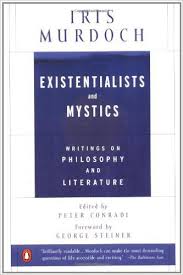
The man who has given up traditional religion but is still haunted by a sense of the reality and unity of some sort of spiritual world. . . . This hero is the new version of the man of faith, believing in goodness without religious guarantees, guilty, muddled, yet not without hope. This image consoles by showing us man as frail, godless, and yet possessed of genuine intuitions of an authoritative good.
Such a person, Murdoch believes, will exhibit many of the characteristics that traditionally religious people might aspire to.
Our life is an interconnected whole and a religious man would feel responsible for the quality of all his thoughts and experiences . . . This sort of–perpetual work–seems to me what religion is . . . It’s humility, and unselfishness–and setting yourself aside to make room for other things, and people.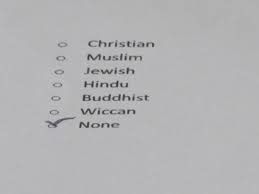
I thought of Murdoch’s mystical hero not long ago when reading an article describing how more and more of the students enrolled at various divinity schools across the country are unaffiliated with any religious denomination. Such students are called “nones” (pronounced “nuns”), since they are the sorts of people who check “None” when asked about their religious affiliation on a survey.
Secular Students Turn to Divinity School
I think this is very cool, but something tells me that many people would stop reading after finding out early in the article that nones are predominantly found at places inclined toward theologically and politically liberal Protestantism like Harvard Divinity School and Chicago Theological Seminary. “Well of course,” the complaint might go. “Such places are bastions of secular humanism with words like ‘Divinity’ or ‘Theological’ on their letterhead for show.” Such concerns are not unique to the Protestant flavor of Christianity; 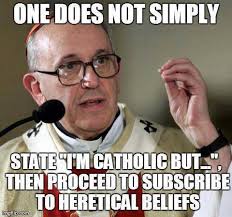 I have taught for the past twenty-one years at a Catholic college that, at least according to its current President, seeks to thread the needle between extreme conservative Catholic campuses and larger Catholic Universities (usually Jesuit) that many judge as CINO (Catholic in name only).
The game of “who is more faithful to the message” is usually zero sum, though, and leaves little room for phenomena such as the nones. What might an agnostic or even an atheist find attractive about divinity school? Several of the nones interviewed in the article provide clear answers. “I am attracted to the search for social justice and for spiritual meaning. And I recognize those things as the fruits of religious tradition,” one none said. “So it makes sense to go to a place where you can study religious tradition.” Another could have been channeling Iris Murdoch: “If you were simply looking for the skills, you might go to the Kennedy School of Government . . . and philosophy and liberal-arts fields have given up on the project of finding a moral language, an articulation of values. That language isn’t found in many places. And when you find it, it’s not easy to abstract it. You have to connect it to a tradition.” I am currently leading a discussion group at church using a text about knowing God written with millennials in mind; current research shows that one-third of millennials are nones. Where are such persons to find a spiritual home or community? If Iris Murdoch is right, the answer to that question will require great creativity and courage across the board, even in traditional places where such creative and courageous challenges to the status quo seem to strike at the very heart of what the place stands for.
I am not a none, but only because I believe that the Christian tradition is broad and resilient enough to accommodate outliers with the nerve to call themselves freelance Christians. And a “heads up” to the nones who are deliberately placing themselves in the atmosphere of divinity school—you never can tell what might happen. Meister Eckhart, a medieval Dominican monk who almost lost his life due to his out of the box theology, wrote that “God begets his Son in you whether you like it or not, whether you sleep or wake—still God is at work.” And more recently, Lutheran pastor Nadia Bolz-Weber reported that a person wrote her a worried email:
I think I’m having a crisis of faith . . . I think I believe in Jesus.
 To which Nadia replied:
I’m so sorry. But sometimes Jesus just hunts your ass down and there’s nothing you can do about it.
Previous Post

January 4, 2017
The Sun and the Other Stars
Next Post
January 11, 2017 Holy Family Values
Browse Our Archives
Select a Category abortion Advent AI Angels Artificial intelligence atheism attention baptism Baptists beauty belief Benedictines Bible bicycling Big Bird books Bovina Camaldoli hermitage Canada Catholicism cats certainty change Christianity Christmas Collegeville Covid-19 creativity Development of Western Civilization dogs doubt Easter Enneagram Epiphany Episcopal ethics Eucharist evil extroverts Facebook faith family fear flowers forgiveness freedom friends God goodness grace happiness heaven hell history Holy Spirit Holy Week hope human nature humility humor idolatry incarnation introverts irreverence Islam Jeanne Jesus Joe Biden joy Judaism justice Kamala Harris knowledge Lent listen literature liturgy love Marsue Memorial Day miracles movies music mystery mythology NPR Old Testament optimism paradox peace Penguins philosophy piano podcast politics power prayer Protestantism Providence College Religion Rhode Island sabbatical sacrament science seeing silence Simone Weil Socrates soul sports St. John's College stories suffering tattoo teaching technology television theology thinking time tolerance transcendence travel trees trust truth Uncategorized Vermont wisdom wonder writing
Select a Month May 2026 April 2026 March 2026 February 2026 January 2026 December 2025 November 2025 October 2025 September 2025 August 2025 July 2025 June 2025 May 2025 April 2025 March 2025 February 2025 January 2025 December 2024 November 2024 October 2024 September 2024 August 2024 July 2024 June 2024 May 2024 April 2024 March 2024 February 2024 January 2024 December 2023 November 2023 October 2023 September 2023 August 2023 July 2023 June 2023 May 2023 April 2023 March 2023 February 2023 January 2023 December 2022 November 2022 October 2022 September 2022 August 2022 July 2022 June 2022 May 2022 April 2022 March 2022 February 2022 January 2022 December 2021 November 2021 October 2021 September 2021 August 2021 July 2021 June 2021 May 2021 April 2021 March 2021 February 2021 January 2021 December 2020 November 2020 October 2020 September 2020 August 2020 July 2020 June 2020 May 2020 April 2020 March 2020 February 2020 January 2020 December 2019 November 2019 October 2019 September 2019 August 2019 July 2019 June 2019 May 2019 April 2019 March 2019 February 2019 January 2019 December 2018 November 2018 October 2018 September 2018 August 2018 July 2018 June 2018 May 2018 April 2018 March 2018 February 2018 January 2018 December 2017 November 2017 October 2017 September 2017 August 2017 July 2017 June 2017 May 2017 April 2017 March 2017 February 2017 January 2017 December 2016 November 2016 October 2016 September 2016 August 2016 July 2016 June 2016 May 2016 April 2016 March 2016 February 2016 January 2016 December 2015 November 2015 October 2015 September 2015 August 2015 July 2015 June 2015 May 2015 April 2015 March 2015 February 2015 January 2015 December 2014 November 2014 October 2014 September 2014 August 2014 July 2014 June 2014 May 2014 April 2014 March 2014 February 2014 January 2014 December 2013 November 2013 October 2013 September 2013 August 2013 July 2013 June 2013 May 2013 April 2013 March 2013 February 2013 January 2013 December 2012 November 2012 October 2012 September 2012
Follow Us!
TAKE THE
Religious Wisdom Quiz
What does Paul tell the Thessalonians to do without ceasing?
Select your answer to see how you score.
Rejoice Study the word Give thanks Pray
Books by This Author Books by Vance G. Morgan
Related posts from Freelance Christianity

The Lonely Pawn: On Faith, Doubt, and Meaning


AI and Love: When a Chatbot Becomes a...

TRENDING AT PATHEOS Progressive Christian

What Being a Modern-Day Apostle Means to Me
In my last column, I discussed the ins and outs of modern-day...

Did Ancient China Once Worship the God of...
Across human history, a common thread weaves through the origins of the...

Love Your Neighbor – Including Earth-Kin: Lev. 19,...
God’s command to love your neighbor means acting in an ethical and...

Lead a Church Study of “Jesus and Lao...
Guest writer Jack Thomas (The Irreverent Reverend) reflects on leading his church...

Pastoral Wisdom for Responding to Sermon Pushback
Getting sermon pushback on your social justice sermon? Learn practical, Proverbs-based strategies...

Principles for Understanding the Apostolic Ministry Today
Whenever people discover that my formal ministry title is "apostle," as in...
view all Progressive Christian blogs
Ad-Free & Subscriber Log-In Subscription Support
- About Us
- 2026 Calendar
- Videos
- Podcasts
- Library of World Religions
- Faith In Media Tracker
- Advertise With Us
- Write for Us
- Privacy Policy
- Terms of Service
- Do Not Sell My Data
- Contact Us
- Radiant Digital
- Manage Newsletter Subscriptions
- Unsubscribe From Notifications
- Sitemap
Copyright 2008-2026, Patheos. All rights reserved.
Subscription Support Ad-Free & Subscriber Log-In
Follow Patheos