
BuddhistCatholicContemplativeEvangelicalGeneral ChristianHinduJewishLatter-day SaintMuslimNew VisionsProgressive Christian
Beliefs
- Buddhist
- Catholic
- Contemplative
- Evangelical
- General Christian
- Hindu
- Jewish
- Latter-day Saint
- More Voices
- Muslim
- New Visions
- Pagan
- Progressive Christian
Topics
- Religion News
- Food and Religion
- Sports and Religion
- Religious Art
- Religious Music and Entertainment
- Religious Events
- History and Religion
- Style and Religion
- Politics and Religion
- Women in Religion
- Recreation Outdoors and Religion
- Business Finance and Religion
- Careers Workplace and Religion
- Education and Religion
- Family Parenting and Religion
- Health Fitness and Religion
- Home and Religion
- Relationships and Religion
- Technology and Religion
- Travel and Religion
Columnists
- Buddhist Columnists
- Business Finance and Religion Columnists
- Careers Workplace and Religion Columnists
- Catholic Columnists
- Contemplative Columnists
- Education and Religion Columnists
- Evangelists Columnists
- Family Parenting and Religion Columnists
- General Christian Columnists
- Health Fitness and Religion Columnists
- Hindu Columnists
- History and Religion Columnists
- Home and Religion Columnists
- Jewish Columnists
- More Voices Columnists
- Latter Day Columnists
- Muslim Columnists
- New Visions Columnists
- Nonreligious Columnists
- Pagan Columnists
- Politics and Religion Columnists
- Progressive Columnists
- Recreation Outdoors and Religion Columnists
- Relationships and Religion Columnists
- Religion News Columnists
- Religious Art Columnists
- Religious Events Columnists
- Religious Music and Entertainment Columnists
- Sports and Religion Columnists
- Style and Religion Columnists
- Technology and Religion Columnists
- Travel and Religion Columnists
- Women in Religion Columnists
Resource Library
- 2026 Calendar
- Library of World Religions
- The 100 Most Holy Places on Earth
- Patheos Answers
- Podcasts
- Videos
- Faith Leaders Database
- Anglican Episcopalian
- Bahai
- Baptist
- Buddhism
- Christianity
- Confucianism
- Eastern Orthodoxy
- Hinduism
- Holiness and Pentecostal
- ISKCON
- Islam
- Judaism
- Lutheran
- Methodist
- The Church of Jesus Christ of Latter-day Saints
- New Age
- Paganism
- Presbytarian and Reformed
- Protestantism
- Religion Behind the Scenes
- Roman Catholic
- Scientology
- Shia Islam
- Sikhism
- Sufism
- Sunni Islam
- Taoism
- Zen
- See all religions
Research Tools
 Ad-Free & Subscriber Log-In Subscription Support
Ad-Free & Subscriber Log-In Subscription Support
Follow Patheos 

- Trending:
- Forgiveness
- |
- Marriage
- |
- Consciousness
- |
- Death Penalty
- |
- Election
- |
- Halloween

- Home
- Progressive Christian
- Reading the Bible as Literarily (not literally) True
Reading the Bible as Literarily (not literally) True
Last updated on: June 2, 2023 at 6:00 am by Vance Morgan
Reading the Bible as Literarily (not literally) True 2023-05-29T16:42:48-04:00 Vance Morgan
Patheos Explore the world's faith through different perspectives on religion and spirituality! Patheos has the views of the prevalent religions and spiritualities of the world.
Last week I participated in a two-day end-of-the-academic-year workshop with a dozen fellow faculty in the Honors program on our campus. As always, the discussions were excellent and invigorating; the Honors workshops are the one annual event that I can depend on to be non-ideological, collegial, text-based, and affirming of all the aspects of the academic life that deserve and need to be affirmed for insiders on a regular basis.This year’s workshop was bittersweet because it marked the end of my friend and colleague Steve’s two decade leadership of the Honors program. He and his associate director, both esteemed members of the English department, are stepping down and passing the torch on.
I feel that in many ways Steve’s and my careers have run on parallel tracks. He started at the college one year before I did; we are both full professors with publishing and service records we can be proud of. We often compared notes about the challenges of being administrators–he in the Honors program and me serving four years each as chair of my department and as director a our large interdisciplinary program (see below)–while all we really wanted to do was to be in the classroom that we both love. We are the second and third winners of the Accinno Teaching Award, the college’s Teacher of the Year award, almost twenty years ago. We are both committed bicyclists (he also is a runner, which I don’t understand at all). We often laugh at younger colleagues who both take the elevator instead of taking the stairs while at the same time passive/aggressively wondering when we are going to retire. Steve and I share a lot in common.
Over the years during summer orientation for freshmen, I occasionally helped Steve, as well as the previous directior of the Honors Progam, with orientation for the incoming Honors freshmen. At the heart of my college’s core curriculum is the Development of Western Civilization (DWC) Program (see above), a twenty-credit required interdisciplinary course that all students, regardless of their major, take over the first four semesters of their time on campus. It’s an ambitious program that is team taught by faculty from the philosophy, theology, history, and literature departments, a course that is, to say the least, a challenge and a handful.
Often students and/or their parents would ask me during orientation “What is your best advice for how to prepare this summer for the beginning of DWC in the fall?” My answer was always the same; “Know your Bible and know your Greek mythology.” The Bible (as literature) and Greek mythology are highly influential on the literature produced over the past two millennia and more. Regardless of whether one believes the Bible to be the word of God, authors ranging from Chaucer to Virginia Woolf, from Shakespeare to Samuel Beckett, assume a familiarity with the Bible, as well as with the stories of Greek mythology, in their audiences.
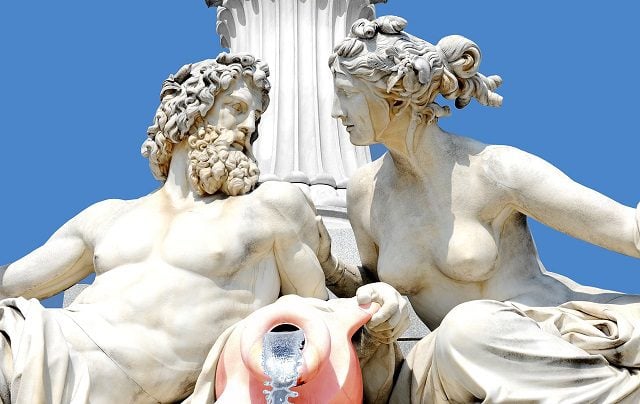
Some of my favorite stories growing up come from Greek and Roman mythology. Edith Hamilton’s Mythology was one of my regular reading companions–sort of like a mid-twentieth century Ovid–so much so that my parents must have replaced a torn and worn out copy with a new one at least three times. What’s not to like? Action, violence, sex—they were better than comic books!
The Olympian deities are gigantic projections of human beings, with all of our strengths and shortcomings, likes and dislikes, jealousies and kindnesses, massive egos and even more massive insecurities. Human beings in these stories, if they are smart, look (usually unsuccessfully) for a place to hide when the deities start throwing their divine weight around, as the fallout frequently lands on unwitting and innocent mortals.
Yet occasionally mortals are able to manipulate the blundering gods and goddesses by offering the right sacrifice, stroking the right part of a divine ego, making deals that the less-than-omniscient deities fail to recognize as guaranteed to end in results that will thwart their purposes. I think the main reason I took four years of Latin in high school was simply because it gave me to opportunity to be immersed deeply in the ancient myths. I spent fourth period senior year with Ms. Thomson and one other Latin geek translating large portions of Ovid’s Metamorphoses—nothing better.
My mother used to occasionally try to get me to put down Edith Hamilton and pick up my Bible. But I knew the Bible stories backwards and forwards from the hours and days spent in church, my home away from home—I’d even memorized a lot of the dialogue and plots of these stories (in King James English, of course). My mother worried that I wasn’t paying sufficient Baptist homage to the Bible stories as opposed to the pagan Greek stories. When she couldn’t pry me away from Edith, she would say “you know, of course, that these are only stories?”
Opposed, that is, to the stories in the Bible, which are true, meaning that they are factual reports of things that really happened, not stories at all. As a good son, I paid lip service to the distinction that my mother, out of concern for her heretic-in-the-making son, was insisting upon.
But I never bought it. The stories in the Old Testament (by far the most interesting Bible stories to a young kid) were just too much like the Greek and Roman myths for me to make a sharp distinction.
God in the Old Testament is just as arbitrary, whimsical, loving, nasty, powerful, and petty as the various Greek deities. He gets into arguments and debates with various mortals and sometimes loses. He sometimes gets into a snit and goes silent, while at other times you just wish He’d shut the hell up and leave people alone. If a skilled psychologist sought to identify all of the various, conflicting personalities of God in the Old Testament, I’m sure they would be at least as great in number as the residents of Olympus. The “truth” of the Bible stories for me did not depend on whether they “really happened”—they were true because they rang true in a deep place.
At a very young age, for instance, I resonated with Jacob in Genesis; he’s still my favorite character from the Bible. As the younger of two sons, I identified with Jacob’s preference for his mother and for hanging around the house rather than going out hunting and killing things, something my older brother did with my Dad. Jacob’s ability to regularly outsmart and manipulate his doofus older brother Esau rang true, because I was sure I could get my equally challenged doofus older brother to do whatever I wanted whenever I wanted. I was sure that if Baptist fathers gave special and exclusive blessings to oldest sons, I could get my older brother to hand over his blessing in exchange for a can of soup.
Jacob is persistent and smart, but he’s also a conniver and occasionally has a very difficult time being truthful and transparent to himself and others. He loves his family, but some of them more than others. He’s courageous at times and a total coward at others. He wants to know God, but wants to write the script according to which that knowledge will unfold. Every time the divine breaks through in a vision or dream, Jacob immediately wants to nail it down and contain it by naming it. In other words, looking back, my original attraction to Jacob makes a lot of sense, because he’s a lot like me.
I knew Kathleen Norris’ definition of “myth” in Amazing Grace as “a story that you know must be true the first time you hear it,” to be true the first time I read it. In ethics classes with nineteen to twenty-one-year-olds who are predominantly survivors of twelve years of parochial education, I lean heavily on Alasdair MacIntyre’s insight that we human beings are “story telling animals”—we understand ourselves and each other by telling stories. Through the stories we tell, we make sense of our past and do our best to recreate the world by telling better and better stories projected into the future.
We are lived stories, in the middle of a “never-ending story” with themes and characters that we catch only brief glimpses of. At the outset of The Gates of the Forest, Elie Wiesel tells the story of a rabbi who confesses to a young listener that he’s old, his memory is failing him, and all he can do is tell stories. But, the rabbi concludes, “It is sufficient. For God made human beings because He loves stories.”
If my mother were here, I’d try to convince her, with scholarly support from Plato through Nietzsche to Rorty, that my childhood conviction was right, that the stories from ancient mythology and from the Bible are true in the same, human affirming and life defining ways, mirrors of what we as human beings are and suggestions of what we can hope for and perhaps become. I’d end with “Q.E.D., Mom–What do you think of that?” And she’d reply, “That’s wonderful, honey, but the stories from the Bible are really true.”
Development of Western Civilization
Previous Post

May 31, 2023
A Blessing for my Final Sabbatical
Next Post

June 4, 2023 Good Times with the Trinity
Recent Comments
"Mary did have a choice. And she was able to make it before the Holy ..."
"i cannot read beyond your recommendations for the books since i like to have a ..."
"AI will never be able to utter with honesty, feeling, or humility, the greeting: "Namaste".It ..."
"They do. I'm sure you could find discussions of the same topic from any of ..."
Browse Our Archives
Select a Category abortion Advent AI Angels Artificial intelligence atheism attention baptism Baptists beauty belief Benedictines Bible bicycling Big Bird books Bovina Camaldoli hermitage Canada Catholicism cats certainty change Christianity Christmas Collegeville Covid-19 creativity Development of Western Civilization dogs doubt Easter Enneagram Epiphany Episcopal ethics Eucharist evil extroverts Facebook faith family fear flowers forgiveness freedom friends God goodness grace happiness heaven hell history Holy Spirit Holy Week hope human nature humility humor idolatry incarnation introverts irreverence Islam Jeanne Jesus Joe Biden joy Judaism justice Kamala Harris knowledge Lent listen literature liturgy love Marsue Memorial Day miracles movies music mystery mythology NPR Old Testament optimism paradox peace Penguins philosophy piano podcast politics power prayer Protestantism Providence College Religion Rhode Island sabbatical sacrament science seeing silence Simone Weil Socrates soul sports St. John's College stories suffering tattoo teaching technology television theology thinking time tolerance transcendence travel trees trust truth Uncategorized Vermont wisdom wonder writing
Select a Month May 2026 April 2026 March 2026 February 2026 January 2026 December 2025 November 2025 October 2025 September 2025 August 2025 July 2025 June 2025 May 2025 April 2025 March 2025 February 2025 January 2025 December 2024 November 2024 October 2024 September 2024 August 2024 July 2024 June 2024 May 2024 April 2024 March 2024 February 2024 January 2024 December 2023 November 2023 October 2023 September 2023 August 2023 July 2023 June 2023 May 2023 April 2023 March 2023 February 2023 January 2023 December 2022 November 2022 October 2022 September 2022 August 2022 July 2022 June 2022 May 2022 April 2022 March 2022 February 2022 January 2022 December 2021 November 2021 October 2021 September 2021 August 2021 July 2021 June 2021 May 2021 April 2021 March 2021 February 2021 January 2021 December 2020 November 2020 October 2020 September 2020 August 2020 July 2020 June 2020 May 2020 April 2020 March 2020 February 2020 January 2020 December 2019 November 2019 October 2019 September 2019 August 2019 July 2019 June 2019 May 2019 April 2019 March 2019 February 2019 January 2019 December 2018 November 2018 October 2018 September 2018 August 2018 July 2018 June 2018 May 2018 April 2018 March 2018 February 2018 January 2018 December 2017 November 2017 October 2017 September 2017 August 2017 July 2017 June 2017 May 2017 April 2017 March 2017 February 2017 January 2017 December 2016 November 2016 October 2016 September 2016 August 2016 July 2016 June 2016 May 2016 April 2016 March 2016 February 2016 January 2016 December 2015 November 2015 October 2015 September 2015 August 2015 July 2015 June 2015 May 2015 April 2015 March 2015 February 2015 January 2015 December 2014 November 2014 October 2014 September 2014 August 2014 July 2014 June 2014 May 2014 April 2014 March 2014 February 2014 January 2014 December 2013 November 2013 October 2013 September 2013 August 2013 July 2013 June 2013 May 2013 April 2013 March 2013 February 2013 January 2013 December 2012 November 2012 October 2012 September 2012
Follow Us!
TAKE THE
Religious Wisdom Quiz
Which Christian tradition developed the doctrine of the Holy Trinity most systematically?
Select your answer to see how you score.
Pentecostalism Quakerism Jehovah's Witnesses Nicene Christianity
Books by This Author Books by Vance G. Morgan
Related posts from Freelance Christianity

The Lonely Pawn: On Faith, Doubt, and Meaning


AI and Love: When a Chatbot Becomes a...

TRENDING AT PATHEOS Progressive Christian

What Being a Modern-Day Apostle Means to Me
In my last column, I discussed the ins and outs of modern-day...

Did Ancient China Once Worship the God of...
Across human history, a common thread weaves through the origins of the...

Love Your Neighbor – Including Earth-Kin: Lev. 19,...
God’s command to love your neighbor means acting in an ethical and...

Lead a Church Study of “Jesus and Lao...
Guest writer Jack Thomas (The Irreverent Reverend) reflects on leading his church...

Pastoral Wisdom for Responding to Sermon Pushback
Getting sermon pushback on your social justice sermon? Learn practical, Proverbs-based strategies...

Principles for Understanding the Apostolic Ministry Today
Whenever people discover that my formal ministry title is "apostle," as in...
view all Progressive Christian blogs
What Are Your Thoughts?leave a comment
Ad-Free & Subscriber Log-In Subscription Support
- About Us
- 2026 Calendar
- Videos
- Podcasts
- Library of World Religions
- Faith In Media Tracker
- Advertise With Us
- Write for Us
- Privacy Policy
- Terms of Service
- Do Not Sell My Data
- Contact Us
- Radiant Digital
- Manage Newsletter Subscriptions
- Unsubscribe From Notifications
- Sitemap
Copyright 2008-2026, Patheos. All rights reserved.
Subscription Support Ad-Free & Subscriber Log-In
Follow Patheos