
BuddhistCatholicContemplativeEvangelicalGeneral ChristianHinduJewishLatter-day SaintMuslimNew VisionsProgressive Christian
Beliefs
- Buddhist
- Catholic
- Contemplative
- Evangelical
- General Christian
- Hindu
- Jewish
- Latter-day Saint
- More Voices
- Muslim
- New Visions
- Pagan
- Progressive Christian
Topics
- Religion News
- Food and Religion
- Sports and Religion
- Religious Art
- Religious Music and Entertainment
- Religious Events
- History and Religion
- Style and Religion
- Politics and Religion
- Women in Religion
- Recreation Outdoors and Religion
- Business Finance and Religion
- Careers Workplace and Religion
- Education and Religion
- Family Parenting and Religion
- Health Fitness and Religion
- Home and Religion
- Relationships and Religion
- Technology and Religion
- Travel and Religion
Columnists
- Buddhist Columnists
- Business Finance and Religion Columnists
- Careers Workplace and Religion Columnists
- Catholic Columnists
- Contemplative Columnists
- Education and Religion Columnists
- Evangelists Columnists
- Family Parenting and Religion Columnists
- General Christian Columnists
- Health Fitness and Religion Columnists
- Hindu Columnists
- History and Religion Columnists
- Home and Religion Columnists
- Jewish Columnists
- More Voices Columnists
- Latter Day Columnists
- Muslim Columnists
- New Visions Columnists
- Nonreligious Columnists
- Pagan Columnists
- Politics and Religion Columnists
- Progressive Columnists
- Recreation Outdoors and Religion Columnists
- Relationships and Religion Columnists
- Religion News Columnists
- Religious Art Columnists
- Religious Events Columnists
- Religious Music and Entertainment Columnists
- Sports and Religion Columnists
- Style and Religion Columnists
- Technology and Religion Columnists
- Travel and Religion Columnists
- Women in Religion Columnists
Resource Library
- 2026 Calendar
- Library of World Religions
- The 100 Most Holy Places on Earth
- Patheos Answers
- Podcasts
- Videos
- Faith Leaders Database
- Anglican Episcopalian
- Bahai
- Baptist
- Buddhism
- Christianity
- Confucianism
- Eastern Orthodoxy
- Hinduism
- Holiness and Pentecostal
- ISKCON
- Islam
- Judaism
- Lutheran
- Methodist
- The Church of Jesus Christ of Latter-day Saints
- New Age
- Paganism
- Presbytarian and Reformed
- Protestantism
- Religion Behind the Scenes
- Roman Catholic
- Scientology
- Shia Islam
- Sikhism
- Sufism
- Sunni Islam
- Taoism
- Zen
- See all religions
Research Tools
 Ad-Free & Subscriber Log-In Subscription Support
Ad-Free & Subscriber Log-In Subscription Support
Follow Patheos 

- Trending:
- Forgiveness
- |
- Marriage
- |
- Consciousness
- |
- Death Penalty
- |
- Election
- |
- Halloween

- Home
- Progressive Christian
- Raised on Original Sin
Raised on Original Sin
Last updated on: January 27, 2022 at 7:00 am by Vance Morgan
Raised on Original Sin 2022-01-26T18:50:49-04:00 Vance Morgan
Patheos Explore the world's faith through different perspectives on religion and spirituality! Patheos has the views of the prevalent religions and spiritualities of the world.
It hardly seems possible that I am now in the tenth calendar year of writing this blog (my first post was at the end of August 2012). It seems even less possible that it was fifteen years ago that I first began experimenting with writing short essays, the type of writing that eventually produced and continues to sustain this blog, as well as two books that have grown out of such essays. I applied to the 2007 Southampton Writers’ Conference at my wife Jeanne’s insistence. The extreme academic and the even more extreme introvert in me screamed “No!” but I applied anyways, fully expecting that I would be rejected.
I wasn’t. My assigned workshop was “Literary Essay” (not my first choice—but I no longer remember what my first choice was); each of the fifteen workshop participants wrote daily 500-word essays, which were submitted to colleagues for critique and (hopefully) helpful evaluation. My essays tended to praise the virtues of my dog  and the Boston Red Sox, while frequently expressing struggles with faith, God, religion, and my own very human inadequacies. About halfway through the two-week conference, during a critique session when I and my most recent submission were on the hot seat, one of my colleagues said “You write so negatively about yourself in your essays. You seem like a really nice guy—why do you have such a negative self-image?” Other colleagues murmured their agreement.
My immediate reaction was not defensive—despite being supremely (perhaps over-) confident in some aspects of my life, my overall self-image at that point in my life was more negative than positive. My internal reaction instead was a quick realization that I might be the only person in the room who didn’t think he or she was pretty much okay.
My fourteen colleagues were a diverse bunch, including a specialist in Chinese history, an archaeologist, a high school student whose mother was running the conference, a vice president of an international banking firm, a local politician, a poet who just published her first collection of poems, several self-described “writers conference rats” (one was at this conference for the seventh straight year), and our workshop leader, a well-known essayist and columnist who had just published his third novel. And they were mildly uncomfortable with my being explicit about my self-doubts and honest about my shortcomings and failures.
I was in the midst of some difficult internal stuff that summer, but I’ll bet many of my colleagues were too. I soon realized that what really made me different from them is original sin—it has defined me for as long as I can remember, and they had never heard of it. I learned at a very early age that I don’t measure up, that I’m not good enough, that “within me dwells no good thing.” And it’s not an exclusively Christian idea (although it sometimes feels as if it is); the Psalmist says, “I was brought forth in iniquity, and in sin my mother conceived me.” We’re all screwed from the start. Thanks Adam and Eve—I’ll be posting an essay about different angles on that iconic couple soon.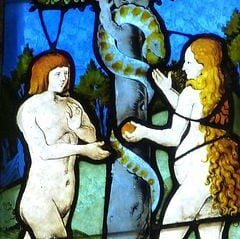
Some make a bigger deal of this than others. Martin Luther, the guy responsible for Protestants, likened divine grace to a layer of freshly fallen snow covering a pile of shit. Grace doesn’t transform the pile—shit is still shit—but it covers it so that its smell is not quite as offensive and it doesn’t look quite as disgusting. And guess who the offensive pile is . . . me. You are as well, so don’t feel too sorry for me.
This is a wonderful foundation upon which to build a positive self-image, but it’s the engine that drives a lot of religious activity. I remember that several years ago the Catholic Dominican Matthew Fox was excommunicated for teaching, among other things, that the doctrine of original sin is wrong and for writing books with titles like Original Blessing. He became an Episcopal priest after his excommunication, which makes sense—we Episcopalians will take anyone as long as they appreciate good liturgy and have sufficiently liberal social and political commitments.
To be honest, after more than thirty years as a recovering Protestant involved in Catholic higher education, I’ve discovered that most Catholics I know take original sin far less seriously than the people I grew up with did. Catholics pay lip service to the notion that human beings need divine help; my people meant it. They told me I deserved to go to hell and would undoubtedly end up there unless I was “right with Jesus.” And my workshop colleagues wondered why I wrote negatively about myself.
Many groups of people, both religious and otherwise, speak as if they have a corner on feeling guilty and inadequate. I knew no Catholics when I was growing up, but now that I spend a large portion of my time with them professionally and have many Catholic friends, I know all about Catholic guilt, despite the fact that they don’t talk about original sin that much. I was surprised to find out that Catholics think that Catholic guilt is particularly debilitating, just as they were surprised to find out that I know all about it; I just call it Protestant guilt. I’ve even participated in good-natured debates about whose guilt is more paralyzing.
Everyone knows about Jewish guilt, Irish guilt, and so on. We apparently don’t need religious doctrine to tell us that we are inadequate and flawed. We just need to be human beings. John Henry Newman wrote that just observing what’s going on around us with the slightest care reveals that humanity is afflicted by “some aboriginal calamity.” That’s a wonderfully British, urbane, nineteenth century way of saying “we’re really f–ked up.”
It’s true. There’s something fundamentally askew at our core, and we all know it. Many manage to cope with this by ignoring it, by refusing to include it in their vocabulary, by defining themselves in terms according to which they can be acceptable and successful. “I’m okay, you’re okay”—but as Emily Dickinson suggests, there’s still a “tooth that nibbles at the soul”—we’re not okay.
A decade ago, toward the end of a lovely lunch conversation, a new friend and colleague observed that “it’s hard being a person,” in the same matter-of-fact tone of voice in which he might have said “these waffles are cold.” I said in response that what told me, years ago, that Simone Weil is my kind of woman was when I read in her notebooks that, in her estimation, “human life is impossible.” So, that’s where I begin. I’m not okay and I need help. And the first step forward has to be one of trust, of a hope that this can be better. Iris Murdoch writes that “God is a belief that at our deepest level we are known and loved, even to there the rays can penetrate.” Let it be so.
Previous Post
January 24, 2022
Why Jesus was Obsessed with Outsiders
Next Post

January 30, 2022 Decorating the Dungeon
Browse Our Archives
Select a Category abortion Advent AI Angels Artificial intelligence atheism attention baptism Baptists beauty belief Benedictines Bible bicycling Big Bird books Bovina Camaldoli hermitage Canada Catholicism cats certainty change Christianity Christmas Collegeville Covid-19 creativity Development of Western Civilization dogs doubt Easter Enneagram Epiphany Episcopal ethics Eucharist evil extroverts Facebook faith family fear flowers forgiveness freedom friends God goodness grace happiness heaven hell history Holy Spirit Holy Week hope human nature humility humor idolatry incarnation introverts irreverence Islam Jeanne Jesus Joe Biden joy Judaism justice Kamala Harris knowledge Lent listen literature liturgy love Marsue Memorial Day miracles movies music mystery mythology NPR Old Testament optimism paradox peace Penguins philosophy piano podcast politics power prayer Protestantism Providence College Religion Rhode Island sabbatical sacrament science seeing silence Simone Weil Socrates soul sports St. John's College stories suffering tattoo teaching technology television theology thinking time tolerance transcendence travel trees trust truth Uncategorized Vermont wisdom wonder writing
Select a Month May 2026 April 2026 March 2026 February 2026 January 2026 December 2025 November 2025 October 2025 September 2025 August 2025 July 2025 June 2025 May 2025 April 2025 March 2025 February 2025 January 2025 December 2024 November 2024 October 2024 September 2024 August 2024 July 2024 June 2024 May 2024 April 2024 March 2024 February 2024 January 2024 December 2023 November 2023 October 2023 September 2023 August 2023 July 2023 June 2023 May 2023 April 2023 March 2023 February 2023 January 2023 December 2022 November 2022 October 2022 September 2022 August 2022 July 2022 June 2022 May 2022 April 2022 March 2022 February 2022 January 2022 December 2021 November 2021 October 2021 September 2021 August 2021 July 2021 June 2021 May 2021 April 2021 March 2021 February 2021 January 2021 December 2020 November 2020 October 2020 September 2020 August 2020 July 2020 June 2020 May 2020 April 2020 March 2020 February 2020 January 2020 December 2019 November 2019 October 2019 September 2019 August 2019 July 2019 June 2019 May 2019 April 2019 March 2019 February 2019 January 2019 December 2018 November 2018 October 2018 September 2018 August 2018 July 2018 June 2018 May 2018 April 2018 March 2018 February 2018 January 2018 December 2017 November 2017 October 2017 September 2017 August 2017 July 2017 June 2017 May 2017 April 2017 March 2017 February 2017 January 2017 December 2016 November 2016 October 2016 September 2016 August 2016 July 2016 June 2016 May 2016 April 2016 March 2016 February 2016 January 2016 December 2015 November 2015 October 2015 September 2015 August 2015 July 2015 June 2015 May 2015 April 2015 March 2015 February 2015 January 2015 December 2014 November 2014 October 2014 September 2014 August 2014 July 2014 June 2014 May 2014 April 2014 March 2014 February 2014 January 2014 December 2013 November 2013 October 2013 September 2013 August 2013 July 2013 June 2013 May 2013 April 2013 March 2013 February 2013 January 2013 December 2012 November 2012 October 2012 September 2012
Follow Us!
TAKE THE
Religious Wisdom Quiz
How many sons did Jacob (Israel) have?
Select your answer to see how you score.
Ten Nine Twelve Seven
Books by This Author Books by Vance G. Morgan
Related posts from Freelance Christianity

The Lonely Pawn: On Faith, Doubt, and Meaning


AI and Love: When a Chatbot Becomes a...

TRENDING AT PATHEOS Progressive Christian

What Being a Modern-Day Apostle Means to Me
In my last column, I discussed the ins and outs of modern-day...

Did Ancient China Once Worship the God of...
Across human history, a common thread weaves through the origins of the...

Love Your Neighbor – Including Earth-Kin: Lev. 19,...
God’s command to love your neighbor means acting in an ethical and...

Lead a Church Study of “Jesus and Lao...
Guest writer Jack Thomas (The Irreverent Reverend) reflects on leading his church...

Pastoral Wisdom for Responding to Sermon Pushback
Getting sermon pushback on your social justice sermon? Learn practical, Proverbs-based strategies...

Principles for Understanding the Apostolic Ministry Today
Whenever people discover that my formal ministry title is "apostle," as in...
view all Progressive Christian blogs
Ad-Free & Subscriber Log-In Subscription Support
- About Us
- 2026 Calendar
- Videos
- Podcasts
- Library of World Religions
- Faith In Media Tracker
- Advertise With Us
- Write for Us
- Privacy Policy
- Terms of Service
- Do Not Sell My Data
- Contact Us
- Radiant Digital
- Manage Newsletter Subscriptions
- Unsubscribe From Notifications
- Sitemap
Copyright 2008-2026, Patheos. All rights reserved.
Subscription Support Ad-Free & Subscriber Log-In
Follow Patheos