
BuddhistCatholicContemplativeEvangelicalGeneral ChristianHinduJewishLatter-day SaintMuslimNew VisionsProgressive Christian
Beliefs
- Buddhist
- Catholic
- Contemplative
- Evangelical
- General Christian
- Hindu
- Jewish
- Latter-day Saint
- More Voices
- Muslim
- New Visions
- Pagan
- Progressive Christian
Topics
- Religion News
- Food and Religion
- Sports and Religion
- Religious Art
- Religious Music and Entertainment
- Religious Events
- History and Religion
- Style and Religion
- Politics and Religion
- Women in Religion
- Recreation Outdoors and Religion
- Business Finance and Religion
- Careers Workplace and Religion
- Education and Religion
- Family Parenting and Religion
- Health Fitness and Religion
- Home and Religion
- Relationships and Religion
- Technology and Religion
- Travel and Religion
Columnists
- Buddhist Columnists
- Business Finance and Religion Columnists
- Careers Workplace and Religion Columnists
- Catholic Columnists
- Contemplative Columnists
- Education and Religion Columnists
- Evangelists Columnists
- Family Parenting and Religion Columnists
- General Christian Columnists
- Health Fitness and Religion Columnists
- Hindu Columnists
- History and Religion Columnists
- Home and Religion Columnists
- Jewish Columnists
- More Voices Columnists
- Latter Day Columnists
- Muslim Columnists
- New Visions Columnists
- Nonreligious Columnists
- Pagan Columnists
- Politics and Religion Columnists
- Progressive Columnists
- Recreation Outdoors and Religion Columnists
- Relationships and Religion Columnists
- Religion News Columnists
- Religious Art Columnists
- Religious Events Columnists
- Religious Music and Entertainment Columnists
- Sports and Religion Columnists
- Style and Religion Columnists
- Technology and Religion Columnists
- Travel and Religion Columnists
- Women in Religion Columnists
Resource Library
- 2026 Calendar
- Library of World Religions
- The 100 Most Holy Places on Earth
- Patheos Answers
- Podcasts
- Videos
- Faith Leaders Database
- Anglican Episcopalian
- Bahai
- Baptist
- Buddhism
- Christianity
- Confucianism
- Eastern Orthodoxy
- Hinduism
- Holiness and Pentecostal
- ISKCON
- Islam
- Judaism
- Lutheran
- Methodist
- The Church of Jesus Christ of Latter-day Saints
- New Age
- Paganism
- Presbytarian and Reformed
- Protestantism
- Religion Behind the Scenes
- Roman Catholic
- Scientology
- Shia Islam
- Sikhism
- Sufism
- Sunni Islam
- Taoism
- Zen
- See all religions
Research Tools
 Ad-Free & Subscriber Log-In Subscription Support
Ad-Free & Subscriber Log-In Subscription Support
Follow Patheos 

- Trending:
- Forgiveness
- |
- Marriage
- |
- Consciousness
- |
- Death Penalty
- |
- Election
- |
- Halloween

- Home
- Progressive Christian
- Piercing the Silence
Piercing the Silence
Last updated on: January 14, 2018 at 8:23 am by Vance Morgan
Piercing the Silence 2018-01-14T08:23:54-04:00 Vance Morgan
Patheos Explore the world's faith through different perspectives on religion and spirituality! Patheos has the views of the prevalent religions and spiritualities of the world.
Every religion which does not confirm that God is hidden is not true. Blaise Pascal
One of the most fascinating and troubling verses in the Jewish scriptures is from the book of Proverbs:. “It is the glory of God to conceal a thing, and the glory of kings to search it out.” I, as many people of faith, often wonder why the divine is so unavailable, so frequently silent. I, as many people of faith, have often assumed that this silence is my fault—especially since various people in my life since my youth have claimed that God speaks to them on a regular basis. The divine, in my experience, has always been elusive, showing itself just often enough in oblique and enigmatic ways to verify that the quarry I am stalking actually does exist.
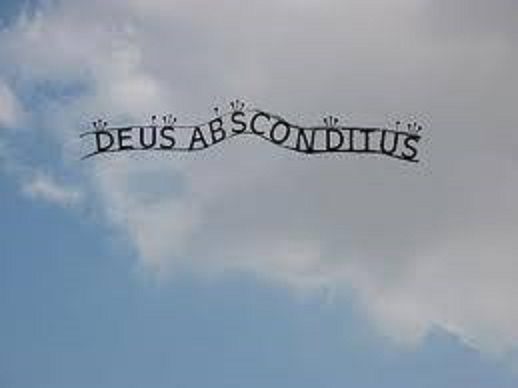
But Proverbs 25:2 tells a different story. God likes to hide and conceal, so much so that those who claim to be in possession of the divine and all of its characteristics, personality traits, likes and dislikes, as well as possessing tools appropriate for distinguishing who is godly and who is not are probably in possession of something other than God. Something like a projection of themselves. The question is—why is God hiding? Why is God so often silent?
As I write this I am on a three day retreat at a tiny Benedictine abbey about an hour north of us in Massachusetts. When I agreed a few weeks ago to take on a challenging administrative position on campus in addition to my teaching and committee duties this coming semester, I decided to find a place to go on retreat for a few days before the semester begins. It’s been at least three years since I did anything like this. I should know better, because such retreats match both my natural inwardness and recent spiritual experiences very well.
Part of my planning for a silent retreat usually includes a couple of days of careful thought about which books I should bring with me. This time, thanks to a snowstorm the day before leaving and hours of shoveling the morning of the day I was to head out, no such planning took place. I just grabbed three or four books as I quickly threw stuff in my book bag, including a couple of books by Barbara Brown Taylor, books that happened to be the first ones my eyes landed on when glancing quickly at the bookshelves in our library room.
One of these books is When God is Silent. I know I’ve read it before, because there are some passages marked with my cryptic book-marking hieroglyphics, but as I started to read it, I found that I remembered virtually none of it. I usually hate it when that happens, but as I read the book cover to cover from late Friday night into the wee hours of Saturday morning, I was glad that it was striking me as brand new. Each page seemed to have something written directly for me with clear applications to where I find myself professionally and personally, as well as relevance to the increasingly unsettling and disturbing contemporary landscape we all find ourselves grappling with.
Our world is so full of words that they have come close to losing their significance. I contribute to this onslaught of verbiage with at least three thousand words per week on this blog, hoping that maybe a handful of people might find something interesting or thought provoking in what I write. But most of us are suffering from a severe case of word overload. For those who profess the Christian faith, this is a problem. Barbara Brown Taylor observes that Christianity is “an overly talkative religion,” not surprising, perhaps, since one of the favored descriptions of God in flesh is “The Word.” We say and sing words in worship, while we listen to more of them read from the lectern, preached from the pulpit, and recited from the altar. Words, words, and more words.
When God is Silent is a series of lectures on preaching that Taylor delivered to an audience including seminarians, clergy, professors, and lay people at Yale Divinity School, persons with a shared concern for how to proclaim the gospel to a world already overfilled with words. One of Taylor’s most important suggestions for such persons is that they should lean into the divine silence that is found throughout scripture.
We find in the Jewish scriptures, for instance, that God’s preferred way of communicating with the children of Israel was to do it directly, but people found the living God too intimidating and frightening to be in the same space with. They insisted that Moses find out what God wanted of them, put it into a form they could handle, and act as the middle man between them and the divine. The result was the law, and God, for the most part, stopped talking.
As Taylor notes, through words remain our preferred method of domesticating the divine.
Many people pray for an encounter with the living God. Those whose prayers are answered rarely ask for the same thing twice. . . . We are not up to direct encounter with God. We want it but we don’t want it. Safe fire is our own invention.
Scripture tells us that our God is a “consuming fire.” We use words to turn God into something safe, manageable, and as unlike the real thing as a YouTube video of a burning fireplace is unlike what burns in a real fireplace.
The Jewish prophets often railed against those who claimed to follow God for precisely this reason. God has withdrawn and is silent for reasons that, although written over two centuries ago, have a remarkably contemporary relevance.
They have substituted liturgy for justice. They have fasted without offering their untouched food to the hungry. . . . God is silent because they do not speak God’s language. But it took God’s silence to teach them that.
There is a reason why the Second Commandment is a prohibition against graven images and idolatry. Human beings are incurable idolaters, choosing to replace the real thing with something domesticated and manageable. God’s silence and elusiveness, Taylor says, is a deliberate response to our idolatrous tendencies.
Silence becomes God’s final defense against our idolatry . . . God deflects our attempts at control by withdrawing into silence, knowing that nothing gets to us like the failure of our speech. . . . Only an idol always answers. The God who keeps silence, even when God’s own flesh and blood is begging for a word, is the God beyond anyone’s control.
For a person of faith in pain or in need, the silence of God becomes personal. At a workshop, an ordained minister seeking guidance once told Barbara Brown Taylor that “all I want is to hear God call me by name. I would give anything just to hear God say my name.” The very Son of God longed for the same thing in his darkest pain, and received . . . silence.
In Gethsemane, Jesus asked for bread and got a stone. Finally, in the most profound silence of his life, he died, believing himself forsaken by God. . . . In the silence surrounding his death, Jesus became the best possible companion for those whose prayers are not answered, who would give anything just to hear God call them by name. Him too.
And yet we know that from this mysterious silence, a silence rooted in love, transformation and salvation emerge.
Sometimes the best thing to do is to stop talking. The deepest truths are often those that cannot be said. We will always seek to capture the mysterious and ineffable in words, and in so doing will effectively remove the mystery. Taylor concludes that
The divine silence is not a vacuum to be filled but a mystery to be entered into, unarmed with words and undistracted by noise . . . Our job is not to pierce that mystery with language but to reverence it.
Previous Post

January 12, 2018
What Are You Reading?
Next Post
January 15, 2018 A S**thole Town Like Nazareth
Browse Our Archives
Select a Category abortion Advent AI Angels Artificial intelligence atheism attention baptism Baptists beauty belief Benedictines Bible bicycling Big Bird books Bovina Camaldoli hermitage Canada Catholicism cats certainty change Christianity Christmas Collegeville Covid-19 creativity Development of Western Civilization dogs doubt Easter Enneagram Epiphany Episcopal ethics Eucharist evil extroverts Facebook faith family fear flowers forgiveness freedom friends God goodness grace happiness heaven hell history Holy Spirit Holy Week hope human nature humility humor idolatry incarnation introverts irreverence Islam Jeanne Jesus Joe Biden joy Judaism justice Kamala Harris knowledge Lent listen literature liturgy love Marsue Memorial Day miracles movies music mystery mythology NPR Old Testament optimism paradox peace Penguins philosophy piano podcast politics power prayer Protestantism Providence College Religion Rhode Island sabbatical sacrament science seeing silence Simone Weil Socrates soul sports St. John's College stories suffering tattoo teaching technology television theology thinking time tolerance transcendence travel trees trust truth Uncategorized Vermont wisdom wonder writing
Select a Month May 2026 April 2026 March 2026 February 2026 January 2026 December 2025 November 2025 October 2025 September 2025 August 2025 July 2025 June 2025 May 2025 April 2025 March 2025 February 2025 January 2025 December 2024 November 2024 October 2024 September 2024 August 2024 July 2024 June 2024 May 2024 April 2024 March 2024 February 2024 January 2024 December 2023 November 2023 October 2023 September 2023 August 2023 July 2023 June 2023 May 2023 April 2023 March 2023 February 2023 January 2023 December 2022 November 2022 October 2022 September 2022 August 2022 July 2022 June 2022 May 2022 April 2022 March 2022 February 2022 January 2022 December 2021 November 2021 October 2021 September 2021 August 2021 July 2021 June 2021 May 2021 April 2021 March 2021 February 2021 January 2021 December 2020 November 2020 October 2020 September 2020 August 2020 July 2020 June 2020 May 2020 April 2020 March 2020 February 2020 January 2020 December 2019 November 2019 October 2019 September 2019 August 2019 July 2019 June 2019 May 2019 April 2019 March 2019 February 2019 January 2019 December 2018 November 2018 October 2018 September 2018 August 2018 July 2018 June 2018 May 2018 April 2018 March 2018 February 2018 January 2018 December 2017 November 2017 October 2017 September 2017 August 2017 July 2017 June 2017 May 2017 April 2017 March 2017 February 2017 January 2017 December 2016 November 2016 October 2016 September 2016 August 2016 July 2016 June 2016 May 2016 April 2016 March 2016 February 2016 January 2016 December 2015 November 2015 October 2015 September 2015 August 2015 July 2015 June 2015 May 2015 April 2015 March 2015 February 2015 January 2015 December 2014 November 2014 October 2014 September 2014 August 2014 July 2014 June 2014 May 2014 April 2014 March 2014 February 2014 January 2014 December 2013 November 2013 October 2013 September 2013 August 2013 July 2013 June 2013 May 2013 April 2013 March 2013 February 2013 January 2013 December 2012 November 2012 October 2012 September 2012
Follow Us!
TAKE THE
Religious Wisdom Quiz
What is the Christian teaching about temptation?
Select your answer to see how you score.
Give in quickly Ignore it Resist and pray for strength Deny it exists
Books by This Author Books by Vance G. Morgan
Related posts from Freelance Christianity

The Lonely Pawn: On Faith, Doubt, and Meaning


AI and Love: When a Chatbot Becomes a...

TRENDING AT PATHEOS Progressive Christian

What Being a Modern-Day Apostle Means to Me
In my last column, I discussed the ins and outs of modern-day...

Did Ancient China Once Worship the God of...
Across human history, a common thread weaves through the origins of the...

Love Your Neighbor – Including Earth-Kin: Lev. 19,...
God’s command to love your neighbor means acting in an ethical and...

Lead a Church Study of “Jesus and Lao...
Guest writer Jack Thomas (The Irreverent Reverend) reflects on leading his church...

Pastoral Wisdom for Responding to Sermon Pushback
Getting sermon pushback on your social justice sermon? Learn practical, Proverbs-based strategies...

Principles for Understanding the Apostolic Ministry Today
Whenever people discover that my formal ministry title is "apostle," as in...
view all Progressive Christian blogs
Ad-Free & Subscriber Log-In Subscription Support
- About Us
- 2026 Calendar
- Videos
- Podcasts
- Library of World Religions
- Faith In Media Tracker
- Advertise With Us
- Write for Us
- Privacy Policy
- Terms of Service
- Do Not Sell My Data
- Contact Us
- Radiant Digital
- Manage Newsletter Subscriptions
- Unsubscribe From Notifications
- Sitemap
Copyright 2008-2026, Patheos. All rights reserved.
Subscription Support Ad-Free & Subscriber Log-In
Follow Patheos