
BuddhistCatholicContemplativeEvangelicalGeneral ChristianHinduJewishLatter-day SaintMuslimNew VisionsProgressive Christian
Beliefs
- Buddhist
- Catholic
- Contemplative
- Evangelical
- General Christian
- Hindu
- Jewish
- Latter-day Saint
- More Voices
- Muslim
- New Visions
- Pagan
- Progressive Christian
Topics
- Religion News
- Food and Religion
- Sports and Religion
- Religious Art
- Religious Music and Entertainment
- Religious Events
- History and Religion
- Style and Religion
- Politics and Religion
- Women in Religion
- Recreation Outdoors and Religion
- Business Finance and Religion
- Careers Workplace and Religion
- Education and Religion
- Family Parenting and Religion
- Health Fitness and Religion
- Home and Religion
- Relationships and Religion
- Technology and Religion
- Travel and Religion
Columnists
- Buddhist Columnists
- Business Finance and Religion Columnists
- Careers Workplace and Religion Columnists
- Catholic Columnists
- Contemplative Columnists
- Education and Religion Columnists
- Evangelists Columnists
- Family Parenting and Religion Columnists
- General Christian Columnists
- Health Fitness and Religion Columnists
- Hindu Columnists
- History and Religion Columnists
- Home and Religion Columnists
- Jewish Columnists
- More Voices Columnists
- Latter Day Columnists
- Muslim Columnists
- New Visions Columnists
- Nonreligious Columnists
- Pagan Columnists
- Politics and Religion Columnists
- Progressive Columnists
- Recreation Outdoors and Religion Columnists
- Relationships and Religion Columnists
- Religion News Columnists
- Religious Art Columnists
- Religious Events Columnists
- Religious Music and Entertainment Columnists
- Sports and Religion Columnists
- Style and Religion Columnists
- Technology and Religion Columnists
- Travel and Religion Columnists
- Women in Religion Columnists
Resource Library
- 2026 Calendar
- Library of World Religions
- The 100 Most Holy Places on Earth
- Patheos Answers
- Podcasts
- Videos
- Faith Leaders Database
- Anglican Episcopalian
- Bahai
- Baptist
- Buddhism
- Christianity
- Confucianism
- Eastern Orthodoxy
- Hinduism
- Holiness and Pentecostal
- ISKCON
- Islam
- Judaism
- Lutheran
- Methodist
- The Church of Jesus Christ of Latter-day Saints
- New Age
- Paganism
- Presbytarian and Reformed
- Protestantism
- Religion Behind the Scenes
- Roman Catholic
- Scientology
- Shia Islam
- Sikhism
- Sufism
- Sunni Islam
- Taoism
- Zen
- See all religions
Research Tools
 Ad-Free & Subscriber Log-In Subscription Support
Ad-Free & Subscriber Log-In Subscription Support
Follow Patheos 

- Trending:
- Forgiveness
- |
- Marriage
- |
- Consciousness
- |
- Death Penalty
- |
- Election
- |
- Halloween

- Home
- Progressive Christian
- Perfect Love Casts Out Fear–or so we’re told
Perfect Love Casts Out Fear–or so we’re told
Last updated on: May 2, 2021 at 6:00 am by Vance Morgan
Perfect Love Casts Out Fear–or so we’re told 2021-04-28T16:14:13-04:00 Vance Morgan
Patheos Explore the world's faith through different perspectives on religion and spirituality! Patheos has the views of the prevalent religions and spiritualities of the world.
After the mass shooting in a Colorado grocery store a few weeks ago, a woman on Twitter posted this:
I’ve got to go to the grocery store today. The store has 1 front entrance, & 1 exit out the back. If a shooter came in, I might not be able to escape, & I’m scared to go. Does this mean I need therapy? Or am I an American accepting the reality of mass shootings?
Several hundred people responded, the vast majority of whom assured her that she does not need therapy. I agreed, but I believe there are more possibilities than the two she proposed. I responded:
We need serious gun reform legislation. And don’t live in fear.
A couple of years ago, I was interviewed on a podcast by a young man who asked me, at the end of a lively hour-long conversation, what advice I might have for a person going through a crisis of faith (he called it a “deconstruction” of faith), a person for whom all of the reliable answers, formulas, and guidelines are no longer working. What is my best advice for a person face to face with uncertainty and doubt in areas that have been, up to that point in their life, the most constant sources of certainty and confidence? After a few moments of consideration, I said: “Don’t be afraid.” Easier said than done.
This morning’s lectionary readings include perhaps the best known line from First John: “Perfect love casts out fear.” There might not be a better one-sentence summary of the heart of the Christian faith. But in the version of Christianity I was raised in, although we used the word “love” a lot, it seemed to me that fear was the primary motivator. God was someone to be afraid of. So were people who didn’t believe and worship as we did. Atheists, the godless Communists, liberal Hollywood, forgetting to witness regularly to everyone you encountered—these were just a few of the things we were afraid of.
Perfect love casts out fear? We knew it had to be true, because it is in the Bible. But what might that actually look like? We had no idea. Fear is a primary motivator of human behavior, and almost always directs us toward thoughts and actions that are damaging and destructive. And one of the greatest sources of human fear is change. The first thing that an angel says in Scripture when showing up to an unsuspecting human being is almost always “Fear not.” And for good reason.

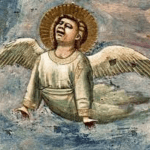
Despite the sanitized versions of angels to be found in art and commerce, the appearance of an angel in Scripture is almost always a harbinger of change, an indication that your world is never going to be the same again. Angels never show up simply to announce that “everything’s fine and you’re on the right track.” Angels are always the heralds of new beginnings, inviting us to adventure. They introduce mystery—they do not clarify. Angels announce new departures and the beginning of something whose end is not in view. And the first thing the angel says is that we don’t need to be afraid of change and disruption.
The problem is that human beings don’t like change. Admit it—no matter how liberal, progressive, open-ended or cutting-edge you think you are, you prefer security and stability to change. As William James wrote, “in the matter of belief, we are all extreme conservatives.” We don’t want our most fundamental and cherished beliefs to be challenged or disrupted. One of the most important aspects of what I do for a living involves regularly challenging my students’ assumptions and most entrenched beliefs—many of which are subconscious and many of which they adopted from their parents and other authorities unquestioningly as children and adolescents. The challenge is intended not primarily to change those beliefs, but rather to reveal them and then to equip students to evaluate them intelligently and consciously.
One of the best pieces of advice I ever received as an inexperienced teacher decades ago comes from Vera Brittain’s Testament of Youth.
There is still, I think, not enough recognition by teachers of the fact that the desire to think–which is fundamentally a moral problem–must be awakened before learning can occur. Most people wish above all else to be comfortable, and thought is a pre-eminently uncomfortable process.
Brittain’s insight is as relevant to the process of faith and belief as to what happens in the classroom. Because the stakes are so high, there is arguably no arena in which we desire certainty in our beliefs more than when considering what is greater than us and our relationship to it. Persons of faith tend to treat their religious convictions as if they are inviolably certain; I have encountered many atheists who are just as certain in their non-theistic beliefs as the most dedicated fundamentalist persons of faith are in theirs.
And yet there is no area of belief in which we have less reason to be certain about anything than when considering what is greater than us. As one of my most beloved philosophical influences, Michel de Montaigne, writes in his Essays,
What is more vain than to want to guess at God by our analogies and conjectures, to regulate him and the world according to our capacity and our laws, and to make use at the expense of divinity of that small sample of sufficiency it has pleased him to dispense to our natural condition? And because we cannot extend our vision as far as his glorious throne, are we to bring it down here to our corruption and to our wretchedness?
The answers to these questions seem obvious—restricting the divine to our limited capacities is indeed vain, and no, we should not seek to drag the divine down to be confined within our limitations. Yet, Montaigne reminds us, this is precisely what we do.
We prescribe limits for him; we besiege his power with our arguments . . . we want to enslave God to the vain and feeble appearances of our understanding, he who has made both us and our knowledge . . . What! Has God put into our hands the keys and the last resorts of his power? Is he obliged not to exceed the limits of our knowledge?
This is why we need not be afraid when what we were taught concerning the nature and preferences of God turns out to be incomplete, flawed, or simply wrong. We need not be afraid when our current “best hypothesis” concerning human/divine relationships turn out to be inadequate to current experience. What else would we expect? Uncertainty, doubt, trial-and-error, incremental advance and retreat—these are part and parcel of being human. To be afraid of change, to be afraid of being wrong—these are to be afraid of being human.
Previous Post
April 29, 2021
Speak What We Feel, Not What We Ought to Say
Next Post

May 3, 2021 Because Survival is Insufficient
Browse Our Archives
Select a Category abortion Advent AI Angels Artificial intelligence atheism attention baptism Baptists beauty belief Benedictines Bible bicycling Big Bird books Bovina Camaldoli hermitage Canada Catholicism cats certainty change Christianity Christmas Collegeville Covid-19 creativity Development of Western Civilization dogs doubt Easter Enneagram Epiphany Episcopal ethics Eucharist evil extroverts Facebook faith family fear flowers forgiveness freedom friends God goodness grace happiness heaven hell history Holy Spirit Holy Week hope human nature humility humor idolatry incarnation introverts irreverence Islam Jeanne Jesus Joe Biden joy Judaism justice Kamala Harris knowledge Lent listen literature liturgy love Marsue Memorial Day miracles movies music mystery mythology NPR Old Testament optimism paradox peace Penguins philosophy piano podcast politics power prayer Protestantism Providence College Religion Rhode Island sabbatical sacrament science seeing silence Simone Weil Socrates soul sports St. John's College stories suffering tattoo teaching technology television theology thinking time tolerance transcendence travel trees trust truth Uncategorized Vermont wisdom wonder writing
Select a Month May 2026 April 2026 March 2026 February 2026 January 2026 December 2025 November 2025 October 2025 September 2025 August 2025 July 2025 June 2025 May 2025 April 2025 March 2025 February 2025 January 2025 December 2024 November 2024 October 2024 September 2024 August 2024 July 2024 June 2024 May 2024 April 2024 March 2024 February 2024 January 2024 December 2023 November 2023 October 2023 September 2023 August 2023 July 2023 June 2023 May 2023 April 2023 March 2023 February 2023 January 2023 December 2022 November 2022 October 2022 September 2022 August 2022 July 2022 June 2022 May 2022 April 2022 March 2022 February 2022 January 2022 December 2021 November 2021 October 2021 September 2021 August 2021 July 2021 June 2021 May 2021 April 2021 March 2021 February 2021 January 2021 December 2020 November 2020 October 2020 September 2020 August 2020 July 2020 June 2020 May 2020 April 2020 March 2020 February 2020 January 2020 December 2019 November 2019 October 2019 September 2019 August 2019 July 2019 June 2019 May 2019 April 2019 March 2019 February 2019 January 2019 December 2018 November 2018 October 2018 September 2018 August 2018 July 2018 June 2018 May 2018 April 2018 March 2018 February 2018 January 2018 December 2017 November 2017 October 2017 September 2017 August 2017 July 2017 June 2017 May 2017 April 2017 March 2017 February 2017 January 2017 December 2016 November 2016 October 2016 September 2016 August 2016 July 2016 June 2016 May 2016 April 2016 March 2016 February 2016 January 2016 December 2015 November 2015 October 2015 September 2015 August 2015 July 2015 June 2015 May 2015 April 2015 March 2015 February 2015 January 2015 December 2014 November 2014 October 2014 September 2014 August 2014 July 2014 June 2014 May 2014 April 2014 March 2014 February 2014 January 2014 December 2013 November 2013 October 2013 September 2013 August 2013 July 2013 June 2013 May 2013 April 2013 March 2013 February 2013 January 2013 December 2012 November 2012 October 2012 September 2012
Follow Us!
TAKE THE
Religious Wisdom Quiz
Who was lowered through a roof to be healed by Jesus?
Select your answer to see how you score.
Jairus' daughter A paralyzed man A blind man A leper
Books by This Author Books by Vance G. Morgan
Related posts from Freelance Christianity

The Lonely Pawn: On Faith, Doubt, and Meaning


AI and Love: When a Chatbot Becomes a...

TRENDING AT PATHEOS Progressive Christian

Why Christians Have a Sacred Duty to Vote:...
The Bible offers strong support for the sacred duty to vote. Here...

What Being a Modern-Day Apostle Means to Me
In my last column, I discussed the ins and outs of modern-day...

Did Ancient China Once Worship the God of...
Across human history, a common thread weaves through the origins of the...

Love Your Neighbor – Including Earth-Kin: Lev. 19,...
God’s command to love your neighbor means acting in an ethical and...

Lead a Church Study of “Jesus and Lao...
Guest writer Jack Thomas (The Irreverent Reverend) reflects on leading his church...

Principles for Understanding the Apostolic Ministry Today
Whenever people discover that my formal ministry title is "apostle," as in...
view all Progressive Christian blogs
Ad-Free & Subscriber Log-In Subscription Support
- About Us
- 2026 Calendar
- Videos
- Podcasts
- Library of World Religions
- Faith In Media Tracker
- Advertise With Us
- Write for Us
- Privacy Policy
- Terms of Service
- Do Not Sell My Data
- Contact Us
- Radiant Digital
- Manage Newsletter Subscriptions
- Unsubscribe From Notifications
- Sitemap
Copyright 2008-2026, Patheos. All rights reserved.
Subscription Support Ad-Free & Subscriber Log-In
Follow Patheos