
BuddhistCatholicContemplativeEvangelicalGeneral ChristianHinduJewishLatter-day SaintMuslimNew VisionsProgressive Christian
Beliefs
- Buddhist
- Catholic
- Contemplative
- Evangelical
- General Christian
- Hindu
- Jewish
- Latter-day Saint
- More Voices
- Muslim
- New Visions
- Pagan
- Progressive Christian
Topics
- Religion News
- Food and Religion
- Sports and Religion
- Religious Art
- Religious Music and Entertainment
- Religious Events
- History and Religion
- Style and Religion
- Politics and Religion
- Women in Religion
- Recreation Outdoors and Religion
- Business Finance and Religion
- Careers Workplace and Religion
- Education and Religion
- Family Parenting and Religion
- Health Fitness and Religion
- Home and Religion
- Relationships and Religion
- Technology and Religion
- Travel and Religion
Columnists
- Buddhist Columnists
- Business Finance and Religion Columnists
- Careers Workplace and Religion Columnists
- Catholic Columnists
- Contemplative Columnists
- Education and Religion Columnists
- Evangelists Columnists
- Family Parenting and Religion Columnists
- General Christian Columnists
- Health Fitness and Religion Columnists
- Hindu Columnists
- History and Religion Columnists
- Home and Religion Columnists
- Jewish Columnists
- More Voices Columnists
- Latter Day Columnists
- Muslim Columnists
- New Visions Columnists
- Nonreligious Columnists
- Pagan Columnists
- Politics and Religion Columnists
- Progressive Columnists
- Recreation Outdoors and Religion Columnists
- Relationships and Religion Columnists
- Religion News Columnists
- Religious Art Columnists
- Religious Events Columnists
- Religious Music and Entertainment Columnists
- Sports and Religion Columnists
- Style and Religion Columnists
- Technology and Religion Columnists
- Travel and Religion Columnists
- Women in Religion Columnists
Resource Library
- 2026 Calendar
- Library of World Religions
- The 100 Most Holy Places on Earth
- Patheos Answers
- Podcasts
- Videos
- Faith Leaders Database
- Anglican Episcopalian
- Bahai
- Baptist
- Buddhism
- Christianity
- Confucianism
- Eastern Orthodoxy
- Hinduism
- Holiness and Pentecostal
- ISKCON
- Islam
- Judaism
- Lutheran
- Methodist
- The Church of Jesus Christ of Latter-day Saints
- New Age
- Paganism
- Presbytarian and Reformed
- Protestantism
- Religion Behind the Scenes
- Roman Catholic
- Scientology
- Shia Islam
- Sikhism
- Sufism
- Sunni Islam
- Taoism
- Zen
- See all religions
Research Tools
 Ad-Free & Subscriber Log-In Subscription Support
Ad-Free & Subscriber Log-In Subscription Support
Follow Patheos 

- Trending:
- Forgiveness
- |
- Marriage
- |
- Consciousness
- |
- Death Penalty
- |
- Election
- |
- Halloween

- Home
- Progressive Christian
- Faith After the Wind Dies Down: A Pentecost Reflection
Faith After the Wind Dies Down: A Pentecost Reflection
Last updated on: June 5, 2022 at 6:33 am by Vance Morgan
Faith After the Wind Dies Down: A Pentecost Reflection 2022-06-05T06:33:32-04:00 Vance Morgan
Patheos Explore the world's faith through different perspectives on religion and spirituality! Patheos has the views of the prevalent religions and spiritualities of the world.
I have the privilege of giving the Pentecost Sunday sermon at the Episcopal church we attend this morning. Trinity is a small and vibrant congregation; we are currently seeking a new priest after our former priest of several year moved to a different parish three or four months ago. Here’s what I’ll be saying in the sermon.
The Day of Pentecost—next to Christmas and Easter, undoubtedly the biggest single day on the Christian liturgical calendar. I was taught as a child that Pentecost is “the birthday of the church,” although I had no idea what that meant. One thing is clear, though—Pentecost marks the coming out party of the Holy Spirit.
In John 3, perhaps the best-known chapter in the New Testament, Jesus is visited by Nicodemus, a Pharisee who is fascinated by what Jesus has been saying and doing but worried enough about it that he visits Jesus at night. When Nicodemus is confused by what Jesus means when he says that “unless a person is born of water and of the Spirit they cannot enter the Kingdom of God,” Jesus explains with one of his famous metaphors, comparing the Spirit to the wind, which “blows where it wishes. You hear the sound of it, but can’t tell where it comes from or where it is going.”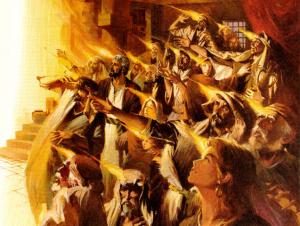
So, it is no surprise that on the day of Pentecost, “there was a sound of a mighty rushing wind.” Sometimes the Holy Spirit is subtle and incognito, but this time she put on a show. The Christian narrative is full of such events—the birth of Jesus, the Resurrection . . . instant gratification events at the heart of belief that are so filling and satisfying that one could imagine that this is the exclusive food that fuels the life of faith. Each of us has had such moments—my family calls them Big Bird moments– times when the veil between the mundane human and glorious divine is pierced, even for a moment, in some unforgettable way.
But are such “mountain top” experiences sufficient to fuel the life of faith in the mundane energy of day-to-day living? Pentecost marks the beginning of “ordinary time,” the longest and, arguably, most uneventful stretch of the liturgical calendar. Think of those who experienced the first Pentecost. Will that experience be enough to sustain those who experienced it when, weeks or months later, they are alone in chains awaiting torture or execution? Will your most spectacular Big Bird moment from the past be enough to get you through the stress of parenting, the tragedy of loss, a divorce, a lost job, an illness, the daily grind, or more than two years of Covid-19 disruption? Are such moments enough to sustain a community of faith when a beloved priest unexpectedly leaves, and we have no certainty about what’s coming next? In the rear-view mirror, the intensity and certainty of Big Bird moments fade over time. Doubt becomes a constant companion of faith.
In the first scene of John Patrick Shanley’s Pulitzer Prize winning play Doubt, Father Brendan Flynn begins his Sunday homily by asking “What do you do when you’re not sure?” He then tells the story of the sole survivor of a shipwreck, a sailor who finds himself floating with a few salvaged provisions in the middle of the ocean on a raft he’s lashed together from floating spars. Using his nautical training, he looks toward the night sky and reads the stars, sets a course for home, and falls asleep. But clouds roll in and block the stars for the next twenty nights. As his provisions dwindle, as thirst and starvation threaten, he begins to have doubts. Is he still on course? Did he set his bearings correctly in the first place? Was his reading of the stars accurate enough to get him home? Or is he doomed to a slow and lonely death in the middle of an unfriendly sea?
I once asked the Living Stones discussion group at the beginning of one of our monthly seminars the following question: “How do we know for sure that we are right? How do we know that what we say we believe every week in the Nicene Creed is true?” The immediate and unanimous response from several of the Stoners was “We don’t.” This may be a very Episcopalian thing to say, but many Christians would consider it to be dangerously wrong—I’ve been told on social media and by commenters on my blog that I’m a heretic and going to hell for saying regularly that doubt and uncertainty are regular companions of faith. But we know better.
One of the final books we considered in my recently concluded “Faith and Doubt” colloquium was Tomáš Halík’s Patience with God. It was my first time through this evocative and dense book that was suggested by my teaching partner. For today, it’s enough to simply appreciate the book’s title and the notion that God is something or someone that we need to have patience with. I think most people of faith, at least occasionally, wish that the God they believe in would demonstrably do something—preferably in answer to a specific prayer. Or maybe something spectacular like the day of Pentecost. But “Let this play out” and “Don’t rush it” are the sorts of phrases that resonate more strongly with my own faith journey—perhaps with yours as well.
In her excellent 2013 book Still, Lauren Winner tells the story of a friend, a pastor’s daughter, who at twelve years of age on the eve of her confirmation service told her father that she was having second thoughts about whether she should be confirmed. She didn’t know whether she really believed all of the things she was supposed to believe, and she was particularly concerned about professing in front of the church that she was ready to believe these things forever. Her wise father responded that “What you promise when you are confirmed is not that you will believe this forever. What you promise when you are confirmed is that this is the story you will wrestle with forever.”
As a preacher’s kid myself, I greatly appreciate this pastor’s loving response to his daughter. The larger religious world in which I grew up was all about certainty, inerrancy, and doctrinal purity. My father was a minister in that world, but over the years I observed him wrestle with the story regularly, evolving from the national vice president of the Independent Fundamental Churches of America to a tongues-speaking charismatic whose primary focus was facilitating the health of those who had been damaged by bad religion. Although we had few explicit conversations about his evolution, I learned by observation that “adventuring with God,” as he would have described it, was exactly that—an adventure. Furthermore, it is not for the faint of heart.
I introduced our “Faith and Doubt” students to Rachel Held Evans during the final week of our semester by viewing together a talk she gave at Lipscomb University in 2015. Lipscomb is a conservative Protestant university, but Evans had the courage to be honest and direct about the doubts that were her constant companions as she evolved from hardcore conservative evangelical Protestant into one of the most important and dynamic voices of progressive Christianity before her untimely death in 2019. Toward the end of her talk, she addressed the question that I’m sure many in the audience that evening were asking.
Why am I still a Christian? Because as hard as that story is to believe, it’s still the story I’m willing to be wrong about.
I love that. Here we are this morning to celebrate one of the high points in the story that we all have embraced, a story so meaningful and life-changing that we are willing to risk being wrong about it.
As we enter into Ordinary Time, we are walking collectively in an uncomfortable season of uncertain faith seeking the Holy Spirit’s guidance. We know that neither Marsue nor Mitch will be walking through that door. Let’s remember the prayer we have been offering over the past several weeks:
Almighty God, giver of every good gift, look graciously on Trinity Church, inspire confidence in us to do your will, and quiet our anxious minds, that we may put our trust in you. We ask you to guide the hearts of those who shall choose a priest for this parish, that we may receive a faithful pastor, who will care for your people and equip us for our ministries, through Jesus Christ our Lord.
Big Bird is in the house, friends. May the energy of Pentecost, when the Spirit showed up and inspired ordinary human beings to change the world, inspire and sustain us today and going forward. Amen.
Previous Post
June 3, 2022
Faith Needs Many Things, But It Doesn't Need a Creed
Next Post
June 7, 2022 How Should a Normal Person Approach the Bible?
Browse Our Archives
Select a Category abortion Advent AI Angels Artificial intelligence atheism attention baptism Baptists beauty belief Benedictines Bible bicycling Big Bird books Bovina Camaldoli hermitage Canada Catholicism cats certainty change Christianity Christmas Collegeville Covid-19 creativity Development of Western Civilization dogs doubt Easter Enneagram Epiphany Episcopal ethics Eucharist evil extroverts Facebook faith family fear flowers forgiveness freedom friends God goodness grace happiness heaven hell history Holy Spirit Holy Week hope human nature humility humor idolatry incarnation introverts irreverence Islam Jeanne Jesus Joe Biden joy Judaism justice Kamala Harris knowledge Lent listen literature liturgy love Marsue Memorial Day miracles movies music mystery mythology NPR Old Testament optimism paradox peace Penguins philosophy piano podcast politics power prayer Protestantism Providence College Religion Rhode Island sabbatical sacrament science seeing silence Simone Weil Socrates soul sports St. John's College stories suffering tattoo teaching technology television theology thinking time tolerance transcendence travel trees trust truth Uncategorized Vermont wisdom wonder writing
Select a Month May 2026 April 2026 March 2026 February 2026 January 2026 December 2025 November 2025 October 2025 September 2025 August 2025 July 2025 June 2025 May 2025 April 2025 March 2025 February 2025 January 2025 December 2024 November 2024 October 2024 September 2024 August 2024 July 2024 June 2024 May 2024 April 2024 March 2024 February 2024 January 2024 December 2023 November 2023 October 2023 September 2023 August 2023 July 2023 June 2023 May 2023 April 2023 March 2023 February 2023 January 2023 December 2022 November 2022 October 2022 September 2022 August 2022 July 2022 June 2022 May 2022 April 2022 March 2022 February 2022 January 2022 December 2021 November 2021 October 2021 September 2021 August 2021 July 2021 June 2021 May 2021 April 2021 March 2021 February 2021 January 2021 December 2020 November 2020 October 2020 September 2020 August 2020 July 2020 June 2020 May 2020 April 2020 March 2020 February 2020 January 2020 December 2019 November 2019 October 2019 September 2019 August 2019 July 2019 June 2019 May 2019 April 2019 March 2019 February 2019 January 2019 December 2018 November 2018 October 2018 September 2018 August 2018 July 2018 June 2018 May 2018 April 2018 March 2018 February 2018 January 2018 December 2017 November 2017 October 2017 September 2017 August 2017 July 2017 June 2017 May 2017 April 2017 March 2017 February 2017 January 2017 December 2016 November 2016 October 2016 September 2016 August 2016 July 2016 June 2016 May 2016 April 2016 March 2016 February 2016 January 2016 December 2015 November 2015 October 2015 September 2015 August 2015 July 2015 June 2015 May 2015 April 2015 March 2015 February 2015 January 2015 December 2014 November 2014 October 2014 September 2014 August 2014 July 2014 June 2014 May 2014 April 2014 March 2014 February 2014 January 2014 December 2013 November 2013 October 2013 September 2013 August 2013 July 2013 June 2013 May 2013 April 2013 March 2013 February 2013 January 2013 December 2012 November 2012 October 2012 September 2012
Follow Us!
TAKE THE
Religious Wisdom Quiz
True or False: Paul wrote to the Philippians while he was imprisoned.
Select your answer to see how you score.
FALSE TRUE
Books by This Author Books by Vance G. Morgan
Related posts from Freelance Christianity

The Lonely Pawn: On Faith, Doubt, and Meaning



AI and Love: When a Chatbot Becomes a...
TRENDING AT PATHEOS Progressive Christian

Why Christians Have a Sacred Duty to Vote:...
The Bible offers strong support for the sacred duty to vote. Here...

What Being a Modern-Day Apostle Means to Me
In my last column, I discussed the ins and outs of modern-day...

Did Ancient China Once Worship the God of...
Across human history, a common thread weaves through the origins of the...

Love Your Neighbor – Including Earth-Kin: Lev. 19,...
God’s command to love your neighbor means acting in an ethical and...

Lead a Church Study of “Jesus and Lao...
Guest writer Jack Thomas (The Irreverent Reverend) reflects on leading his church...

Principles for Understanding the Apostolic Ministry Today
Whenever people discover that my formal ministry title is "apostle," as in...
view all Progressive Christian blogs
Ad-Free & Subscriber Log-In Subscription Support
- About Us
- 2026 Calendar
- Videos
- Podcasts
- Library of World Religions
- Faith In Media Tracker
- Advertise With Us
- Write for Us
- Privacy Policy
- Terms of Service
- Do Not Sell My Data
- Contact Us
- Radiant Digital
- Manage Newsletter Subscriptions
- Unsubscribe From Notifications
- Sitemap
Copyright 2008-2026, Patheos. All rights reserved.
Subscription Support Ad-Free & Subscriber Log-In
Follow Patheos