
BuddhistCatholicContemplativeEvangelicalGeneral ChristianHinduJewishLatter-day SaintMuslimNew VisionsProgressive Christian
Beliefs
- Buddhist
- Catholic
- Contemplative
- Evangelical
- General Christian
- Hindu
- Jewish
- Latter-day Saint
- More Voices
- Muslim
- New Visions
- Pagan
- Progressive Christian
Topics
- Religion News
- Food and Religion
- Sports and Religion
- Religious Art
- Religious Music and Entertainment
- Religious Events
- History and Religion
- Style and Religion
- Politics and Religion
- Women in Religion
- Recreation Outdoors and Religion
- Business Finance and Religion
- Careers Workplace and Religion
- Education and Religion
- Family Parenting and Religion
- Health Fitness and Religion
- Home and Religion
- Relationships and Religion
- Technology and Religion
- Travel and Religion
Columnists
- Buddhist Columnists
- Business Finance and Religion Columnists
- Careers Workplace and Religion Columnists
- Catholic Columnists
- Contemplative Columnists
- Education and Religion Columnists
- Evangelists Columnists
- Family Parenting and Religion Columnists
- General Christian Columnists
- Health Fitness and Religion Columnists
- Hindu Columnists
- History and Religion Columnists
- Home and Religion Columnists
- Jewish Columnists
- More Voices Columnists
- Latter Day Columnists
- Muslim Columnists
- New Visions Columnists
- Nonreligious Columnists
- Pagan Columnists
- Politics and Religion Columnists
- Progressive Columnists
- Recreation Outdoors and Religion Columnists
- Relationships and Religion Columnists
- Religion News Columnists
- Religious Art Columnists
- Religious Events Columnists
- Religious Music and Entertainment Columnists
- Sports and Religion Columnists
- Style and Religion Columnists
- Technology and Religion Columnists
- Travel and Religion Columnists
- Women in Religion Columnists
Resource Library
- 2026 Calendar
- Library of World Religions
- The 100 Most Holy Places on Earth
- Patheos Answers
- Podcasts
- Videos
- Faith Leaders Database
- Anglican Episcopalian
- Bahai
- Baptist
- Buddhism
- Christianity
- Confucianism
- Eastern Orthodoxy
- Hinduism
- Holiness and Pentecostal
- ISKCON
- Islam
- Judaism
- Lutheran
- Methodist
- The Church of Jesus Christ of Latter-day Saints
- New Age
- Paganism
- Presbytarian and Reformed
- Protestantism
- Religion Behind the Scenes
- Roman Catholic
- Scientology
- Shia Islam
- Sikhism
- Sufism
- Sunni Islam
- Taoism
- Zen
- See all religions
Research Tools
 Ad-Free & Subscriber Log-In Subscription Support
Ad-Free & Subscriber Log-In Subscription Support
Follow Patheos 

- Trending:
- Forgiveness
- |
- Marriage
- |
- Consciousness
- |
- Death Penalty
- |
- Election
- |
- Halloween

- Home
- Progressive Christian
- Palm Sunday and the Teaching Life
Palm Sunday and the Teaching Life
Last updated on: April 5, 2020 at 6:49 am by Vance Morgan
Palm Sunday and the Teaching Life 2020-04-05T06:49:47-04:00 Vance Morgan
Patheos Explore the world's faith through different perspectives on religion and spirituality! Patheos has the views of the prevalent religions and spiritualities of the world.
With Palm Sunday begins what will be the strangest Holy Week of my lifetime. The music, the liturgical celebrations, the pomp and circumstance—all of these will have to be virtual and from a distance. It will be interesting to find out the creative ways that people find to connect without physically connecting. I’ll be leading a meeting of my Living Stones seminar on Zoom this afternoon; among other things, perhaps we will be swapping Palm Sunday and Holy Week stories.
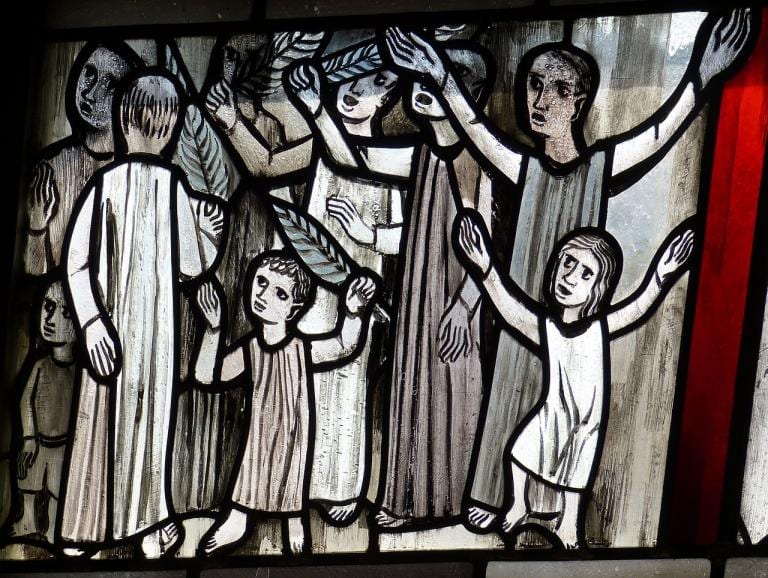
The Palm Sunday celebration in a liturgical Christian church is both confusing and jarring. Everyone with a religious molecule in their bodies knows that Palm Sunday is about Jesus riding triumphantly into Jerusalem on a donkey (or colt), but this gets only about fifteen minutes of air time in the Palm Sunday liturgy. The priest reads the Palm Sunday gospel, the ushers distribute palms while everyone sings “All Glory, Laud and Honor” or something similar, the Old Testament reading, Psalm, and New Testament readings for the day are delivered, and then the liturgical transmission shifts from fifth to second without a clutch. Various assigned participants read the Passion story from the gospel du jour—this year it is Matthew—and the joy of Jesus’s triumphant entry transitions into the drama and tragedy of the Passion, ending with Joseph of Arimathea providing a tomb for Jesus’s body.
I remember a specific Palm Sunday liturgy from several years ago at Trinity Episcopal Church. It was particularly busy for Jeanne and me as she was scheduled as chalice bearer and reader, while I was subbing as lector for the originally scheduled person who was in San Francisco. I was disappointed to be assigned “Criminal Two” (the “good thief”) for the Passion reading (I was hoping for Pilate or Jesus); Jeanne got the centurion, a role played by John Wayne in “The Greatest Story Ever told” and by Ernest Borgnine in “Jesus of Nazareth.” I’m not sure if anyone notable has ever played Criminal Two. But at least my role had more words than hers.
My duties on that Palm Sunday began with my lector assignment—at Trinity, the lector reads the Old Testament reading for the day and leads the prayers of the people. Standing behind the lectern, I looked at the passage from Isaiah—the same passage from the Jewish scriptures for today—for the first time (usually I’m much more prepared), and read
The Lord God has given me the tongue of a teacher . . . Morning by morning he wakens—wakens my ear to listen as those who are taught.
Yes, God has, and yes, God does, if I’m listening. The more I do what I do, the more interested I am in where it comes from. I almost never ask the question “Why am I a teacher?” since I’m convinced that there is nothing else I would be happy doing. But the spring from which teaching bubbles up is of endless fascination to me, since on my best days in the classroom, the energy that connects all participants together in a web of discovery is clearly something I can neither manufacture nor completely control.
A few years ago, I raised some eyebrows on campus by giving a talk entitled “Erotic Pedagogy.” Although the talk was primarily focused on how my study of Simone Weil over the past many years has shaped my teaching, the title was inspired by Richard Rorty, who wrote about
The erotic relationships between teacher and student . . . reminding us that “love is notoriously untheorizable. Such erotic relationships are occasions of growth, and their occurrence and their development are as unpredictable as growth itself. Yet nothing happens in non-vocational higher education without them.
I understand why the Dominican priest who directed the on-campus center where I gave my talk received some questioning emails and phone calls about its advertised title, because out of context the idea of erotic relationships between professors and students on the campus of a Catholic college (or anywhere else) is indeed a bit disturbing.
But Rorty is right—what I do, and what I think all teachers should be doing, in the classroom is almost always more about love than it is about content, vocational preparation, “teaching to the test” or any other such thing. I want students to fall in love with texts, in love with the whole dynamic of learning, with the idea of never stopping the process of learning until they die. As I’ve been teaching classes on Zoom for the past two or three weeks, I have been seeking to duplicate this energy as much as technology and physical distancing will allow.
In my experience, the sparks of lifetime learning are best kindled by example. I almost never place a text on a syllabus unless I can remember some point at which it grabbed me, shook me up, and insisted that I pay attention. Continuing in his essay, Rorty writes that in order “to have inspirational value, a work must be allowed to recontextualize much of what you previously thought you knew;” inspired teaching
is the result of an encounter with an author, character, plot, stanza, line or archaic torso which has made a difference to the [teacher’s] conception of who she is, what she is good for, what she wants to do with herself: an encounter which has rearranged her priorities and purposes.
The characters, ideas and lines from such texts, which continue to rearrange my priorities and purposes as they regularly fill my classroom as well as spilling out of the confines of this blog two or three times each week, give shape and direction to an activity that is unlike any other—learning together. What I most appreciated about the lines from Isaiah that I read from the lectern on that Palm Sunday is being reminded of something that I too often forget. The whole process of teaching and learning, when liberated from my frequent well-meaning but misguided attempts to shape and control it, has divine energy behind it.
This all sounds idealistic and impractical in a world where the value of higher education is often exclusively identified as and judged according to the standard of focused (and very expensive) job preparation. Maybe so—practicality has never been my strong suit. But identifying the tools of lifetime learning and honing skilled use of these tools through engagement with the greatest texts that human beings have produced is an activity whose importance transcends the size of one’s future paycheck.
In an online New York Times commentary entitled “Why Do I Teach?” not that long ago, Gary Gutting, a philosophy professor at Notre Dame, went so far as to argue that far from directed preparation for the job market, the real goal of a college education is not even the passing of knowledge from teacher to student. Gutting writes that
We should judge teaching not by the amount of knowledge it passes on, but by the enduring excitement it generates. Knowledge, when it comes, is a later arrival, flaring up, when the time is right, from the sparks good teachers have implanted in their students’ souls.
Richard Rorty would have endorsed that sentiment, and so do I.
The most important part of Isaiah’s brief comment about teaching is the one that is easiest to forget or ignore—the Lord may have given me the tongue of a teacher, but often effective pedagogy depends on my not using it. “Morning by morning he wakens,” Isaiah tells us, “wakens my ear to listen as those who are taught.” Jeanne pointed out to me once that the word “listen” is made of the same letters as the word “silent.” Listening is perhaps the most important lifetime learning tool to become skilled with; it is definitely the most difficult. When I am sure that I know everything I need to know about a text or an idea walking into the classroom, I am laying the groundwork for a mediocre learning encounter.
Similarly, when I slog through a day never taking the time to be still and listen to anything—a bird outside the window, another person, the too-often-ignored little voice deep inside—I have frittered away a little more of the dwindling time I am given to never learning and growing. As I continue social distancing and hunkering down for the foreseeable future, and as I continue to engage virtually with my students on Zoom, it’s important for me—and for all of us—to pay attention to the things that we tend to ignore, to stop, look, and listen. We all just might learn something.
Previous Post
April 2, 2020
"I Don't Know": The most profoundly religious statement of all
Next Post

April 7, 2020 God is a Question. What is the Answer?
Browse Our Archives
Select a Category abortion Advent AI Angels Artificial intelligence atheism attention baptism Baptists beauty belief Benedictines Bible bicycling Big Bird books Bovina Camaldoli hermitage Canada Catholicism cats certainty change Christianity Christmas Collegeville Covid-19 creativity Development of Western Civilization dogs doubt Easter Enneagram Epiphany Episcopal ethics Eucharist evil extroverts Facebook faith family fear flowers forgiveness freedom friends God goodness grace happiness heaven hell history Holy Spirit Holy Week hope human nature humility humor idolatry incarnation introverts irreverence Islam Jeanne Jesus Joe Biden joy Judaism justice Kamala Harris knowledge Lent listen literature liturgy love Marsue Memorial Day miracles movies music mystery mythology NPR Old Testament optimism paradox peace Penguins philosophy piano podcast politics power prayer Protestantism Providence College Religion Rhode Island sabbatical sacrament science seeing silence Simone Weil Socrates soul sports St. John's College stories suffering tattoo teaching technology television theology thinking time tolerance transcendence travel trees trust truth Uncategorized Vermont wisdom wonder writing
Select a Month May 2026 April 2026 March 2026 February 2026 January 2026 December 2025 November 2025 October 2025 September 2025 August 2025 July 2025 June 2025 May 2025 April 2025 March 2025 February 2025 January 2025 December 2024 November 2024 October 2024 September 2024 August 2024 July 2024 June 2024 May 2024 April 2024 March 2024 February 2024 January 2024 December 2023 November 2023 October 2023 September 2023 August 2023 July 2023 June 2023 May 2023 April 2023 March 2023 February 2023 January 2023 December 2022 November 2022 October 2022 September 2022 August 2022 July 2022 June 2022 May 2022 April 2022 March 2022 February 2022 January 2022 December 2021 November 2021 October 2021 September 2021 August 2021 July 2021 June 2021 May 2021 April 2021 March 2021 February 2021 January 2021 December 2020 November 2020 October 2020 September 2020 August 2020 July 2020 June 2020 May 2020 April 2020 March 2020 February 2020 January 2020 December 2019 November 2019 October 2019 September 2019 August 2019 July 2019 June 2019 May 2019 April 2019 March 2019 February 2019 January 2019 December 2018 November 2018 October 2018 September 2018 August 2018 July 2018 June 2018 May 2018 April 2018 March 2018 February 2018 January 2018 December 2017 November 2017 October 2017 September 2017 August 2017 July 2017 June 2017 May 2017 April 2017 March 2017 February 2017 January 2017 December 2016 November 2016 October 2016 September 2016 August 2016 July 2016 June 2016 May 2016 April 2016 March 2016 February 2016 January 2016 December 2015 November 2015 October 2015 September 2015 August 2015 July 2015 June 2015 May 2015 April 2015 March 2015 February 2015 January 2015 December 2014 November 2014 October 2014 September 2014 August 2014 July 2014 June 2014 May 2014 April 2014 March 2014 February 2014 January 2014 December 2013 November 2013 October 2013 September 2013 August 2013 July 2013 June 2013 May 2013 April 2013 March 2013 February 2013 January 2013 December 2012 November 2012 October 2012 September 2012
Follow Us!
TAKE THE
Religious Wisdom Quiz
What principle is behind "let your light shine before men"?
Select your answer to see how you score.
Show good deeds to glorify God Hide your faith Never speak of God Boast of your wealth
Books by This Author Books by Vance G. Morgan
Related posts from Freelance Christianity

The Lonely Pawn: On Faith, Doubt, and Meaning


AI and Love: When a Chatbot Becomes a...

TRENDING AT PATHEOS Progressive Christian

What Being a Modern-Day Apostle Means to Me
In my last column, I discussed the ins and outs of modern-day...

Did Ancient China Once Worship the God of...
Across human history, a common thread weaves through the origins of the...

Love Your Neighbor – Including Earth-Kin: Lev. 19,...
God’s command to love your neighbor means acting in an ethical and...

Lead a Church Study of “Jesus and Lao...
Guest writer Jack Thomas (The Irreverent Reverend) reflects on leading his church...

Pastoral Wisdom for Responding to Sermon Pushback
Getting sermon pushback on your social justice sermon? Learn practical, Proverbs-based strategies...

Principles for Understanding the Apostolic Ministry Today
Whenever people discover that my formal ministry title is "apostle," as in...
view all Progressive Christian blogs
Ad-Free & Subscriber Log-In Subscription Support
- About Us
- 2026 Calendar
- Videos
- Podcasts
- Library of World Religions
- Faith In Media Tracker
- Advertise With Us
- Write for Us
- Privacy Policy
- Terms of Service
- Do Not Sell My Data
- Contact Us
- Radiant Digital
- Manage Newsletter Subscriptions
- Unsubscribe From Notifications
- Sitemap
Copyright 2008-2026, Patheos. All rights reserved.
Subscription Support Ad-Free & Subscriber Log-In
Follow Patheos