
BuddhistCatholicContemplativeEvangelicalGeneral ChristianHinduJewishLatter-day SaintMuslimNew VisionsProgressive Christian
Beliefs
- Buddhist
- Catholic
- Contemplative
- Evangelical
- General Christian
- Hindu
- Jewish
- Latter-day Saint
- More Voices
- Muslim
- New Visions
- Pagan
- Progressive Christian
Topics
- Religion News
- Food and Religion
- Sports and Religion
- Religious Art
- Religious Music and Entertainment
- Religious Events
- History and Religion
- Style and Religion
- Politics and Religion
- Women in Religion
- Recreation Outdoors and Religion
- Business Finance and Religion
- Careers Workplace and Religion
- Education and Religion
- Family Parenting and Religion
- Health Fitness and Religion
- Home and Religion
- Relationships and Religion
- Technology and Religion
- Travel and Religion
Columnists
- Buddhist Columnists
- Business Finance and Religion Columnists
- Careers Workplace and Religion Columnists
- Catholic Columnists
- Contemplative Columnists
- Education and Religion Columnists
- Evangelists Columnists
- Family Parenting and Religion Columnists
- General Christian Columnists
- Health Fitness and Religion Columnists
- Hindu Columnists
- History and Religion Columnists
- Home and Religion Columnists
- Jewish Columnists
- More Voices Columnists
- Latter Day Columnists
- Muslim Columnists
- New Visions Columnists
- Nonreligious Columnists
- Pagan Columnists
- Politics and Religion Columnists
- Progressive Columnists
- Recreation Outdoors and Religion Columnists
- Relationships and Religion Columnists
- Religion News Columnists
- Religious Art Columnists
- Religious Events Columnists
- Religious Music and Entertainment Columnists
- Sports and Religion Columnists
- Style and Religion Columnists
- Technology and Religion Columnists
- Travel and Religion Columnists
- Women in Religion Columnists
Resource Library
- 2026 Calendar
- Library of World Religions
- The 100 Most Holy Places on Earth
- Patheos Answers
- Podcasts
- Videos
- Faith Leaders Database
- Anglican Episcopalian
- Bahai
- Baptist
- Buddhism
- Christianity
- Confucianism
- Eastern Orthodoxy
- Hinduism
- Holiness and Pentecostal
- ISKCON
- Islam
- Judaism
- Lutheran
- Methodist
- The Church of Jesus Christ of Latter-day Saints
- New Age
- Paganism
- Presbytarian and Reformed
- Protestantism
- Religion Behind the Scenes
- Roman Catholic
- Scientology
- Shia Islam
- Sikhism
- Sufism
- Sunni Islam
- Taoism
- Zen
- See all religions
Research Tools
 Ad-Free & Subscriber Log-In Subscription Support
Ad-Free & Subscriber Log-In Subscription Support
Follow Patheos 

- Trending:
- Forgiveness
- |
- Marriage
- |
- Consciousness
- |
- Death Penalty
- |
- Election
- |
- Halloween

- Home
- Progressive Christian
- Why Faith Needs Doubt: A Lesson from Exams and a Pope
Why Faith Needs Doubt: A Lesson from Exams and a Pope
Last updated on: May 14, 2025 at 10:57 am by Vance Morgan
Why Faith Needs Doubt: A Lesson from Exams and a Pope 2025-05-14T10:57:30-04:00 Vance Morgan
Patheos Explore the world's faith through different perspectives on religion and spirituality! Patheos has the views of the prevalent religions and spiritualities of the world.
Oral Exams and Conclaves
Last week was final exam week–I administered 32 written exams and held 34 oral exams (25-30 minutes each) in my office. I greatly prefer oral to written exams and would love for all exams in my courses to be oral. But one week doesn’t provide enough time for that, so I made oral exams optional in two of my three courses.
Oral exams tend to run together when you have seven or eight of them per day for five straight days. But some of them are memorable. I always end an oral exam with the same hypothetical question: Ten years from now, suppose you are back on campus for your ten-year class reunion. You get into a conversation with someone who was in this class with you and you realize that you haven’t thought much about the class since your oral exam. But once you start thinking about it, you realize that there was one thing from the course that really stuck with you. What would that thing be?
Questions and Doubts Remained
One of the students from my American Philosophy class answered the question by telling a personal story. Raised Catholic in a devout family, she went to twelve years of Catholic school before college, regularly attending mass with her family while hitting all of the Catholic mile markers such as baptism, first communion, confession, and CCD along the way. But there was a problem, a problem that I recognized clearly from my own religious upbringing–she had doubts. Not all the time, but frequently enough to both raise questions and cause guilt. No one else in her family or circle of Catholic friends expressed such doubts, so she assumed there was something wrong with her. But the questions and doubts remained.
Now as a twenty or twenty-one year old college junior, she told me what the one thing from our class that would stick with her the most is that “it is okay not to be sure.” Our course focused primarily on “pragmatism,” arguably the unique and most important American contribution to the Western tradition in philosophy. One of the most important and controversial aspects of pragmatism is its treatment of truth. Traditionally, an idea or belief has been considered as “true” if the idea matches up or “corresponds” to the way things actually are in reality. The pragmatists reject this correspondence theory, proposing instead an entirely different criterion as expressed by William James.
Pragmatism is an American Philosophy
Pragmatism . . . asks its usual question. ‘Grant an idea or belief to be true,’ it says, ‘what concrete difference will its being true make in any one’s actual life? How will the truth be realized? What experiences will be different from those that would obtain if the belief were false? What, in short, is the truth’s cash-value in experiential terms? . . . The truth of an idea is not a stagnant property inherent in it. Truth happens to an idea. It becomes true, is made true by events. Its verity is in fact an event, a process: the process, namely, of its verifying itself.
Truth is an event, not a fixed relationship between idea and reality. A belief or idea becomes true on the basis of its fruitfulness and cash-value. The truth of an idea is established by how well it works in terms of opening possibilities and positive pathways. Pragmatism is an American philosophy through and through. More to come in future posts.
Greater Than Us?
Back to my student. She went on to say that she carried a certain amount of self-consciousness and guilt into her early adulthood because of her doubts about what she thought she was supposed to be certain about. In this class she learned of a different way of thinking about belief, a way that not only embraces but requires doubt and constant revision. The pragmatists ask what one should do when a belief or set of beliefs has gone stale or no longer is meaningful. Their answer is to change your belief. This is controversial in any area of belief, but particularly so when applied to faith.
My student, as the vast majority of religious believers, had been taught that one’s beliefs concerning what is greater than us cannot be challenged. Certainty is a sign of faithfulness, while doubt is a sign of weakness or, at worst, apostasy. But as she told me in her oral exam, being given the permission to doubt, to suppose that her faith will be a matter of continual growth and change, was life-giving. Both she and I were smiling as she left my office when her oral exam ended.
Doubt Serves Faith
Fair Use
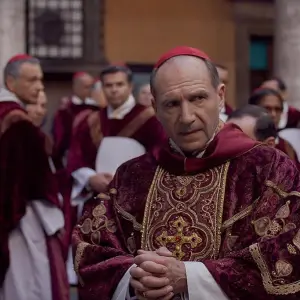
This student’s oral exam was early in the week, so on that day, the new pope had not yet been selected. The conclave was in session and who knew when the white smoke would be produced. Jeanne and I had watched the movie “Conclave” the previous weekend on Amazon Prime in anticipation. We had seen the movie at our usual movie complex when it was in the theatres and were not particularly impressed. This time I liked it better, particularly the sermon by Cardinal Lawrence (played by Ralph Fiennes). Here’s an excerpt:
My brothers and sisters, in the course of a long life in the service of our Mother the Church, let me tell you that the one sin I have come to fear more than any other is certainty. Certainty is the great enemy of unity. Certainty is the deadly enemy of tolerance. Even Christ was not certain at the end. He cried out in His agony at the ninth hour on the cross, “My God, my God, why have you forsaken me?” Our faith is a living thing precisely because it walks hand in hand with doubt. If there was only certainty, and if there was no doubt, there would be no mystery, and therefore no need for faith.
Let us pray that the Lord will grant us a Pope who doubts. Let Him grant us a Pope who sins, and asks forgiveness, and carries on.
Early signs are that Leo XIV is well aware that certainty is the enemy of faith and that faith and doubt go hand in hand. Good news for everyone.
Previous Post
May 11, 2025
We Are Waterproof: Finding Faith in the Life of Sheep
Next Post

May 15, 2025 The President and the Cult of Ignorance
Recent Comments
"Mary did have a choice. And she was able to make it before the Holy ..."
"i cannot read beyond your recommendations for the books since i like to have a ..."
"AI will never be able to utter with honesty, feeling, or humility, the greeting: "Namaste".It ..."
"They do. I'm sure you could find discussions of the same topic from any of ..."
Browse Our Archives
Select a Category abortion Advent AI Angels Artificial intelligence atheism attention baptism Baptists beauty belief Benedictines Bible bicycling Big Bird books Bovina Camaldoli hermitage Canada Catholicism cats certainty change Christianity Christmas Collegeville Covid-19 creativity Development of Western Civilization dogs doubt Easter Enneagram Epiphany Episcopal ethics Eucharist evil extroverts Facebook faith family fear flowers forgiveness freedom friends God goodness grace happiness heaven hell history Holy Spirit Holy Week hope human nature humility humor idolatry incarnation introverts irreverence Islam Jeanne Jesus Joe Biden joy Judaism justice Kamala Harris knowledge Lent listen literature liturgy love Marsue Memorial Day miracles movies music mystery mythology NPR Old Testament optimism paradox peace Penguins philosophy piano podcast politics power prayer Protestantism Providence College Religion Rhode Island sabbatical sacrament science seeing silence Simone Weil Socrates soul sports St. John's College stories suffering tattoo teaching technology television theology thinking time tolerance transcendence travel trees trust truth Uncategorized Vermont wisdom wonder writing
Select a Month May 2026 April 2026 March 2026 February 2026 January 2026 December 2025 November 2025 October 2025 September 2025 August 2025 July 2025 June 2025 May 2025 April 2025 March 2025 February 2025 January 2025 December 2024 November 2024 October 2024 September 2024 August 2024 July 2024 June 2024 May 2024 April 2024 March 2024 February 2024 January 2024 December 2023 November 2023 October 2023 September 2023 August 2023 July 2023 June 2023 May 2023 April 2023 March 2023 February 2023 January 2023 December 2022 November 2022 October 2022 September 2022 August 2022 July 2022 June 2022 May 2022 April 2022 March 2022 February 2022 January 2022 December 2021 November 2021 October 2021 September 2021 August 2021 July 2021 June 2021 May 2021 April 2021 March 2021 February 2021 January 2021 December 2020 November 2020 October 2020 September 2020 August 2020 July 2020 June 2020 May 2020 April 2020 March 2020 February 2020 January 2020 December 2019 November 2019 October 2019 September 2019 August 2019 July 2019 June 2019 May 2019 April 2019 March 2019 February 2019 January 2019 December 2018 November 2018 October 2018 September 2018 August 2018 July 2018 June 2018 May 2018 April 2018 March 2018 February 2018 January 2018 December 2017 November 2017 October 2017 September 2017 August 2017 July 2017 June 2017 May 2017 April 2017 March 2017 February 2017 January 2017 December 2016 November 2016 October 2016 September 2016 August 2016 July 2016 June 2016 May 2016 April 2016 March 2016 February 2016 January 2016 December 2015 November 2015 October 2015 September 2015 August 2015 July 2015 June 2015 May 2015 April 2015 March 2015 February 2015 January 2015 December 2014 November 2014 October 2014 September 2014 August 2014 July 2014 June 2014 May 2014 April 2014 March 2014 February 2014 January 2014 December 2013 November 2013 October 2013 September 2013 August 2013 July 2013 June 2013 May 2013 April 2013 March 2013 February 2013 January 2013 December 2012 November 2012 October 2012 September 2012
Follow Us!
TAKE THE
Religious Wisdom Quiz
Who said, "Father, I have sinned against heaven and against you"?
Select your answer to see how you score.
The Pharisee The Lost Sheep The Prodigal Son The Rich Young Ruler
Books by This Author Books by Vance G. Morgan
Related posts from Freelance Christianity

The Lonely Pawn: On Faith, Doubt, and Meaning


AI and Love: When a Chatbot Becomes a...

TRENDING AT PATHEOS Progressive Christian

What Being a Modern-Day Apostle Means to Me
In my last column, I discussed the ins and outs of modern-day...

Did Ancient China Once Worship the God of...
Across human history, a common thread weaves through the origins of the...

Love Your Neighbor – Including Earth-Kin: Lev. 19,...
God’s command to love your neighbor means acting in an ethical and...

Lead a Church Study of “Jesus and Lao...
Guest writer Jack Thomas (The Irreverent Reverend) reflects on leading his church...

Pastoral Wisdom for Responding to Sermon Pushback
Getting sermon pushback on your social justice sermon? Learn practical, Proverbs-based strategies...

Principles for Understanding the Apostolic Ministry Today
Whenever people discover that my formal ministry title is "apostle," as in...
view all Progressive Christian blogs
What Are Your Thoughts?leave a comment
Ad-Free & Subscriber Log-In Subscription Support
- About Us
- 2026 Calendar
- Videos
- Podcasts
- Library of World Religions
- Faith In Media Tracker
- Advertise With Us
- Write for Us
- Privacy Policy
- Terms of Service
- Do Not Sell My Data
- Contact Us
- Radiant Digital
- Manage Newsletter Subscriptions
- Unsubscribe From Notifications
- Sitemap
Copyright 2008-2026, Patheos. All rights reserved.
Subscription Support Ad-Free & Subscriber Log-In
Follow Patheos