
BuddhistCatholicContemplativeEvangelicalGeneral ChristianHinduJewishLatter-day SaintMuslimNew VisionsProgressive Christian
Beliefs
- Buddhist
- Catholic
- Contemplative
- Evangelical
- General Christian
- Hindu
- Jewish
- Latter-day Saint
- More Voices
- Muslim
- New Visions
- Pagan
- Progressive Christian
Topics
- Religion News
- Food and Religion
- Sports and Religion
- Religious Art
- Religious Music and Entertainment
- Religious Events
- History and Religion
- Style and Religion
- Politics and Religion
- Women in Religion
- Recreation Outdoors and Religion
- Business Finance and Religion
- Careers Workplace and Religion
- Education and Religion
- Family Parenting and Religion
- Health Fitness and Religion
- Home and Religion
- Relationships and Religion
- Technology and Religion
- Travel and Religion
Columnists
- Buddhist Columnists
- Business Finance and Religion Columnists
- Careers Workplace and Religion Columnists
- Catholic Columnists
- Contemplative Columnists
- Education and Religion Columnists
- Evangelists Columnists
- Family Parenting and Religion Columnists
- General Christian Columnists
- Health Fitness and Religion Columnists
- Hindu Columnists
- History and Religion Columnists
- Home and Religion Columnists
- Jewish Columnists
- More Voices Columnists
- Latter Day Columnists
- Muslim Columnists
- New Visions Columnists
- Nonreligious Columnists
- Pagan Columnists
- Politics and Religion Columnists
- Progressive Columnists
- Recreation Outdoors and Religion Columnists
- Relationships and Religion Columnists
- Religion News Columnists
- Religious Art Columnists
- Religious Events Columnists
- Religious Music and Entertainment Columnists
- Sports and Religion Columnists
- Style and Religion Columnists
- Technology and Religion Columnists
- Travel and Religion Columnists
- Women in Religion Columnists
Resource Library
- 2026 Calendar
- Library of World Religions
- The 100 Most Holy Places on Earth
- Patheos Answers
- Podcasts
- Videos
- Faith Leaders Database
- Anglican Episcopalian
- Bahai
- Baptist
- Buddhism
- Christianity
- Confucianism
- Eastern Orthodoxy
- Hinduism
- Holiness and Pentecostal
- ISKCON
- Islam
- Judaism
- Lutheran
- Methodist
- The Church of Jesus Christ of Latter-day Saints
- New Age
- Paganism
- Presbytarian and Reformed
- Protestantism
- Religion Behind the Scenes
- Roman Catholic
- Scientology
- Shia Islam
- Sikhism
- Sufism
- Sunni Islam
- Taoism
- Zen
- See all religions
Research Tools
 Ad-Free & Subscriber Log-In Subscription Support
Ad-Free & Subscriber Log-In Subscription Support
Follow Patheos 

- Trending:
- Forgiveness
- |
- Marriage
- |
- Consciousness
- |
- Death Penalty
- |
- Election
- |
- Halloween

- Home
- Progressive Christian
- Old White Guys
Old White Guys
Last updated on: April 4, 2016 at 7:30 am by Vance Morgan
Old White Guys 2016-04-04T07:30:54-04:00 Vance Morgan
Patheos Explore the world's faith through different perspectives on religion and spirituality! Patheos has the views of the prevalent religions and spiritualities of the world.
The fault, dear Brutus, lies not in our stars, but in ourselves.
William Shakespeare, Julius Caesar
Looking in the mirror for the first time every morning is always a sobering shock, but the other day it was a bit more disturbing than usual. “Wow, you old white guy,” I thought to myself.” “The success of Donald Trump’s run for president thus far is due to people like you.”
A couple of days later, this came up in a locker room conversation. One of my favorite conversation people to talk with is a retired professor from the history department, with whom I had the privilege of team-teaching a course a couple of years ago during his final year in the classroom. J is curmudgeonly, direct, opinionated, and very insightful—all reasons that I enjoy conversing with him. Our most recent conversation took place in the locker room at our on-campus gym; we tend to work out around the same late morning time on weekdays.
Him: History proves that human beings are the worst thing that’s ever happened to our planet. Things would be a lot better if about seventy-five percent of the people now alive were wiped out.
Me: Really?
Him: Yeah—a motorcycle-riding buddy of mine once said that he agreed with me until I reminded him that this included children.
Me: You know, the typical Donald Trump supporters are predominantly old white guys. I’d be happy to start by wiping out old white guys, except that’s my demographic.
Him: Mine too. That’s a problem.
During our current Presidential election cycle my sixty-year-old whiteness has come to my attention more frequently than in the past—I hear and read over and over again that certain elements of U. S. citizenry are angry, upset about all sorts of things, an anger that has made outsider candidates such Ben Carson, early on, and Donald Trump attractive in spite of their complete lack of traditional qualifications for the Presidency. And what sorts of people are angriest? Older white people, particularly older white guys. My demographic, in other words. What are older white guys mad about? Just about everything, apparently; the general sense is a gnawing fear that things they have taken for granted their whole lives are changing and that the world they thought they could depend on seems not quite so dependable any more.  A world which used to make perfect sense isn’t making sense any more. Perhaps more to the point, older white guys aren’t happy about an emerging world in which whiteness, maleness, and entitlement are no longer synonymous. I refer to these guys as “they” and often rail against their fear and rigidity—but as Pogo once said, “we have met the enemy, and he is us.” Like it or not, I’m getting older and I’m a white male. “They” are my people.
I have written about white privilege before, noting that even though older white folks such as I have been the beneficiaries of generations of accumulated and embedded privilege our whole lives—often without our even being aware—it can be jarring to be told forcefully in various ways that what we take for granted has been institutionally denied to those unlike us throughout the history of our country.
But as Bob Dylan observed more than a half century ago, “the times, they are a-changin’.” For those who long for the world they thought had been guaranteed to them and to which they believe they are entitled, the news is not good. Those days are not coming back.
In Louise Penny’s Still Life, the first installment in her award-winning Chief Inspector Gamache mystery series that I have just begun reading, the Chief Inspector and Myrna, proprietor of a small bookstore in Three Pines, Quebec, have a conversation about the inevitability of change and the various ways in which human beings deal with it. For twenty-five years Myrna was a psychologist in Montreal, one hour’s drive to the north, before chucking it all, moving to rural Three Pines, and rebooting her life entirely. Why did she do it?
I lost sympathy with many of my patients. After twenty-five years of listening to their complaints I finally snapped. I woke up one morning bent out of shape about this client who was forty-three but acting sixteen. Every week he’d come with the same complaints, “Someone hurt me. Life is unfair. It’s not my fault.” For three years I’d been making suggestions, and for three years he’d done nothing. Then, listening to him this one day, I suddenly understood. He wasn’t changing because he didn’t want to.  He had no intention of changing. For the next twenty years we would go through this charade. And I realized in that same instant that most of my clients were exactly like him.
This puts a different spin on things. The world around us is what it is, as Jeanne would say, and there is often little or nothing we can do about it. But as the ancient Stoics, Myrna’s point is that what really matters is how I will respond to those things outside my control, how I will process what comes to me on a daily basis, particularly those things that impose themselves on me without my permission or agreement. And the choice of how to respond, react, and process is entirely up to me.
Most of us are great with change, as long as it was our idea. But change imposed from the outside sends most people into a tailspin. If we can accept that nothing is permanent, and change is inevitable, if we can adapt, then we’re going to be happier people.
I recall clearly my first “old white guy” reaction to change— it happened over twenty-five years ago, well before I officially entered the old white guy demographic. I was applying to my first college teaching positions with my Ph.D. soon to be in hand; I had terrific recommendations, straight A’s, teaching experience, and even a couple of published articles. And no one was calling me for interviews. After a certain amount of frustration, I managed to put two and two together—and didn’t like the resulting sum. I knew that 85-90% of all the college level university philosophy professors in America at that time were white males. I was aware that I am white and male. But I had not joined these promising facts together with the fact that the world had changed and was continuing to change in ways that did not particularly favor people in my demographic. In short, I was born with two tickets—whiteness and maleness—that in the past were the most useful tickets to have in our country for gaining access to just about everything that matters—jobs, housing, education, and so on.
But during my own lifetime, those tickets not only began to stop giving people like me surefire access to everything—they sometimes even became liabilities. The very characteristics that traditionally would have put me at the top of the list were now more likely to put me at the bottom. Imagine that—philosophy departments full of people who looked like me were beginning to think that perhaps qualified women and persons of color had not been treated fairly. Furthermore, armed with programs like affirmative action, they were beginning to do something about it. “Well that’s not fair!” I thought. “It’s not my fault that I’m white and male!” No it wasn’t, but neither would it have been fair for me to benefit from a skewed and unjust system that would have favored me in the past for reasons having nothing to do with my own qualifications. Change had come and was continuing to do so without my permission. My only choice was to decide how to respond to and process this development.
As their conversation continues, Myrna and the Chief Inspector draw an important conclusion, one memorably summarized by Cassius in Shakespeare’s Julius Caesar.
Myrna: Life is change. If you aren’t growing and evolving you’re standing still, and the rest of the world is surging ahead. Most of these people are very immature. They lead “still” lives, waiting. Waiting for someone to save them. Expecting someone to save them or at least protect them from the big, bad world. 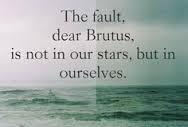 The thing is no one else can save them because the problem is theirs and so is the solution. Only they can get out of it.
Gamache: “The fault, dear Brutus, is not in our stars, but in ourselves.”
Myrna: That’s it. It’s not fate, not genetics, not bad luck . . . Ultimately it’s us and our choices. The vast majority of troubled people don’t get it. The fault is here, but so is the solution. That’s the grace.
Previous Post

April 1, 2016
Jesus, Moe, and Curly
Next Post
April 6, 2016 Are Philosophers Hypocrites? (Or are they just normal human beings?)
Browse Our Archives
Select a Category abortion Advent AI Angels Artificial intelligence atheism attention baptism Baptists beauty belief Benedictines Bible bicycling Big Bird books Bovina Camaldoli hermitage Canada Catholicism cats certainty change Christianity Christmas Collegeville Covid-19 creativity Development of Western Civilization dogs doubt Easter Enneagram Epiphany Episcopal ethics Eucharist evil extroverts Facebook faith family fear flowers forgiveness freedom friends God goodness grace happiness heaven hell history Holy Spirit Holy Week hope human nature humility humor idolatry incarnation introverts irreverence Islam Jeanne Jesus Joe Biden joy Judaism justice Kamala Harris knowledge Lent listen literature liturgy love Marsue Memorial Day miracles movies music mystery mythology NPR Old Testament optimism paradox peace Penguins philosophy piano podcast politics power prayer Protestantism Providence College Religion Rhode Island sabbatical sacrament science seeing silence Simone Weil Socrates soul sports St. John's College stories suffering tattoo teaching technology television theology thinking time tolerance transcendence travel trees trust truth Uncategorized Vermont wisdom wonder writing
Select a Month May 2026 April 2026 March 2026 February 2026 January 2026 December 2025 November 2025 October 2025 September 2025 August 2025 July 2025 June 2025 May 2025 April 2025 March 2025 February 2025 January 2025 December 2024 November 2024 October 2024 September 2024 August 2024 July 2024 June 2024 May 2024 April 2024 March 2024 February 2024 January 2024 December 2023 November 2023 October 2023 September 2023 August 2023 July 2023 June 2023 May 2023 April 2023 March 2023 February 2023 January 2023 December 2022 November 2022 October 2022 September 2022 August 2022 July 2022 June 2022 May 2022 April 2022 March 2022 February 2022 January 2022 December 2021 November 2021 October 2021 September 2021 August 2021 July 2021 June 2021 May 2021 April 2021 March 2021 February 2021 January 2021 December 2020 November 2020 October 2020 September 2020 August 2020 July 2020 June 2020 May 2020 April 2020 March 2020 February 2020 January 2020 December 2019 November 2019 October 2019 September 2019 August 2019 July 2019 June 2019 May 2019 April 2019 March 2019 February 2019 January 2019 December 2018 November 2018 October 2018 September 2018 August 2018 July 2018 June 2018 May 2018 April 2018 March 2018 February 2018 January 2018 December 2017 November 2017 October 2017 September 2017 August 2017 July 2017 June 2017 May 2017 April 2017 March 2017 February 2017 January 2017 December 2016 November 2016 October 2016 September 2016 August 2016 July 2016 June 2016 May 2016 April 2016 March 2016 February 2016 January 2016 December 2015 November 2015 October 2015 September 2015 August 2015 July 2015 June 2015 May 2015 April 2015 March 2015 February 2015 January 2015 December 2014 November 2014 October 2014 September 2014 August 2014 July 2014 June 2014 May 2014 April 2014 March 2014 February 2014 January 2014 December 2013 November 2013 October 2013 September 2013 August 2013 July 2013 June 2013 May 2013 April 2013 March 2013 February 2013 January 2013 December 2012 November 2012 October 2012 September 2012
Follow Us!
TAKE THE
Religious Wisdom Quiz
I am a seller of purple cloth from Thyatira. My heart was opened to respond to Paul's message, and I became the first European convert. Who am I?
Select your answer to see how you score.
Lydia Mary Phoebe Priscilla
Books by This Author Books by Vance G. Morgan
Related posts from Freelance Christianity

The Lonely Pawn: On Faith, Doubt, and Meaning


AI and Love: When a Chatbot Becomes a...

TRENDING AT PATHEOS Progressive Christian

What Being a Modern-Day Apostle Means to Me
In my last column, I discussed the ins and outs of modern-day...

Did Ancient China Once Worship the God of...
Across human history, a common thread weaves through the origins of the...

Love Your Neighbor – Including Earth-Kin: Lev. 19,...
God’s command to love your neighbor means acting in an ethical and...

Lead a Church Study of “Jesus and Lao...
Guest writer Jack Thomas (The Irreverent Reverend) reflects on leading his church...

Pastoral Wisdom for Responding to Sermon Pushback
Getting sermon pushback on your social justice sermon? Learn practical, Proverbs-based strategies...

Principles for Understanding the Apostolic Ministry Today
Whenever people discover that my formal ministry title is "apostle," as in...
view all Progressive Christian blogs
Ad-Free & Subscriber Log-In Subscription Support
- About Us
- 2026 Calendar
- Videos
- Podcasts
- Library of World Religions
- Faith In Media Tracker
- Advertise With Us
- Write for Us
- Privacy Policy
- Terms of Service
- Do Not Sell My Data
- Contact Us
- Radiant Digital
- Manage Newsletter Subscriptions
- Unsubscribe From Notifications
- Sitemap
Copyright 2008-2026, Patheos. All rights reserved.
Subscription Support Ad-Free & Subscriber Log-In
Follow Patheos