
BuddhistCatholicContemplativeEvangelicalGeneral ChristianHinduJewishLatter-day SaintMuslimNew VisionsProgressive Christian
Beliefs
- Buddhist
- Catholic
- Contemplative
- Evangelical
- General Christian
- Hindu
- Jewish
- Latter-day Saint
- More Voices
- Muslim
- New Visions
- Pagan
- Progressive Christian
Topics
- Religion News
- Food and Religion
- Sports and Religion
- Religious Art
- Religious Music and Entertainment
- Religious Events
- History and Religion
- Style and Religion
- Politics and Religion
- Women in Religion
- Recreation Outdoors and Religion
- Business Finance and Religion
- Careers Workplace and Religion
- Education and Religion
- Family Parenting and Religion
- Health Fitness and Religion
- Home and Religion
- Relationships and Religion
- Technology and Religion
- Travel and Religion
Columnists
- Buddhist Columnists
- Business Finance and Religion Columnists
- Careers Workplace and Religion Columnists
- Catholic Columnists
- Contemplative Columnists
- Education and Religion Columnists
- Evangelists Columnists
- Family Parenting and Religion Columnists
- General Christian Columnists
- Health Fitness and Religion Columnists
- Hindu Columnists
- History and Religion Columnists
- Home and Religion Columnists
- Jewish Columnists
- More Voices Columnists
- Latter Day Columnists
- Muslim Columnists
- New Visions Columnists
- Nonreligious Columnists
- Pagan Columnists
- Politics and Religion Columnists
- Progressive Columnists
- Recreation Outdoors and Religion Columnists
- Relationships and Religion Columnists
- Religion News Columnists
- Religious Art Columnists
- Religious Events Columnists
- Religious Music and Entertainment Columnists
- Sports and Religion Columnists
- Style and Religion Columnists
- Technology and Religion Columnists
- Travel and Religion Columnists
- Women in Religion Columnists
Resource Library
- 2026 Calendar
- Library of World Religions
- The 100 Most Holy Places on Earth
- Patheos Answers
- Podcasts
- Videos
- Faith Leaders Database
- Anglican Episcopalian
- Bahai
- Baptist
- Buddhism
- Christianity
- Confucianism
- Eastern Orthodoxy
- Hinduism
- Holiness and Pentecostal
- ISKCON
- Islam
- Judaism
- Lutheran
- Methodist
- The Church of Jesus Christ of Latter-day Saints
- New Age
- Paganism
- Presbytarian and Reformed
- Protestantism
- Religion Behind the Scenes
- Roman Catholic
- Scientology
- Shia Islam
- Sikhism
- Sufism
- Sunni Islam
- Taoism
- Zen
- See all religions
Research Tools
 Ad-Free & Subscriber Log-In Subscription Support
Ad-Free & Subscriber Log-In Subscription Support
Follow Patheos 

- Trending:
- Forgiveness
- |
- Marriage
- |
- Consciousness
- |
- Death Penalty
- |
- Election
- |
- Halloween

- Home
- Progressive Christian
- Not Even Jesus Was Always His Best Self
Not Even Jesus Was Always His Best Self
Last updated on: September 2, 2021 at 6:00 am by Vance Morgan
Not Even Jesus Was Always His Best Self 2021-08-30T11:18:16-04:00 Vance Morgan
Patheos Explore the world's faith through different perspectives on religion and spirituality! Patheos has the views of the prevalent religions and spiritualities of the world.
My first teaching position was at a small university in Memphis. My department was the “Department of Religion and Philosophy,” housing four theologians and two philosophers. I taught most of the philosophy courses (five classes per semester—that’s a lot, in case you’re wondering); the other philosopher on staff had a reduced teaching load because he was also the Dean of the School of Humanities.
Peter was also the most awkwardly, painfully introverted, and shy adult human being I have ever met. Every time I describe myself as an off-the-charts introvert (which I am), I remember Peter and am thankful that I’m not that introverted. Peter was a fifty-something bachelor (there were rumors that he had been on a date once a couple of decades earlier). One of his passions was trains. In the basement of his small house, Peter had a model train village that rivalled anything I had ever seen in a large museum. Before long, I learned about Peter’s other passion.
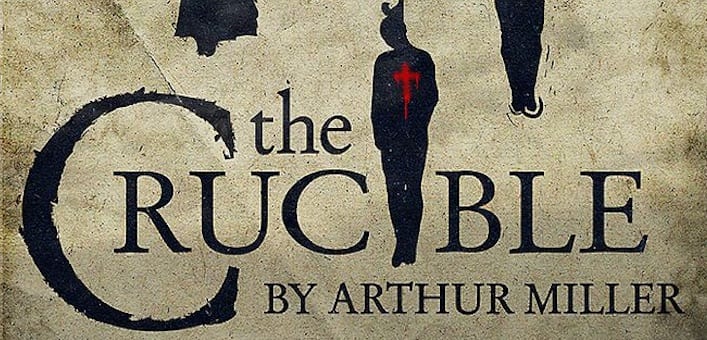
During my first year at the university, I attended an in-house production of Arthur Miller’s The Crucible, a powerful play about the Salem witch trials. Written in the 1950s, it is also clearly an allegory for McCarthyism. Perusing the program as I waited for the play to begin, I was astounded to read that the important role of Reverend John Hale would be played by Peter. “This will not be good,” I thought. I could not imagine anything more incongruous than this guy—whose introversion and awkwardness were legendary on campus—playing a major role in a famous drama on stage.
Long story short, Peter was brilliant. By the end of the first act, I had completely forgotten that the actor playing Hale with such nuance, insight, and fervor was my strange, mousy colleague. It was Peter, but it wasn’t. Whatever internal depths he was reaching into on stage were deep waters that I had never suspected the existence of. Peter had not been temporarily invaded by a thespian spirit—what I witnessed on stage was just a Peter no one ever saw except when he was acting.
For the remainder of my three years in Memphis, I often wondered why Peter never brought the “Peter” I saw on stage, so confident and comfortable in his own skin, into his “real” life off stage. I suspect that everyone has been urged by someone in their lives—an authority figure, parent, grandparent, significant other, boss—to “be your best self,” or to “put your best foot forward.” These can be annoying clichés, but they reflect our general awareness that each of us chooses to conceal as much as we reveal.
The idea is that an integrated person is a healthier person than one who compartmentalizes, only allowing certain aspects of themselves to emerge in rare and narrowly defined circumstances. But what if there are some parts of my “self” that I hide because I don’t like them, because they might reveal character flaws and weaknesses that I would prefer no one know about? Does my “best self” include even my feet of clay? These are central questions in one of my favorite texts from the gospels; Mark’s version of the story is next Sunday’s gospel reading.
As is typical in Mark’s gospel, the account is relatively brief and sparse. Permit me to use Matthew’s slightly extended version, in which a number of things are going on. We learn from the disciples that the Pharisees are offended by something that Jesus recently said; Jesus’ lengthy response essentially reduces to “Big deal. That’s their problem.” Jesus is still pontificating as he and his entourage hit the road for the next town, undoubtedly still heated by self-righteous energy.
As the group presses forward, a woman elbows her way to within shouting distance of Jesus. Her accent and clothing show that she is a Canaanite, a non-Jew, but that doesn’t stop her from doing whatever she can to attract Jesus’ attention because she has a big problem. Her daughter is “tormented by a demon,” and she knows by reputation that this itinerant rabbi is also a healer. He has cast out demons before.
“Have mercy on me, Lord, Son of David; my daughter is tormented by a demon!” she screams at the top of her lungs. And she keeps screaming—her daughter’s health and well-being matter more than the fact that as a woman and as a foreigner, she has no reason to think that anyone, let alone Jesus, will take notice of her.
At first, Jesus simply ignores her. He’s too busy, too tired, too annoyed by the crowds, too something to be bothered with this woman. But she continues screaming for his help, so much so that now it’s getting embarrassing. “Send her away,” a disciple or two mutters to him. “She keeps shouting after us.” “Jesus Christ” (really), Jesus finally sighs. “Enough already.” Turning to the annoying foreigner, he says “I was sent only to the lost sheep of the house of Israel.” Ignoring this rather gentle dismissal, she simply gasps, with tears flowing down her cheeks, “Lord, help me.” That should work, right? This is Jesus, after all, the ultimate good guy who never turns down an opportunity to help the needy who come across his path.
But no. Jesus counters that “It is not fair to take the children’s food and throw it to the dogs.” Oh my. That’s not very nice. And we know from other stories that Jesus has often addressed the needs of non-Jews without hesitation. The hero of one of his best stories, the Good Samaritan, is a non-Jew. So, what the hell’s his problem?
The simplest explanation is that he just isn’t in the mood. Just as all human beings are prone to have—and he was one, after all—he’s having a tough day and he’s not at his best. He doesn’t feel like helping this foreign person, and has provided a perfectly good rationalization for why he doesn’t have to. End of story—the demons can have your daughter.
Not quite. This woman is not only insistent, but she’s also as quick on her feet as Jesus is. “Yes, Lord, yet even the dogs eat the crumbs that fall from their masters’ table!” Touché! In your face, holy man! This is impressive—her retort is the sort of thing that I always come up with hours after the conversation is over and I’m alone. “Man, I should have said . . .” But despite her panicked concern for her daughter, the unnamed woman is able to match Jesus one-liner for one-liner with her daughter’s health, perhaps her life, at stake.
And even more impressively, it works. Something here, her persistence, her intelligence, her lack of regard for propriety, cuts through Jesus’ bullshit. “Woman, great is your faith. Let it be done for you as you wish.” “And her daughter was healed instantly.” The Jesus posse continues on its way and we never hear of this woman again.
What’s the takeaway? Without the exchange between Jesus and the woman, this tale would be indistinguishable from dozens of other accounts of persons healed by Jesus. Why does Mark, then Matthew, choose to tell the story in this fashion? In the estimation of many, Jesus is the ultimate and cosmic “Mister Perfect”—their faith depends on it. So why make a point of showing that even Jesus had off days, could be rude and judgmental, and had clay body parts just as we all do? In addition to driving home the “Jesus was a human being” point, one the Nicene Creed tells Christians every Sunday but that we tend to ignore, there’s a more direct behavioral lesson to be learned here.
Jesus listened. Even on a bad day crowded with distractions and annoyances, he was able to hear the truth, recognize he was being an ass, and wake up. We all have bad days, many more than Jesus did undoubtedly, and we tend to use “I was having a bad day” as a justification for all manner of bad behavior, even to those we love the most. The story of Jesus having a bad day lets us know not only that the best of us occasionally fail to live up to expectations, but also that such failures need not be debilitating. Each of us can hear the truth and change a bad day into a not-so-bad one. Even Jesus.
I don’t know about you, but I appreciate that the lectionary-masters include this story every year as a Sunday gospel text during Ordinary Time. I find it refreshing, after weeks of evocative parables and blockbuster miracles, to encounter Jesus as a human being struggling with, and getting on top of, a bad day. Putting one’s best foot forward and seeking to be one’s best self is all well and good, but sometimes it’s helpful to hear that managing to be human is also a reasonable goal.
Previous Post
August 31, 2021
I'm Faith and He's Doubt
Next Post

September 4, 2021 Jesus and Capitalism: A Labor Day Reflection
Browse Our Archives
Select a Category abortion Advent AI Angels Artificial intelligence atheism attention baptism Baptists beauty belief Benedictines Bible bicycling Big Bird books Bovina Camaldoli hermitage Canada Catholicism cats certainty change Christianity Christmas Collegeville Covid-19 creativity Development of Western Civilization dogs doubt Easter Enneagram Epiphany Episcopal ethics Eucharist evil extroverts Facebook faith family fear flowers forgiveness freedom friends God goodness grace happiness heaven hell history Holy Spirit Holy Week hope human nature humility humor idolatry incarnation introverts irreverence Islam Jeanne Jesus Joe Biden joy Judaism justice Kamala Harris knowledge Lent listen literature liturgy love Marsue Memorial Day miracles movies music mystery mythology NPR Old Testament optimism paradox peace Penguins philosophy piano podcast politics power prayer Protestantism Providence College Religion Rhode Island sabbatical sacrament science seeing silence Simone Weil Socrates soul sports St. John's College stories suffering tattoo teaching technology television theology thinking time tolerance transcendence travel trees trust truth Uncategorized Vermont wisdom wonder writing
Select a Month May 2026 April 2026 March 2026 February 2026 January 2026 December 2025 November 2025 October 2025 September 2025 August 2025 July 2025 June 2025 May 2025 April 2025 March 2025 February 2025 January 2025 December 2024 November 2024 October 2024 September 2024 August 2024 July 2024 June 2024 May 2024 April 2024 March 2024 February 2024 January 2024 December 2023 November 2023 October 2023 September 2023 August 2023 July 2023 June 2023 May 2023 April 2023 March 2023 February 2023 January 2023 December 2022 November 2022 October 2022 September 2022 August 2022 July 2022 June 2022 May 2022 April 2022 March 2022 February 2022 January 2022 December 2021 November 2021 October 2021 September 2021 August 2021 July 2021 June 2021 May 2021 April 2021 March 2021 February 2021 January 2021 December 2020 November 2020 October 2020 September 2020 August 2020 July 2020 June 2020 May 2020 April 2020 March 2020 February 2020 January 2020 December 2019 November 2019 October 2019 September 2019 August 2019 July 2019 June 2019 May 2019 April 2019 March 2019 February 2019 January 2019 December 2018 November 2018 October 2018 September 2018 August 2018 July 2018 June 2018 May 2018 April 2018 March 2018 February 2018 January 2018 December 2017 November 2017 October 2017 September 2017 August 2017 July 2017 June 2017 May 2017 April 2017 March 2017 February 2017 January 2017 December 2016 November 2016 October 2016 September 2016 August 2016 July 2016 June 2016 May 2016 April 2016 March 2016 February 2016 January 2016 December 2015 November 2015 October 2015 September 2015 August 2015 July 2015 June 2015 May 2015 April 2015 March 2015 February 2015 January 2015 December 2014 November 2014 October 2014 September 2014 August 2014 July 2014 June 2014 May 2014 April 2014 March 2014 February 2014 January 2014 December 2013 November 2013 October 2013 September 2013 August 2013 July 2013 June 2013 May 2013 April 2013 March 2013 February 2013 January 2013 December 2012 November 2012 October 2012 September 2012
Follow Us!
TAKE THE
Religious Wisdom Quiz
Which Christian group worships mainly on Saturday, not Sunday?
Select your answer to see how you score.
Catholic Seventh-day Adventist Orthodox Methodist
Books by This Author Books by Vance G. Morgan
Related posts from Freelance Christianity

The Lonely Pawn: On Faith, Doubt, and Meaning


AI and Love: When a Chatbot Becomes a...

TRENDING AT PATHEOS Progressive Christian

What Being a Modern-Day Apostle Means to Me
In my last column, I discussed the ins and outs of modern-day...

Did Ancient China Once Worship the God of...
Across human history, a common thread weaves through the origins of the...

Love Your Neighbor – Including Earth-Kin: Lev. 19,...
God’s command to love your neighbor means acting in an ethical and...

Lead a Church Study of “Jesus and Lao...
Guest writer Jack Thomas (The Irreverent Reverend) reflects on leading his church...

Pastoral Wisdom for Responding to Sermon Pushback
Getting sermon pushback on your social justice sermon? Learn practical, Proverbs-based strategies...

Principles for Understanding the Apostolic Ministry Today
Whenever people discover that my formal ministry title is "apostle," as in...
view all Progressive Christian blogs
Ad-Free & Subscriber Log-In Subscription Support
- About Us
- 2026 Calendar
- Videos
- Podcasts
- Library of World Religions
- Faith In Media Tracker
- Advertise With Us
- Write for Us
- Privacy Policy
- Terms of Service
- Do Not Sell My Data
- Contact Us
- Radiant Digital
- Manage Newsletter Subscriptions
- Unsubscribe From Notifications
- Sitemap
Copyright 2008-2026, Patheos. All rights reserved.
Subscription Support Ad-Free & Subscriber Log-In
Follow Patheos