
BuddhistCatholicContemplativeEvangelicalGeneral ChristianHinduJewishLatter-day SaintMuslimNew VisionsProgressive Christian
Beliefs
- Buddhist
- Catholic
- Contemplative
- Evangelical
- General Christian
- Hindu
- Jewish
- Latter-day Saint
- More Voices
- Muslim
- New Visions
- Pagan
- Progressive Christian
Topics
- Religion News
- Food and Religion
- Sports and Religion
- Religious Art
- Religious Music and Entertainment
- Religious Events
- History and Religion
- Style and Religion
- Politics and Religion
- Women in Religion
- Recreation Outdoors and Religion
- Business Finance and Religion
- Careers Workplace and Religion
- Education and Religion
- Family Parenting and Religion
- Health Fitness and Religion
- Home and Religion
- Relationships and Religion
- Technology and Religion
- Travel and Religion
Columnists
- Buddhist Columnists
- Business Finance and Religion Columnists
- Careers Workplace and Religion Columnists
- Catholic Columnists
- Contemplative Columnists
- Education and Religion Columnists
- Evangelists Columnists
- Family Parenting and Religion Columnists
- General Christian Columnists
- Health Fitness and Religion Columnists
- Hindu Columnists
- History and Religion Columnists
- Home and Religion Columnists
- Jewish Columnists
- More Voices Columnists
- Latter Day Columnists
- Muslim Columnists
- New Visions Columnists
- Nonreligious Columnists
- Pagan Columnists
- Politics and Religion Columnists
- Progressive Columnists
- Recreation Outdoors and Religion Columnists
- Relationships and Religion Columnists
- Religion News Columnists
- Religious Art Columnists
- Religious Events Columnists
- Religious Music and Entertainment Columnists
- Sports and Religion Columnists
- Style and Religion Columnists
- Technology and Religion Columnists
- Travel and Religion Columnists
- Women in Religion Columnists
Resource Library
- 2026 Calendar
- Library of World Religions
- The 100 Most Holy Places on Earth
- Patheos Answers
- Podcasts
- Videos
- Faith Leaders Database
- Anglican Episcopalian
- Bahai
- Baptist
- Buddhism
- Christianity
- Confucianism
- Eastern Orthodoxy
- Hinduism
- Holiness and Pentecostal
- ISKCON
- Islam
- Judaism
- Lutheran
- Methodist
- The Church of Jesus Christ of Latter-day Saints
- New Age
- Paganism
- Presbytarian and Reformed
- Protestantism
- Religion Behind the Scenes
- Roman Catholic
- Scientology
- Shia Islam
- Sikhism
- Sufism
- Sunni Islam
- Taoism
- Zen
- See all religions
Research Tools
 Ad-Free & Subscriber Log-In Subscription Support
Ad-Free & Subscriber Log-In Subscription Support
Follow Patheos 

- Trending:
- Forgiveness
- |
- Marriage
- |
- Consciousness
- |
- Death Penalty
- |
- Election
- |
- Halloween

- Home
- Progressive Christian
- Mansplaining in the Bible, and a Woman Who Overcame It
Mansplaining in the Bible, and a Woman Who Overcame It
Last updated on: November 20, 2021 at 12:00 pm by Vance Morgan
Mansplaining in the Bible, and a Woman Who Overcame It 2021-11-20T09:14:09-04:00 Vance Morgan
Patheos Explore the world's faith through different perspectives on religion and spirituality! Patheos has the views of the prevalent religions and spiritualities of the world.
At a recent department meeting, our department chair wondered whether it might be good for building department chemistry to have various events in which we share teaching tricks of the trade with each other. “After all,” he said, “two of our faculty have won the Accinno award!” The Accinno award is my college’s “Teacher of the Year” award, which I won fifteen years ago in just the third year of its existence.  The departmental colleague who won the same award five years ago is one of my best friends in the department; he was hired when I was department chair a dozen or more years ago and learned everything he knows about teaching from me. 🙂 I expressed my support for the chair’s idea, but also mentioned that since I’m a very different teacher now than I was fifteen years ago, I’m not sure that I would even be nominated for the award now even if I could be (you can only win the award once).
Over the years I have evolved from a somewhat traditional conveyor of complex information, who both took pride in my ability to make complex philosophical concepts accessible and also hoped to occasionally inspire my clientele, into a dedicated storyteller who seeks unashamedly to seduce my students into joining me in dedicating themselves to lifetime learning. I agree with Alasdair MacIntyre’s thesis that human beings are “story telling animals” and that we understand ourselves and each other within narrative frameworks shaped by the stories we tell.
Jesus understood this, of course, which explains why he delivered his message of love and redemption through parables and stories instead of doctrines and dogmas. As a young person I was force-fed the Bible on a regular basis; what stuck with me then and remains with me now are the stories that weave through the various accounts of how different generations of people understood their relationship to what is greater than us. In her Afterword to Rachel Held Evans’ final book, Wholehearted Faith, Nadia Bolz-Weber writes that
We are storytelling creatures because we are fashioned in the image of a storytelling God. May we never neglect that gift. May we never lose our love for telling the story. Amen.
Last Sunday I was lector at church for the first time in a few months—my assigned reading from the Hebrew Scriptures was the story of Hannah from First Samuel. Hannah’s son Samuel was one of my role models as a child, because as a child he was perceptive enough to be able to hear the voice of the divine calling him when the grownups couldn’t hear a thing. But that’s the second half of the Hannah and Samuel story. The assigned reading last Sunday was the first half of the story, a tale with many of the familiar elements from the narratives in the Jewish scriptures: a powerful and faithful woman surrounded by mansplaining and clueless males who, although in social positions of power, have a lot to learn.
The story is set in the late period of the judges in Israel. Hannah is the favored (and presumably younger) wife of Elkanah, a faithful man of the tribe of Ephraim. Peninnah, Elkanah’s other wife, has several children (we don’t know how many, but there are “many sons and daughters”), while Hannah has no children because “the Lord had closed Hannah’s womb.” In a typically human move, Peninnah uses Hannah’s barrenness against her; the text reports that Peninnah “kept provoking [Hannah] in order to irritate her,” to the point that Hannah “wept and would not eat.”
We’ve seen this story before—think, for instance of Sarah’s jealousy when Hagar gives birth to Abraham’s son Ishmael while the son promised to Abraham and Sarah has noticeably not shown up. Or of Rachel, the beautiful and favored wife of Jacob, who has no reason to be jealous of her less beautiful, older sister Leah—whom Jacob does not love but had to marry in order to marry Rachel—except that Rachel has no children and Leah has ten sons and counting. The stage is set for continuing drama worthy of a “Wives of the Ancient Middle East”-style reality show.
In Hannah’s case, well-meaning but totally clueless Elkanah doesn’t help the situation when he mansplains to Hannah why, in truth, she has no reason to be sad. He asks “Hannah, why are you weeping? Why don’t you eat? Why are you downhearted? Don’t I mean more to you than ten sons?” I’m sure that Hannah’s unrecorded response was along the lines of “No, jackass, as a matter fact you don’t mean more than ten sons to me. In this patriarchal iron age world where a woman’s worth is calculated by how many sons she has, you definitely are not worth even one son, let alone ten. You want to know how to help? Get that bitch Peninnah off my back!” Or something like that. Maybe Hannah was nicer than I would have been.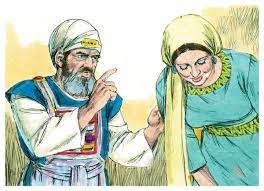
One year at Shiloh, the establishment where Elkanah and the family went annually to sacrifice and worship, Hannah went off by herself and, “weeping bitterly,” begged God for a son, promising to dedicate that son to God should her prayer be heard and answered. She prayed silently, but her lips were moving. Enter another well-meaning but clueless male. Eli, the father of the two priests in charge at Shiloh, concluded that this weeping and mumbling woman was drunk. “How long are you going to stay drunk?’ Eli asked. “Go put away your wine.”
The Hannah of my imagination, sick to death of male obtuseness and mansplaining, thinks “Oh for God’s sake, old man, leave me the F alone! The Lord and I are trying to have a conversation here! Get out of my face!” Showing great self-control, Hannah says “I am a woman who is deeply troubled [idiot]. I have not been drinking wine or beer [moron]; I was pouring out my soul to the Lord. Do not take your servant for a wicked woman; I have been praying here out of my great anguish and grief.” Eli, to his credit, realizes his mistake and wishes her well—but wisely doesn’t guarantee anything.
We learn in the remainder of the chapter, of course, that Hannah does become pregnant, her son Samuel is dedicated to the Lord as she promised (which means that Eli ends up being his father figure and unwitting mentor in things concerning the divine), and Samuel becomes a major player in the events that move the Jewish people from a loose tribal confederation to a fledgling nation. Samuel, acting as the representative of God in these events, anoints Saul, then David, as the first two kings of Israel.
Hannah gets center stage one last time in the next chapter with “Hannah’s Prayer,” a powerful song of thanksgiving, prophecy, and justice that Mary, the mother of Jesus, clearly had in mind when she sings her similarly powerful Magnificat of thanks centuries later. As we approach Advent, the liturgical season of waiting and hope, we would do well to embrace the grace and power of Hannah, this beautiful and apparently insignificant woman who simply wanted to be treated fairly and to be a mother.
The bows of the warriors are broken, but those who stumbled are armed with strength.
Those who were full hire themselves out for food, but those who were hungry are hungry no more.
The Lord brings death and makes alive; he brings down to the grave and raises up.
The Lord sends poverty and wealth; he humbles and he exalts.
He raises the poor from the dust and lifts the needy from the ash heap;
He seats them with princes and has them inherit a throne of honor.
Let it be so.
Development of Western Civilization
Previous Post

November 18, 2021
Teachers, Guns, and Sacred Spaces
Next Post

November 23, 2021 What are YOU Thankful for this Thanksgiving Week?
Browse Our Archives
Select a Category abortion Advent AI Angels Artificial intelligence atheism attention baptism Baptists beauty belief Benedictines Bible bicycling Big Bird books Bovina Camaldoli hermitage Canada Catholicism cats certainty change Christianity Christmas Collegeville Covid-19 creativity Development of Western Civilization dogs doubt Easter Enneagram Epiphany Episcopal ethics Eucharist evil extroverts Facebook faith family fear flowers forgiveness freedom friends God goodness grace happiness heaven hell history Holy Spirit Holy Week hope human nature humility humor idolatry incarnation introverts irreverence Islam Jeanne Jesus Joe Biden joy Judaism justice Kamala Harris knowledge Lent listen literature liturgy love Marsue Memorial Day miracles movies music mystery mythology NPR Old Testament optimism paradox peace Penguins philosophy piano podcast politics power prayer Protestantism Providence College Religion Rhode Island sabbatical sacrament science seeing silence Simone Weil Socrates soul sports St. John's College stories suffering tattoo teaching technology television theology thinking time tolerance transcendence travel trees trust truth Uncategorized Vermont wisdom wonder writing
Select a Month May 2026 April 2026 March 2026 February 2026 January 2026 December 2025 November 2025 October 2025 September 2025 August 2025 July 2025 June 2025 May 2025 April 2025 March 2025 February 2025 January 2025 December 2024 November 2024 October 2024 September 2024 August 2024 July 2024 June 2024 May 2024 April 2024 March 2024 February 2024 January 2024 December 2023 November 2023 October 2023 September 2023 August 2023 July 2023 June 2023 May 2023 April 2023 March 2023 February 2023 January 2023 December 2022 November 2022 October 2022 September 2022 August 2022 July 2022 June 2022 May 2022 April 2022 March 2022 February 2022 January 2022 December 2021 November 2021 October 2021 September 2021 August 2021 July 2021 June 2021 May 2021 April 2021 March 2021 February 2021 January 2021 December 2020 November 2020 October 2020 September 2020 August 2020 July 2020 June 2020 May 2020 April 2020 March 2020 February 2020 January 2020 December 2019 November 2019 October 2019 September 2019 August 2019 July 2019 June 2019 May 2019 April 2019 March 2019 February 2019 January 2019 December 2018 November 2018 October 2018 September 2018 August 2018 July 2018 June 2018 May 2018 April 2018 March 2018 February 2018 January 2018 December 2017 November 2017 October 2017 September 2017 August 2017 July 2017 June 2017 May 2017 April 2017 March 2017 February 2017 January 2017 December 2016 November 2016 October 2016 September 2016 August 2016 July 2016 June 2016 May 2016 April 2016 March 2016 February 2016 January 2016 December 2015 November 2015 October 2015 September 2015 August 2015 July 2015 June 2015 May 2015 April 2015 March 2015 February 2015 January 2015 December 2014 November 2014 October 2014 September 2014 August 2014 July 2014 June 2014 May 2014 April 2014 March 2014 February 2014 January 2014 December 2013 November 2013 October 2013 September 2013 August 2013 July 2013 June 2013 May 2013 April 2013 March 2013 February 2013 January 2013 December 2012 November 2012 October 2012 September 2012
Follow Us!
TAKE THE
Religious Wisdom Quiz
Who said, "Whom shall I send, and who will go for us?"
Select your answer to see how you score.
God Isaiah Moses Jesus
Books by This Author Books by Vance G. Morgan
Related posts from Freelance Christianity

The Lonely Pawn: On Faith, Doubt, and Meaning


AI and Love: When a Chatbot Becomes a...

TRENDING AT PATHEOS Progressive Christian

What Being a Modern-Day Apostle Means to Me
In my last column, I discussed the ins and outs of modern-day...

Did Ancient China Once Worship the God of...
Across human history, a common thread weaves through the origins of the...

Love Your Neighbor – Including Earth-Kin: Lev. 19,...
God’s command to love your neighbor means acting in an ethical and...

Lead a Church Study of “Jesus and Lao...
Guest writer Jack Thomas (The Irreverent Reverend) reflects on leading his church...

Pastoral Wisdom for Responding to Sermon Pushback
Getting sermon pushback on your social justice sermon? Learn practical, Proverbs-based strategies...

Principles for Understanding the Apostolic Ministry Today
Whenever people discover that my formal ministry title is "apostle," as in...
view all Progressive Christian blogs
Ad-Free & Subscriber Log-In Subscription Support
- About Us
- 2026 Calendar
- Videos
- Podcasts
- Library of World Religions
- Faith In Media Tracker
- Advertise With Us
- Write for Us
- Privacy Policy
- Terms of Service
- Do Not Sell My Data
- Contact Us
- Radiant Digital
- Manage Newsletter Subscriptions
- Unsubscribe From Notifications
- Sitemap
Copyright 2008-2026, Patheos. All rights reserved.
Subscription Support Ad-Free & Subscriber Log-In
Follow Patheos