
BuddhistCatholicContemplativeEvangelicalGeneral ChristianHinduJewishLatter-day SaintMuslimNew VisionsProgressive Christian
Beliefs
- Buddhist
- Catholic
- Contemplative
- Evangelical
- General Christian
- Hindu
- Jewish
- Latter-day Saint
- More Voices
- Muslim
- New Visions
- Pagan
- Progressive Christian
Topics
- Religion News
- Food and Religion
- Sports and Religion
- Religious Art
- Religious Music and Entertainment
- Religious Events
- History and Religion
- Style and Religion
- Politics and Religion
- Women in Religion
- Recreation Outdoors and Religion
- Business Finance and Religion
- Careers Workplace and Religion
- Education and Religion
- Family Parenting and Religion
- Health Fitness and Religion
- Home and Religion
- Relationships and Religion
- Technology and Religion
- Travel and Religion
Columnists
- Buddhist Columnists
- Business Finance and Religion Columnists
- Careers Workplace and Religion Columnists
- Catholic Columnists
- Contemplative Columnists
- Education and Religion Columnists
- Evangelists Columnists
- Family Parenting and Religion Columnists
- General Christian Columnists
- Health Fitness and Religion Columnists
- Hindu Columnists
- History and Religion Columnists
- Home and Religion Columnists
- Jewish Columnists
- More Voices Columnists
- Latter Day Columnists
- Muslim Columnists
- New Visions Columnists
- Nonreligious Columnists
- Pagan Columnists
- Politics and Religion Columnists
- Progressive Columnists
- Recreation Outdoors and Religion Columnists
- Relationships and Religion Columnists
- Religion News Columnists
- Religious Art Columnists
- Religious Events Columnists
- Religious Music and Entertainment Columnists
- Sports and Religion Columnists
- Style and Religion Columnists
- Technology and Religion Columnists
- Travel and Religion Columnists
- Women in Religion Columnists
Resource Library
- 2026 Calendar
- Library of World Religions
- The 100 Most Holy Places on Earth
- Patheos Answers
- Podcasts
- Videos
- Faith Leaders Database
- Anglican Episcopalian
- Bahai
- Baptist
- Buddhism
- Christianity
- Confucianism
- Eastern Orthodoxy
- Hinduism
- Holiness and Pentecostal
- ISKCON
- Islam
- Judaism
- Lutheran
- Methodist
- The Church of Jesus Christ of Latter-day Saints
- New Age
- Paganism
- Presbytarian and Reformed
- Protestantism
- Religion Behind the Scenes
- Roman Catholic
- Scientology
- Shia Islam
- Sikhism
- Sufism
- Sunni Islam
- Taoism
- Zen
- See all religions
Research Tools
 Ad-Free & Subscriber Log-In Subscription Support
Ad-Free & Subscriber Log-In Subscription Support
Follow Patheos 

- Trending:
- Forgiveness
- |
- Marriage
- |
- Consciousness
- |
- Death Penalty
- |
- Election
- |
- Halloween

- Home
- Progressive Christian
- Looking for God in All the Wrong Places
Looking for God in All the Wrong Places
Last updated on: October 12, 2021 at 6:00 am by Vance Morgan
Looking for God in All the Wrong Places 2021-10-10T14:29:16-04:00 Vance Morgan
Patheos Explore the world's faith through different perspectives on religion and spirituality! Patheos has the views of the prevalent religions and spiritualities of the world.
Although it often caused trouble and brought me grief during my primary and secondary education years, I have never tried very hard to hide my serious geekiness. Accordingly, I start today’s blog post with the ancient Greek lyric poet Pindar. I need to be careful here, because I have four colleagues and friends on campus who are trained classicists—for all I know, one of them might have written their dissertation on Pindar. Many of Pindar’s surviving poems are “victory odes,” celebrations of triumphs gained by competitors in Panhellenic festivals such as the Olympian Games. Here’s an example:
One born to prowess / May be whetted and stirred / To win huge glory / If a god be his helper.
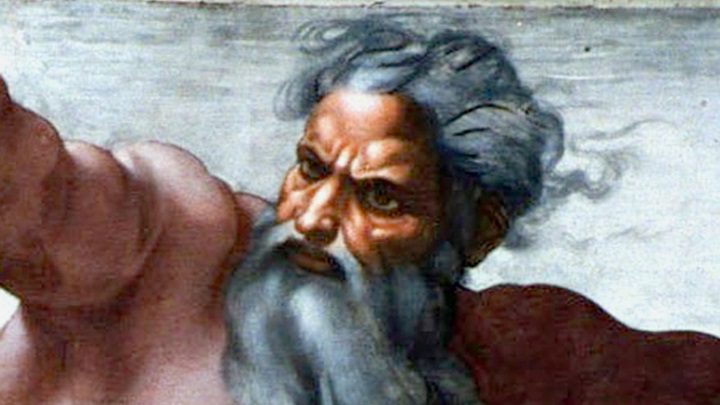
This tendency to attribute athletic prowess to divine help is still with us, as anyone who has watched a football player point to heaven after scoring a touchdown or heard a basketball star thank his Lord and Savior Jesus Christ for a game winning shot will tell you.
It’s highly unlikely, of course, that God gives a crap about who wins or loses sporting events, but attribution of success to divine assistance is so common among athletes both professional and amateur that it can easily become annoying. I remember once a number of years ago hearing Jim Rome mention on his daily sports talk radio show what he would say if he was God when someone points to heaven after scoring a touchdown: Stop pointing at my crib when you score a touchdown or I’ll break that finger off and shove it up your ass! That’s the sort of God who inspires a muscular Christianity. But the very idea of God playing favorites in this way makes no sense.
Or does it? My “go to” news source, The Onion, published a shocking and revealing article on this very topic not long ago. As it turns out, the Lord God Almighty, Creator of heaven and earth, has been caught red-handed playing favorites and giving gifts to certain college athletes in deliberate defiance of NCAA rules and regulations.
Reports indicated that over the past several decades, the Almighty has provided hundreds of players from high-profile Division I football and basketball programs with abundant natural speed, strength, and agility, and both the universities and the players themselves are now said to be facing heavy sanctions and punishments. “We take these allegations incredibly seriously and are doing everything in our power to determine the precise nature of God’s relationship with these college athletes,” said NCAA president Mark Emmert. “There is mounting evidence that the Lord—in blatant violation of NCAA rules and regulations—bestowed upon these players special and innate athletic abilities that other students never received.”
The article goes on to say that over 300 D-1 NCAA schools are implicated; I must say that when I watch my Providence Friars play, I fear that at least two of our players may have received such gifts—which makes me wonder whether our many wins this coming season will ultimately be voided. One thing’s for sure—athletic directors across the country are not going to put up with God acting in this manner.
University of Oklahoma athletic director Joe Castiglione . . . denied any knowledge of Sooners players receiving illegitimate gifts, but assured reporters that going forward, the school will strictly forbid any communication between student-athletes and God during church services or private moments of prayer.
The article concludes by reporting that “at press time, NCAA officials had announced an eternal ban on God that will prevent Him from having any association with collegiate sports until the end of time.” Good for them—the last thing we want is a deity inserting itself inequitably into human affairs.
NCAA investigates God for giving gifts to athlete
As shocked as I was by the revelations from The Onion, upon further thought I wasn’t that surprised. Jeanne has remarked regularly ever since I have known her about the various ways in which God plays favorites, granting miracles and making personal appearances to those who don’t deserve it while the most pious and committed among us get the divine cold shoulder and silence. One can hardly read a chapter of any book in the Jewish scriptures without encountering blatant divine favoritism on display.
But in fairness, there are other ways to explain this apparent unfairness. We are told that the sun shines and the rain falls both on the just and the unjust; any number of sacred texts warn against assuming that God is being unfair simply because things don’t turn out the way we would prefer. In divine inscrutability, God does what God does, and it is up to us to find a way to work with what often looks for all the world like divine randomness. As James Stockdale once summarized the message of the Book of Job, God is telling Job that “this is my world. Deal with it. Either get with the program or get out.”
The older I get, the more inclined I am to look for intimations of the divine in places both unusual and mundane. Sometimes favor seems to drop into the day as light as a feather and as ephemeral as a wisp of smoke, while at other times transcendence invades the everyday in ways that only the most deliberately blind could miss. Jeanne and I call such events “Big Bird moments” and have come to expect them as a normal part of our lives. Then there are other reminders that we are not alone and that this is not all there is which, instead of dropping in from outside, arise from within our deepest selves. Marilynne Robinson refers to these as moments when we discover that “we are more than we are,” moments she describes as follows:
By this I mean to suggest the feeling all of us have who try something difficult and find that, for a moment or two perhaps, we succeed beyond our aspirations. The character on the page speaks in her own voice, goes her own way. The paintbrush takes life in the painter’s hand, the violin plays itself. There is no answer to the inevitable questions: Where did that idea come from? How did you get that effect? Again, particulars are lacking. We have no language to describe the sense of a second order of reality that comes with these assertions of higher insights and will override even very settled intentions, when we are fortunate.
In my own life, these moments occur regularly in the classroom; I have also experienced such moments on the organ or piano bench. When I walk out of a classroom thinking “Whoa! Where did that come from?” I am realizing that I am more than I am and I had nothing to do with it. When I am able to improvise a bridge between the penultimate and final verse of a hymn on the fly that is far better than I could have come up with if I had thought about it, I have the “sense of a second order of reality” that Robinson is talking about. Sure, it could be luck, chance, a confluence of unknown events, or Scrooge’s blob of undigested cheese. But I choose to consider such moments as “thin places” where the membrane between the here and now and what is greater than us becomes so porous as to almost disappear.
Such moments cannot be planned, nor can they be manufactured. But they can be witnessed rather than ignored. Recognizing them requires a shift in attitude and focus that needs to be cultivated—it’s something I’ve been working on, with mixed success, for the past several years. We are surrounded by moments of pure grace, moments when, as Anne Lamott writes, “suddenly you’re in a different universe from the one where you were stuck, and there was absolutely no way for you get there on your own.” We are surrounded by such moments, if we only have the eyes to see them.
Previous Post

October 10, 2021
An Appropriate Level of Outrage
Next Post

October 14, 2021 The Ethics of Invisibility: What would you do if no one is watching?
Browse Our Archives
Select a Category abortion Advent AI Angels Artificial intelligence atheism attention baptism Baptists beauty belief Benedictines Bible bicycling Big Bird books Bovina Camaldoli hermitage Canada Catholicism cats certainty change Christianity Christmas Collegeville Covid-19 creativity Development of Western Civilization dogs doubt Easter Enneagram Epiphany Episcopal ethics Eucharist evil extroverts Facebook faith family fear flowers forgiveness freedom friends God goodness grace happiness heaven hell history Holy Spirit Holy Week hope human nature humility humor idolatry incarnation introverts irreverence Islam Jeanne Jesus Joe Biden joy Judaism justice Kamala Harris knowledge Lent listen literature liturgy love Marsue Memorial Day miracles movies music mystery mythology NPR Old Testament optimism paradox peace Penguins philosophy piano podcast politics power prayer Protestantism Providence College Religion Rhode Island sabbatical sacrament science seeing silence Simone Weil Socrates soul sports St. John's College stories suffering tattoo teaching technology television theology thinking time tolerance transcendence travel trees trust truth Uncategorized Vermont wisdom wonder writing
Select a Month May 2026 April 2026 March 2026 February 2026 January 2026 December 2025 November 2025 October 2025 September 2025 August 2025 July 2025 June 2025 May 2025 April 2025 March 2025 February 2025 January 2025 December 2024 November 2024 October 2024 September 2024 August 2024 July 2024 June 2024 May 2024 April 2024 March 2024 February 2024 January 2024 December 2023 November 2023 October 2023 September 2023 August 2023 July 2023 June 2023 May 2023 April 2023 March 2023 February 2023 January 2023 December 2022 November 2022 October 2022 September 2022 August 2022 July 2022 June 2022 May 2022 April 2022 March 2022 February 2022 January 2022 December 2021 November 2021 October 2021 September 2021 August 2021 July 2021 June 2021 May 2021 April 2021 March 2021 February 2021 January 2021 December 2020 November 2020 October 2020 September 2020 August 2020 July 2020 June 2020 May 2020 April 2020 March 2020 February 2020 January 2020 December 2019 November 2019 October 2019 September 2019 August 2019 July 2019 June 2019 May 2019 April 2019 March 2019 February 2019 January 2019 December 2018 November 2018 October 2018 September 2018 August 2018 July 2018 June 2018 May 2018 April 2018 March 2018 February 2018 January 2018 December 2017 November 2017 October 2017 September 2017 August 2017 July 2017 June 2017 May 2017 April 2017 March 2017 February 2017 January 2017 December 2016 November 2016 October 2016 September 2016 August 2016 July 2016 June 2016 May 2016 April 2016 March 2016 February 2016 January 2016 December 2015 November 2015 October 2015 September 2015 August 2015 July 2015 June 2015 May 2015 April 2015 March 2015 February 2015 January 2015 December 2014 November 2014 October 2014 September 2014 August 2014 July 2014 June 2014 May 2014 April 2014 March 2014 February 2014 January 2014 December 2013 November 2013 October 2013 September 2013 August 2013 July 2013 June 2013 May 2013 April 2013 March 2013 February 2013 January 2013 December 2012 November 2012 October 2012 September 2012
Follow Us!
TAKE THE
Religious Wisdom Quiz
What was Bezalel's profession?
Select your answer to see how you score.
Soldier Craftsman Priest Farmer
Books by This Author Books by Vance G. Morgan
Related posts from Freelance Christianity

The Lonely Pawn: On Faith, Doubt, and Meaning


AI and Love: When a Chatbot Becomes a...

TRENDING AT PATHEOS Progressive Christian

What Being a Modern-Day Apostle Means to Me
In my last column, I discussed the ins and outs of modern-day...

Did Ancient China Once Worship the God of...
Across human history, a common thread weaves through the origins of the...

Love Your Neighbor – Including Earth-Kin: Lev. 19,...
God’s command to love your neighbor means acting in an ethical and...

Lead a Church Study of “Jesus and Lao...
Guest writer Jack Thomas (The Irreverent Reverend) reflects on leading his church...

Pastoral Wisdom for Responding to Sermon Pushback
Getting sermon pushback on your social justice sermon? Learn practical, Proverbs-based strategies...

Principles for Understanding the Apostolic Ministry Today
Whenever people discover that my formal ministry title is "apostle," as in...
view all Progressive Christian blogs
Ad-Free & Subscriber Log-In Subscription Support
- About Us
- 2026 Calendar
- Videos
- Podcasts
- Library of World Religions
- Faith In Media Tracker
- Advertise With Us
- Write for Us
- Privacy Policy
- Terms of Service
- Do Not Sell My Data
- Contact Us
- Radiant Digital
- Manage Newsletter Subscriptions
- Unsubscribe From Notifications
- Sitemap
Copyright 2008-2026, Patheos. All rights reserved.
Subscription Support Ad-Free & Subscriber Log-In
Follow Patheos