
BuddhistCatholicContemplativeEvangelicalGeneral ChristianHinduJewishLatter-day SaintMuslimNew VisionsProgressive Christian
Beliefs
- Buddhist
- Catholic
- Contemplative
- Evangelical
- General Christian
- Hindu
- Jewish
- Latter-day Saint
- More Voices
- Muslim
- New Visions
- Pagan
- Progressive Christian
Topics
- Religion News
- Food and Religion
- Sports and Religion
- Religious Art
- Religious Music and Entertainment
- Religious Events
- History and Religion
- Style and Religion
- Politics and Religion
- Women in Religion
- Recreation Outdoors and Religion
- Business Finance and Religion
- Careers Workplace and Religion
- Education and Religion
- Family Parenting and Religion
- Health Fitness and Religion
- Home and Religion
- Relationships and Religion
- Technology and Religion
- Travel and Religion
Columnists
- Buddhist Columnists
- Business Finance and Religion Columnists
- Careers Workplace and Religion Columnists
- Catholic Columnists
- Contemplative Columnists
- Education and Religion Columnists
- Evangelists Columnists
- Family Parenting and Religion Columnists
- General Christian Columnists
- Health Fitness and Religion Columnists
- Hindu Columnists
- History and Religion Columnists
- Home and Religion Columnists
- Jewish Columnists
- More Voices Columnists
- Latter Day Columnists
- Muslim Columnists
- New Visions Columnists
- Nonreligious Columnists
- Pagan Columnists
- Politics and Religion Columnists
- Progressive Columnists
- Recreation Outdoors and Religion Columnists
- Relationships and Religion Columnists
- Religion News Columnists
- Religious Art Columnists
- Religious Events Columnists
- Religious Music and Entertainment Columnists
- Sports and Religion Columnists
- Style and Religion Columnists
- Technology and Religion Columnists
- Travel and Religion Columnists
- Women in Religion Columnists
Resource Library
- 2026 Calendar
- Library of World Religions
- The 100 Most Holy Places on Earth
- Patheos Answers
- Podcasts
- Videos
- Faith Leaders Database
- Anglican Episcopalian
- Bahai
- Baptist
- Buddhism
- Christianity
- Confucianism
- Eastern Orthodoxy
- Hinduism
- Holiness and Pentecostal
- ISKCON
- Islam
- Judaism
- Lutheran
- Methodist
- The Church of Jesus Christ of Latter-day Saints
- New Age
- Paganism
- Presbytarian and Reformed
- Protestantism
- Religion Behind the Scenes
- Roman Catholic
- Scientology
- Shia Islam
- Sikhism
- Sufism
- Sunni Islam
- Taoism
- Zen
- See all religions
Research Tools
 Ad-Free & Subscriber Log-In Subscription Support
Ad-Free & Subscriber Log-In Subscription Support
Follow Patheos 

- Trending:
- Forgiveness
- |
- Marriage
- |
- Consciousness
- |
- Death Penalty
- |
- Election
- |
- Halloween

- Home
- Progressive Christian
- Like this God Stuff is Real
Like this God Stuff is Real
Last updated on: July 30, 2018 at 4:48 pm by Vance Morgan
Like this God Stuff is Real 2018-07-30T16:48:48-04:00 Vance Morgan
Patheos Explore the world's faith through different perspectives on religion and spirituality! Patheos has the views of the prevalent religions and spiritualities of the world.
In her wonderful memoir Take This Bread, Sara Miles tells us of a conversation she had with a fellow volunteer as they distributed food at their church’s food pantry one Friday morning. Both Sara and Steve were lay eucharistic ministers who brought the chalice to parishioners on Sunday morning; they noted the similarities between handing out food on Fridays and their activities at the altar on Sunday, including the importance of looking past the ritual and making eye contact with each person being served and saying the person’s name. “Yeah,” said Steve,” Isn’t that freaky? When you actually see inside them. Like this God stuff is real.” I am currently at a writer’s conference in Minnesota, at a place where a number of years ago the “God stuff” started becoming real for me in ways that I continue to both celebrate and grapple with.
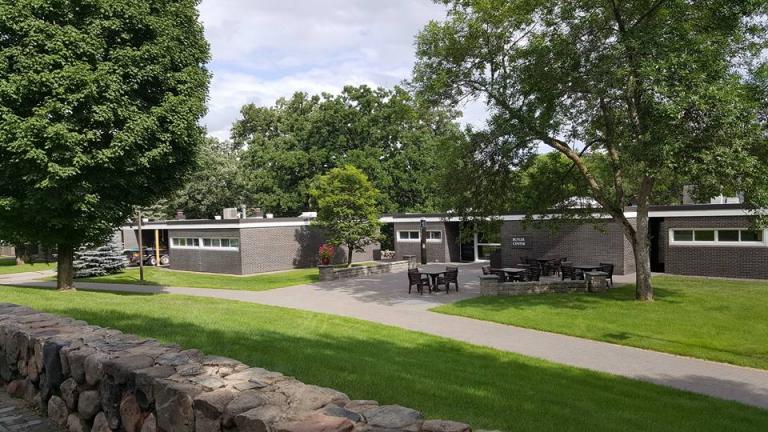
In January 2009, the day before Barack Obama took the oath of office for his first term as President, I arrived on a bitterly cold afternoon at the Collegeville Institute for Ecumenical and Cultural Research for a four-month sabbatical semester as one of eight or nine resident scholars. I had just finished four years of chairing my large and often fractious academic department, my wife and I were still emerging and recovering from the most challenging years of our marriage (then twenty years in), and I was exhausted. I knew I was physically tired and hoped that the Institute and the surrounding college campus and environs would be as peaceful and restorative as advertised. The title of the book project I planned to work on should have told me something about my worn-out spirit: SEEING THE INVISIBLE: Creative Faith and the Absence of God.
I imagined the project as an investigation of whether it is possible to live a meaningful life of faith in a world in which God is apparently absent, but the project was an academic reflection of something much deeper. For most of my fifty plus years, I had struggled with the conservative, fundamentalist Protestant Christianity in which I was raised. What soon became clear to me in Minnesota was that what I thought was a long-term, low-grade spiritual dissatisfaction had become, without my being aware of it, a full blown spiritual crisis. Beneath my introverted, overly cerebral surface my soul was asking John the Baptist’s question: “Are you the one, or is it time to look for another?”
Two evenings ago, as we went around the table introducing ourselves at the first gathering of our writer’s conference, I told my new colleagues that although I am not naturally given to hyperbole, the most honest thing I could say about why I was at this conference in this place at this time was that “this place changed my life.” The changes were subtle and slow, so slow as to be unnoticeable at first. But as I tested the waters of daily prayer with the monks at St. John’s Abbey a quarter mile up the road, I noticed a space of silence and peace slowly opening inside of me that I had never known. No voices, no visions, no miracles—but I was writing differently. The low-grade anger that had accompanied me for most of my life began to dissipate. I felt more and more like a whole person instead of a cardboard cutout of one. The world looked different. I felt different. Eventually a few of my colleagues said, “You’re not the same person you were when you first got here.” And they were right–I wasn’t. I began spending more time with the monks at prayer, often three times a day. Essays began to flow from a place I didn’t recognize, but really liked. Little had changed outwardly, but everything was changing.
Now, more than nine years later, I know that my relationships, my writing, my teaching, and my faith have all continued to evolve from those months at Collegeville. I have returned several times to get what I call my “Collegeville fix,” but this is my first time back in almost four years. This blog, almost six years old, began and has grown inexorably as I explore new paths in writing and put my deepest inner convictions and doubts on public display. This is not a linear or clean narrative; like the evolutionary process itself, the changing me carries lots of baggage from the past, some welcome and some not.
What has happened and is happening with me is nothing like the “born again” conversion experience that was the sine qua non of the religious world I grew up in. As Sara Miles writes, “Conversion isn’t a moment: It’s a process, and keeps happening, with cycles of acceptance and resistance, epiphany and doubt . . . It’s hard.” The more I change, the less certain I am about much of anything with relation to my faith—I’m finding that growth makes a mockery of claims to certainty. But I wouldn’t have it any other way.
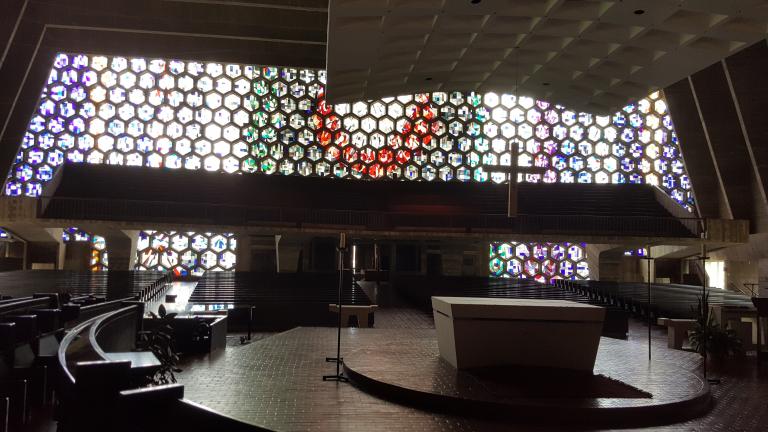
Morning prayer two days ago took me back to the physical and internal space in St. John’s Abbey where I learned nine years ago, over the passage of several months that “my deepest me is God,” surrounded by silence alternating with collective psalms and prayers. It also brought me back to two favorite texts that have sunk deep into my soul over the past several years. Psalm 149 announces the good news that God is not angry with us, but offers both exhilaration and peace:
For the Lord takes delight in his people
He crowns the poor with salvation.
Let the faithful rejoice in their glory,
shout for joy and take their rest.
And the “Benedictus,” the canticle that is the capstone of every morning prayer, provides a promise that our contemporary world, shattered with division and strife, badly needs to hang on to:
In the tender compassion of our God,
the dawn from on high shall break upon us,
To shine on those who dwell in darkness and the shadow of death,
and to guide our feet into the way of peace.
I’m a very different person than I was when I showed up here on that bitterly cold January day, different in ways that are better shown than described. My changing and emerging faith is uncertain, doubtful, non-dogmatic, and alive. Sara Miles once again: “Christianity isn’t an argument I can win, or even resolve. It isn’t a thesis. It is a mystery that I am finally willing to swallow.” And because of that, I know that this God stuff is real.
Previous Post
July 28, 2018
I Forgot What You Said
Next Post

July 31, 2018 Magnetic Jesus
Browse Our Archives
Select a Category abortion Advent AI Angels Artificial intelligence atheism attention baptism Baptists beauty belief Benedictines Bible bicycling Big Bird books Bovina Camaldoli hermitage Canada Catholicism cats certainty change Christianity Christmas Collegeville Covid-19 creativity Development of Western Civilization dogs doubt Easter Enneagram Epiphany Episcopal ethics Eucharist evil extroverts Facebook faith family fear flowers forgiveness freedom friends God goodness grace happiness heaven hell history Holy Spirit Holy Week hope human nature humility humor idolatry incarnation introverts irreverence Islam Jeanne Jesus Joe Biden joy Judaism justice Kamala Harris knowledge Lent listen literature liturgy love Marsue Memorial Day miracles movies music mystery mythology NPR Old Testament optimism paradox peace Penguins philosophy piano podcast politics power prayer Protestantism Providence College Religion Rhode Island sabbatical sacrament science seeing silence Simone Weil Socrates soul sports St. John's College stories suffering tattoo teaching technology television theology thinking time tolerance transcendence travel trees trust truth Uncategorized Vermont wisdom wonder writing
Select a Month May 2026 April 2026 March 2026 February 2026 January 2026 December 2025 November 2025 October 2025 September 2025 August 2025 July 2025 June 2025 May 2025 April 2025 March 2025 February 2025 January 2025 December 2024 November 2024 October 2024 September 2024 August 2024 July 2024 June 2024 May 2024 April 2024 March 2024 February 2024 January 2024 December 2023 November 2023 October 2023 September 2023 August 2023 July 2023 June 2023 May 2023 April 2023 March 2023 February 2023 January 2023 December 2022 November 2022 October 2022 September 2022 August 2022 July 2022 June 2022 May 2022 April 2022 March 2022 February 2022 January 2022 December 2021 November 2021 October 2021 September 2021 August 2021 July 2021 June 2021 May 2021 April 2021 March 2021 February 2021 January 2021 December 2020 November 2020 October 2020 September 2020 August 2020 July 2020 June 2020 May 2020 April 2020 March 2020 February 2020 January 2020 December 2019 November 2019 October 2019 September 2019 August 2019 July 2019 June 2019 May 2019 April 2019 March 2019 February 2019 January 2019 December 2018 November 2018 October 2018 September 2018 August 2018 July 2018 June 2018 May 2018 April 2018 March 2018 February 2018 January 2018 December 2017 November 2017 October 2017 September 2017 August 2017 July 2017 June 2017 May 2017 April 2017 March 2017 February 2017 January 2017 December 2016 November 2016 October 2016 September 2016 August 2016 July 2016 June 2016 May 2016 April 2016 March 2016 February 2016 January 2016 December 2015 November 2015 October 2015 September 2015 August 2015 July 2015 June 2015 May 2015 April 2015 March 2015 February 2015 January 2015 December 2014 November 2014 October 2014 September 2014 August 2014 July 2014 June 2014 May 2014 April 2014 March 2014 February 2014 January 2014 December 2013 November 2013 October 2013 September 2013 August 2013 July 2013 June 2013 May 2013 April 2013 March 2013 February 2013 January 2013 December 2012 November 2012 October 2012 September 2012
Follow Us!
TAKE THE
Religious Wisdom Quiz
Why was Daniel thrown into the lion’s den?
Select your answer to see how you score.
He prayed to God He stole from the treasury He spoke against the king He refused to bow to the king
Books by This Author Books by Vance G. Morgan
Related posts from Freelance Christianity

The Lonely Pawn: On Faith, Doubt, and Meaning


AI and Love: When a Chatbot Becomes a...

TRENDING AT PATHEOS Progressive Christian

What Being a Modern-Day Apostle Means to Me
In my last column, I discussed the ins and outs of modern-day...

Did Ancient China Once Worship the God of...
Across human history, a common thread weaves through the origins of the...

Love Your Neighbor – Including Earth-Kin: Lev. 19,...
God’s command to love your neighbor means acting in an ethical and...

Lead a Church Study of “Jesus and Lao...
Guest writer Jack Thomas (The Irreverent Reverend) reflects on leading his church...

Pastoral Wisdom for Responding to Sermon Pushback
Getting sermon pushback on your social justice sermon? Learn practical, Proverbs-based strategies...

Principles for Understanding the Apostolic Ministry Today
Whenever people discover that my formal ministry title is "apostle," as in...
view all Progressive Christian blogs
Ad-Free & Subscriber Log-In Subscription Support
- About Us
- 2026 Calendar
- Videos
- Podcasts
- Library of World Religions
- Faith In Media Tracker
- Advertise With Us
- Write for Us
- Privacy Policy
- Terms of Service
- Do Not Sell My Data
- Contact Us
- Radiant Digital
- Manage Newsletter Subscriptions
- Unsubscribe From Notifications
- Sitemap
Copyright 2008-2026, Patheos. All rights reserved.
Subscription Support Ad-Free & Subscriber Log-In
Follow Patheos