
BuddhistCatholicContemplativeEvangelicalGeneral ChristianHinduJewishLatter-day SaintMuslimNew VisionsProgressive Christian
Beliefs
- Buddhist
- Catholic
- Contemplative
- Evangelical
- General Christian
- Hindu
- Jewish
- Latter-day Saint
- More Voices
- Muslim
- New Visions
- Pagan
- Progressive Christian
Topics
- Religion News
- Food and Religion
- Sports and Religion
- Religious Art
- Religious Music and Entertainment
- Religious Events
- History and Religion
- Style and Religion
- Politics and Religion
- Women in Religion
- Recreation Outdoors and Religion
- Business Finance and Religion
- Careers Workplace and Religion
- Education and Religion
- Family Parenting and Religion
- Health Fitness and Religion
- Home and Religion
- Relationships and Religion
- Technology and Religion
- Travel and Religion
Columnists
- Buddhist Columnists
- Business Finance and Religion Columnists
- Careers Workplace and Religion Columnists
- Catholic Columnists
- Contemplative Columnists
- Education and Religion Columnists
- Evangelists Columnists
- Family Parenting and Religion Columnists
- General Christian Columnists
- Health Fitness and Religion Columnists
- Hindu Columnists
- History and Religion Columnists
- Home and Religion Columnists
- Jewish Columnists
- More Voices Columnists
- Latter Day Columnists
- Muslim Columnists
- New Visions Columnists
- Nonreligious Columnists
- Pagan Columnists
- Politics and Religion Columnists
- Progressive Columnists
- Recreation Outdoors and Religion Columnists
- Relationships and Religion Columnists
- Religion News Columnists
- Religious Art Columnists
- Religious Events Columnists
- Religious Music and Entertainment Columnists
- Sports and Religion Columnists
- Style and Religion Columnists
- Technology and Religion Columnists
- Travel and Religion Columnists
- Women in Religion Columnists
Resource Library
- 2026 Calendar
- Library of World Religions
- The 100 Most Holy Places on Earth
- Patheos Answers
- Podcasts
- Videos
- Faith Leaders Database
- Anglican Episcopalian
- Bahai
- Baptist
- Buddhism
- Christianity
- Confucianism
- Eastern Orthodoxy
- Hinduism
- Holiness and Pentecostal
- ISKCON
- Islam
- Judaism
- Lutheran
- Methodist
- The Church of Jesus Christ of Latter-day Saints
- New Age
- Paganism
- Presbytarian and Reformed
- Protestantism
- Religion Behind the Scenes
- Roman Catholic
- Scientology
- Shia Islam
- Sikhism
- Sufism
- Sunni Islam
- Taoism
- Zen
- See all religions
Research Tools
 Ad-Free & Subscriber Log-In Subscription Support
Ad-Free & Subscriber Log-In Subscription Support
Follow Patheos 

- Trending:
- Forgiveness
- |
- Marriage
- |
- Consciousness
- |
- Death Penalty
- |
- Election
- |
- Halloween

- Home
- Progressive Christian
- The Life of the Mind, or the Sewage of the Soul?
The Life of the Mind, or the Sewage of the Soul?
Last updated on: January 8, 2018 at 9:19 am by Vance Morgan
The Life of the Mind, or the Sewage of the Soul? 2018-01-08T09:19:20-04:00 Vance Morgan
Patheos Explore the world's faith through different perspectives on religion and spirituality! Patheos has the views of the prevalent religions and spiritualities of the world.
I recently got a shout-out from a colleague in the history department with whom I have taught in an interdisciplinary course on several occasions. In my college’s quarterly magazine publication for “alumni, parents, and friends,” this colleague was asked to provide a brief reflection on an aspect of his experience at the college. He wrote of what it is like to walk down the hall of our beautiful center for the humanities as he heads toward his office in the back wing of the building each morning. He noted that he takes pleasure in observing some of his colleagues “doing their thing” in the seminar rooms that line the hall—I was one of three professors he mentioned by name. Noting that he doesn’t loiter or eavesdrop at the open doors of his colleagues’ classes since “that would be creepy,” he summarized his workday morning experience in the next paragraph.
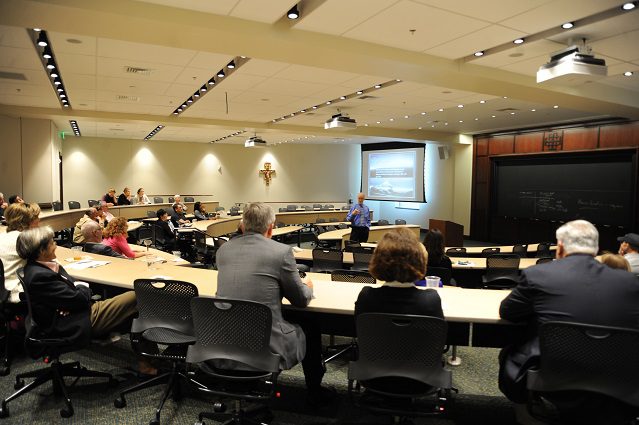
Every single day I get to catch tiny, inspirational glimpses of the amazing education my colleagues are offering our students. I love walking into work because I get to see Providence College professors doing what they do best. And, trust me, they are masters of their craft.
Shortly after reading the article, I bumped into one of the other colleagues mentioned as “masters of their craft”—she and I immediately congratulated each other on our status as teaching “masters,” then began to tease various colleagues for the rest of the morning who, despite their obvious excellence in the classroom, have not achieved “masters of their craft” status.
I’m currently in the very early stages of gathering my ideas and thoughts for my next book project, tentatively entitled “Nice Work If You Can Get It: Reflections on a Lifetime in the Classroom.” When it comes to the teaching profession, I am unashamedly idealistic, regularly telling anyone who will listen that I have the greatest job in the world. Actually, I don’t consider what I do to be a job. It’s a vocation, a calling every bit as sacred as that professed by the Dominican priests whom one meets every day on our campus. But I was reminded the other day that not all college professors think the same way about what they do for a living.
The current edition of The Atlantic includes an article by George Mason University economics professor Bryan Caplan entitled “What’s College Good For?,” with the following opening caption: “College students learn little, and most forget what they do learn with shocking speed. So why are we pushing ever more people into higher education?” Caplan’s article, which I read in its entirety, is adapted from his recent book The Case Against Education, which I will not read. I understand that it is trendy these days for academics to actively trash the value of what they do for a living, but I always wonder how someone who shares the same profession I love so dearly can believe so differently concerning its value than I do. In Caplan’s case, one paragraph from the middle of the article told me all I needed to know. Calling himself a “cynical idealist,” Kaplan writes that
I embrace the idea of transformative education. I believe whole-heartedly in the life of the mind. What I’m cynical about is people. I’m cynical about students. The vast majority are philistines. I’m cynical about teachers. The vast majority are uninspiring. I’m cynical about “deciders”—the school officials who control what students study. The vast majority think they’ve done their job as long as students comply.
I hate cynicism—I say that as a person who has had a more difficult time avoiding cynicism and its silent partner, apathy, over the past couple of years than in any time during my adult life. I agree with Maria Popova, who once in an “On Being” NPR interview with Krista Tippett described cynicism as “the sewage of the soul.” I’m willing to accept the label “idealist,” as long as it doesn’t imply that my ideals are disconnected with reality. In the spirit of Hillary Clinton describing herself in a 2016 debate as “a progressive who gets things done,” I prefer to describe myself as a pragmatic idealist—a person whose ideals are always tempered by and answerable to reality.
Bryan Caplan put his finger on the difference between people like him and people like me when he writes “what I’m cynical about is people.” I’m not—decidedly not. My faith directs me not to be cynical about people, as does my natural optimism. Most importantly, my real life experience, regardless of what the media shouts at me on a daily basis, is what tells me not to be cynical about people. Since much of my “real life” is spent with students, with fellow faculty, and with administrators on campus, I have a well-developed response, rooted in almost three decades of experience, to Caplan’s cynical judgment that most students are “philistines,” most teachers are “uninspiring,” and most administrators are simply mailing it in. My response? You, Professor Caplan, are full of shit.
As one might expect from an economics professor, Caplan is a number-cruncher. He provides a few survey results to support his cynicism in his article; I’m sure his book piles the numbers on with inexorable urgency. As a professor in the humanities, I respond that a good experiential anecdote outweighs any number of studies and polls. I used to laugh when one of my teaching mentors from my early years as a professor told me (when he was undoubtedly younger than I am now) that the older he got, the more he found himself slipping into his anecdotage. I don’t laugh about it any longer, first because I find the same thing happening to me and, second, because I believe that’s a good thing. Human beings are story-telling animals; we weave our realities out of stories and experiences. My expectation is that the book I hope to write will be of that sort.
After almost three decades of teaching, I have more anecdotes and stories to support my natural optimism about teaching and people than could possibly make the cut even in a book several hundred pages long. My latest story comes from my recently completed Philosophy of Knowledge course, a class with an eclectic collection of eleven students ranging across several philosophy majors and minors, a few honors students, and a handful of guys from the lacrosse team. My assumption going into every class, including this one, is that despite various stereotypes and preconceptions, I should give every student the benefit of a doubt. Each student wants to be here, wants to learn, is capable of learning, and will work hard to satisfy course requirements until proven otherwise. I am occasionally disappointed, but not very often.
At the end of the semester, several students reminisced about their class experience in their final intellectual notebook entries (the notebook is an ongoing writing assignment throughout the semester). Here are a couple of examples:
Student One:
- The best way I can describe this class, is that it allowed me to better channel the exhausting ruminations that go on inside my head . . . Overall, I think the world has gotten a lot less “black and white” and a lot less bland for me over the course of the semester. I have discovered that even if my beliefs orient me towards a given conclusion there is no weakness in saying that I may be wrong or even hoping that I am wrong. Sure it is noble for a human being to stick to their principles, but it is also an injustice to the self if we let these principles completely wipe out any possibility for change.
Student Two (who had to beg me to let him into the class a week after the semester started):
- I walked out of every class discussion, and this is not an exaggeration, feeling clear headed and more open to the world. Although I was quiet in the beginning, I was still always engaged mentally. As the semester progressed and I opened up I felt as if I was expressing myself honestly, something that I often feel I cannot do properly . . . As I move forward in my life I plan on keeping philosophy close to my heart, no matter what I do. For it truly does give me life and a more exciting existence . . . [Philosophy] allows me to see the mystery it allows me to view life as a question—one that needs an answer . . . Transferring over to your class was one of the best decisions I made at Providence College. Thank you so much for everything.
Whenever I feel overwhelmed by the demands of what I do (which does happen on occasion), the faces of students such as these pass in front of me. “What’s College Good For,” Professor Caplan? Not much, perhaps, if one relies solely on polls and numbers. But I’ll take a transformed life or two over your numbers every time.
Previous Post

January 4, 2018
Technology and the Life of Faith
Next Post

January 7, 2018 An Epiphany
Browse Our Archives
Select a Category abortion Advent AI Angels Artificial intelligence atheism attention baptism Baptists beauty belief Benedictines Bible bicycling Big Bird books Bovina Camaldoli hermitage Canada Catholicism cats certainty change Christianity Christmas Collegeville Covid-19 creativity Development of Western Civilization dogs doubt Easter Enneagram Epiphany Episcopal ethics Eucharist evil extroverts Facebook faith family fear flowers forgiveness freedom friends God goodness grace happiness heaven hell history Holy Spirit Holy Week hope human nature humility humor idolatry incarnation introverts irreverence Islam Jeanne Jesus Joe Biden joy Judaism justice Kamala Harris knowledge Lent listen literature liturgy love Marsue Memorial Day miracles movies music mystery mythology NPR Old Testament optimism paradox peace Penguins philosophy piano podcast politics power prayer Protestantism Providence College Religion Rhode Island sabbatical sacrament science seeing silence Simone Weil Socrates soul sports St. John's College stories suffering tattoo teaching technology television theology thinking time tolerance transcendence travel trees trust truth Uncategorized Vermont wisdom wonder writing
Select a Month May 2026 April 2026 March 2026 February 2026 January 2026 December 2025 November 2025 October 2025 September 2025 August 2025 July 2025 June 2025 May 2025 April 2025 March 2025 February 2025 January 2025 December 2024 November 2024 October 2024 September 2024 August 2024 July 2024 June 2024 May 2024 April 2024 March 2024 February 2024 January 2024 December 2023 November 2023 October 2023 September 2023 August 2023 July 2023 June 2023 May 2023 April 2023 March 2023 February 2023 January 2023 December 2022 November 2022 October 2022 September 2022 August 2022 July 2022 June 2022 May 2022 April 2022 March 2022 February 2022 January 2022 December 2021 November 2021 October 2021 September 2021 August 2021 July 2021 June 2021 May 2021 April 2021 March 2021 February 2021 January 2021 December 2020 November 2020 October 2020 September 2020 August 2020 July 2020 June 2020 May 2020 April 2020 March 2020 February 2020 January 2020 December 2019 November 2019 October 2019 September 2019 August 2019 July 2019 June 2019 May 2019 April 2019 March 2019 February 2019 January 2019 December 2018 November 2018 October 2018 September 2018 August 2018 July 2018 June 2018 May 2018 April 2018 March 2018 February 2018 January 2018 December 2017 November 2017 October 2017 September 2017 August 2017 July 2017 June 2017 May 2017 April 2017 March 2017 February 2017 January 2017 December 2016 November 2016 October 2016 September 2016 August 2016 July 2016 June 2016 May 2016 April 2016 March 2016 February 2016 January 2016 December 2015 November 2015 October 2015 September 2015 August 2015 July 2015 June 2015 May 2015 April 2015 March 2015 February 2015 January 2015 December 2014 November 2014 October 2014 September 2014 August 2014 July 2014 June 2014 May 2014 April 2014 March 2014 February 2014 January 2014 December 2013 November 2013 October 2013 September 2013 August 2013 July 2013 June 2013 May 2013 April 2013 March 2013 February 2013 January 2013 December 2012 November 2012 October 2012 September 2012
Follow Us!
TAKE THE
Religious Wisdom Quiz
Who refused to defile himself with the king's food and wine?
Select your answer to see how you score.
Ezekiel Obadiah Joel Daniel
Books by This Author Books by Vance G. Morgan
Related posts from Freelance Christianity

The Lonely Pawn: On Faith, Doubt, and Meaning


AI and Love: When a Chatbot Becomes a...

TRENDING AT PATHEOS Progressive Christian

What Being a Modern-Day Apostle Means to Me
In my last column, I discussed the ins and outs of modern-day...

Did Ancient China Once Worship the God of...
Across human history, a common thread weaves through the origins of the...

Love Your Neighbor – Including Earth-Kin: Lev. 19,...
God’s command to love your neighbor means acting in an ethical and...

Lead a Church Study of “Jesus and Lao...
Guest writer Jack Thomas (The Irreverent Reverend) reflects on leading his church...

Pastoral Wisdom for Responding to Sermon Pushback
Getting sermon pushback on your social justice sermon? Learn practical, Proverbs-based strategies...

Principles for Understanding the Apostolic Ministry Today
Whenever people discover that my formal ministry title is "apostle," as in...
view all Progressive Christian blogs
Ad-Free & Subscriber Log-In Subscription Support
- About Us
- 2026 Calendar
- Videos
- Podcasts
- Library of World Religions
- Faith In Media Tracker
- Advertise With Us
- Write for Us
- Privacy Policy
- Terms of Service
- Do Not Sell My Data
- Contact Us
- Radiant Digital
- Manage Newsletter Subscriptions
- Unsubscribe From Notifications
- Sitemap
Copyright 2008-2026, Patheos. All rights reserved.
Subscription Support Ad-Free & Subscriber Log-In
Follow Patheos