
BuddhistCatholicContemplativeEvangelicalGeneral ChristianHinduJewishLatter-day SaintMuslimNew VisionsProgressive Christian
Beliefs
- Buddhist
- Catholic
- Contemplative
- Evangelical
- General Christian
- Hindu
- Jewish
- Latter-day Saint
- More Voices
- Muslim
- New Visions
- Pagan
- Progressive Christian
Topics
- Religion News
- Food and Religion
- Sports and Religion
- Religious Art
- Religious Music and Entertainment
- Religious Events
- History and Religion
- Style and Religion
- Politics and Religion
- Women in Religion
- Recreation Outdoors and Religion
- Business Finance and Religion
- Careers Workplace and Religion
- Education and Religion
- Family Parenting and Religion
- Health Fitness and Religion
- Home and Religion
- Relationships and Religion
- Technology and Religion
- Travel and Religion
Columnists
- Buddhist Columnists
- Business Finance and Religion Columnists
- Careers Workplace and Religion Columnists
- Catholic Columnists
- Contemplative Columnists
- Education and Religion Columnists
- Evangelists Columnists
- Family Parenting and Religion Columnists
- General Christian Columnists
- Health Fitness and Religion Columnists
- Hindu Columnists
- History and Religion Columnists
- Home and Religion Columnists
- Jewish Columnists
- More Voices Columnists
- Latter Day Columnists
- Muslim Columnists
- New Visions Columnists
- Nonreligious Columnists
- Pagan Columnists
- Politics and Religion Columnists
- Progressive Columnists
- Recreation Outdoors and Religion Columnists
- Relationships and Religion Columnists
- Religion News Columnists
- Religious Art Columnists
- Religious Events Columnists
- Religious Music and Entertainment Columnists
- Sports and Religion Columnists
- Style and Religion Columnists
- Technology and Religion Columnists
- Travel and Religion Columnists
- Women in Religion Columnists
Resource Library
- 2026 Calendar
- Library of World Religions
- The 100 Most Holy Places on Earth
- Patheos Answers
- Podcasts
- Videos
- Faith Leaders Database
- Anglican Episcopalian
- Bahai
- Baptist
- Buddhism
- Christianity
- Confucianism
- Eastern Orthodoxy
- Hinduism
- Holiness and Pentecostal
- ISKCON
- Islam
- Judaism
- Lutheran
- Methodist
- The Church of Jesus Christ of Latter-day Saints
- New Age
- Paganism
- Presbytarian and Reformed
- Protestantism
- Religion Behind the Scenes
- Roman Catholic
- Scientology
- Shia Islam
- Sikhism
- Sufism
- Sunni Islam
- Taoism
- Zen
- See all religions
Research Tools
 Ad-Free & Subscriber Log-In Subscription Support
Ad-Free & Subscriber Log-In Subscription Support
Follow Patheos 

- Trending:
- Forgiveness
- |
- Marriage
- |
- Consciousness
- |
- Death Penalty
- |
- Election
- |
- Halloween

- Home
- Progressive Christian
- Joy in a Minor Key
Joy in a Minor Key
Last updated on: May 5, 2017 at 7:00 am by Vance Morgan
Joy in a Minor Key 2017-05-05T06:51:53-04:00 Vance Morgan
Patheos Explore the world's faith through different perspectives on religion and spirituality! Patheos has the views of the prevalent religions and spiritualities of the world.
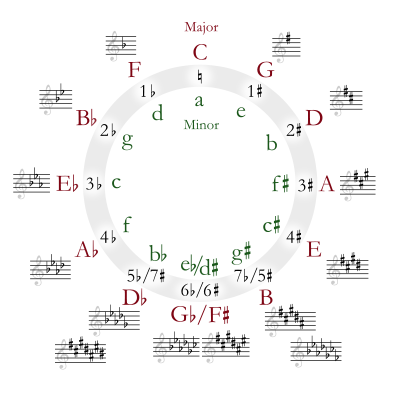
At some point early in their musical training, all serious musicians are introduced to the “circle of fifths,” a handy chart that maps out the complicated but fascinating relationships among the twelve tones of the chromatic scale, their corresponding key signatures, as well as the associations between the major and minor keys.I was fortunate to have Katrina Munn, a graduate of Julliard, as my piano teacher from age four to eleven—she was a stickler for theory and precision and had a large poster of the circle of fifths on the wall of her studio. I was immediately fascinated—it looked like a labyrinth or something out of The Lord of the Rings, and as I was gradually introduced to the twelve major keys, the twelve related minors, and their harmonic relationships I was able to trace geometrically on the chart the harmonies I had been hearing in my head for as long as I could remember.
Recently the following from Richard Powers’ Orfeo got me to thinking about the major and minor keys in a new way.
There’s joy in a minor key, a deep pleasure to be had from hearing the darkest tune and discovering you’re equal to it.
 A lot can be learned from the major and minor keys that is applicable to everyday life. Traditionally the major keys have been described as “bright, extroverted, upbeat” and so on, while the minor keys are “introspective, complex, sad” or even “depressing.” Yet the circle of fifths shows that each major has its relative minor that is only one note different—a note that makes all the difference. Powers, who is a classically trained musician, is noting something important about the minor keys—they are rich and evocative in ways with which the brighter and more popular majors cannot compete. Yet the dividing line between major and minor is razor thin—if we are to pay proper attention to the music of our lives, understanding how major and minor interweave is crucial.
I had the opportunity to explore this with “Living Stones,” the adult Christian education group that I lead after church once a month, one Sunday last summer after the morning service. I was doing double duty, as I was also organist that morning,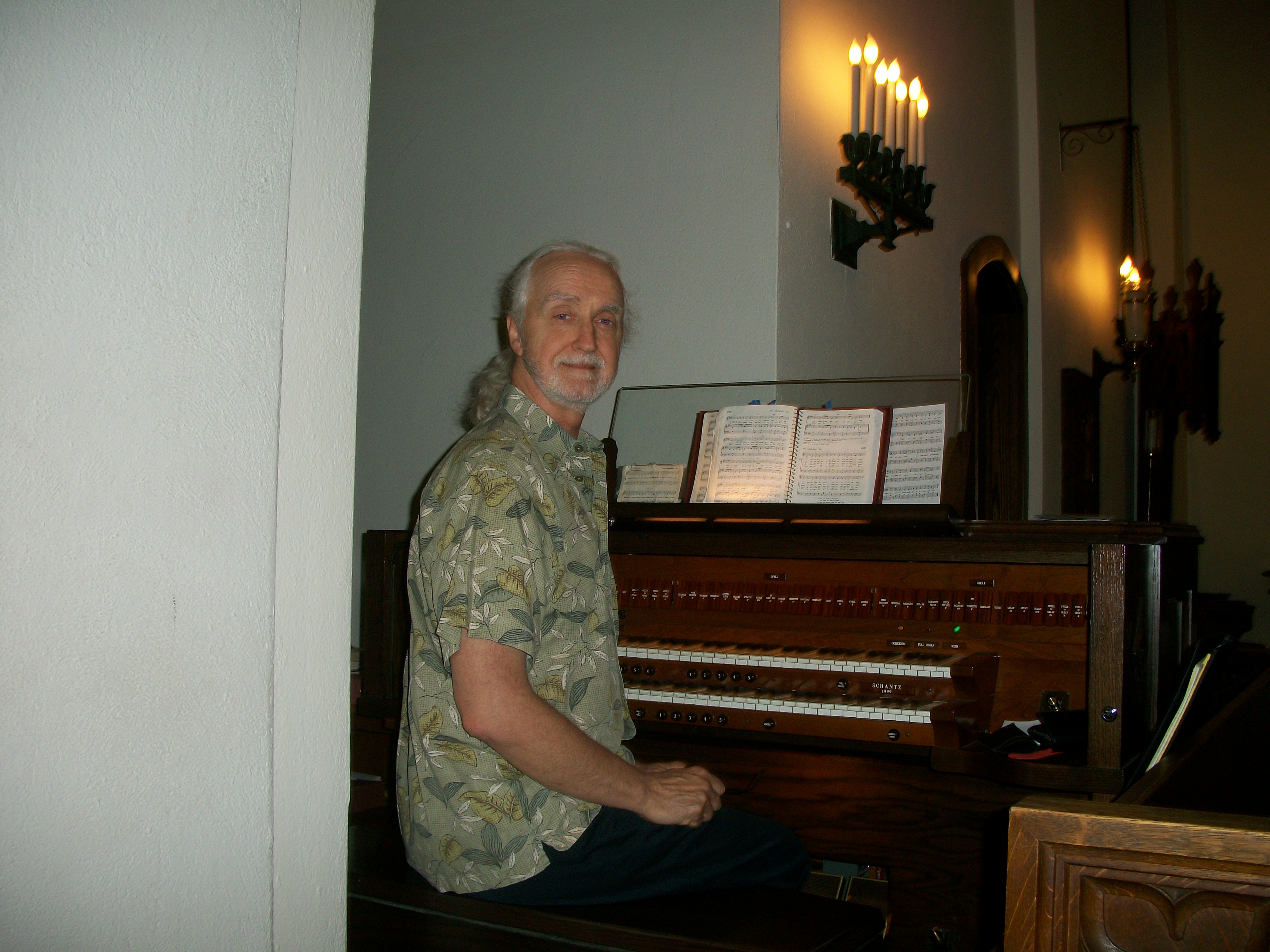 alternating with the organist emeritus every other week through the summer as the church was searching for a new full-time music minister. The fifteen or so regulars have a wide range of experience with music (or lack of same), so I presumed no prior knowledge. Gathering in the choir stalls by the organ rather than in our usual location, I oriented them to the major/minor distinction by suggesting that in the cycle of liturgical seasons, Easter and Christmas are major key seasons while Advent and Lent are minor key seasons. We moved then to a listening exercise, as I played first
 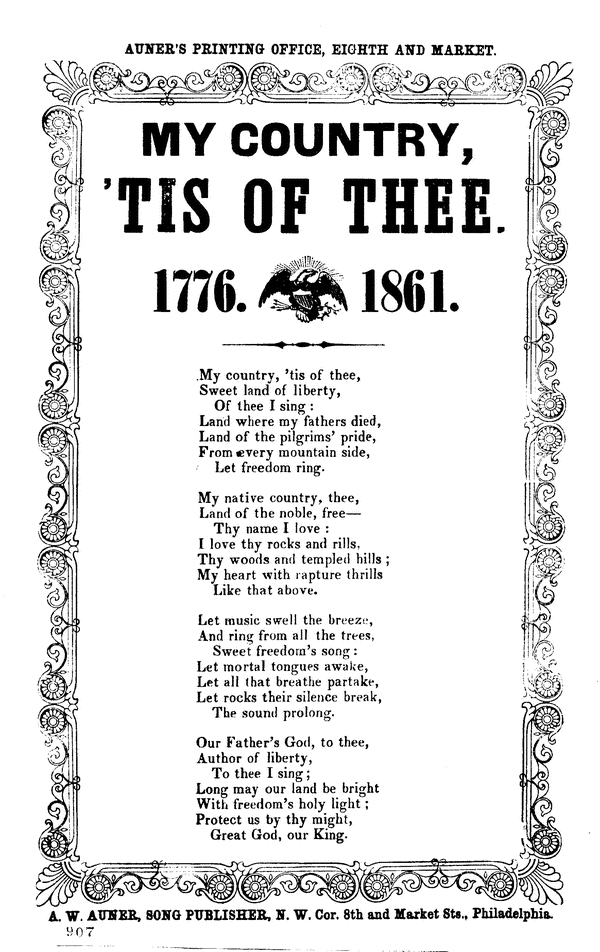 “My Country ‘Tis of Thee,” our closing hymn for the morning because of it being July 4th Sunday, in F minor rather than its original F major, then a representative minor key hymn, “If Thou But Trust in God to Guide Thee,” in G major rather than its original G minor. As the Living Stoners compared the new keys to the hymn texts, they agreed that major is appropriate for the first hymn than minor and minor more appropriate to the second than major. Different texts require different tunes—and so it goes with the chapters and texts of our lives.
The Book of Job from the Hebrew Scriptures is a case in point. The story is familiar. Job, “a man blameless and upright . . . who feared God and shunned evil,” is the topic of conversation between God and Satan, “the accuser.” In response to God’s “Have you considered my servant Job? There is none like him on the earth,” Satan replies “Well duh! You give him everything he wants and you have built a protective hedge around him.” After God agrees to remove the hedge at Satan’s suggestion just to see what happens, Job’s flocks, crops, 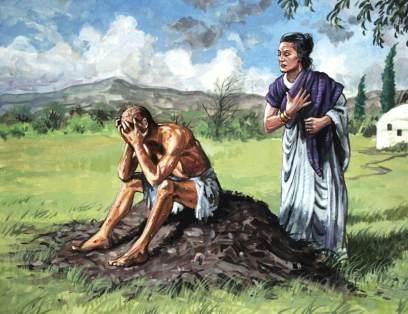 servants and children are swept away within six short verses and one of the greatest texts on the dynamic of suffering is underway.
The drama of Job is relentless, with his suffering unaddressed by his apparently well-meaning friends and his less than supportive wife. Underlying it all is Job’s insistence that his suffering and pain is not justified in any sense that he (or any other human being) can understand. It is clear that he will not “curse God and die,” as his wife advises him to do—his commitment to his God is unshakeable. “Though he slay me, yet I will trust him.” Job’s commitment, however, is neither passive nor facile. He wants answers and challenges a silent God to provide them. With very few exceptions, the Book of Job is entirely written in a minor key; the message of Job is that sometimes minor keys do not get resolved into major keys. Sometimes the text of one’s life demands a minor key; simply “waiting it out” or longing for it to be something it is not is to rob oneself of the richness and depth that only minor harmonies can provide.
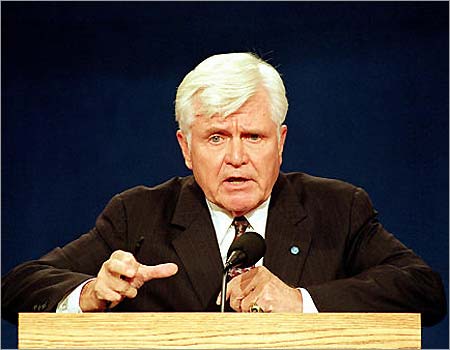 When God finally does respond to Job’s questions and challenges, it is in a way that on the surface, at least, is entirely unsatisfactory to our contemporary sense of fairness and justice. God does not provide any reasons for Job’s misfortunes, nor does God explain himself. Rather, God makes clear in a lengthy soliloquy that he does not have to explain himself at all. As Admiral James Stockdale once described God’s response to Job, “I’m God and you’re not. This is my world—either deal with it or get out.”
It’s a tough message for our modern sensibilities, but is far closer to the reality of the world we find ourselves in than the stories we tell ourselves about “things working out in the end” or “justice will prevail.” Whatever value there is in suffering cannot lie in hopes for its removal or resolution. Yet we continue to try. 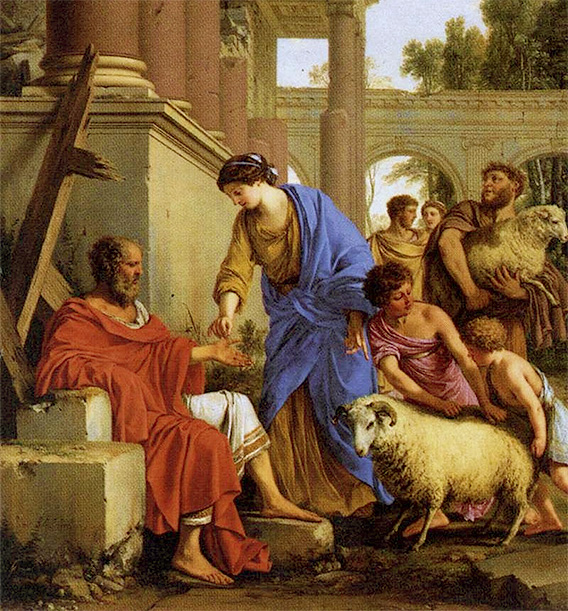 There is nothing hokier or more forced than to resolve a composition from a minor key to its accompanying major in the last measure of the piece. But this is precisely what we find at the end of Job. In the final verses of the last chapter, after Job has been subdued by the divine display of power and superiority, Job magically gets everything back—children, flocks, servants, lands—and even his useless “comforters” and unhelpful wife get told off by God. “And they lived happily ever after,” in other words. I learned from one of my theology colleagues a number of years ago that these closing verses are not in the oldest texts of Job, but were apparently added in several decades or even centuries later.
Why? I asked my group. Why would someone want to change the original minor key story of Job, resolving it to a major key in the last measure? “Because the original ending is too tough,” someone suggested. “Because people want to believe that the suffering has a point, that it is all for something,” another thought. Which makes the better story? The original or the one with the new ending? “The original is truer,” an eighty-something Living Stoner said. “People don’t come back. Things that you lose don’t return.” And she was right. If there is meaning in the minor key movements of my life’s symphony, it has to be in the movement, not because the final movement will return to a joyful major key. The major keys ride the waves, but the minor keys plumb the depths, depths that give a life its richness and texture. As Richard Powers suggests, there is joy and satisfaction to be found in the midst of the suffering, a joy that is largely unavailable in any other context.
A couple of years ago, MSNBC (the only 24-7 news channel I can stomach, and even that not for very long) had a new ad campaign: Lean Forward. Out of context, it made little sense. Lean forward to what? But in the minor keys of our lives, “lean forward” or “lean in” is far better advice than “hold your breath and wait it out.” The purpose of the minor keys is not to provide a temporary alternative to majors. Rather, as another ad campaign many years ago suggested, sometimes minor harmonies are the most important threads in “the fabric of our lives.”
Previous Post

May 3, 2017
A Compassionate Capitalist
Next Post

May 8, 2017 Does God Love Diversity?
Browse Our Archives
Select a Category abortion Advent AI Angels Artificial intelligence atheism attention baptism Baptists beauty belief Benedictines Bible bicycling Big Bird books Bovina Camaldoli hermitage Canada Catholicism cats certainty change Christianity Christmas Collegeville Covid-19 creativity Development of Western Civilization dogs doubt Easter Enneagram Epiphany Episcopal ethics Eucharist evil extroverts Facebook faith family fear flowers forgiveness freedom friends God goodness grace happiness heaven hell history Holy Spirit Holy Week hope human nature humility humor idolatry incarnation introverts irreverence Islam Jeanne Jesus Joe Biden joy Judaism justice Kamala Harris knowledge Lent listen literature liturgy love Marsue Memorial Day miracles movies music mystery mythology NPR Old Testament optimism paradox peace Penguins philosophy piano podcast politics power prayer Protestantism Providence College Religion Rhode Island sabbatical sacrament science seeing silence Simone Weil Socrates soul sports St. John's College stories suffering tattoo teaching technology television theology thinking time tolerance transcendence travel trees trust truth Uncategorized Vermont wisdom wonder writing
Select a Month May 2026 April 2026 March 2026 February 2026 January 2026 December 2025 November 2025 October 2025 September 2025 August 2025 July 2025 June 2025 May 2025 April 2025 March 2025 February 2025 January 2025 December 2024 November 2024 October 2024 September 2024 August 2024 July 2024 June 2024 May 2024 April 2024 March 2024 February 2024 January 2024 December 2023 November 2023 October 2023 September 2023 August 2023 July 2023 June 2023 May 2023 April 2023 March 2023 February 2023 January 2023 December 2022 November 2022 October 2022 September 2022 August 2022 July 2022 June 2022 May 2022 April 2022 March 2022 February 2022 January 2022 December 2021 November 2021 October 2021 September 2021 August 2021 July 2021 June 2021 May 2021 April 2021 March 2021 February 2021 January 2021 December 2020 November 2020 October 2020 September 2020 August 2020 July 2020 June 2020 May 2020 April 2020 March 2020 February 2020 January 2020 December 2019 November 2019 October 2019 September 2019 August 2019 July 2019 June 2019 May 2019 April 2019 March 2019 February 2019 January 2019 December 2018 November 2018 October 2018 September 2018 August 2018 July 2018 June 2018 May 2018 April 2018 March 2018 February 2018 January 2018 December 2017 November 2017 October 2017 September 2017 August 2017 July 2017 June 2017 May 2017 April 2017 March 2017 February 2017 January 2017 December 2016 November 2016 October 2016 September 2016 August 2016 July 2016 June 2016 May 2016 April 2016 March 2016 February 2016 January 2016 December 2015 November 2015 October 2015 September 2015 August 2015 July 2015 June 2015 May 2015 April 2015 March 2015 February 2015 January 2015 December 2014 November 2014 October 2014 September 2014 August 2014 July 2014 June 2014 May 2014 April 2014 March 2014 February 2014 January 2014 December 2013 November 2013 October 2013 September 2013 August 2013 July 2013 June 2013 May 2013 April 2013 March 2013 February 2013 January 2013 December 2012 November 2012 October 2012 September 2012
Follow Us!
TAKE THE
Religious Wisdom Quiz
Who rebelled with 250 men against Moses and Aaron?
Select your answer to see how you score.
Dathan Korah Abihu Nadab
Books by This Author Books by Vance G. Morgan
Related posts from Freelance Christianity

The Lonely Pawn: On Faith, Doubt, and Meaning


AI and Love: When a Chatbot Becomes a...

TRENDING AT PATHEOS Progressive Christian

What Being a Modern-Day Apostle Means to Me
In my last column, I discussed the ins and outs of modern-day...

Did Ancient China Once Worship the God of...
Across human history, a common thread weaves through the origins of the...

Love Your Neighbor – Including Earth-Kin: Lev. 19,...
God’s command to love your neighbor means acting in an ethical and...

Lead a Church Study of “Jesus and Lao...
Guest writer Jack Thomas (The Irreverent Reverend) reflects on leading his church...

Pastoral Wisdom for Responding to Sermon Pushback
Getting sermon pushback on your social justice sermon? Learn practical, Proverbs-based strategies...

Principles for Understanding the Apostolic Ministry Today
Whenever people discover that my formal ministry title is "apostle," as in...
view all Progressive Christian blogs
Ad-Free & Subscriber Log-In Subscription Support
- About Us
- 2026 Calendar
- Videos
- Podcasts
- Library of World Religions
- Faith In Media Tracker
- Advertise With Us
- Write for Us
- Privacy Policy
- Terms of Service
- Do Not Sell My Data
- Contact Us
- Radiant Digital
- Manage Newsletter Subscriptions
- Unsubscribe From Notifications
- Sitemap
Copyright 2008-2026, Patheos. All rights reserved.
Subscription Support Ad-Free & Subscriber Log-In
Follow Patheos