
BuddhistCatholicContemplativeEvangelicalGeneral ChristianHinduJewishLatter-day SaintMuslimNew VisionsProgressive Christian
Beliefs
- Buddhist
- Catholic
- Contemplative
- Evangelical
- General Christian
- Hindu
- Jewish
- Latter-day Saint
- More Voices
- Muslim
- New Visions
- Pagan
- Progressive Christian
Topics
- Religion News
- Food and Religion
- Sports and Religion
- Religious Art
- Religious Music and Entertainment
- Religious Events
- History and Religion
- Style and Religion
- Politics and Religion
- Women in Religion
- Recreation Outdoors and Religion
- Business Finance and Religion
- Careers Workplace and Religion
- Education and Religion
- Family Parenting and Religion
- Health Fitness and Religion
- Home and Religion
- Relationships and Religion
- Technology and Religion
- Travel and Religion
Columnists
- Buddhist Columnists
- Business Finance and Religion Columnists
- Careers Workplace and Religion Columnists
- Catholic Columnists
- Contemplative Columnists
- Education and Religion Columnists
- Evangelists Columnists
- Family Parenting and Religion Columnists
- General Christian Columnists
- Health Fitness and Religion Columnists
- Hindu Columnists
- History and Religion Columnists
- Home and Religion Columnists
- Jewish Columnists
- More Voices Columnists
- Latter Day Columnists
- Muslim Columnists
- New Visions Columnists
- Nonreligious Columnists
- Pagan Columnists
- Politics and Religion Columnists
- Progressive Columnists
- Recreation Outdoors and Religion Columnists
- Relationships and Religion Columnists
- Religion News Columnists
- Religious Art Columnists
- Religious Events Columnists
- Religious Music and Entertainment Columnists
- Sports and Religion Columnists
- Style and Religion Columnists
- Technology and Religion Columnists
- Travel and Religion Columnists
- Women in Religion Columnists
Resource Library
- 2026 Calendar
- Library of World Religions
- The 100 Most Holy Places on Earth
- Patheos Answers
- Podcasts
- Videos
- Faith Leaders Database
- Anglican Episcopalian
- Bahai
- Baptist
- Buddhism
- Christianity
- Confucianism
- Eastern Orthodoxy
- Hinduism
- Holiness and Pentecostal
- ISKCON
- Islam
- Judaism
- Lutheran
- Methodist
- The Church of Jesus Christ of Latter-day Saints
- New Age
- Paganism
- Presbytarian and Reformed
- Protestantism
- Religion Behind the Scenes
- Roman Catholic
- Scientology
- Shia Islam
- Sikhism
- Sufism
- Sunni Islam
- Taoism
- Zen
- See all religions
Research Tools
 Ad-Free & Subscriber Log-In Subscription Support
Ad-Free & Subscriber Log-In Subscription Support
Follow Patheos 

- Trending:
- Forgiveness
- |
- Marriage
- |
- Consciousness
- |
- Death Penalty
- |
- Election
- |
- Halloween

- Home
- Progressive Christian
- It’s the Message, Stupid!
It’s the Message, Stupid!
Last updated on: September 28, 2015 at 7:30 am by Vance Morgan
It’s the Message, Stupid! 2015-09-28T07:30:54-04:00 Vance Morgan
Patheos Explore the world's faith through different perspectives on religion and spirituality! Patheos has the views of the prevalent religions and spiritualities of the world.
As he shepherded Bill Clinton’s successful run for the Presidency in the early 90s, James Carville famously used to keep the candidate and all campaign spokespersons on task by reminding them frequently that “It’s the economy, stupid!” Don’t let yourselves get sidetracked by shiny objects along the way—keep focused and on message. If we keep reminding people about the state the economy is in and what a Clinton presidency will do about it, we’ll win. And they did. In politics, the message is everything, something that the dozen and a half or so persons seeking to win the 2016 Presidential election had better not forget. The person who best crafts a convincing message and sticks to it is likely to be our next President.
I was reminded of James Carville the other day when I received an email asking me to contribute a 500-1000 word essay to a national publication reflecting on the following question: At what point does political advocacy on the part of Christians distort or compromise the Christian message? A timely question, to be sure—my essay (which I have yet to finish) will be one of four commissioned essays the magazine will be publishing in consecutive weekly editions this fall. A sure sign that I am inexorably being drawn into the social media orbit is what I did shortly after I agreed to write the essay— I sent the question out to a couple of Facebook groups I am a member of and simply asked for ideas and opinions. And I got some.
Mind you, these Facebook groups were carefully selected; both are loose collections of persons similar to me. Members are self-identified persons of faith, politically liberal, and willing to press the traditional boundaries of Christian religious orthodoxy regardless of where the orthodoxy comes from. At what point does political advocacy on the part of Christians distort or compromise the Christian message? Here are selected unedited comments and ideas:
- When the advocacy stops helping others or putting others first. When the message is in conflict with the words of Jesus.
 When people feel excluded. When the message lacks love.
 - Honestly, to me, the message is compromised any time the focus is on the “letter” of the law – rather than the “spirit” of the law. And, (to me) one of Jesus’ main messages was to love God – it wasn’t to fear God – so, whenever fear (or control) is the foundation, it’s distorted. And, whenever a faith-path is used to deny people rights, suppress, etc. it’s a distortion. I had to really think about your question – because I don’t think Christianity or any other religion/faith path has a place in politics. People are free to believe & practice whatever works for them – but, I don’t like seeing or hearing it talked about – and, believe that laws should not be proposed or based on someone’s (or a particular groups) beliefs…
- When the use of cherry picked scriptures are used to govern others and make them feel “less than” in any way.
- Where it seeks to limit the liberty of others.
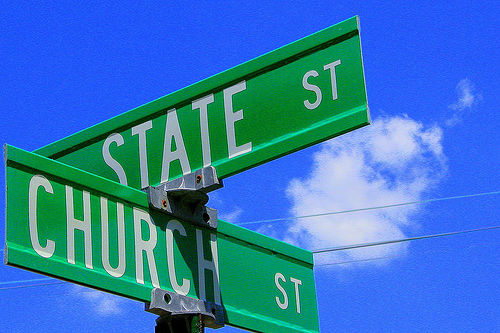
These suggestions seem eminently reasonable to me. We live in a society where church and state are deliberately and constitutionally kept separate, for the mutual protection of both. Religiously motivated advocacy runs afoul of the Constitution when it seeks to limit the freedoms of those who do not share the advocator’s religious principles. More specific to the question asked, most Christians would agree, I think, that at the heart of their faith is a spirit of love, of focusing on others rather than oneself, of concern for the least among us, and of inclusion. Policies advocated in the name of Christianity that violate this foundational spirit are a distortion of the Christian message.
Yet I have no doubt that I would have received radically different answers had I posed the question to a group of persons of faith who do not share my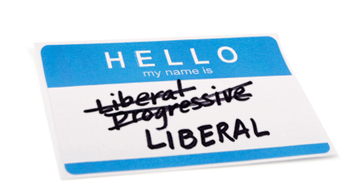 liberal/progressive convictions and commitments. Anyone with the slightest awareness of what is going on in the public sphere knows that political advocacy in the name of Christian principles happens on a daily basis that at least on the surface seeks to infringe on the freedoms of others, to draw lines of exclusion rather than blurring or erasing them, as well as ignoring or underemphasizing the needs of the poor and disenfranchised. In seeking for possible explanations for these apparent contradictions, I found the following observation from a Facebook friend to be particularly helpful.
- People who disagree on “what is the Christian message” may also disagree whether it is compromised by political advocacy.
The philosopher in me resonates with this. The question as presented to me (and presented by me to my Facebook acquaintances) is misleading because it refers to “the Christian message” as if this message is something agreed upon by all person who profess the Christian faith. This obviously is not the case. 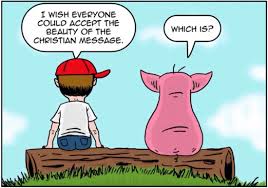 So before we start asking about how far political advocacy can go before it distorts the Christian message, we need first to figure out what that message is. Good luck.
I honestly despair of agreement between Christians concerning what the Christian message is. The message I was taught as a child is very different than the message with which I resonate now—yet I was just as much “Christian” then as I am now. What I was taught then is extraordinarily different from what I believe now. The bridge across this disconnect, and across the disconnect between Christians now, cannot be constructed from dogmas, principles, rules, or political action. My Christian faith prompts me to endorse policies and perspectives that directly conflict with the very policies and perspectives endorsed by fellow Christians whose understanding of the implications of their faith is entirely different from mine. So what is to be done?
On one level of understanding, I don’t know. But I am reminded of the story in the gospels of the Publican and the Pharisee. 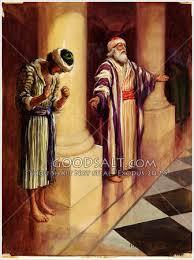 The Pharisee’s prayer was public, self-righteous, and confident in his conviction that he understood the mind of God. The Publican’s prayer was unobserved, private, and repentant. And guess whose prayer Jesus endorsed? Samuel Coleridge once wrote that Christianity is a life, not a doctrine. The Christian who advocates politically should not be promoting a rule of law but rather exemplifying a way of life. I wonder whether Christian political advocacy might not be an oxymoron. Who I am, what I advocate and fight for in the public square, should not be a matter of principles and doctrines. It should rather be a natural reflection of the person my faith has caused me to become. And since faith works in radically individual ways, the expressions of lived Christian faith will be as various and unique as the persons within whom that faith has made a difference.
Previous Post

September 25, 2015
An Aria as Lovely as a Tree
Next Post
October 2, 2015 A Jesuit Frame of Mind
Browse Our Archives
Select a Category abortion Advent AI Angels Artificial intelligence atheism attention baptism Baptists beauty belief Benedictines Bible bicycling Big Bird books Bovina Camaldoli hermitage Canada Catholicism cats certainty change Christianity Christmas Collegeville Covid-19 creativity Development of Western Civilization dogs doubt Easter Enneagram Epiphany Episcopal ethics Eucharist evil extroverts Facebook faith family fear flowers forgiveness freedom friends God goodness grace happiness heaven hell history Holy Spirit Holy Week hope human nature humility humor idolatry incarnation introverts irreverence Islam Jeanne Jesus Joe Biden joy Judaism justice Kamala Harris knowledge Lent listen literature liturgy love Marsue Memorial Day miracles movies music mystery mythology NPR Old Testament optimism paradox peace Penguins philosophy piano podcast politics power prayer Protestantism Providence College Religion Rhode Island sabbatical sacrament science seeing silence Simone Weil Socrates soul sports St. John's College stories suffering tattoo teaching technology television theology thinking time tolerance transcendence travel trees trust truth Uncategorized Vermont wisdom wonder writing
Select a Month May 2026 April 2026 March 2026 February 2026 January 2026 December 2025 November 2025 October 2025 September 2025 August 2025 July 2025 June 2025 May 2025 April 2025 March 2025 February 2025 January 2025 December 2024 November 2024 October 2024 September 2024 August 2024 July 2024 June 2024 May 2024 April 2024 March 2024 February 2024 January 2024 December 2023 November 2023 October 2023 September 2023 August 2023 July 2023 June 2023 May 2023 April 2023 March 2023 February 2023 January 2023 December 2022 November 2022 October 2022 September 2022 August 2022 July 2022 June 2022 May 2022 April 2022 March 2022 February 2022 January 2022 December 2021 November 2021 October 2021 September 2021 August 2021 July 2021 June 2021 May 2021 April 2021 March 2021 February 2021 January 2021 December 2020 November 2020 October 2020 September 2020 August 2020 July 2020 June 2020 May 2020 April 2020 March 2020 February 2020 January 2020 December 2019 November 2019 October 2019 September 2019 August 2019 July 2019 June 2019 May 2019 April 2019 March 2019 February 2019 January 2019 December 2018 November 2018 October 2018 September 2018 August 2018 July 2018 June 2018 May 2018 April 2018 March 2018 February 2018 January 2018 December 2017 November 2017 October 2017 September 2017 August 2017 July 2017 June 2017 May 2017 April 2017 March 2017 February 2017 January 2017 December 2016 November 2016 October 2016 September 2016 August 2016 July 2016 June 2016 May 2016 April 2016 March 2016 February 2016 January 2016 December 2015 November 2015 October 2015 September 2015 August 2015 July 2015 June 2015 May 2015 April 2015 March 2015 February 2015 January 2015 December 2014 November 2014 October 2014 September 2014 August 2014 July 2014 June 2014 May 2014 April 2014 March 2014 February 2014 January 2014 December 2013 November 2013 October 2013 September 2013 August 2013 July 2013 June 2013 May 2013 April 2013 March 2013 February 2013 January 2013 December 2012 November 2012 October 2012 September 2012
Follow Us!
TAKE THE
Religious Wisdom Quiz
What does the Pale Horse in Revelations symbolize?
Select your answer to see how you score.
The Kingdom of God Death War Prosperity
Books by This Author Books by Vance G. Morgan
Related posts from Freelance Christianity

The Lonely Pawn: On Faith, Doubt, and Meaning


AI and Love: When a Chatbot Becomes a...

TRENDING AT PATHEOS Progressive Christian

What Being a Modern-Day Apostle Means to Me
In my last column, I discussed the ins and outs of modern-day...

Did Ancient China Once Worship the God of...
Across human history, a common thread weaves through the origins of the...

Love Your Neighbor – Including Earth-Kin: Lev. 19,...
God’s command to love your neighbor means acting in an ethical and...

Lead a Church Study of “Jesus and Lao...
Guest writer Jack Thomas (The Irreverent Reverend) reflects on leading his church...

Pastoral Wisdom for Responding to Sermon Pushback
Getting sermon pushback on your social justice sermon? Learn practical, Proverbs-based strategies...

Principles for Understanding the Apostolic Ministry Today
Whenever people discover that my formal ministry title is "apostle," as in...
view all Progressive Christian blogs
Ad-Free & Subscriber Log-In Subscription Support
- About Us
- 2026 Calendar
- Videos
- Podcasts
- Library of World Religions
- Faith In Media Tracker
- Advertise With Us
- Write for Us
- Privacy Policy
- Terms of Service
- Do Not Sell My Data
- Contact Us
- Radiant Digital
- Manage Newsletter Subscriptions
- Unsubscribe From Notifications
- Sitemap
Copyright 2008-2026, Patheos. All rights reserved.
Subscription Support Ad-Free & Subscriber Log-In
Follow Patheos