
BuddhistCatholicContemplativeEvangelicalGeneral ChristianHinduJewishLatter-day SaintMuslimNew VisionsProgressive Christian
Beliefs
- Buddhist
- Catholic
- Contemplative
- Evangelical
- General Christian
- Hindu
- Jewish
- Latter-day Saint
- More Voices
- Muslim
- New Visions
- Pagan
- Progressive Christian
Topics
- Religion News
- Food and Religion
- Sports and Religion
- Religious Art
- Religious Music and Entertainment
- Religious Events
- History and Religion
- Style and Religion
- Politics and Religion
- Women in Religion
- Recreation Outdoors and Religion
- Business Finance and Religion
- Careers Workplace and Religion
- Education and Religion
- Family Parenting and Religion
- Health Fitness and Religion
- Home and Religion
- Relationships and Religion
- Technology and Religion
- Travel and Religion
Columnists
- Buddhist Columnists
- Business Finance and Religion Columnists
- Careers Workplace and Religion Columnists
- Catholic Columnists
- Contemplative Columnists
- Education and Religion Columnists
- Evangelists Columnists
- Family Parenting and Religion Columnists
- General Christian Columnists
- Health Fitness and Religion Columnists
- Hindu Columnists
- History and Religion Columnists
- Home and Religion Columnists
- Jewish Columnists
- More Voices Columnists
- Latter Day Columnists
- Muslim Columnists
- New Visions Columnists
- Nonreligious Columnists
- Pagan Columnists
- Politics and Religion Columnists
- Progressive Columnists
- Recreation Outdoors and Religion Columnists
- Relationships and Religion Columnists
- Religion News Columnists
- Religious Art Columnists
- Religious Events Columnists
- Religious Music and Entertainment Columnists
- Sports and Religion Columnists
- Style and Religion Columnists
- Technology and Religion Columnists
- Travel and Religion Columnists
- Women in Religion Columnists
Resource Library
- 2026 Calendar
- Library of World Religions
- The 100 Most Holy Places on Earth
- Patheos Answers
- Podcasts
- Videos
- Faith Leaders Database
- Anglican Episcopalian
- Bahai
- Baptist
- Buddhism
- Christianity
- Confucianism
- Eastern Orthodoxy
- Hinduism
- Holiness and Pentecostal
- ISKCON
- Islam
- Judaism
- Lutheran
- Methodist
- The Church of Jesus Christ of Latter-day Saints
- New Age
- Paganism
- Presbytarian and Reformed
- Protestantism
- Religion Behind the Scenes
- Roman Catholic
- Scientology
- Shia Islam
- Sikhism
- Sufism
- Sunni Islam
- Taoism
- Zen
- See all religions
Research Tools
 Ad-Free & Subscriber Log-In Subscription Support
Ad-Free & Subscriber Log-In Subscription Support
Follow Patheos 

- Trending:
- Forgiveness
- |
- Marriage
- |
- Consciousness
- |
- Death Penalty
- |
- Election
- |
- Halloween

- Home
- Progressive Christian
- Is My Ignorance Worth as Much as Your Knowledge?
Is My Ignorance Worth as Much as Your Knowledge?
Last updated on: November 21, 2018 at 9:08 am by Vance Morgan
Is My Ignorance Worth as Much as Your Knowledge? 2018-11-21T09:08:46-04:00 Vance Morgan
Patheos Explore the world's faith through different perspectives on religion and spirituality! Patheos has the views of the prevalent religions and spiritualities of the world.
In early 1980, Isaac Asimov wrote something in a Newsweek article that has been making the rounds on social media over the past few months, something that could have been written yesterday.
The strain of anti-intellectualism has been a constant thread winding its way through our political and cultural life, nurtured by the false notion that democracy means that “my ignorance is just as good as your knowledge.”
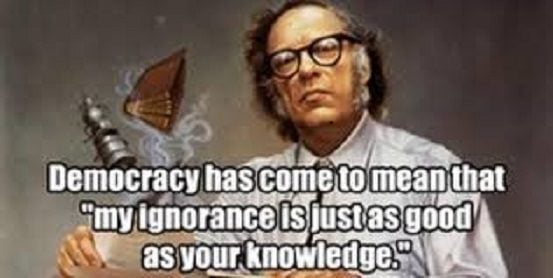
Asimov died over twenty-five years ago; I suspect that he would have adapted well to the internet and social media, and would be a powerful voice pushing back against the virulent anti-intellectualism that currently plagues us.
Asimov would have been interested in a recent book by Tom Nichols, who teaches at the Naval War College in Newport, Rhode Island. The thesis of The Death of Expertise: The Campaign against Established Knowledge and Why It Matters describes a classic “good news/bad news” situation. The good news: People are now exposed to more information than ever before, provided both by technology and by increasing access to every level of education. The bad news: These societal gains have helped fuel a surge in narcissistic and misguided intellectual egalitarianism that has crippled informed debates on any number of issues. Nichols writes that
The abysmal literacy, both political and general, of the American public . . . is the soil in which many other dysfunctions have taken root and prospered, with the 2016 election only its most recent expression . . . Americans have increasingly unrealistic expectations of what their political and economic system can provide. This sense of entitlement is one reason they are continually angry at “experts” and especially at “elitists,” a word that in modern American usage can mean almost anyone with any education who refuses to coddle the public’s mistaken beliefs . . . All voices, even the most ridiculous, demand to be taken with equal seriousness, and any claim to the contrary is dismissed as undemocratic elitism.
My twenty-five-plus years of college professorship convinces me that Nichols’ thesis is correct. I am solidly in the camp of “experts” and “elites” whose ideas and insights are more and more frequently dismissed out of hand for the reasons Nichols cites. I never thought that I would find myself living in a world in which the value of a person’s ideas would stand in inverse proportion to that person’s education and training, but that’s the world we increasingly find ourselves in.
I experienced this phenomenon on Twitter a year or so ago. I was in the beginning stages of what struck me as a reasonably civil Twitter-bate (new word) with a stranger who was, let’s say, slightly more conservative than I am. I had asked him to explain why, as he had expressed in a tweet, he thought Roy Moore would be the best thing that ever happened to the U. S. Senate; he apparently checked my Twitter home page and found out that I’m a college professor. Within a few minutes I received the following tweets in rapid fire, close enough together that I had no chance to even respond. I just sat back and watched the barrage roll onto my computer screen (I’ve cleaned up the spelling and capitalization—just can’t help myself):
- You’re a so called “Christian Philosopher” who touts Marxist propaganda? Gee, history proves how well that works out.
- As a professor, you’re either painfully confused, poorly educated or a straight up Marxist propagandist.
- Says the leftist clown, who claims he’s a Christian while supporting the very leftist policies that destroy religion and inalienable rights.
- Priceless: an Obama worshipping, Hillary supporting, America Hating Marxist Clown! Your page says it all
- What I find most troubling is how you claim to be a Christian, while you reject the human condition—that is, centuries of human history.
- Why would a Hegelian, Rousseauian, Marxist of your ilk care? Be proud of your beliefs—defend them!
Eventually I was able to squeeze in my own tweet, asking him what of Marx, Hegel and Rousseau he had read (also letting him know that “Rousseauian” isn’t a real word); he replied
- I enjoy philosophy and have read quite a bit, ergo, discerning your mindset wasn’t brain surgery.
After replying that I was impressed by how much he learned with confidence about me from a few tweets, I finished with this:
- Confidence is fine, but remember this from Montaigne: “On the loftiest throne in the world, you are still sitting on your own ass.”
Haven’t heard back from him since, but he may just be planning his next barrage. Of course, that’s what the “block” button is for.
What I really wanted to tweet was
- WHO DO YOU THINK YOU’RE TWEETING TO, YOU IGNORANT, SELF-IMPORTANT JACKASS?? MY TEN YEARS OF COLLEGE AND TWENTY-FIVE YEARS OF TEACHING ON THE COLLEGE LEVEL TRUMP (PUN INTENDED) YOUR SELF-TAUGHT, PAINT-BY-NUMBERS ABSURDITIES!!
Followed by spiking my copy of Hegel’s Phenomenology of Spirit to my office floor in triumph. But that’s too many characters for a tweet, and it wouldn’t be kind. But I must admit that I don’t feel particularly kind when someone claims that their ignorance masquerading as knowledge trumps what I consider to be my hard-earned real knowledge.
Millions of words have been and will be written about this “ignorance is just as good as knowledge” phenomenon, embraced by some and ignored or belittled on principle by others. I confess to annoyance when someone considers my years of education and twenty-five years of experience as a liability on issues that I actually know something about, but so be it. Let me instead say a word about the value of ignorance. Earned ignorance, that is. I often tell my students that a liberally educated person earns the right to have an opinion. Such a person also earns the right to embrace their ignorance—and that’s a good thing.
The godfather of Western philosophy, the patron saint of my academic discipline, is Socrates, a man whose only claim to fame—in his own estimation, at least—is that he did not know anything. He was a solid island of ignorance in a sea of Athenian pretensions to expertise and knowledge, and yet for millions over the centuries he has become the hallmark of wisdom. How does that work? How can wisdom coexist with ignorance? As it turns out, they go hand in hand—but it takes a lot of hard work and self-awareness to arrive at earned ignorance.
Michael Smithson, a psychologist teaching at the Australian National University, provides an interesting metaphor to illustrate the important dynamic between what we know and we don’t know. Imagine human knowledge as an island in a vast sea of ignorance. The island is dynamic and growing—living in the middle of it one might think it is a continent and be unaware of the surrounding sea. Smithson points out that the larger the island of knowledge grows, the longer the shoreline — where knowledge meets ignorance — extends.
This is why I find the teaching profession and facilitating the life of learning is so exhilarating and fascinating. The shoreline between sea and land is always fluctuating as the tide rolls in and rolls out. The line of demarcation between land and water, between knowledge and ignorance, is shifting sand—that’s the territory of true learning. The pedagogy of uncertainty and ignorance favors questions over answers, uncertainty over certainty, the unknown over the set and established.
The message here is to keep seeking the shoreline, rather than settling down permanently in the middle of the island and pretending that there is no ocean of ignorance surrounding what appears to be a fixed and vast continent. Socrates took great delight in leading his fellow Athenians, who were sure that “it doesn’t get any better than this” in terms of culture, sophistication, and knowledge, to the shoreline of knowledge in order to catch a glimpse of how much vaster our ignorance is than our knowledge.
This would be good for all of us to remember the next time we are tempted to present our favorite religious or political commitments, many of which were handed to us years ago and which we have never thought to question, as if they are insights into the mind of God. They aren’t—they are, instead, the natural starting point of what should be a life-long exploration of the shoreline between knowledge and ignorance. Happy exploring!
Previous Post

November 20, 2018
A Birthday Worth Noting
Next Post

November 23, 2018 Black Friday and the War on Christmas
Browse Our Archives
Select a Category abortion Advent AI Angels Artificial intelligence atheism attention baptism Baptists beauty belief Benedictines Bible bicycling Big Bird books Bovina Camaldoli hermitage Canada Catholicism cats certainty change Christianity Christmas Collegeville Covid-19 creativity Development of Western Civilization dogs doubt Easter Enneagram Epiphany Episcopal ethics Eucharist evil extroverts Facebook faith family fear flowers forgiveness freedom friends God goodness grace happiness heaven hell history Holy Spirit Holy Week hope human nature humility humor idolatry incarnation introverts irreverence Islam Jeanne Jesus Joe Biden joy Judaism justice Kamala Harris knowledge Lent listen literature liturgy love Marsue Memorial Day miracles movies music mystery mythology NPR Old Testament optimism paradox peace Penguins philosophy piano podcast politics power prayer Protestantism Providence College Religion Rhode Island sabbatical sacrament science seeing silence Simone Weil Socrates soul sports St. John's College stories suffering tattoo teaching technology television theology thinking time tolerance transcendence travel trees trust truth Uncategorized Vermont wisdom wonder writing
Select a Month May 2026 April 2026 March 2026 February 2026 January 2026 December 2025 November 2025 October 2025 September 2025 August 2025 July 2025 June 2025 May 2025 April 2025 March 2025 February 2025 January 2025 December 2024 November 2024 October 2024 September 2024 August 2024 July 2024 June 2024 May 2024 April 2024 March 2024 February 2024 January 2024 December 2023 November 2023 October 2023 September 2023 August 2023 July 2023 June 2023 May 2023 April 2023 March 2023 February 2023 January 2023 December 2022 November 2022 October 2022 September 2022 August 2022 July 2022 June 2022 May 2022 April 2022 March 2022 February 2022 January 2022 December 2021 November 2021 October 2021 September 2021 August 2021 July 2021 June 2021 May 2021 April 2021 March 2021 February 2021 January 2021 December 2020 November 2020 October 2020 September 2020 August 2020 July 2020 June 2020 May 2020 April 2020 March 2020 February 2020 January 2020 December 2019 November 2019 October 2019 September 2019 August 2019 July 2019 June 2019 May 2019 April 2019 March 2019 February 2019 January 2019 December 2018 November 2018 October 2018 September 2018 August 2018 July 2018 June 2018 May 2018 April 2018 March 2018 February 2018 January 2018 December 2017 November 2017 October 2017 September 2017 August 2017 July 2017 June 2017 May 2017 April 2017 March 2017 February 2017 January 2017 December 2016 November 2016 October 2016 September 2016 August 2016 July 2016 June 2016 May 2016 April 2016 March 2016 February 2016 January 2016 December 2015 November 2015 October 2015 September 2015 August 2015 July 2015 June 2015 May 2015 April 2015 March 2015 February 2015 January 2015 December 2014 November 2014 October 2014 September 2014 August 2014 July 2014 June 2014 May 2014 April 2014 March 2014 February 2014 January 2014 December 2013 November 2013 October 2013 September 2013 August 2013 July 2013 June 2013 May 2013 April 2013 March 2013 February 2013 January 2013 December 2012 November 2012 October 2012 September 2012
Follow Us!
TAKE THE
Religious Wisdom Quiz
Who was Jacob's favorite son?
Select your answer to see how you score.
Levi Dan Joseph Judah
Books by This Author Books by Vance G. Morgan
Related posts from Freelance Christianity

The Lonely Pawn: On Faith, Doubt, and Meaning


AI and Love: When a Chatbot Becomes a...

TRENDING AT PATHEOS Progressive Christian

What Being a Modern-Day Apostle Means to Me
In my last column, I discussed the ins and outs of modern-day...

Did Ancient China Once Worship the God of...
Across human history, a common thread weaves through the origins of the...

Love Your Neighbor – Including Earth-Kin: Lev. 19,...
God’s command to love your neighbor means acting in an ethical and...

Lead a Church Study of “Jesus and Lao...
Guest writer Jack Thomas (The Irreverent Reverend) reflects on leading his church...

Pastoral Wisdom for Responding to Sermon Pushback
Getting sermon pushback on your social justice sermon? Learn practical, Proverbs-based strategies...

Principles for Understanding the Apostolic Ministry Today
Whenever people discover that my formal ministry title is "apostle," as in...
view all Progressive Christian blogs
Ad-Free & Subscriber Log-In Subscription Support
- About Us
- 2026 Calendar
- Videos
- Podcasts
- Library of World Religions
- Faith In Media Tracker
- Advertise With Us
- Write for Us
- Privacy Policy
- Terms of Service
- Do Not Sell My Data
- Contact Us
- Radiant Digital
- Manage Newsletter Subscriptions
- Unsubscribe From Notifications
- Sitemap
Copyright 2008-2026, Patheos. All rights reserved.
Subscription Support Ad-Free & Subscriber Log-In
Follow Patheos