
BuddhistCatholicContemplativeEvangelicalGeneral ChristianHinduJewishLatter-day SaintMuslimNew VisionsProgressive Christian
Beliefs
- Buddhist
- Catholic
- Contemplative
- Evangelical
- General Christian
- Hindu
- Jewish
- Latter-day Saint
- More Voices
- Muslim
- New Visions
- Pagan
- Progressive Christian
Topics
- Religion News
- Food and Religion
- Sports and Religion
- Religious Art
- Religious Music and Entertainment
- Religious Events
- History and Religion
- Style and Religion
- Politics and Religion
- Women in Religion
- Recreation Outdoors and Religion
- Business Finance and Religion
- Careers Workplace and Religion
- Education and Religion
- Family Parenting and Religion
- Health Fitness and Religion
- Home and Religion
- Relationships and Religion
- Technology and Religion
- Travel and Religion
Columnists
- Buddhist Columnists
- Business Finance and Religion Columnists
- Careers Workplace and Religion Columnists
- Catholic Columnists
- Contemplative Columnists
- Education and Religion Columnists
- Evangelists Columnists
- Family Parenting and Religion Columnists
- General Christian Columnists
- Health Fitness and Religion Columnists
- Hindu Columnists
- History and Religion Columnists
- Home and Religion Columnists
- Jewish Columnists
- More Voices Columnists
- Latter Day Columnists
- Muslim Columnists
- New Visions Columnists
- Nonreligious Columnists
- Pagan Columnists
- Politics and Religion Columnists
- Progressive Columnists
- Recreation Outdoors and Religion Columnists
- Relationships and Religion Columnists
- Religion News Columnists
- Religious Art Columnists
- Religious Events Columnists
- Religious Music and Entertainment Columnists
- Sports and Religion Columnists
- Style and Religion Columnists
- Technology and Religion Columnists
- Travel and Religion Columnists
- Women in Religion Columnists
Resource Library
- 2026 Calendar
- Library of World Religions
- The 100 Most Holy Places on Earth
- Patheos Answers
- Podcasts
- Videos
- Faith Leaders Database
- Anglican Episcopalian
- Bahai
- Baptist
- Buddhism
- Christianity
- Confucianism
- Eastern Orthodoxy
- Hinduism
- Holiness and Pentecostal
- ISKCON
- Islam
- Judaism
- Lutheran
- Methodist
- The Church of Jesus Christ of Latter-day Saints
- New Age
- Paganism
- Presbytarian and Reformed
- Protestantism
- Religion Behind the Scenes
- Roman Catholic
- Scientology
- Shia Islam
- Sikhism
- Sufism
- Sunni Islam
- Taoism
- Zen
- See all religions
Research Tools
 Ad-Free & Subscriber Log-In Subscription Support
Ad-Free & Subscriber Log-In Subscription Support
Follow Patheos 

- Trending:
- Forgiveness
- |
- Marriage
- |
- Consciousness
- |
- Death Penalty
- |
- Election
- |
- Halloween

- Home
- Progressive Christian
- Is it the end of us? An end-of-the-year reflection
Is it the end of us? An end-of-the-year reflection
Last updated on: December 29, 2022 at 7:00 pm by Vance Morgan
Is it the end of us? An end-of-the-year reflection 2022-12-29T19:00:50-04:00 Vance Morgan
Patheos Explore the world's faith through different perspectives on religion and spirituality! Patheos has the views of the prevalent religions and spiritualities of the world.
He who loves his life will lose it. John 12:25
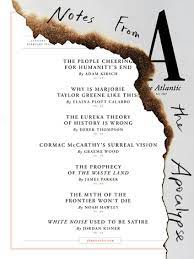
I subscribe to two magazines, The New Yorker and The Atlantic. They pile up on the end table next to my side of the bed all semester–I generally start catching up on them in between semesters, often while riding on the stationary bike at the gym. The theme of the recently-arrived January 2023 The Atlantic is “Notes from the Apocalypse.” Given that I have participated in a team-taught colloquium called “Apocalypse” three times–including during the Spring 2020 semester–and am penciled in to do so again in the Spring 2024 semester, this seemed to be suitable reading material for working out.
First up the other day was Adam Kirsch’s “The People Cheering for Humanity’s End.”
Adam Kirsch: The People Cheering for Humanity’s End
Kirsch asks the question “Is the reign of human beings on Earth nearing its end?”, noting that “a disparate group of thinkers says yes—and that we should welcome our demise.” This rather unfortunate (for humans) and eclectic group includes “engineers and philosophers [of course], political activists and would-be hermits, novelists and paleontologists,” not a movement so much as a motley crew of eclectic folks who agree on only one thing: “the end of humanity’s reign on Earth is imminent, and we should welcome it.”
This turn against human primacy is being driven by two ways of thinking that, at least at first approach, seem to be opposites. The first of these might be called “environmentalism on steroids.” In fact, it is called Anthropocene anti-humanism, inspired by revulsion at humanity’s destruction of the natural environment. It claims that our self-destruction is inevitable and that we whould welcome it as a sentence we have justly passed on ourselves. It is a rejection of humanity’s traditional role as Earth’s primary protagonist, the most important being in creation.
The other way of thinking is transhumanism which glorifies some of the very things that anti-humanism regrets, including scientific and technological progress and the primacy of human reason. Transhumanists believe that the only way forward for humanity is to create new forms of intelligent life that will no longer be us. While anti-humanists believe that the meaningfulness of the universe does not depend on human consciousness (or existence), transhumanists believe that the universe would be meaningless without minds to experience and understand it. But those minds don’t need to be human minds—and probably won’t be.
If this all seems rather esoteric and philosophical, it is—and that’s why it fascinates me (remember what I do for a living, after all). Although environmental issues are front and center in my concerns for the future, I find transhumanism particularly interesting, perhaps because its general optimism about the future of the universe fits my natural optimism—even though that future universe does not include human beings. Transhumanists consider the primary task of humanity to be the stewardship of reason.
Without getting too far into the weeds, the Holy Grail of transhumanism is
artificial general intelligence—a computer mind that can learn about any subject, rather than being confined to a narrow domain such as chess. Even if such an AI started out in a rudimentary form, it would be able to apply itself to the problem of AI design and improve itself to think faster and deeper. Then the improved version would improve itself, and so on, exponentially.
Such a general AI would quickly replace humanity from its position as “apex cogitator” before we even knew it. This is good news, of course, only if the expansion of intelligent minds is more important than the continuation of the human species. But why do we imagine that our preferences are so special?
An AI takeover would certainly be bad for the human beings who are alive when it occurs, but perhaps a world dominated by nonhuman minds would be morally preferable in the end, with less cruelty and waste . . . AI minds might be more appreciative than we are of the wonder of creation. They might know nothing of the violence and hatred that often makes humanity loathsome to human beings themselves. Our greatest spiritual achievements might seem as crude and indecipherable to them as a coyote’s howl to us.
At this point you might be wondering why I’m geeking out on transhumanism on a blog called “Freelance Christianity.” I’m that sort of guy—in my early years as an academic cognitive science and artificial intelligence were some of my primary research interests. But toward the end of his article, Adam Kirsch makes some observations that bring transhumanism into the arena of faith—creating something that you can’t control is a familiar story.
Or maybe our preferences are entirely irrelevant. We might be in the position of God after he created humanity with free will, thus forfeiting the right to intervene when his creation makes mistakes.
The traditional “go to” answer to the question of why a good and all-powerful God allows so much evil in this divinely created world is that God created human beings with free will—the evil is our fault. What many miss is that in creating humans with free will, God has created a world that God can no longer control—the direct result of God’s own creating decisions. The analogy with transhumanism is not perfect, but is definitely illuminating. I’ll keep it in mind the next time we’re doing the problem of evil in class.
Of course, the apocalyptic prophecies of the end of humanity, whether the anti-humanist or the transhumanist version, may never come true. Most prophecies don’t, at least not in the way prophesied. But as Adam Kirsch writes, this does not devalue the importance of the prophecy.
The accuracy of a prophecy is one thing; its significance is another. In the Gospel of Matthew, Jesus tells his followers that the world is going to end in their lifetime: “Verily I say to you, there are some standing here who shall not taste death till they see the Son of Man coming in His kingdom.” This proved not to be true—at least not in any straightforward sense—but the promise still changed the world.
Considering the possible extinction of humanity has great moral importance, even though it is unlikely that it will happen—if it happens at all—in our lifetimes. It decenters us from the middle of what is most important, which is always a good thing.
The revolt against humanity has a great future ahead of it because it appeals to people who are at once committed to science and reason yet yearn for the clarity and purpose of an absolute moral imperative. It says that we can move the plan, maybe even the universe, in the direction of the good, on one condition—that we forfeit our own existence as a species. In this way, the question of why humanity exists is given a convincing yet wholly immanent answer. Following the logic of sacrifice, we give our life meaning by giving it up.
I think I’ve heard that one before.

Next Post

January 1, 2023 Hope in Unexpected Form—A New Year’s Day Reflection
Browse Our Archives
Select a Category abortion Advent AI Angels Artificial intelligence atheism attention baptism Baptists beauty belief Benedictines Bible bicycling Big Bird books Bovina Camaldoli hermitage Canada Catholicism cats certainty change Christianity Christmas Collegeville Covid-19 creativity Development of Western Civilization dogs doubt Easter Enneagram Epiphany Episcopal ethics Eucharist evil extroverts Facebook faith family fear flowers forgiveness freedom friends God goodness grace happiness heaven hell history Holy Spirit Holy Week hope human nature humility humor idolatry incarnation introverts irreverence Islam Jeanne Jesus Joe Biden joy Judaism justice Kamala Harris knowledge Lent listen literature liturgy love Marsue Memorial Day miracles movies music mystery mythology NPR Old Testament optimism paradox peace Penguins philosophy piano podcast politics power prayer Protestantism Providence College Religion Rhode Island sabbatical sacrament science seeing silence Simone Weil Socrates soul sports St. John's College stories suffering tattoo teaching technology television theology thinking time tolerance transcendence travel trees trust truth Uncategorized Vermont wisdom wonder writing
Select a Month May 2026 April 2026 March 2026 February 2026 January 2026 December 2025 November 2025 October 2025 September 2025 August 2025 July 2025 June 2025 May 2025 April 2025 March 2025 February 2025 January 2025 December 2024 November 2024 October 2024 September 2024 August 2024 July 2024 June 2024 May 2024 April 2024 March 2024 February 2024 January 2024 December 2023 November 2023 October 2023 September 2023 August 2023 July 2023 June 2023 May 2023 April 2023 March 2023 February 2023 January 2023 December 2022 November 2022 October 2022 September 2022 August 2022 July 2022 June 2022 May 2022 April 2022 March 2022 February 2022 January 2022 December 2021 November 2021 October 2021 September 2021 August 2021 July 2021 June 2021 May 2021 April 2021 March 2021 February 2021 January 2021 December 2020 November 2020 October 2020 September 2020 August 2020 July 2020 June 2020 May 2020 April 2020 March 2020 February 2020 January 2020 December 2019 November 2019 October 2019 September 2019 August 2019 July 2019 June 2019 May 2019 April 2019 March 2019 February 2019 January 2019 December 2018 November 2018 October 2018 September 2018 August 2018 July 2018 June 2018 May 2018 April 2018 March 2018 February 2018 January 2018 December 2017 November 2017 October 2017 September 2017 August 2017 July 2017 June 2017 May 2017 April 2017 March 2017 February 2017 January 2017 December 2016 November 2016 October 2016 September 2016 August 2016 July 2016 June 2016 May 2016 April 2016 March 2016 February 2016 January 2016 December 2015 November 2015 October 2015 September 2015 August 2015 July 2015 June 2015 May 2015 April 2015 March 2015 February 2015 January 2015 December 2014 November 2014 October 2014 September 2014 August 2014 July 2014 June 2014 May 2014 April 2014 March 2014 February 2014 January 2014 December 2013 November 2013 October 2013 September 2013 August 2013 July 2013 June 2013 May 2013 April 2013 March 2013 February 2013 January 2013 December 2012 November 2012 October 2012 September 2012
Follow Us!
TAKE THE
Religious Wisdom Quiz
What is the shortest verse in the Bible?
Select your answer to see how you score.
"Rejoice always." "Jesus wept." "God is love." "I am."
Books by This Author Books by Vance G. Morgan
Related posts from Freelance Christianity

The Lonely Pawn: On Faith, Doubt, and Meaning


AI and Love: When a Chatbot Becomes a...

TRENDING AT PATHEOS Progressive Christian

What Being a Modern-Day Apostle Means to Me
In my last column, I discussed the ins and outs of modern-day...

Did Ancient China Once Worship the God of...
Across human history, a common thread weaves through the origins of the...

Love Your Neighbor – Including Earth-Kin: Lev. 19,...
God’s command to love your neighbor means acting in an ethical and...

Lead a Church Study of “Jesus and Lao...
Guest writer Jack Thomas (The Irreverent Reverend) reflects on leading his church...

Pastoral Wisdom for Responding to Sermon Pushback
Getting sermon pushback on your social justice sermon? Learn practical, Proverbs-based strategies...

Principles for Understanding the Apostolic Ministry Today
Whenever people discover that my formal ministry title is "apostle," as in...
view all Progressive Christian blogs
Ad-Free & Subscriber Log-In Subscription Support
- About Us
- 2026 Calendar
- Videos
- Podcasts
- Library of World Religions
- Faith In Media Tracker
- Advertise With Us
- Write for Us
- Privacy Policy
- Terms of Service
- Do Not Sell My Data
- Contact Us
- Radiant Digital
- Manage Newsletter Subscriptions
- Unsubscribe From Notifications
- Sitemap
Copyright 2008-2026, Patheos. All rights reserved.
Subscription Support Ad-Free & Subscriber Log-In
Follow Patheos