
BuddhistCatholicContemplativeEvangelicalGeneral ChristianHinduJewishLatter-day SaintMuslimNew VisionsProgressive Christian
Beliefs
- Buddhist
- Catholic
- Contemplative
- Evangelical
- General Christian
- Hindu
- Jewish
- Latter-day Saint
- More Voices
- Muslim
- New Visions
- Pagan
- Progressive Christian
Topics
- Religion News
- Food and Religion
- Sports and Religion
- Religious Art
- Religious Music and Entertainment
- Religious Events
- History and Religion
- Style and Religion
- Politics and Religion
- Women in Religion
- Recreation Outdoors and Religion
- Business Finance and Religion
- Careers Workplace and Religion
- Education and Religion
- Family Parenting and Religion
- Health Fitness and Religion
- Home and Religion
- Relationships and Religion
- Technology and Religion
- Travel and Religion
Columnists
- Buddhist Columnists
- Business Finance and Religion Columnists
- Careers Workplace and Religion Columnists
- Catholic Columnists
- Contemplative Columnists
- Education and Religion Columnists
- Evangelists Columnists
- Family Parenting and Religion Columnists
- General Christian Columnists
- Health Fitness and Religion Columnists
- Hindu Columnists
- History and Religion Columnists
- Home and Religion Columnists
- Jewish Columnists
- More Voices Columnists
- Latter Day Columnists
- Muslim Columnists
- New Visions Columnists
- Nonreligious Columnists
- Pagan Columnists
- Politics and Religion Columnists
- Progressive Columnists
- Recreation Outdoors and Religion Columnists
- Relationships and Religion Columnists
- Religion News Columnists
- Religious Art Columnists
- Religious Events Columnists
- Religious Music and Entertainment Columnists
- Sports and Religion Columnists
- Style and Religion Columnists
- Technology and Religion Columnists
- Travel and Religion Columnists
- Women in Religion Columnists
Resource Library
- 2026 Calendar
- Library of World Religions
- The 100 Most Holy Places on Earth
- Patheos Answers
- Podcasts
- Videos
- Faith Leaders Database
- Anglican Episcopalian
- Bahai
- Baptist
- Buddhism
- Christianity
- Confucianism
- Eastern Orthodoxy
- Hinduism
- Holiness and Pentecostal
- ISKCON
- Islam
- Judaism
- Lutheran
- Methodist
- The Church of Jesus Christ of Latter-day Saints
- New Age
- Paganism
- Presbytarian and Reformed
- Protestantism
- Religion Behind the Scenes
- Roman Catholic
- Scientology
- Shia Islam
- Sikhism
- Sufism
- Sunni Islam
- Taoism
- Zen
- See all religions
Research Tools
 Ad-Free & Subscriber Log-In Subscription Support
Ad-Free & Subscriber Log-In Subscription Support
Follow Patheos 

- Trending:
- Forgiveness
- |
- Marriage
- |
- Consciousness
- |
- Death Penalty
- |
- Election
- |
- Halloween

- Home
- Progressive Christian
- Is Donald Trump “The Chosen One”?
Is Donald Trump “The Chosen One”?
Last updated on: August 21, 2019 at 6:25 pm by Vance Morgan
Is Donald Trump “The Chosen One”? 2019-08-21T18:20:20-04:00 Vance Morgan
Patheos Explore the world's faith through different perspectives on religion and spirituality! Patheos has the views of the prevalent religions and spiritualities of the world.
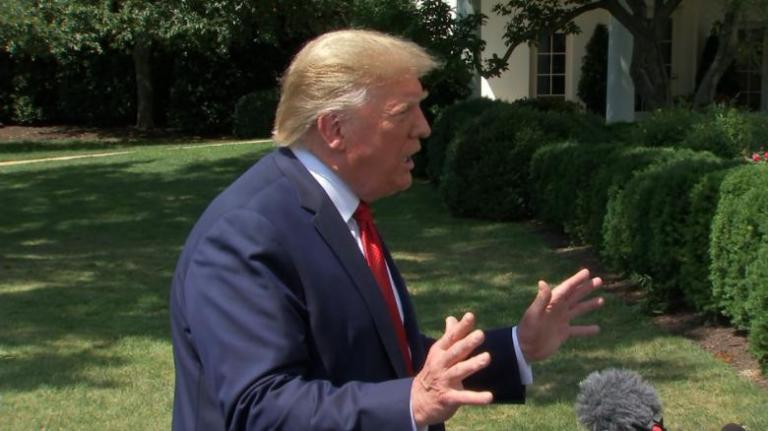
So that just happened. In a wide-ranging “conversation” with reporters on the White House lawn yesterday, Donald Trump looked toward the sky and said “I am the chosen one.” Really. Context is important, of course. Trump was talking about trade wars with China, something that he claimed previous Presidents dropped the ball on. Since he believes he is not dropping the ball, he is apparently the “chosen one” to get this done.
But this is not the first time President Trump has made such claims. Before he was even elected President, he pronounced that “only I can solve” the many problems facing our country. Early yesterday morning he favorably retweeted comments from a conservative pundit claiming that citizens of Israel consider Trump to be some kind of “King” and “the second coming of God.” So perhaps he thinks he is “the chosen one” in more ways than just trade wars.
There are many contexts—fiction, movies, superheroes, and so on—in which the notion of “the chosen one” is central. But for millions of Christians in this country, the phrase is a dog whistle, code words that point toward a person who is divinely inspired and favored by God. Machiavelli wrote that there is nothing that will solidify a political leader’s power more reliably than convincing people that her or his power is divinely ordained and that by supporting the leader, one is aligning oneself with God’s will.
I am currently in the middle of watching Netflix’s disturbing documentary series “The Family,” in which a shadowy group of Christians works behind the scenes to raise persons believed to be “chosen” by God to positions of authority and keep them there. And there are millions of evangelical Christians in this country who believe that in Donald Trump, we have precisely the person “chosen” by God to lead this country back to God and to protect it against the attempts of atheists and liberals to turn it in the other direction. Whether Trump truly believes himself to be divinely “chosen” is one thing. What is clear is that he has learned how to communicate effectively and directly with those who believe that he is.
In a recent article in The Atlantic, Peter Wehner—himself an evangelical Christian—begins his article by describing the various ways in which white evangelical Christians, who voted for Trump in 2016 in massive numbers and continue to give him higher than 80% approval ratings two years later, consider Trump to be more than just the “not-Obama” that they had been hoping for.
Ralph Reed, the Faith and Freedom Coalition’s founder and chairman, says that “There has never been anyone who has defended us and who has fought for us, who [sic] we have loved more than Donald J. Trump. No one!” A Trump supporter told Wehner, after attending a Trump rally in Orlando, upon guarantee of anonymity (so as to avoid personal and professional repercussions) that “I have never witnessed the kind of excitement and enthusiasm for a political figure in my life. I honestly couldn’t believe the unwavering support they have. And to a person, it was all about ‘the fight.’”
The Trump supporter went on to say that many of the people he spoke to believe that Trump’s Presidency “is spiritually driven.” Wehner writes that
I asked whether he meant by this that Trump’s supporters believe God’s hand is on Trump, this moment and at the election—that Donald Trump is God’s man, in effect—he told me, “Yes—a number of people said they believe there is no other way to explain his victories. Starting with the election and continuing with the conclusion of the Mueller report. Many said God has chosen him and is protecting him.”
For these supporters, Trump’s announcement yesterday that he is “the chosen one” was a confirmation that he gets it, that he recognizes what they have believed all along, that the Lord often works in (very) mysterious ways, and that the Divine’s hand is upon this man. Which, of course, means that anyone who disagrees is not only blind to Trump’s perceived successes, but also is deliberately and willingly resisting God’s will.
I have spent a lot of time over the past three years on this blog trying to figure out this phenomenon, which seems not only false and dangerous, but false and dangerous on steroids. It is of importance and interest to me not only because I am a concerned citizen, but also because I am a product of the fundamentalist, evangelical Christian world. I have relatives who are Trump supporters, although I don’t imagine that they would go so far as to say that Trump is God’s man. They might, however, go so far as to suggest that Hillary Clinton was Satan’s candidate, so anyone who defeated her is, by process of elimination, on God’s side.
Many of the explanations I’ve come up with have to do with policy (stacking the courts with conservative, pro-life judges, for instance), policies so important in some people’s minds that all manner of moral failings can be overlooked in a person who is on the right side of such policies. But there’s something more going on here than policy preferences. Donald Trump perceived it during his candidacy when he said that he could murder someone in Times Square and not lose his base. He was right, and it is still true today. There is something close to cultish about the mindset of Trump’s most committed supporters, so much so that it would make sense for the opposition to save their breath when seeking to convince Trump’s base to change on the basis of a better health care plan. Members of a cult are not talked out of their commitments by reasoned arguments.
If evangelical Christians support Trump in such numbers and believe that he has been hand selected by God for his task, it’s not about policies. It’s about their perceptions of good and evil, light and darkness, the hosts of heaven and the hosts of hell. Wehner points out that Trump’s evangelical Christian supporters believe they are engaged in an existential battle, one that justifies siding with anyone they perceive to be a possible bulwark against the enemy—even a moral disaster like Donald Trump. Wehner writes that
[They believe] that they are engaged in an existential struggle against a wicked enemy—not Russia, not North Korea, not Iran, but rather American liberals and the left . . . Many white evangelical Christians are deeply fearful of what a Trump loss would mean for America, American culture, and American Christianity. If a Democrat is elected president, they believe, it might all come crashing down around us.
There is not enough room in one blog post, or even several, to discuss clearly all of the ways that this fear-based belief is not only fundamentally un-American and misguided, but also very dangerous. For those who profess the Christian faith, “perfect love casts out fear” is something worth remembering on a daily basis. I will not be afraid of those whom I approach with the love of Christ. Wehner writes eloquently in the second half of his article about various alternatives to fear that Christians should consider. But he ends his article with a sobering observation.
Evangelical Christians should acknowledge the profound damage that’s being done to their movement by its braided political relationship—its love affair, to bring us back to the words of Ralph Reed—with a president who is an ethical and moral wreck. Until that is undone—until followers of Jesus are once again willing to speak truth to power rather than act like court pastors—the crisis in American Christianity will only deepen, its public testimony only dim, its effort to be a healing agent in a broken world only weaken. At this point, I can’t help but wonder whether that really matters to many of Donald Trump’s besotted evangelical supporters.
Previous Post

August 20, 2019
Will All Things Be Well?

Browse Our Archives
Select a Category abortion Advent AI Angels Artificial intelligence atheism attention baptism Baptists beauty belief Benedictines Bible bicycling Big Bird books Bovina Camaldoli hermitage Canada Catholicism cats certainty change Christianity Christmas Collegeville Covid-19 creativity Development of Western Civilization dogs doubt Easter Enneagram Epiphany Episcopal ethics Eucharist evil extroverts Facebook faith family fear flowers forgiveness freedom friends God goodness grace happiness heaven hell history Holy Spirit Holy Week hope human nature humility humor idolatry incarnation introverts irreverence Islam Jeanne Jesus Joe Biden joy Judaism justice Kamala Harris knowledge Lent listen literature liturgy love Marsue Memorial Day miracles movies music mystery mythology NPR Old Testament optimism paradox peace Penguins philosophy piano podcast politics power prayer Protestantism Providence College Religion Rhode Island sabbatical sacrament science seeing silence Simone Weil Socrates soul sports St. John's College stories suffering tattoo teaching technology television theology thinking time tolerance transcendence travel trees trust truth Uncategorized Vermont wisdom wonder writing
Select a Month May 2026 April 2026 March 2026 February 2026 January 2026 December 2025 November 2025 October 2025 September 2025 August 2025 July 2025 June 2025 May 2025 April 2025 March 2025 February 2025 January 2025 December 2024 November 2024 October 2024 September 2024 August 2024 July 2024 June 2024 May 2024 April 2024 March 2024 February 2024 January 2024 December 2023 November 2023 October 2023 September 2023 August 2023 July 2023 June 2023 May 2023 April 2023 March 2023 February 2023 January 2023 December 2022 November 2022 October 2022 September 2022 August 2022 July 2022 June 2022 May 2022 April 2022 March 2022 February 2022 January 2022 December 2021 November 2021 October 2021 September 2021 August 2021 July 2021 June 2021 May 2021 April 2021 March 2021 February 2021 January 2021 December 2020 November 2020 October 2020 September 2020 August 2020 July 2020 June 2020 May 2020 April 2020 March 2020 February 2020 January 2020 December 2019 November 2019 October 2019 September 2019 August 2019 July 2019 June 2019 May 2019 April 2019 March 2019 February 2019 January 2019 December 2018 November 2018 October 2018 September 2018 August 2018 July 2018 June 2018 May 2018 April 2018 March 2018 February 2018 January 2018 December 2017 November 2017 October 2017 September 2017 August 2017 July 2017 June 2017 May 2017 April 2017 March 2017 February 2017 January 2017 December 2016 November 2016 October 2016 September 2016 August 2016 July 2016 June 2016 May 2016 April 2016 March 2016 February 2016 January 2016 December 2015 November 2015 October 2015 September 2015 August 2015 July 2015 June 2015 May 2015 April 2015 March 2015 February 2015 January 2015 December 2014 November 2014 October 2014 September 2014 August 2014 July 2014 June 2014 May 2014 April 2014 March 2014 February 2014 January 2014 December 2013 November 2013 October 2013 September 2013 August 2013 July 2013 June 2013 May 2013 April 2013 March 2013 February 2013 January 2013 December 2012 November 2012 October 2012 September 2012
Follow Us!
TAKE THE
Religious Wisdom Quiz
Who leaped for joy after being healed at the Temple gate (by Peter, in Jesus' name)?
Select your answer to see how you score.
A blind man A rich man A Pharisee A lame man
Books by This Author Books by Vance G. Morgan
Related posts from Freelance Christianity

The Lonely Pawn: On Faith, Doubt, and Meaning


AI and Love: When a Chatbot Becomes a...

TRENDING AT PATHEOS Progressive Christian

Why Christians Have a Sacred Duty to Vote:...
The Bible offers strong support for the sacred duty to vote. Here...

What Being a Modern-Day Apostle Means to Me
In my last column, I discussed the ins and outs of modern-day...

Did Ancient China Once Worship the God of...
Across human history, a common thread weaves through the origins of the...

Love Your Neighbor – Including Earth-Kin: Lev. 19,...
God’s command to love your neighbor means acting in an ethical and...

Lead a Church Study of “Jesus and Lao...
Guest writer Jack Thomas (The Irreverent Reverend) reflects on leading his church...

Principles for Understanding the Apostolic Ministry Today
Whenever people discover that my formal ministry title is "apostle," as in...
view all Progressive Christian blogs
Ad-Free & Subscriber Log-In Subscription Support
- About Us
- 2026 Calendar
- Videos
- Podcasts
- Library of World Religions
- Faith In Media Tracker
- Advertise With Us
- Write for Us
- Privacy Policy
- Terms of Service
- Do Not Sell My Data
- Contact Us
- Radiant Digital
- Manage Newsletter Subscriptions
- Unsubscribe From Notifications
- Sitemap
Copyright 2008-2026, Patheos. All rights reserved.
Subscription Support Ad-Free & Subscriber Log-In
Follow Patheos