
BuddhistCatholicContemplativeEvangelicalGeneral ChristianHinduJewishLatter-day SaintMuslimNew VisionsProgressive Christian
Beliefs
- Buddhist
- Catholic
- Contemplative
- Evangelical
- General Christian
- Hindu
- Jewish
- Latter-day Saint
- More Voices
- Muslim
- New Visions
- Pagan
- Progressive Christian
Topics
- Religion News
- Food and Religion
- Sports and Religion
- Religious Art
- Religious Music and Entertainment
- Religious Events
- History and Religion
- Style and Religion
- Politics and Religion
- Women in Religion
- Recreation Outdoors and Religion
- Business Finance and Religion
- Careers Workplace and Religion
- Education and Religion
- Family Parenting and Religion
- Health Fitness and Religion
- Home and Religion
- Relationships and Religion
- Technology and Religion
- Travel and Religion
Columnists
- Buddhist Columnists
- Business Finance and Religion Columnists
- Careers Workplace and Religion Columnists
- Catholic Columnists
- Contemplative Columnists
- Education and Religion Columnists
- Evangelists Columnists
- Family Parenting and Religion Columnists
- General Christian Columnists
- Health Fitness and Religion Columnists
- Hindu Columnists
- History and Religion Columnists
- Home and Religion Columnists
- Jewish Columnists
- More Voices Columnists
- Latter Day Columnists
- Muslim Columnists
- New Visions Columnists
- Nonreligious Columnists
- Pagan Columnists
- Politics and Religion Columnists
- Progressive Columnists
- Recreation Outdoors and Religion Columnists
- Relationships and Religion Columnists
- Religion News Columnists
- Religious Art Columnists
- Religious Events Columnists
- Religious Music and Entertainment Columnists
- Sports and Religion Columnists
- Style and Religion Columnists
- Technology and Religion Columnists
- Travel and Religion Columnists
- Women in Religion Columnists
Resource Library
- 2026 Calendar
- Library of World Religions
- The 100 Most Holy Places on Earth
- Patheos Answers
- Podcasts
- Videos
- Faith Leaders Database
- Anglican Episcopalian
- Bahai
- Baptist
- Buddhism
- Christianity
- Confucianism
- Eastern Orthodoxy
- Hinduism
- Holiness and Pentecostal
- ISKCON
- Islam
- Judaism
- Lutheran
- Methodist
- The Church of Jesus Christ of Latter-day Saints
- New Age
- Paganism
- Presbytarian and Reformed
- Protestantism
- Religion Behind the Scenes
- Roman Catholic
- Scientology
- Shia Islam
- Sikhism
- Sufism
- Sunni Islam
- Taoism
- Zen
- See all religions
Research Tools
 Ad-Free & Subscriber Log-In Subscription Support
Ad-Free & Subscriber Log-In Subscription Support
Follow Patheos 

- Trending:
- Forgiveness
- |
- Marriage
- |
- Consciousness
- |
- Death Penalty
- |
- Election
- |
- Halloween

- Home
- Progressive Christian
- Idolatry and Abortion
Idolatry and Abortion
Last updated on: February 7, 2020 at 7:03 am by Vance Morgan
Idolatry and Abortion 2020-02-07T07:03:46-04:00 Vance Morgan
Patheos Explore the world's faith through different perspectives on religion and spirituality! Patheos has the views of the prevalent religions and spiritualities of the world.
I wrote the essay that follows several months ago; on the advice of some trusted friends and colleagues, I put it on the shelf to wait for the “right time.” Within the past ten days, Paula White, one of President Trump’s “spiritual advisers,” publicly called for God to “cause satanic pregnancies to miscarry,” while the President himself, in remarks at the March for Life 2020 in Washington D.C. last week that were noticeably similar to his standard remarks at his rallies, proclaimed that “Unborn children have never had a stronger defender in the White House.” Unless, apparently, the pregnancy in question is “satanic.”
The status and rights of the unborn, as well as that of the pregnant woman, and the possibility of Roe v. Wade being overturned will undoubtedly be part of the conversation for the next several months leading to the election in November. Accordingly, I’m taking this essay off the shelf–I think this is the right time to post it. Please read it with an open mind and heart–I welcome and invite your comments.
I say “Idolatry” and you think about . . . what? Worshiping golden calves? Elijah and the priests of Baal? Early Christian leaders debating whether it is okay to eat food that has been dedicated to idols? “Idolatry” is one of those words that largely has been co-opted by various religious systems, a word reserved for the worst of badly directed worship, worship focused so wrongly that—according to the ancient texts, at least—it is likely to draw the negative attention and even wrath of what the idol is replacing.
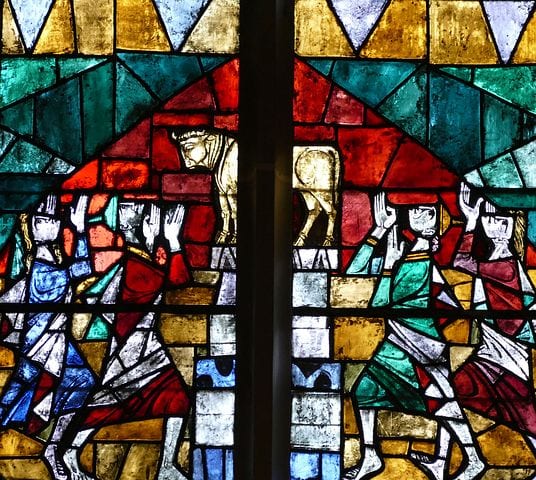
But there is a reason that the second of the Ten Commandments is a prohibition against idolatry, a reason that has relevance far beyond religious frameworks. We human beings are incurable idolaters, more than happy to pattern ourselves after someone or something else rather than to take on responsibility for ourselves. Anything can be an idol—a person, an idea, a group, whatever is raised to such importance that all other matters, including even basic moral guidelines and principles, fade into the background.
Last spring, I studied the work of Simone Weil, a fascinating and important 20th century social activist, mystic, and philosopher, with students in two different courses. Weil defines “idolatry” as “the error that attributes a sacred character to what is not sacred,” describing it as “the crime that is most widespread in every time and every country.” Weil argues that idolatry is one of the strategies that we regularly use when we seek to escape the complexities of the moral life and to avoid grappling with the realities of good and evil. She writes that idolatry “consists in marking out a social area into which . . . good and evil may not enter. In so far as he is contained within this area, man is freed from good and evil.”
Weil’s own examples of such social areas include science, where moral standards are often set aside in deference to letting research and knowledge progress unrestricted, and nationalism, as in “my country, right or wrong,” or “America, love it or leave it.” As we worked with Weil’s essays in one of my classes, after discussing the day’s essay for a bit together, I broke my dozen students up into three groups of four and asked them to spend ten minutes coming up with their own examples of what Weil means by idolatry. Several of my students were business majors, so not surprisingly, many of their examples focused on how easy it is to set one’s moral principles aside at the workplace in order to be successful and climb the corporate ladder. Another frequent example was the power and seduction of peer and group pressure, causing one to do things that one would never consider doing on one’s own.
As I listened to my students’ examples of how we frequently turn parts of our lives into “ethics-free zones,” an unsolicited and unexpected example of my own occurred to me. “Don’t go there,” a little internal voice said. “Not on a Catholic campus.” We already had a variety of illustrations—time to move on. But, despite my misgivings, something told me that the example I had just come up with was important, a real-life example that everyone would understand. I went there.
My students know from previous conversations that I was raised in a conservative, evangelical Protestant Christian tradition. Over the past three or four years, I have regularly wondered in multiple venues, including this blog and in face-to-face conversations, how it is that more than 80% of white evangelical Christians (my original faith tribe) both voted for Donald Trump as President and continue to support him now. I would venture to say that no U.S. President, certainly none in my lifetime, has failed more spectacularly to live up to any recognizable version of a Christian ethic. How can evangelical Christians have voted for and continue to support this pussy-grabbing, narcissistic, serially lying, moral embarrassment?
I have heard a number of possible explanations. One of the most frequently offered explanations is something along the lines of “Sure he’s an embarrassment. Sure, I wish he would stop tweeting so much. Sure, I wish [fill in the blank with any number of other moral outrages that they wish Donald would stop]. But he’s strongly pro-life. He’s putting pro-life judges on the bench. He’s put two of them on the Supreme Court. We might even see Roe v. Wade overturned because of him.” Fair enough. At least that’s a reason (although a very bad one in my estimation).
“Notice what’s going on here,” I said to my students. For an evangelical Trump supporter, having a pro-life stance on the abortion issue has been raised to such moral importance that everything else of moral importance pales in comparison. “I am willing to turn a blind eye to and ignore any moral failings, even the most obvious and blatant ones, as long as the person in question has the right moral position on this one issue,” the evangelical Trump supporter says. This person has raised the abortion issue to such exalted status that she or he will support a person who brags that he would not be abandoned by his base even if he shot a person dead in cold blood in the middle of Fifth Avenue, just as long as he has the right stance on abortion.
And Trump is right about the Fifth Avenue thing, because in his evangelical supporter’s estimation, even murder doesn’t occupy the same moral universe as being right about abortion. One issue—being pro-life on the abortion issue—has been raised in status to being the only thing that matters. The abortion issue has become the only moral issue. And that, my friends, is idolatry.
I raised this example toward the end of the class period, intending to pick it up in subsequent classes. But judging from facial expressions and body language, it was clear that my example of idolatry had an immediate impact on my students, particularly one who clearly was struggling to keep her emotions in check. “Thank you,” she whispered with tears in her eyes as she walked past me on her way to the door when class was over.
I have well-defined beliefs concerning abortion; I describe myself either as “intelligently pro-life” or “conservatively pro-choice” when required to take a position, deliberately blurring the supposedly “all-or-nothing” bright line between pro-life and pro-choice. But bottom-line, this is not about the abortion issue—I’m using that simply as one familiar example of how an idea, a moral or political position, can become an idol as soon as one raises it to such importance that everything else takes a back seat. The idol could be the second amendment. Or a commitment to gun control. Or the environment. Or fear of socialism. The author of the Ten Commandments was right—we really can make an idol out of anything. And we need to stop doing that.
The best cure for the disease of idolatry that I am aware of begins with embracing the complexity, ambiguity, uncertainty, and provisional nature of everything that we believe and think we know. Idolatry is always an attempt to establish certainty where it is both unwarranted and unearned. Simply learning to describe one’s beliefs as follows helps:
- This is what I believe, but I might be wrong, or
- This is what I believe, but I have a lot to learn.
And then there’s this from Nadia Bolz-Weber that I just read the other day: It is possible for more than one thing to be true at the same time. Yes, it is. Imagine that.
Previous Post
January 30, 2020
Best of 2019 #1: I am a Liberal Because I am a Christian
Next Post
February 4, 2020 Profiles in Cowardice: Moving forward after the impeachment trial
Browse Our Archives
Select a Category abortion Advent AI Angels Artificial intelligence atheism attention baptism Baptists beauty belief Benedictines Bible bicycling Big Bird books Bovina Camaldoli hermitage Canada Catholicism cats certainty change Christianity Christmas Collegeville Covid-19 creativity Development of Western Civilization dogs doubt Easter Enneagram Epiphany Episcopal ethics Eucharist evil extroverts Facebook faith family fear flowers forgiveness freedom friends God goodness grace happiness heaven hell history Holy Spirit Holy Week hope human nature humility humor idolatry incarnation introverts irreverence Islam Jeanne Jesus Joe Biden joy Judaism justice Kamala Harris knowledge Lent listen literature liturgy love Marsue Memorial Day miracles movies music mystery mythology NPR Old Testament optimism paradox peace Penguins philosophy piano podcast politics power prayer Protestantism Providence College Religion Rhode Island sabbatical sacrament science seeing silence Simone Weil Socrates soul sports St. John's College stories suffering tattoo teaching technology television theology thinking time tolerance transcendence travel trees trust truth Uncategorized Vermont wisdom wonder writing
Select a Month May 2026 April 2026 March 2026 February 2026 January 2026 December 2025 November 2025 October 2025 September 2025 August 2025 July 2025 June 2025 May 2025 April 2025 March 2025 February 2025 January 2025 December 2024 November 2024 October 2024 September 2024 August 2024 July 2024 June 2024 May 2024 April 2024 March 2024 February 2024 January 2024 December 2023 November 2023 October 2023 September 2023 August 2023 July 2023 June 2023 May 2023 April 2023 March 2023 February 2023 January 2023 December 2022 November 2022 October 2022 September 2022 August 2022 July 2022 June 2022 May 2022 April 2022 March 2022 February 2022 January 2022 December 2021 November 2021 October 2021 September 2021 August 2021 July 2021 June 2021 May 2021 April 2021 March 2021 February 2021 January 2021 December 2020 November 2020 October 2020 September 2020 August 2020 July 2020 June 2020 May 2020 April 2020 March 2020 February 2020 January 2020 December 2019 November 2019 October 2019 September 2019 August 2019 July 2019 June 2019 May 2019 April 2019 March 2019 February 2019 January 2019 December 2018 November 2018 October 2018 September 2018 August 2018 July 2018 June 2018 May 2018 April 2018 March 2018 February 2018 January 2018 December 2017 November 2017 October 2017 September 2017 August 2017 July 2017 June 2017 May 2017 April 2017 March 2017 February 2017 January 2017 December 2016 November 2016 October 2016 September 2016 August 2016 July 2016 June 2016 May 2016 April 2016 March 2016 February 2016 January 2016 December 2015 November 2015 October 2015 September 2015 August 2015 July 2015 June 2015 May 2015 April 2015 March 2015 February 2015 January 2015 December 2014 November 2014 October 2014 September 2014 August 2014 July 2014 June 2014 May 2014 April 2014 March 2014 February 2014 January 2014 December 2013 November 2013 October 2013 September 2013 August 2013 July 2013 June 2013 May 2013 April 2013 March 2013 February 2013 January 2013 December 2012 November 2012 October 2012 September 2012
Follow Us!
TAKE THE
Religious Wisdom Quiz
What animal did Samson kill with his bare hands?
Select your answer to see how you score.
Lion Bear Leopard Wolf
Books by This Author Books by Vance G. Morgan
Related posts from Freelance Christianity

The Lonely Pawn: On Faith, Doubt, and Meaning


AI and Love: When a Chatbot Becomes a...

TRENDING AT PATHEOS Progressive Christian

What Being a Modern-Day Apostle Means to Me
In my last column, I discussed the ins and outs of modern-day...

Did Ancient China Once Worship the God of...
Across human history, a common thread weaves through the origins of the...

Love Your Neighbor – Including Earth-Kin: Lev. 19,...
God’s command to love your neighbor means acting in an ethical and...

Lead a Church Study of “Jesus and Lao...
Guest writer Jack Thomas (The Irreverent Reverend) reflects on leading his church...

Pastoral Wisdom for Responding to Sermon Pushback
Getting sermon pushback on your social justice sermon? Learn practical, Proverbs-based strategies...

Principles for Understanding the Apostolic Ministry Today
Whenever people discover that my formal ministry title is "apostle," as in...
view all Progressive Christian blogs
Ad-Free & Subscriber Log-In Subscription Support
- About Us
- 2026 Calendar
- Videos
- Podcasts
- Library of World Religions
- Faith In Media Tracker
- Advertise With Us
- Write for Us
- Privacy Policy
- Terms of Service
- Do Not Sell My Data
- Contact Us
- Radiant Digital
- Manage Newsletter Subscriptions
- Unsubscribe From Notifications
- Sitemap
Copyright 2008-2026, Patheos. All rights reserved.
Subscription Support Ad-Free & Subscriber Log-In
Follow Patheos