
BuddhistCatholicContemplativeEvangelicalGeneral ChristianHinduJewishLatter-day SaintMuslimNew VisionsProgressive Christian
Beliefs
- Buddhist
- Catholic
- Contemplative
- Evangelical
- General Christian
- Hindu
- Jewish
- Latter-day Saint
- More Voices
- Muslim
- New Visions
- Pagan
- Progressive Christian
Topics
- Religion News
- Food and Religion
- Sports and Religion
- Religious Art
- Religious Music and Entertainment
- Religious Events
- History and Religion
- Style and Religion
- Politics and Religion
- Women in Religion
- Recreation Outdoors and Religion
- Business Finance and Religion
- Careers Workplace and Religion
- Education and Religion
- Family Parenting and Religion
- Health Fitness and Religion
- Home and Religion
- Relationships and Religion
- Technology and Religion
- Travel and Religion
Columnists
- Buddhist Columnists
- Business Finance and Religion Columnists
- Careers Workplace and Religion Columnists
- Catholic Columnists
- Contemplative Columnists
- Education and Religion Columnists
- Evangelists Columnists
- Family Parenting and Religion Columnists
- General Christian Columnists
- Health Fitness and Religion Columnists
- Hindu Columnists
- History and Religion Columnists
- Home and Religion Columnists
- Jewish Columnists
- More Voices Columnists
- Latter Day Columnists
- Muslim Columnists
- New Visions Columnists
- Nonreligious Columnists
- Pagan Columnists
- Politics and Religion Columnists
- Progressive Columnists
- Recreation Outdoors and Religion Columnists
- Relationships and Religion Columnists
- Religion News Columnists
- Religious Art Columnists
- Religious Events Columnists
- Religious Music and Entertainment Columnists
- Sports and Religion Columnists
- Style and Religion Columnists
- Technology and Religion Columnists
- Travel and Religion Columnists
- Women in Religion Columnists
Resource Library
- 2026 Calendar
- Library of World Religions
- The 100 Most Holy Places on Earth
- Patheos Answers
- Podcasts
- Videos
- Faith Leaders Database
- Anglican Episcopalian
- Bahai
- Baptist
- Buddhism
- Christianity
- Confucianism
- Eastern Orthodoxy
- Hinduism
- Holiness and Pentecostal
- ISKCON
- Islam
- Judaism
- Lutheran
- Methodist
- The Church of Jesus Christ of Latter-day Saints
- New Age
- Paganism
- Presbytarian and Reformed
- Protestantism
- Religion Behind the Scenes
- Roman Catholic
- Scientology
- Shia Islam
- Sikhism
- Sufism
- Sunni Islam
- Taoism
- Zen
- See all religions
Research Tools
 Ad-Free & Subscriber Log-In Subscription Support
Ad-Free & Subscriber Log-In Subscription Support
Follow Patheos 

- Trending:
- Forgiveness
- |
- Marriage
- |
- Consciousness
- |
- Death Penalty
- |
- Election
- |
- Halloween

- Home
- Progressive Christian
- I Don’t Think That Parable Means What You Think It Means
I Don’t Think That Parable Means What You Think It Means
Last updated on: November 22, 2023 at 6:00 am by Vance Morgan
I Don’t Think That Parable Means What You Think It Means 2023-11-21T16:32:45-04:00 Vance Morgan
Patheos Explore the world's faith through different perspectives on religion and spirituality! Patheos has the views of the prevalent religions and spiritualities of the world.
Simone Weil once observed in a notebook entry that “the stories of miracles complicate everything.” She’s right about that, but she could have replaced “stories of miracles” with “Jesus’s parables” and her statement would also have been true. A section of one of my sabbatical book chapters works through a few of the parables in Matthew’s gospel and draws out some of the complicated meanings just below the surface of what appears to be the “obvious” meaning of the story.
Consider, for instance, the parable of the vineyard owner in Matthew 20 who pays each of the laborers in his vineyard the same daily wage regardless of whether they have worked for an hour or all day. My students observe that this guy is acting like a socialist. Jesus observes at the end of the story that “the last will be first, and the first will be last.”
Compare that parable with last Sunday’s parable of the talents from Matthew 25, in which a very rich man goes on a journey and leaves a bunch of money with three different servants to take care of while he’s gone. Upon his return, the master rewards the two servants who have doubled the amount left with them, but gets very angry with the third servant who buried the treasure entrusted to him so he wouldn’t lose any. The master takes the money from the timid slave, gives it to the other two slaves, then orders that the loser slave be “thrown into the outer darkness, where there will be wailing and gnashing of teeth.” For, the master observes, “to all those who have, more will be given . . . but from those who have nothing, even what they have will be taken away.”
So which is it? Will the last be first and the first last, or will the little that the last have be taken away from them and given to the first who already have enough? It would take a skilled homilist to draw a consistent message from these two parables–I’m not sure it can be done. I was told as a child that Jesus told stories so that everyone could understand his message, but many of the parables are followed by the disciples telling Jesus that they have no idea what he’s talking about. I don’t blame them.
I recently had the opportunity to observe one of the best preachers I’ve ever encountered tackle a parable that’s even more challenging than the stories of the vineyard owner and of the talents. The final session at the Evolving Faith conference that Jeanne and I attended in Minneapolis a bit over a month ago was a eucharist celebrated by Nadia Bolz-Weber, one of the many outstanding progressive Christian authors and speakers who presented at the two-day event. Nadia also was the homilist that Saturday afternoon; she preached on the gospel assigned in the lectionary for the next day, the parable of the wedding feast from Matthew 22.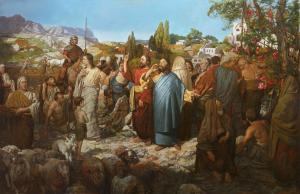
I’m not sure that I had ever heard a sermon based on this text, probably because it is an extraordinarily strange and challenging story. A king is throwing a wedding banquet for his son and sends his slaves out to deliver the invitations far and wide, but everyone ignores the invitation. Next the king sends out a more detailed invitation with the menu and entertainment included, but some continued to ignore the invite while others went so far as to mistreat or even kill the servants bringing the invitation.
In response, the king sends soldiers to kill the murderers and destroy their city. Not wanting to have a banquet with no attendees, he now sends his servants out to gather up everyone they can find on the streets, rich and poor, good and bad, to fill the banquet hall. He even provides free fancy clothes for people to wear. But on the day of the wedding, as he scans the guests at the banquet, the king notices that one guy isn’t wearing the proper clothes. When the guy has no explanation for his failure to abide by expected protocol and rules, the king has him “cast into the outer darkness where there will be wailing and gnashing of teeth,” just as at the end of the talents parable, commenting that “many are called, but few are chosen.” Whatever that means.
Nadia Bolz-Weber began her homily by noting that while we want a parable to have a nice, neat moral lesson that can be reduced to a meme or tweet, in reality, “trying to nail down a parable is like trying to nail Jell-o to a tree.” The parables are endless sources of meaning, meaning that arises in the context of our own lives.
That’s a big problem with this parable though, because at first read, Nadia notes, this is the story of a king with a fragile ego who can’t handle the idea that people don’t recognize how important and special he is. Those who end up at the banquet are there out of fear, not respect or regard for the king or his son. The king “notices the one dude not playing along” and has him thrown out into outer darkness. “Suck it up dude, for many are called but few are chosen. The gospel of the Lord.”
“God is like a violent man with a fragile ego and unlimited power,” Nadia concluded as she finished her quick summary of the parable. “Not unlike the God many of us were taught to fear.” As I encountered these parables growing up in my faith tradition, I was taught that the most powerful person in a given parable—the vineyard owner, the rich man, the king—is supposed to be God. Bolz-Weber addresses this directly: “Why in the world do we always assume that the ruler, the slave owner, the property owner, the tyrant in the story always represents God?” Mainly because many of us were taught that God is “a controller with a killer surveillance system” always looking to judge and punish those who get out of line. “Here are some terrifying stories about what God will do to those who don’t follow the rules. By the way, God loves you very much.”
But “scripture and theology are too potent to be left in the hands of those who only use them to justify their dominance against another group of people.” Christianity is not supposed to be about who can gain the most control or be dominant. “Christianity is supposed to be about raising the dead.” And with such a radical idea at its heart, one should expect its supporting stories to be similarly radical. We tend to read the parables within a framework of power and social control that we are familiar with. But the story of Jesus and his aftermath is about resisting and challenging the status quo and what we expect.
So, Nadia Bolz-Weber wonders, “What if the kingdom of heaven is not like the bullying king? What if the kingdom of heaven is like the guy who won’t play along? What if the kingdom of heaven is like someone who shows up and says ‘no’ to empire?” Now there’s a thought! What if the kingdom of heaven is like someone who won’t dignify taunts and threats with a reply? That sounds a lot like the guy who taught us about the kingdom of heaven. “What if the kingdom of heaven is like the guy who gets hogtied and thrown into the outer darkness, and what if that outer darkness is called Calvary?” “And from Calvary he forgives them all, because in his kingdom there’s simply nothing to win at.”
We have submitted to the reign of the unresentful loser, the one who was cast out, the prince of peace, whose judgment is one of forgiveness and mercy, a servant king, a crucified, enemy-loving king under whose wounded feet all notions of supremacy are crushed. To be a citizen of his kingdom is to have an identity, and a value, and a peace that is unthreatenable. There’s nothing to earn. There’s no extra credit to be had.
I grew up in a Protestant tradition where the emphasis in church was on preaching. I’ve literally heard thousands of sermons in my life. This was one of the best—the link for the whole homily is below.
Among many other things, Nadia Bolz-Weber’s sermon is a call to think and feel differently, to never imagine that even the most familiar text has nothing new to teach us. That works regardless of one’s faith commitment or lack of same. For those who profess the Christian faith, hers is a clarion call to remember just how radical and corrosive the faith we profess is to the status quo, assumptions, and established power. These are all eminently worth considering and remembering.
Nadia Bolz-Weber’s sermon runs from to 15:55 to 28:15.
https://community.evolvingfaith.com/posts/evolving-faith-2023-closing-communion
Previous Post

November 20, 2023
It's Justin's Birthday!
Next Post

November 24, 2023 How to Celebrate the Season Like a Real American
Recent Comments
"Mary did have a choice. And she was able to make it before the Holy ..."
"i cannot read beyond your recommendations for the books since i like to have a ..."
"AI will never be able to utter with honesty, feeling, or humility, the greeting: "Namaste".It ..."
"They do. I'm sure you could find discussions of the same topic from any of ..."
Browse Our Archives
Select a Category abortion Advent AI Angels Artificial intelligence atheism attention baptism Baptists beauty belief Benedictines Bible bicycling Big Bird books Bovina Camaldoli hermitage Canada Catholicism cats certainty change Christianity Christmas Collegeville Covid-19 creativity Development of Western Civilization dogs doubt Easter Enneagram Epiphany Episcopal ethics Eucharist evil extroverts Facebook faith family fear flowers forgiveness freedom friends God goodness grace happiness heaven hell history Holy Spirit Holy Week hope human nature humility humor idolatry incarnation introverts irreverence Islam Jeanne Jesus Joe Biden joy Judaism justice Kamala Harris knowledge Lent listen literature liturgy love Marsue Memorial Day miracles movies music mystery mythology NPR Old Testament optimism paradox peace Penguins philosophy piano podcast politics power prayer Protestantism Providence College Religion Rhode Island sabbatical sacrament science seeing silence Simone Weil Socrates soul sports St. John's College stories suffering tattoo teaching technology television theology thinking time tolerance transcendence travel trees trust truth Uncategorized Vermont wisdom wonder writing
Select a Month May 2026 April 2026 March 2026 February 2026 January 2026 December 2025 November 2025 October 2025 September 2025 August 2025 July 2025 June 2025 May 2025 April 2025 March 2025 February 2025 January 2025 December 2024 November 2024 October 2024 September 2024 August 2024 July 2024 June 2024 May 2024 April 2024 March 2024 February 2024 January 2024 December 2023 November 2023 October 2023 September 2023 August 2023 July 2023 June 2023 May 2023 April 2023 March 2023 February 2023 January 2023 December 2022 November 2022 October 2022 September 2022 August 2022 July 2022 June 2022 May 2022 April 2022 March 2022 February 2022 January 2022 December 2021 November 2021 October 2021 September 2021 August 2021 July 2021 June 2021 May 2021 April 2021 March 2021 February 2021 January 2021 December 2020 November 2020 October 2020 September 2020 August 2020 July 2020 June 2020 May 2020 April 2020 March 2020 February 2020 January 2020 December 2019 November 2019 October 2019 September 2019 August 2019 July 2019 June 2019 May 2019 April 2019 March 2019 February 2019 January 2019 December 2018 November 2018 October 2018 September 2018 August 2018 July 2018 June 2018 May 2018 April 2018 March 2018 February 2018 January 2018 December 2017 November 2017 October 2017 September 2017 August 2017 July 2017 June 2017 May 2017 April 2017 March 2017 February 2017 January 2017 December 2016 November 2016 October 2016 September 2016 August 2016 July 2016 June 2016 May 2016 April 2016 March 2016 February 2016 January 2016 December 2015 November 2015 October 2015 September 2015 August 2015 July 2015 June 2015 May 2015 April 2015 March 2015 February 2015 January 2015 December 2014 November 2014 October 2014 September 2014 August 2014 July 2014 June 2014 May 2014 April 2014 March 2014 February 2014 January 2014 December 2013 November 2013 October 2013 September 2013 August 2013 July 2013 June 2013 May 2013 April 2013 March 2013 February 2013 January 2013 December 2012 November 2012 October 2012 September 2012
Follow Us!
TAKE THE
Religious Wisdom Quiz
In Revelation, how long does Satan remain bound in the Abyss?
Select your answer to see how you score.
1,000 years 666 years 144,000 days 7 years
Books by This Author Books by Vance G. Morgan
Related posts from Freelance Christianity

The Lonely Pawn: On Faith, Doubt, and Meaning


AI and Love: When a Chatbot Becomes a...

TRENDING AT PATHEOS Progressive Christian

Why Christians Have a Sacred Duty to Vote:...
The Bible offers strong support for the sacred duty to vote. Here...

What Being a Modern-Day Apostle Means to Me
In my last column, I discussed the ins and outs of modern-day...

Did Ancient China Once Worship the God of...
Across human history, a common thread weaves through the origins of the...

Love Your Neighbor – Including Earth-Kin: Lev. 19,...
God’s command to love your neighbor means acting in an ethical and...

Lead a Church Study of “Jesus and Lao...
Guest writer Jack Thomas (The Irreverent Reverend) reflects on leading his church...

Principles for Understanding the Apostolic Ministry Today
Whenever people discover that my formal ministry title is "apostle," as in...
view all Progressive Christian blogs
What Are Your Thoughts?leave a comment
Ad-Free & Subscriber Log-In Subscription Support
- About Us
- 2026 Calendar
- Videos
- Podcasts
- Library of World Religions
- Faith In Media Tracker
- Advertise With Us
- Write for Us
- Privacy Policy
- Terms of Service
- Do Not Sell My Data
- Contact Us
- Radiant Digital
- Manage Newsletter Subscriptions
- Unsubscribe From Notifications
- Sitemap
Copyright 2008-2026, Patheos. All rights reserved.
Subscription Support Ad-Free & Subscriber Log-In
Follow Patheos