
BuddhistCatholicContemplativeEvangelicalGeneral ChristianHinduJewishLatter-day SaintMuslimNew VisionsProgressive Christian
Beliefs
- Buddhist
- Catholic
- Contemplative
- Evangelical
- General Christian
- Hindu
- Jewish
- Latter-day Saint
- More Voices
- Muslim
- New Visions
- Pagan
- Progressive Christian
Topics
- Religion News
- Food and Religion
- Sports and Religion
- Religious Art
- Religious Music and Entertainment
- Religious Events
- History and Religion
- Style and Religion
- Politics and Religion
- Women in Religion
- Recreation Outdoors and Religion
- Business Finance and Religion
- Careers Workplace and Religion
- Education and Religion
- Family Parenting and Religion
- Health Fitness and Religion
- Home and Religion
- Relationships and Religion
- Technology and Religion
- Travel and Religion
Columnists
- Buddhist Columnists
- Business Finance and Religion Columnists
- Careers Workplace and Religion Columnists
- Catholic Columnists
- Contemplative Columnists
- Education and Religion Columnists
- Evangelists Columnists
- Family Parenting and Religion Columnists
- General Christian Columnists
- Health Fitness and Religion Columnists
- Hindu Columnists
- History and Religion Columnists
- Home and Religion Columnists
- Jewish Columnists
- More Voices Columnists
- Latter Day Columnists
- Muslim Columnists
- New Visions Columnists
- Nonreligious Columnists
- Pagan Columnists
- Politics and Religion Columnists
- Progressive Columnists
- Recreation Outdoors and Religion Columnists
- Relationships and Religion Columnists
- Religion News Columnists
- Religious Art Columnists
- Religious Events Columnists
- Religious Music and Entertainment Columnists
- Sports and Religion Columnists
- Style and Religion Columnists
- Technology and Religion Columnists
- Travel and Religion Columnists
- Women in Religion Columnists
Resource Library
- 2026 Calendar
- Library of World Religions
- The 100 Most Holy Places on Earth
- Patheos Answers
- Podcasts
- Videos
- Faith Leaders Database
- Anglican Episcopalian
- Bahai
- Baptist
- Buddhism
- Christianity
- Confucianism
- Eastern Orthodoxy
- Hinduism
- Holiness and Pentecostal
- ISKCON
- Islam
- Judaism
- Lutheran
- Methodist
- The Church of Jesus Christ of Latter-day Saints
- New Age
- Paganism
- Presbytarian and Reformed
- Protestantism
- Religion Behind the Scenes
- Roman Catholic
- Scientology
- Shia Islam
- Sikhism
- Sufism
- Sunni Islam
- Taoism
- Zen
- See all religions
Research Tools
 Ad-Free & Subscriber Log-In Subscription Support
Ad-Free & Subscriber Log-In Subscription Support
Follow Patheos 

- Trending:
- Forgiveness
- |
- Marriage
- |
- Consciousness
- |
- Death Penalty
- |
- Election
- |
- Halloween

- Home
- Progressive Christian
- Humility and Wonder
Humility and Wonder
Last updated on: August 6, 2014 at 6:45 am by Vance Morgan
Humility and Wonder 2014-08-06T06:45:52-04:00 Vance Morgan
Patheos Explore the world's faith through different perspectives on religion and spirituality! Patheos has the views of the prevalent religions and spiritualities of the world.
Last Sunday’s gospel focused on one of Jesus’ signature miracles–the feeding of the five thousand. Here is a reflection on that story and its implications that I first posted about a year ago.
 My youngest son was always the inquisitive sort, the kind of kid who, from the moment he began to speak, fashioned most of his communication into questions starting with the word “Why?” The setting for one of his favorite stories is the beat up car I was driving when he was little; I was running errands and his three-or-four-year-old self was strapped into the car seat next to me on the passenger’s side facing the front. This was, as a friend of mine says, “before safety was invented.”
On this particular day, apparently, I had only sufficient tolerance for one thousand “Whys” before noon. As soon as he asked his one thousand and first “Why?”, I yelled “STOP ASKING SO MANY QUESTIONS!!!” To which, I’m sure, he replied “Why?” I have no recollection of this event, since it makes me look bad.
Here’s what I remember as my usual response when his litany of questions exceeded tolerable levels. After several consecutive “Dad, why . . . . .?” events, I would reply “I don’t know, Justin—it must be a miracle.”
And for a long time, that was an effective show stopper, because as  Simone Weil wrote, “the reports of miracles confuse everything.” We want answers and explanations, and a miracle says “Oh, yeah? Explain THIS, jerk!” We can’t, because a miracle by definition lies outside the confines of human knowledge. Or at least my knowledge, as my son figured out before very long. One day in response to “It must be a miracle,” he shot back “Just because you don’t know the answer, Dad, doesn’t mean that there isn’t one!” True enough.
 I teach philosophy, which has the reputation for trying to rationally explain everything and dismissively rejecting anything that resists such treatment. Philosophers also have the reputation of lacking humility.This reputation is, unfortunately, well deserved if referring to the main streams of philosophy since the Scientific Revolution and the Enlightenment. From its ancient roots, though, real philosophy begins with humility.
  Hamlet had it right when he said “There are more things in heaven and earth, Horatio, than are dreamt of in your philosophy.” And, I would add, your theology, your science, and anything else we use in our attempts to jam our vast, wonderful, and often terrifying reality into manageable boundaries and straitjackets.
The other ancient philosophical starting point is identified by Aristotle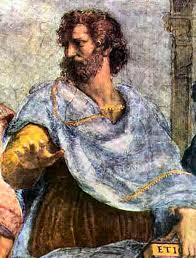 , perhaps the greatest philosopher of all, when he wrote that “philosophy begins with wonder.” This is what a baby shows with her frank and forthright way of gazing about in bewilderment, trying to balance her oversized head on her undersized neck as she wonders “What’s this thing? And what’s that over there? And holy crap what’s THAT??” Wonder and humility, woven together, turn philosophy, as well as theology, science, and everything else into foundational, intimately connected human activities. Psalm 8
 gets this connection just right. “When I see the heavens, the work of your hands, the moon and stars which you arranged—What are we that you should keep us in mind, men and women that you care for us?” Wonder turns our minds and imaginations with expectation toward what transcends us, while humility continually reminds us of the vast gulf between us and what transcends us.
I heard a homily a few years ago on Jesus’ feeding of the five thousand in which the homilist struggled mightily with the very notion that so many people could be fed with five loaves and two fishes from a kid’s picnic basket. The homilist set things up eloquently, paid proper attention to Jesus’ compassion for the crowd of hungry people, then hit a wall with the miracle itself. “We modern persons have a difficult time with the stories of Jesus’ miracles,” 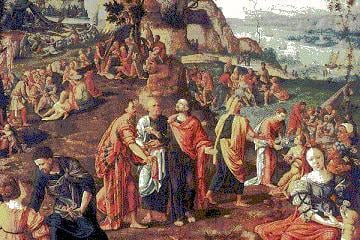 he said, “since what they describe violates the laws of nature.” Accordingly, he did what most of us do when faced with such an apparent violation—he provided alternative interpretations of the story in which such a violation did not occur.
It’s possible, for instance, unless Jesus was dealing with a crowd of morons that day, that the little boy was not the only person among the thousands in attendance smart enough to have brought along something to eat. The “miracle” is not that a tiny amount of food was increased to feed thousands, but rather that the boy’s innocent generosity sparked similar generosity in others. Those who had intended to hoard their carefully packed lunches for themselves were suddenly motivated, either through inspiration or shame, to share with others around them.
And then perhaps a further “miracle” occurred, in that many realized that they didn’t really need all the food they had brought—five loaves and two fishes are more than one person can eat, right? So not only does a spirit of generosity start spreading through the crowd, but gluttony takes a big hit. If each person eats only what they need and shares the remainder, everyone has enough. An impromptu community is built on the spot, everyone learns to share with others as well as to stop eating too much, and no laws of nature are violated. Thanks be to God.
Why did the homilist, and why do all of us, find it necessary to explain a miracle away, to bring it within the confines of what we believe we know and can explain? This is partly a failure of humility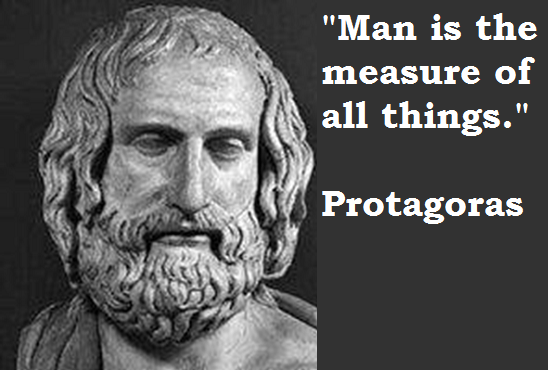 , an insistence that we are the center of the universe and that, as Protagoras infamously claimed, we humans are “the measure of all things.” But we’re not. We are subject to the laws of nature, but they are neither defined by nor limited to our experience and understanding. Remember Hamlet: “There are more things in heaven and earth . . .”
But our dogged attempts to explain (or explain away) everything smells more like fear than lack of humility to me. What better way to carve a home out of a reality far beyond our control than to define it in terms of what we can control? Pascal put it succinctly: “The eternal silence of these infinite spaces fills me with dread.” And while humility is the antidote for hubris, the cure for fear is wonder. Fear turns us inward; wonder turns us outward, toward the infinitely fascinating reality in which we find ourselves. And ultimately, wonder turns us toward God, who crosses the vast distance between divine and human by infusing everything, including us, with transcendence. This is the wonder of the incarnation, that God inhabits everything, that we are living sacraments, testimony to divine love.
 Thomas Jefferson once published an edition of the Gospels with all the miracles taken out, resulting in a very short book. A daily existence from which miracles have been removed is similarly impoverished. A good friend of mine defines a miracle as “something that everyone says will never, ever, ever happen and it happens anyways.” And that covers just about everything, from individual acts of generosity, through impromptu human solidarity, to feeding five thousand with a kid’s lunch. As Gerard Manley Hopkins wrote, “The earth is charged with the grandeur of God.” We need only learn to see it with the eyes of wonder and humility.
Previous Post

July 30, 2014
If I Were a Beer, or What I have learned about myself from Facebook
Next Post
August 18, 2014 How to Herd a Hedgehog (or a Fox)
Browse Our Archives
Select a Category abortion Advent AI Angels Artificial intelligence atheism attention baptism Baptists beauty belief Benedictines Bible bicycling Big Bird books Bovina Camaldoli hermitage Canada Catholicism cats certainty change Christianity Christmas Collegeville Covid-19 creativity Development of Western Civilization dogs doubt Easter Enneagram Epiphany Episcopal ethics Eucharist evil extroverts Facebook faith family fear flowers forgiveness freedom friends God goodness grace happiness heaven hell history Holy Spirit Holy Week hope human nature humility humor idolatry incarnation introverts irreverence Islam Jeanne Jesus Joe Biden joy Judaism justice Kamala Harris knowledge Lent listen literature liturgy love Marsue Memorial Day miracles movies music mystery mythology NPR Old Testament optimism paradox peace Penguins philosophy piano podcast politics power prayer Protestantism Providence College Religion Rhode Island sabbatical sacrament science seeing silence Simone Weil Socrates soul sports St. John's College stories suffering tattoo teaching technology television theology thinking time tolerance transcendence travel trees trust truth Uncategorized Vermont wisdom wonder writing
Select a Month May 2026 April 2026 March 2026 February 2026 January 2026 December 2025 November 2025 October 2025 September 2025 August 2025 July 2025 June 2025 May 2025 April 2025 March 2025 February 2025 January 2025 December 2024 November 2024 October 2024 September 2024 August 2024 July 2024 June 2024 May 2024 April 2024 March 2024 February 2024 January 2024 December 2023 November 2023 October 2023 September 2023 August 2023 July 2023 June 2023 May 2023 April 2023 March 2023 February 2023 January 2023 December 2022 November 2022 October 2022 September 2022 August 2022 July 2022 June 2022 May 2022 April 2022 March 2022 February 2022 January 2022 December 2021 November 2021 October 2021 September 2021 August 2021 July 2021 June 2021 May 2021 April 2021 March 2021 February 2021 January 2021 December 2020 November 2020 October 2020 September 2020 August 2020 July 2020 June 2020 May 2020 April 2020 March 2020 February 2020 January 2020 December 2019 November 2019 October 2019 September 2019 August 2019 July 2019 June 2019 May 2019 April 2019 March 2019 February 2019 January 2019 December 2018 November 2018 October 2018 September 2018 August 2018 July 2018 June 2018 May 2018 April 2018 March 2018 February 2018 January 2018 December 2017 November 2017 October 2017 September 2017 August 2017 July 2017 June 2017 May 2017 April 2017 March 2017 February 2017 January 2017 December 2016 November 2016 October 2016 September 2016 August 2016 July 2016 June 2016 May 2016 April 2016 March 2016 February 2016 January 2016 December 2015 November 2015 October 2015 September 2015 August 2015 July 2015 June 2015 May 2015 April 2015 March 2015 February 2015 January 2015 December 2014 November 2014 October 2014 September 2014 August 2014 July 2014 June 2014 May 2014 April 2014 March 2014 February 2014 January 2014 December 2013 November 2013 October 2013 September 2013 August 2013 July 2013 June 2013 May 2013 April 2013 March 2013 February 2013 January 2013 December 2012 November 2012 October 2012 September 2012
Follow Us!
TAKE THE
Religious Wisdom Quiz
Who was swallowed by a great fish for three days?
Select your answer to see how you score.
Jonah Daniel Noah Solomon
Books by This Author Books by Vance G. Morgan
Related posts from Freelance Christianity

The Lonely Pawn: On Faith, Doubt, and Meaning


AI and Love: When a Chatbot Becomes a...

TRENDING AT PATHEOS Progressive Christian

What Being a Modern-Day Apostle Means to Me
In my last column, I discussed the ins and outs of modern-day...

Did Ancient China Once Worship the God of...
Across human history, a common thread weaves through the origins of the...

Love Your Neighbor – Including Earth-Kin: Lev. 19,...
God’s command to love your neighbor means acting in an ethical and...

Lead a Church Study of “Jesus and Lao...
Guest writer Jack Thomas (The Irreverent Reverend) reflects on leading his church...

Pastoral Wisdom for Responding to Sermon Pushback
Getting sermon pushback on your social justice sermon? Learn practical, Proverbs-based strategies...

Principles for Understanding the Apostolic Ministry Today
Whenever people discover that my formal ministry title is "apostle," as in...
view all Progressive Christian blogs
Ad-Free & Subscriber Log-In Subscription Support
- About Us
- 2026 Calendar
- Videos
- Podcasts
- Library of World Religions
- Faith In Media Tracker
- Advertise With Us
- Write for Us
- Privacy Policy
- Terms of Service
- Do Not Sell My Data
- Contact Us
- Radiant Digital
- Manage Newsletter Subscriptions
- Unsubscribe From Notifications
- Sitemap
Copyright 2008-2026, Patheos. All rights reserved.
Subscription Support Ad-Free & Subscriber Log-In
Follow Patheos