
BuddhistCatholicContemplativeEvangelicalGeneral ChristianHinduJewishLatter-day SaintMuslimNew VisionsProgressive Christian
Beliefs
- Buddhist
- Catholic
- Contemplative
- Evangelical
- General Christian
- Hindu
- Jewish
- Latter-day Saint
- More Voices
- Muslim
- New Visions
- Pagan
- Progressive Christian
Topics
- Religion News
- Food and Religion
- Sports and Religion
- Religious Art
- Religious Music and Entertainment
- Religious Events
- History and Religion
- Style and Religion
- Politics and Religion
- Women in Religion
- Recreation Outdoors and Religion
- Business Finance and Religion
- Careers Workplace and Religion
- Education and Religion
- Family Parenting and Religion
- Health Fitness and Religion
- Home and Religion
- Relationships and Religion
- Technology and Religion
- Travel and Religion
Columnists
- Buddhist Columnists
- Business Finance and Religion Columnists
- Careers Workplace and Religion Columnists
- Catholic Columnists
- Contemplative Columnists
- Education and Religion Columnists
- Evangelists Columnists
- Family Parenting and Religion Columnists
- General Christian Columnists
- Health Fitness and Religion Columnists
- Hindu Columnists
- History and Religion Columnists
- Home and Religion Columnists
- Jewish Columnists
- More Voices Columnists
- Latter Day Columnists
- Muslim Columnists
- New Visions Columnists
- Nonreligious Columnists
- Pagan Columnists
- Politics and Religion Columnists
- Progressive Columnists
- Recreation Outdoors and Religion Columnists
- Relationships and Religion Columnists
- Religion News Columnists
- Religious Art Columnists
- Religious Events Columnists
- Religious Music and Entertainment Columnists
- Sports and Religion Columnists
- Style and Religion Columnists
- Technology and Religion Columnists
- Travel and Religion Columnists
- Women in Religion Columnists
Resource Library
- 2026 Calendar
- Library of World Religions
- The 100 Most Holy Places on Earth
- Patheos Answers
- Podcasts
- Videos
- Faith Leaders Database
- Anglican Episcopalian
- Bahai
- Baptist
- Buddhism
- Christianity
- Confucianism
- Eastern Orthodoxy
- Hinduism
- Holiness and Pentecostal
- ISKCON
- Islam
- Judaism
- Lutheran
- Methodist
- The Church of Jesus Christ of Latter-day Saints
- New Age
- Paganism
- Presbytarian and Reformed
- Protestantism
- Religion Behind the Scenes
- Roman Catholic
- Scientology
- Shia Islam
- Sikhism
- Sufism
- Sunni Islam
- Taoism
- Zen
- See all religions
Research Tools
 Ad-Free & Subscriber Log-In Subscription Support
Ad-Free & Subscriber Log-In Subscription Support
Follow Patheos 

- Trending:
- Forgiveness
- |
- Marriage
- |
- Consciousness
- |
- Death Penalty
- |
- Election
- |
- Halloween

- Home
- Progressive Christian
- How to Drink Coffee Like a Stoic
How to Drink Coffee Like a Stoic
Last updated on: June 22, 2023 at 6:00 am by Vance Morgan
How to Drink Coffee Like a Stoic 2023-06-16T17:18:37-04:00 Vance Morgan
Patheos Explore the world's faith through different perspectives on religion and spirituality! Patheos has the views of the prevalent religions and spiritualities of the world.
If you are fond of a cup, say “I am fond of a cup!” For then when it is broken you will not be upset. Epictetus
Every time I teach the Stoics, I am reminded of how full their philosophy is of “Well, duh!!” truths. That’s a compliment. As a philosophy professor, I rely on such truths when trying to hook students into a discipline that can often be— as Dostoevsky’s Grand Inquisitor accused Jesus of being—“vague, exceptional, and enigmatic.” Every time the students’ eyes glaze over after a little too much exposure to metaphysical fog, it’s good to find something, somewhere, in the assigned text that actually relates to the lives that human beings live. This is not a case, as my father used to say, of “putting the cookies on the lowest shelf where everyone can reach them.” Rather, it is a recognition that since all human beings live on the same shelf most of the time, a “take away” relevant to life on that shelf helps to keep bad attitudes about philosophy at a minimum.
One the most basic “Well, duh!” Stoicisms has to do with not getting too attached to material things. In his Encheiridion (The Manual), Epictetus reminds us regularly that putting all of our happiness eggs in the material things basket is risky business, a business he strongly advises against. My students all know that they are not supposed to love material things—Jesus said so, Socrates said so, Gandhi said so, and so did their grandmother—but we live in a world in which this “truism” is extraordinarily difficult to actually live out.
Although one of the typical concerns about material things is that they tend to corrupt one’s soul or turn one’s attention away from eternal things, in true Stoic fashion Epictetus’ warning is more practical. It doesn’t make sense to get too attached to anything that is not within one’s control, and despite our best efforts, material things are not within our control. Just ask the millionaire whose carefully selected and accumulated possessions have just been wiped out by a tornado or a wildfire. We need material things to survive but should not try to construct happiness on such a foundation. Well, duh!
I have never had much difficulty with this particular truth.Even though Jeanne and I have accumulated a lot of items over the years, stuff just isn’t that big of a deal for me for the most part. Except for books. And my favorite coffee cups. We must have a couple of dozen coffee cups at home, two of which are my favorites, one because its handle accommodates two fingers on my large right hand rather than one, the other because it has an image of the Book Cow from the CowParade phenomenon of several years ago.  Then there is my “I’m a Big Fucking Deal” coffee cup–a much appreciated Father’s Day gift from my youngest son–that sits proudly on a top shelf in myoffice. That cup is so important that I have never drunk anything out of it.
But in terms of importance and meaning these pale in comparison to a coffee cup that experienced a tragic disaster a few years ago. One of the fascinating features of the Collegeville, MN collection of university, Benedictine Abbey, ecumenical institute and other interesting centers of spirituality and education where I spent a life-changing sabbatical a dozen years ago is the St. John’s Pottery establishment, described on its main web page as follows:
For more than forty years, The Saint John’s Pottery has embodied the Benedictine values of community, hospitality and self-sufficiency as well as the University’s commitment to the integration of art and life; the preservation of the environment; the linkage between work and worship; and the celebration of diverse cultures.
During my months at Collegeville I never visited the Pottery, which is located in enough of an out-of-the-way location on campus that I chose not to take the dozens of extra steps in ass-freezing weather to get there. But I often admired the plates, cups and other assorted pottery things in the university bookstore. I imagined that the Pottery was something like Santa’s Workshop at the North Pole, with Benedictine monks taking the place of Santa’s elves, making and then packaging their wares to be shipped around the world. I never could pull the trigger on purchasing a $35 coffee cup, though, and returned home from sabbatical without one.
A couple of years later when back on campus with Jeanne for Easter, we visited the Pottery and she talked me into purchasing a coffee cup (not that it took a lot of convincing). It turns out that a master potter and his assistants make the stuff rather than monks. With the trademark St. John’s cross imprinted in the center, attractive blue/gray and cream swirled colors (or so they seem to partially colorblind me), and the necessary handle large enough to accommodate my fat fingers, I had a monk-made coffee cup (I chose to believe the myth) to remind me of my spiritual home away from home. Nice.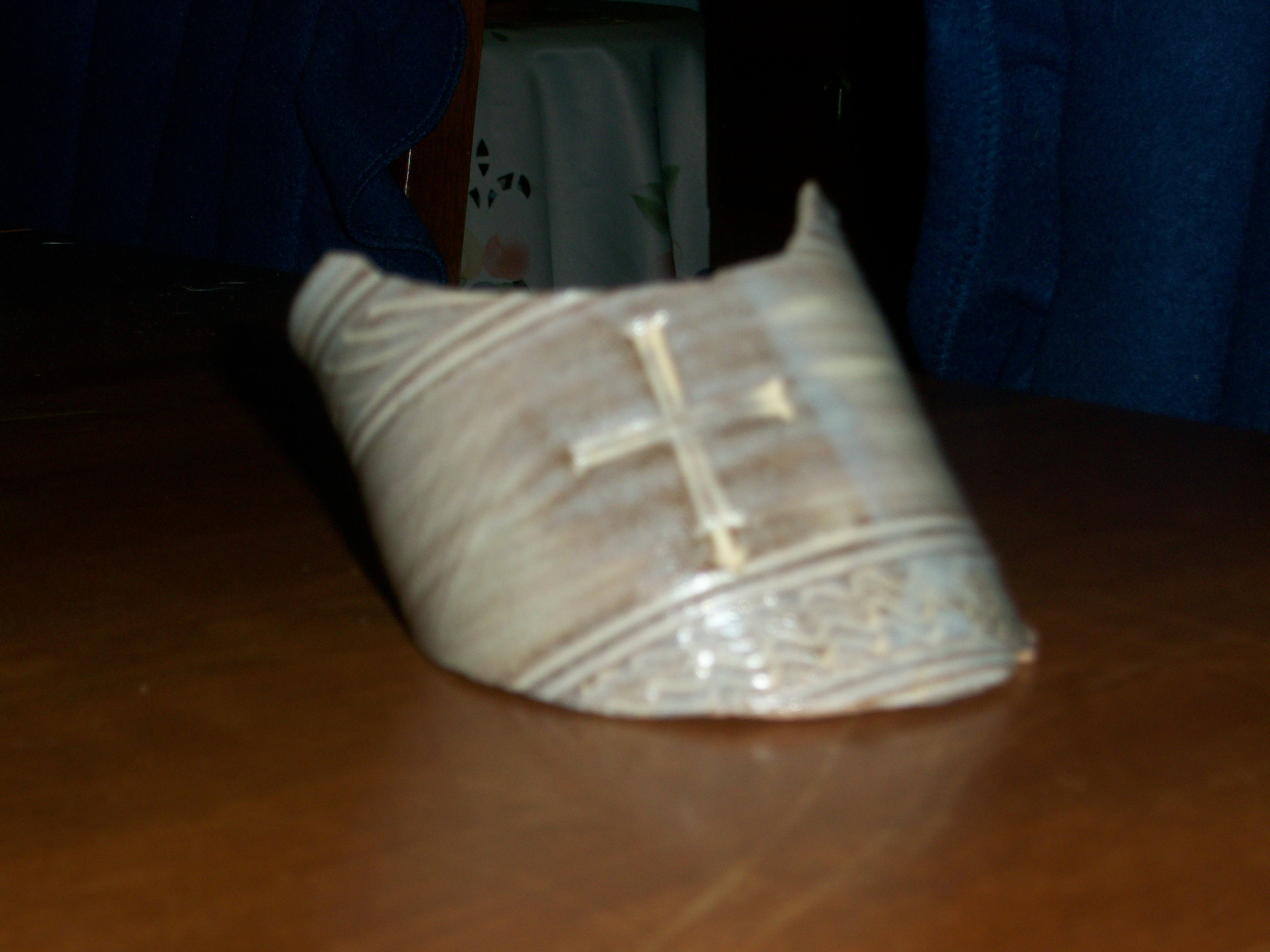
Until I dropped it and it broke into about eighteen pieces. It happened on a typically frantic morning as I juggled various demands, slipping out of my hand on my way to the Keurig machine. A hush fell over those in the break room, as they knew this was my favorite coffee-drinking implement. As I stoically said “Oh well, there are more where that came from,” I was internally screaming “FUUUUUUCCCCKKKK!” Stoicism is about creating a space of inner tranquility that will lead to outer effectiveness, but in this case my attempts at inner tranquility had not averted outer catastrophe. The largest portion of the shattered cup preserved the imprinted cross intact; this shard has perched on an office bookshelf ever since as a reminder of a dark day in my history. It will also be a cool remnant of twenty-first century culture  when it is excavated at an archaeological dig many millennia in the future.
Some time later I returned to Collegeville for a four-day retreat; before even showing up at the retreat venue I drove onto campus in order to visit the bookstore and purchase a new monk-crafted coffee cup (I still choose to believe the myth). From a row of a half-dozen candidates, I chose a cup with the same shape, color scheme and imprinted cross, plunked down my $35 (inflation had not hit Benedictine pottery yet) and I was in business. I drank tea and coffee from it mindfully and with proper attentiveness at the retreat and it is now my favorite coffee cup in my office.
But in comparing it with the fragmented shard from the broken original, I noticed that while the exteriors of the new and old cups are quite similar, the inside of the new one is significantly more attractive than the inside of its predecessor.  The swirling contrasts of the colors are more interesting, a couple of random cream-colored spots celebrate its uniqueness, and I especially like that the inside of the bottom says YOU REALLY ARE A BIG FUCKING DEAL! when I have consumed the liquid (not really).
I choose to consider my replacement monk-crafted cup as a reflection of what has been going on with me over the past dozen years. I’m pretty much the same on the outside; all of the change has been internal. And for the most part, the changes have been welcome. Because I like what I’m discovering inside, I’m becoming more effective externally. Inner tranquility to outer effectiveness. The retreat I attended reminded me of the importance of internal peace and tranquility as a proper receptacle for the divine within me. As Lao Tzu wrote, We shape clay into a pot, but it is the emptiness inside that holds whatever we want.
Previous Post

June 20, 2023
Loving Your Life
Next Post

June 24, 2023 How to Be the Resurrection
Recent Comments
"Mary did have a choice. And she was able to make it before the Holy ..."
"i cannot read beyond your recommendations for the books since i like to have a ..."
"AI will never be able to utter with honesty, feeling, or humility, the greeting: "Namaste".It ..."
"They do. I'm sure you could find discussions of the same topic from any of ..."
Browse Our Archives
Select a Category abortion Advent AI Angels Artificial intelligence atheism attention baptism Baptists beauty belief Benedictines Bible bicycling Big Bird books Bovina Camaldoli hermitage Canada Catholicism cats certainty change Christianity Christmas Collegeville Covid-19 creativity Development of Western Civilization dogs doubt Easter Enneagram Epiphany Episcopal ethics Eucharist evil extroverts Facebook faith family fear flowers forgiveness freedom friends God goodness grace happiness heaven hell history Holy Spirit Holy Week hope human nature humility humor idolatry incarnation introverts irreverence Islam Jeanne Jesus Joe Biden joy Judaism justice Kamala Harris knowledge Lent listen literature liturgy love Marsue Memorial Day miracles movies music mystery mythology NPR Old Testament optimism paradox peace Penguins philosophy piano podcast politics power prayer Protestantism Providence College Religion Rhode Island sabbatical sacrament science seeing silence Simone Weil Socrates soul sports St. John's College stories suffering tattoo teaching technology television theology thinking time tolerance transcendence travel trees trust truth Uncategorized Vermont wisdom wonder writing
Select a Month May 2026 April 2026 March 2026 February 2026 January 2026 December 2025 November 2025 October 2025 September 2025 August 2025 July 2025 June 2025 May 2025 April 2025 March 2025 February 2025 January 2025 December 2024 November 2024 October 2024 September 2024 August 2024 July 2024 June 2024 May 2024 April 2024 March 2024 February 2024 January 2024 December 2023 November 2023 October 2023 September 2023 August 2023 July 2023 June 2023 May 2023 April 2023 March 2023 February 2023 January 2023 December 2022 November 2022 October 2022 September 2022 August 2022 July 2022 June 2022 May 2022 April 2022 March 2022 February 2022 January 2022 December 2021 November 2021 October 2021 September 2021 August 2021 July 2021 June 2021 May 2021 April 2021 March 2021 February 2021 January 2021 December 2020 November 2020 October 2020 September 2020 August 2020 July 2020 June 2020 May 2020 April 2020 March 2020 February 2020 January 2020 December 2019 November 2019 October 2019 September 2019 August 2019 July 2019 June 2019 May 2019 April 2019 March 2019 February 2019 January 2019 December 2018 November 2018 October 2018 September 2018 August 2018 July 2018 June 2018 May 2018 April 2018 March 2018 February 2018 January 2018 December 2017 November 2017 October 2017 September 2017 August 2017 July 2017 June 2017 May 2017 April 2017 March 2017 February 2017 January 2017 December 2016 November 2016 October 2016 September 2016 August 2016 July 2016 June 2016 May 2016 April 2016 March 2016 February 2016 January 2016 December 2015 November 2015 October 2015 September 2015 August 2015 July 2015 June 2015 May 2015 April 2015 March 2015 February 2015 January 2015 December 2014 November 2014 October 2014 September 2014 August 2014 July 2014 June 2014 May 2014 April 2014 March 2014 February 2014 January 2014 December 2013 November 2013 October 2013 September 2013 August 2013 July 2013 June 2013 May 2013 April 2013 March 2013 February 2013 January 2013 December 2012 November 2012 October 2012 September 2012
Follow Us!
TAKE THE
Religious Wisdom Quiz
True or False: The book of Psalms contains exactly 100 psalms.
Select your answer to see how you score.
FALSE TRUE
Books by This Author Books by Vance G. Morgan
Related posts from Freelance Christianity

The Lonely Pawn: On Faith, Doubt, and Meaning


AI and Love: When a Chatbot Becomes a...

TRENDING AT PATHEOS Progressive Christian

What Being a Modern-Day Apostle Means to Me
In my last column, I discussed the ins and outs of modern-day...

Did Ancient China Once Worship the God of...
Across human history, a common thread weaves through the origins of the...

Love Your Neighbor – Including Earth-Kin: Lev. 19,...
God’s command to love your neighbor means acting in an ethical and...

Lead a Church Study of “Jesus and Lao...
Guest writer Jack Thomas (The Irreverent Reverend) reflects on leading his church...

Pastoral Wisdom for Responding to Sermon Pushback
Getting sermon pushback on your social justice sermon? Learn practical, Proverbs-based strategies...

Principles for Understanding the Apostolic Ministry Today
Whenever people discover that my formal ministry title is "apostle," as in...
view all Progressive Christian blogs
What Are Your Thoughts?leave a comment
Ad-Free & Subscriber Log-In Subscription Support
- About Us
- 2026 Calendar
- Videos
- Podcasts
- Library of World Religions
- Faith In Media Tracker
- Advertise With Us
- Write for Us
- Privacy Policy
- Terms of Service
- Do Not Sell My Data
- Contact Us
- Radiant Digital
- Manage Newsletter Subscriptions
- Unsubscribe From Notifications
- Sitemap
Copyright 2008-2026, Patheos. All rights reserved.
Subscription Support Ad-Free & Subscriber Log-In
Follow Patheos