
BuddhistCatholicContemplativeEvangelicalGeneral ChristianHinduJewishLatter-day SaintMuslimNew VisionsProgressive Christian
Beliefs
- Buddhist
- Catholic
- Contemplative
- Evangelical
- General Christian
- Hindu
- Jewish
- Latter-day Saint
- More Voices
- Muslim
- New Visions
- Pagan
- Progressive Christian
Topics
- Religion News
- Food and Religion
- Sports and Religion
- Religious Art
- Religious Music and Entertainment
- Religious Events
- History and Religion
- Style and Religion
- Politics and Religion
- Women in Religion
- Recreation Outdoors and Religion
- Business Finance and Religion
- Careers Workplace and Religion
- Education and Religion
- Family Parenting and Religion
- Health Fitness and Religion
- Home and Religion
- Relationships and Religion
- Technology and Religion
- Travel and Religion
Columnists
- Buddhist Columnists
- Business Finance and Religion Columnists
- Careers Workplace and Religion Columnists
- Catholic Columnists
- Contemplative Columnists
- Education and Religion Columnists
- Evangelists Columnists
- Family Parenting and Religion Columnists
- General Christian Columnists
- Health Fitness and Religion Columnists
- Hindu Columnists
- History and Religion Columnists
- Home and Religion Columnists
- Jewish Columnists
- More Voices Columnists
- Latter Day Columnists
- Muslim Columnists
- New Visions Columnists
- Nonreligious Columnists
- Pagan Columnists
- Politics and Religion Columnists
- Progressive Columnists
- Recreation Outdoors and Religion Columnists
- Relationships and Religion Columnists
- Religion News Columnists
- Religious Art Columnists
- Religious Events Columnists
- Religious Music and Entertainment Columnists
- Sports and Religion Columnists
- Style and Religion Columnists
- Technology and Religion Columnists
- Travel and Religion Columnists
- Women in Religion Columnists
Resource Library
- 2026 Calendar
- Library of World Religions
- The 100 Most Holy Places on Earth
- Patheos Answers
- Podcasts
- Videos
- Faith Leaders Database
- Anglican Episcopalian
- Bahai
- Baptist
- Buddhism
- Christianity
- Confucianism
- Eastern Orthodoxy
- Hinduism
- Holiness and Pentecostal
- ISKCON
- Islam
- Judaism
- Lutheran
- Methodist
- The Church of Jesus Christ of Latter-day Saints
- New Age
- Paganism
- Presbytarian and Reformed
- Protestantism
- Religion Behind the Scenes
- Roman Catholic
- Scientology
- Shia Islam
- Sikhism
- Sufism
- Sunni Islam
- Taoism
- Zen
- See all religions
Research Tools
 Ad-Free & Subscriber Log-In Subscription Support
Ad-Free & Subscriber Log-In Subscription Support
Follow Patheos 

- Trending:
- Forgiveness
- |
- Marriage
- |
- Consciousness
- |
- Death Penalty
- |
- Election
- |
- Halloween

- Home
- Progressive Christian
- Dr. Seuss, an Unborn Child, and Why Each Of Us Matters
Dr. Seuss, an Unborn Child, and Why Each Of Us Matters
Last updated on: March 13, 2018 at 6:36 am by Vance Morgan
Dr. Seuss, an Unborn Child, and Why Each Of Us Matters 2018-03-13T06:36:33-04:00 Vance Morgan
Patheos Explore the world's faith through different perspectives on religion and spirituality! Patheos has the views of the prevalent religions and spiritualities of the world.
Dr. Seuss was a regular in our house when my sons were young—my thirty-something sons still occasionally mention how much they both loved Green Eggs and Ham in particular. Theodor Geisel’s creatively madcap work has occasionally made it into this blog over the past five years, from the star-bellied Sneetches in an early essay on heresy to the environmentally-minded Lorax during an on-campus controversy over the demise of a 150-year-old oak.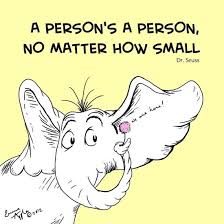
The most recent Dr. Seuss classic to cross my radar screen involves a gentle elephant who believes that “a person’s a person no matter how small,” a couple of kangaroos with bad attitudes, and other jungle animals dedicated to making the elephant’s life difficult. Early last summer someone at a conference Jeanne was attending told her that she should read Horton Hears a Who; by late summer a large orange-covered copy had arrived at our house. I paid no attention to it until a few months ago.
As I drove across town headed for minor oral surgery (a phrase that has turned out to be oxymoronic), I listened to an interview on Boston Public Radio with Ian McEwan, one of my favorite contemporary novelists. McEwan was in town on a book tour promoting his new novel, Nutshell. On the basis of the interview, I ordered the book on Amazon as soon as I got home. It is a reworking of Hamlet with a few twists, including that it is narrated by an unborn child hanging upside-down in its mother’s uterus. A la Hamlet, the unborn child knows that its mother is having an affair with its uncle and that they are plotting to kill its father. The fetus is urbane, sophisticated, listens to music and podcasts vicariously through its mother, has developed a connoisseur’s picky tastes in wine, and wonders whether there is life after the uterus.
Toward the end of the segment, the two interviewers asked McEwan to read a passage from Nutshell.
Certain artists in print or paint flourish, like babies to be, in confined spaces. Their narrow subjects may confound or disappoint some: courtship among the 18th century gentry, life beneath a sail, talking rabbits, sculpted hares, fat people in oils, dog portraits, horse portraits, portraits of aristocrats, reclining nudes, nativities by the millions, and crucifixions, assumptions, bowls of fruit, flowers in vases, and Dutch bread and cheese, with or without a knife on the side. Some give themselves in prose merely to the self.
In science, too, one dedicates his life to an Albanian snail, another to a virus. Darwin gave eight years to barnacles, and in wise later life, to earthworms. The Higgs Bosun, a tiny thing, perhaps not even a thing, is the lifetime’s pursuit of thousands. To be bound in a nutshell, see the world in two inches of ivory, in a grain of sand. Why not, when all of literature, all of art, of human endeavor, is just a speck in the universe of possible things? And even this universe may be a speck in a multitude of actual and possible universes. So, why not be an owl poet?
In the wonderfully random way that things often connect together, this passage made me think of the book that had been laying on our coffee table for the last couple of weeks: Horton Hears a Who. Horton the Elephant, while splashing in a pool, hears a small speck of dust talking to him. He comes to realize that the voice is coming from a small person who lives on the dust speck; indeed, the speck is actually a tiny planet, home to a community called Whoville, the home of microscopic creatures called Whos.
The Whos know that they are vulnerable and exposed to possible harm in a dangerous world; the mayor of Whoville asks Horton for protection, which Horton happily agrees to provide. He places the Who-planet on a clover that he proceeds to carry in his trunk as carefully as a waiter carrying a tray of crystal champagne glasses. Horton has come to the same realization as the pre-born narrator of Nutshell: Each existing thing is the center of its own universe of interests, desires, and concerns—but each existing thing is “bound in a nutshell,” “just a speck in the universe of possible things.”
The apparent insignificance of human existence prompted seventeenth-century mathematician and philosopher Blaise Pascal to write that The eternal silence of these infinite spaces frightens me. Yet in Psalm 139 we are told that
You have formed my inward parts;
You have formed me in my mother’s womb . . .
My frame was not hidden from you,
When I was made in secret
And skillfully wrought in the lowest parts of the earth.
As both Horton and McEwan’s upside-down narrator realize, everything is at the same time both insignificant and unique. The challenge is to keep both of these in mind simultaneously.
As Horton’s story proceeds, his fellow jungle animals refuse to believe that the Whos exist, believing rather that Horton is nuts. In scenes reminiscent of grade school playgrounds, various animals ridicule Horton, eventually managing to steal his Who-bearing clover and hide it from him in a large field of clovers. After a long search, Horton rescues the frightened and shaken Whos; at his prompting, they finally prove their existence to the still skeptical jungle animals by making as much collective noise as possible until everyone can hear them. Now convinced of the Whos’ existence, all the animals vow to help Horton protect the tiny community.
Each of us is both insignificant and infinitely precious, no matter what current circumstances might indicate. From within the confines of his mother’s womb, McEwan’s narrator gains insights into a world he’s not sure he will ever reach. The Whos, upon discovering just how vulnerable and fragile their world is, are discovered by someone greater than themselves, someone willing to put himself on the line again and again to preserve their special existence. It’s a wonderful retelling of a story that generations have embraced. “A person’s a person no matter how small,” after all.
Previous Post

March 11, 2018
Childish or Childlike?
Next Post

March 15, 2018 The Christian Faith In a Nutshell
Browse Our Archives
Select a Category abortion Advent AI Angels Artificial intelligence atheism attention baptism Baptists beauty belief Benedictines Bible bicycling Big Bird books Bovina Camaldoli hermitage Canada Catholicism cats certainty change Christianity Christmas Collegeville Covid-19 creativity Development of Western Civilization dogs doubt Easter Enneagram Epiphany Episcopal ethics Eucharist evil extroverts Facebook faith family fear flowers forgiveness freedom friends God goodness grace happiness heaven hell history Holy Spirit Holy Week hope human nature humility humor idolatry incarnation introverts irreverence Islam Jeanne Jesus Joe Biden joy Judaism justice Kamala Harris knowledge Lent listen literature liturgy love Marsue Memorial Day miracles movies music mystery mythology NPR Old Testament optimism paradox peace Penguins philosophy piano podcast politics power prayer Protestantism Providence College Religion Rhode Island sabbatical sacrament science seeing silence Simone Weil Socrates soul sports St. John's College stories suffering tattoo teaching technology television theology thinking time tolerance transcendence travel trees trust truth Uncategorized Vermont wisdom wonder writing
Select a Month May 2026 April 2026 March 2026 February 2026 January 2026 December 2025 November 2025 October 2025 September 2025 August 2025 July 2025 June 2025 May 2025 April 2025 March 2025 February 2025 January 2025 December 2024 November 2024 October 2024 September 2024 August 2024 July 2024 June 2024 May 2024 April 2024 March 2024 February 2024 January 2024 December 2023 November 2023 October 2023 September 2023 August 2023 July 2023 June 2023 May 2023 April 2023 March 2023 February 2023 January 2023 December 2022 November 2022 October 2022 September 2022 August 2022 July 2022 June 2022 May 2022 April 2022 March 2022 February 2022 January 2022 December 2021 November 2021 October 2021 September 2021 August 2021 July 2021 June 2021 May 2021 April 2021 March 2021 February 2021 January 2021 December 2020 November 2020 October 2020 September 2020 August 2020 July 2020 June 2020 May 2020 April 2020 March 2020 February 2020 January 2020 December 2019 November 2019 October 2019 September 2019 August 2019 July 2019 June 2019 May 2019 April 2019 March 2019 February 2019 January 2019 December 2018 November 2018 October 2018 September 2018 August 2018 July 2018 June 2018 May 2018 April 2018 March 2018 February 2018 January 2018 December 2017 November 2017 October 2017 September 2017 August 2017 July 2017 June 2017 May 2017 April 2017 March 2017 February 2017 January 2017 December 2016 November 2016 October 2016 September 2016 August 2016 July 2016 June 2016 May 2016 April 2016 March 2016 February 2016 January 2016 December 2015 November 2015 October 2015 September 2015 August 2015 July 2015 June 2015 May 2015 April 2015 March 2015 February 2015 January 2015 December 2014 November 2014 October 2014 September 2014 August 2014 July 2014 June 2014 May 2014 April 2014 March 2014 February 2014 January 2014 December 2013 November 2013 October 2013 September 2013 August 2013 July 2013 June 2013 May 2013 April 2013 March 2013 February 2013 January 2013 December 2012 November 2012 October 2012 September 2012
Follow Us!
TAKE THE
Religious Wisdom Quiz
Who became Moses' spokesperson to Pharaoh?
Select your answer to see how you score.
Joshua Aaron Hur Miriam
Books by This Author Books by Vance G. Morgan
Related posts from Freelance Christianity

The Lonely Pawn: On Faith, Doubt, and Meaning


AI and Love: When a Chatbot Becomes a...

TRENDING AT PATHEOS Progressive Christian

What Being a Modern-Day Apostle Means to Me
In my last column, I discussed the ins and outs of modern-day...

Did Ancient China Once Worship the God of...
Across human history, a common thread weaves through the origins of the...

Love Your Neighbor – Including Earth-Kin: Lev. 19,...
God’s command to love your neighbor means acting in an ethical and...

Lead a Church Study of “Jesus and Lao...
Guest writer Jack Thomas (The Irreverent Reverend) reflects on leading his church...

Pastoral Wisdom for Responding to Sermon Pushback
Getting sermon pushback on your social justice sermon? Learn practical, Proverbs-based strategies...

Principles for Understanding the Apostolic Ministry Today
Whenever people discover that my formal ministry title is "apostle," as in...
view all Progressive Christian blogs
Ad-Free & Subscriber Log-In Subscription Support
- About Us
- 2026 Calendar
- Videos
- Podcasts
- Library of World Religions
- Faith In Media Tracker
- Advertise With Us
- Write for Us
- Privacy Policy
- Terms of Service
- Do Not Sell My Data
- Contact Us
- Radiant Digital
- Manage Newsletter Subscriptions
- Unsubscribe From Notifications
- Sitemap
Copyright 2008-2026, Patheos. All rights reserved.
Subscription Support Ad-Free & Subscriber Log-In
Follow Patheos