
BuddhistCatholicContemplativeEvangelicalGeneral ChristianHinduJewishLatter-day SaintMuslimNew VisionsProgressive Christian
Beliefs
- Buddhist
- Catholic
- Contemplative
- Evangelical
- General Christian
- Hindu
- Jewish
- Latter-day Saint
- More Voices
- Muslim
- New Visions
- Pagan
- Progressive Christian
Topics
- Religion News
- Food and Religion
- Sports and Religion
- Religious Art
- Religious Music and Entertainment
- Religious Events
- History and Religion
- Style and Religion
- Politics and Religion
- Women in Religion
- Recreation Outdoors and Religion
- Business Finance and Religion
- Careers Workplace and Religion
- Education and Religion
- Family Parenting and Religion
- Health Fitness and Religion
- Home and Religion
- Relationships and Religion
- Technology and Religion
- Travel and Religion
Columnists
- Buddhist Columnists
- Business Finance and Religion Columnists
- Careers Workplace and Religion Columnists
- Catholic Columnists
- Contemplative Columnists
- Education and Religion Columnists
- Evangelists Columnists
- Family Parenting and Religion Columnists
- General Christian Columnists
- Health Fitness and Religion Columnists
- Hindu Columnists
- History and Religion Columnists
- Home and Religion Columnists
- Jewish Columnists
- More Voices Columnists
- Latter Day Columnists
- Muslim Columnists
- New Visions Columnists
- Nonreligious Columnists
- Pagan Columnists
- Politics and Religion Columnists
- Progressive Columnists
- Recreation Outdoors and Religion Columnists
- Relationships and Religion Columnists
- Religion News Columnists
- Religious Art Columnists
- Religious Events Columnists
- Religious Music and Entertainment Columnists
- Sports and Religion Columnists
- Style and Religion Columnists
- Technology and Religion Columnists
- Travel and Religion Columnists
- Women in Religion Columnists
Resource Library
- 2026 Calendar
- Library of World Religions
- The 100 Most Holy Places on Earth
- Patheos Answers
- Podcasts
- Videos
- Faith Leaders Database
- Anglican Episcopalian
- Bahai
- Baptist
- Buddhism
- Christianity
- Confucianism
- Eastern Orthodoxy
- Hinduism
- Holiness and Pentecostal
- ISKCON
- Islam
- Judaism
- Lutheran
- Methodist
- The Church of Jesus Christ of Latter-day Saints
- New Age
- Paganism
- Presbytarian and Reformed
- Protestantism
- Religion Behind the Scenes
- Roman Catholic
- Scientology
- Shia Islam
- Sikhism
- Sufism
- Sunni Islam
- Taoism
- Zen
- See all religions
Research Tools
 Ad-Free & Subscriber Log-In Subscription Support
Ad-Free & Subscriber Log-In Subscription Support
Follow Patheos 

- Trending:
- Forgiveness
- |
- Marriage
- |
- Consciousness
- |
- Death Penalty
- |
- Election
- |
- Halloween

- Home
- Progressive Christian
- Holy Saturday: “Mortals die, and are laid low”
Holy Saturday: “Mortals die, and are laid low”
Last updated on: April 19, 2025 at 7:00 am by Vance Morgan
Holy Saturday: “Mortals die, and are laid low” 2025-04-13T19:16:53-04:00 Vance Morgan
Patheos Explore the world's faith through different perspectives on religion and spirituality! Patheos has the views of the prevalent religions and spiritualities of the world.
Holy Saturday reminds us that we are mortal and that we all will die. Quoting the Book of Job, the Holy Saturday liturgy reminds us that
[m]ortals die, and are laid low . . . As waters fail from a lake, and a river wastes away and dries up, so mortals lie down and do not rise again; until the heavens are no more, they will not awake or be roused out of their sleep.
Those who loved and followed Jesus, both those who fled and those who stayed, could not have escaped these truths on the day after Jesus was crucified and laid in the tomb. As poet Christian Wiman notes, “resurrection is a fiction and a distraction to anyone who refuses to face the reality of death.” Human beings die and are laid low. And Jesus was a human being.
In 1521 the German master Hans Holbein the Younger painted “The Body of the Dead Christ in the Tomb,” a work that continues to startle and disturb viewers five hundred years later. Emaciated, battered, unflinchingly grotesque, this figure is in the early stages of putrefaction, of rigor mortis, the glassy eyes and mouth open. Three wounds of the Crucifixion are visible: on the side, the effect of a Roman lance, and nail piercings on the feet and on the hand.
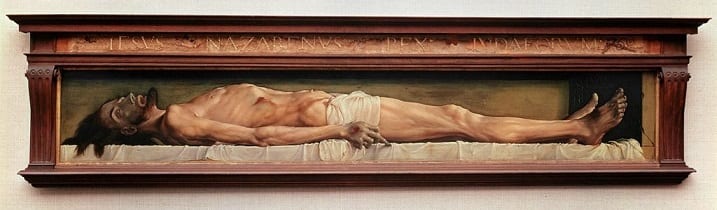
Fyodor Dostoevsky viewed the painting in 1867. His reaction was so intense that his wife became concerned. She reported that he turned white and refused to leave. She dragged him away afraid that his heightened emotions might trigger an epileptic episode. He later remarked, “Such a picture might make one lose one’s faith.” A character in Dostoevsky’s 1868 novel The Idiot has the following reaction to a print of Holbein’s painting, undoubtedly reflecting Dostoevsky’s own reaction a year or so earlier:
Supposing that the disciples, the future apostles, the women who had followed Him and stood by the cross, all of whom believed in and worshipped Him—supposing that they saw this tortured body, this face so mangled and bleeding and bruised (and they must have so seen it)—how could they have gazed upon the dreadful sight and yet have believed that He would rise again?
The most likely answer is that they couldn’t. And they didn’t. There is no indication in the Gospels that, despite various things that Jesus had said in the previous months, anyone really believed that he was anything but dead for good.
It is clear throughout his novels that Dostoevsky considered confronting doubts to be a central part of faith. He believed that faith wasn’t bolstered by finding evidence for God, but rather by believing despite the evidence against the story. That helps explain Dostoevsky’s response to Holbein’s painting. The depiction of the dead Christ is so realistic, so jarring, that it is a challenge to one’s faith to continue to believe in the Resurrection. Our eyes and our experience with death tell us that death is final, there can be no reversal of death to life. Mortals die, and are laid low.
The eighteenth-century essayist and philosopher Voltaire once provocatively wrote, “If God did not exist, it would be necessary to invent him.” This statement shook up a number of Voltaire’s contemporaries, leading many to imagine that any person who could write such a thing seriously must be an atheist. The statement remains provocative, and it is clear from his body of work that whatever Voltaire might have been, he was not a traditional religious believer. But with the apparent meaninglessness of human existence and reality in view, Voltaire’s famous claim is absolutely true. The darkest and most sobering parts of human reality cry out for, actually demand, a response. The human epitaph cannot be “Life’s a bitch, and then you die.”
All sorts of responses to whether life has meaning without belief in something greater than us, ranging from religious through philosophical and literary to political, have been offered over the centuries, responses that often conflict with each other and even more frequently fail to take the fundamental problem on squarely. Which of these responses is true? More important, how can we know if any of them are true? How can we be sure that they are anything more than a collection of tunes human beings have written to whistle in the dark until the night overwhelms them?
We cannot be sure. Yet billions of people have been and continue to be willing to shape their lives, to stake their very existence, on the truth of one or more of these stories. Why? Because there is something in the human heart that has to believe them, something that has to hope. And it is that very longing and hope that is perhaps most convincing. As Simone Weil reminds us, “[I]f we ask our Father for bread, he will not give us a stone.”
The third and final portion of George Friedrich Handel’s masterpiece Messiah, immediately following the “Hallelujah Chorus,” begins with “I Know That My Redeemer Liveth,” a soaring, beautiful soprano solo setting of a text from Job, with a concluding sentiment from 1 Corinthians:
I know that my redeemer liveth, and that he shall stand at the latter day upon the earth;
And though worms destroy this body, yet in my flesh shall I see God.
For now is Christ risen from the dead, the first fruits of them that sleep.
From the depths of despair, literally from the middle of a pile of ashes, Job clings to a hopeful story, that there is a transcendent and triumphant divine response to human incapacity, despair, and hopelessness. It’s a wonderful story. How can we not believe it?
For reflection: Kathleen Norris writes that “a myth is a story that you know must be true the first time you hear it.” Do the seminal stories of the Christian faith present truths that transcend the facts of what might or might not have actually happened?
Previous Post
April 18, 2025
Good Friday: "Actually, he died"
Next Post
April 20, 2025 Easter--Now It Begins
Browse Our Archives
Select a Category abortion Advent AI Angels Artificial intelligence atheism attention baptism Baptists beauty belief Benedictines Bible bicycling Big Bird books Bovina Camaldoli hermitage Canada Catholicism cats certainty change Christianity Christmas Collegeville Covid-19 creativity Development of Western Civilization dogs doubt Easter Enneagram Epiphany Episcopal ethics Eucharist evil extroverts Facebook faith family fear flowers forgiveness freedom friends God goodness grace happiness heaven hell history Holy Spirit Holy Week hope human nature humility humor idolatry incarnation introverts irreverence Islam Jeanne Jesus Joe Biden joy Judaism justice Kamala Harris knowledge Lent listen literature liturgy love Marsue Memorial Day miracles movies music mystery mythology NPR Old Testament optimism paradox peace Penguins philosophy piano podcast politics power prayer Protestantism Providence College Religion Rhode Island sabbatical sacrament science seeing silence Simone Weil Socrates soul sports St. John's College stories suffering tattoo teaching technology television theology thinking time tolerance transcendence travel trees trust truth Uncategorized Vermont wisdom wonder writing
Select a Month May 2026 April 2026 March 2026 February 2026 January 2026 December 2025 November 2025 October 2025 September 2025 August 2025 July 2025 June 2025 May 2025 April 2025 March 2025 February 2025 January 2025 December 2024 November 2024 October 2024 September 2024 August 2024 July 2024 June 2024 May 2024 April 2024 March 2024 February 2024 January 2024 December 2023 November 2023 October 2023 September 2023 August 2023 July 2023 June 2023 May 2023 April 2023 March 2023 February 2023 January 2023 December 2022 November 2022 October 2022 September 2022 August 2022 July 2022 June 2022 May 2022 April 2022 March 2022 February 2022 January 2022 December 2021 November 2021 October 2021 September 2021 August 2021 July 2021 June 2021 May 2021 April 2021 March 2021 February 2021 January 2021 December 2020 November 2020 October 2020 September 2020 August 2020 July 2020 June 2020 May 2020 April 2020 March 2020 February 2020 January 2020 December 2019 November 2019 October 2019 September 2019 August 2019 July 2019 June 2019 May 2019 April 2019 March 2019 February 2019 January 2019 December 2018 November 2018 October 2018 September 2018 August 2018 July 2018 June 2018 May 2018 April 2018 March 2018 February 2018 January 2018 December 2017 November 2017 October 2017 September 2017 August 2017 July 2017 June 2017 May 2017 April 2017 March 2017 February 2017 January 2017 December 2016 November 2016 October 2016 September 2016 August 2016 July 2016 June 2016 May 2016 April 2016 March 2016 February 2016 January 2016 December 2015 November 2015 October 2015 September 2015 August 2015 July 2015 June 2015 May 2015 April 2015 March 2015 February 2015 January 2015 December 2014 November 2014 October 2014 September 2014 August 2014 July 2014 June 2014 May 2014 April 2014 March 2014 February 2014 January 2014 December 2013 November 2013 October 2013 September 2013 August 2013 July 2013 June 2013 May 2013 April 2013 March 2013 February 2013 January 2013 December 2012 November 2012 October 2012 September 2012
Follow Us!
TAKE THE
Religious Wisdom Quiz
Which Gospel records the most parables?
Select your answer to see how you score.
Mark John Matthew Luke
Books by This Author Books by Vance G. Morgan
Related posts from Freelance Christianity


TRENDING AT PATHEOS Progressive Christian

Why Christians Have a Sacred Duty to Vote:...
The Bible offers strong support for the sacred duty to vote. Here...

What Being a Modern-Day Apostle Means to Me
In my last column, I discussed the ins and outs of modern-day...

Did Ancient China Once Worship the God of...
Across human history, a common thread weaves through the origins of the...

Love Your Neighbor – Including Earth-Kin: Lev. 19,...
God’s command to love your neighbor means acting in an ethical and...

Lead a Church Study of “Jesus and Lao...
Guest writer Jack Thomas (The Irreverent Reverend) reflects on leading his church...

Principles for Understanding the Apostolic Ministry Today
Whenever people discover that my formal ministry title is "apostle," as in...
view all Progressive Christian blogs
Ad-Free & Subscriber Log-In Subscription Support
- About Us
- 2026 Calendar
- Videos
- Podcasts
- Library of World Religions
- Faith In Media Tracker
- Advertise With Us
- Write for Us
- Privacy Policy
- Terms of Service
- Do Not Sell My Data
- Contact Us
- Radiant Digital
- Manage Newsletter Subscriptions
- Unsubscribe From Notifications
- Sitemap
Copyright 2008-2026, Patheos. All rights reserved.
Subscription Support Ad-Free & Subscriber Log-In
Follow Patheos