
BuddhistCatholicContemplativeEvangelicalGeneral ChristianHinduJewishLatter-day SaintMuslimNew VisionsProgressive Christian
Beliefs
- Buddhist
- Catholic
- Contemplative
- Evangelical
- General Christian
- Hindu
- Jewish
- Latter-day Saint
- More Voices
- Muslim
- New Visions
- Pagan
- Progressive Christian
Topics
- Religion News
- Food and Religion
- Sports and Religion
- Religious Art
- Religious Music and Entertainment
- Religious Events
- History and Religion
- Style and Religion
- Politics and Religion
- Women in Religion
- Recreation Outdoors and Religion
- Business Finance and Religion
- Careers Workplace and Religion
- Education and Religion
- Family Parenting and Religion
- Health Fitness and Religion
- Home and Religion
- Relationships and Religion
- Technology and Religion
- Travel and Religion
Columnists
- Buddhist Columnists
- Business Finance and Religion Columnists
- Careers Workplace and Religion Columnists
- Catholic Columnists
- Contemplative Columnists
- Education and Religion Columnists
- Evangelists Columnists
- Family Parenting and Religion Columnists
- General Christian Columnists
- Health Fitness and Religion Columnists
- Hindu Columnists
- History and Religion Columnists
- Home and Religion Columnists
- Jewish Columnists
- More Voices Columnists
- Latter Day Columnists
- Muslim Columnists
- New Visions Columnists
- Nonreligious Columnists
- Pagan Columnists
- Politics and Religion Columnists
- Progressive Columnists
- Recreation Outdoors and Religion Columnists
- Relationships and Religion Columnists
- Religion News Columnists
- Religious Art Columnists
- Religious Events Columnists
- Religious Music and Entertainment Columnists
- Sports and Religion Columnists
- Style and Religion Columnists
- Technology and Religion Columnists
- Travel and Religion Columnists
- Women in Religion Columnists
Resource Library
- 2026 Calendar
- Library of World Religions
- The 100 Most Holy Places on Earth
- Patheos Answers
- Podcasts
- Videos
- Faith Leaders Database
- Anglican Episcopalian
- Bahai
- Baptist
- Buddhism
- Christianity
- Confucianism
- Eastern Orthodoxy
- Hinduism
- Holiness and Pentecostal
- ISKCON
- Islam
- Judaism
- Lutheran
- Methodist
- The Church of Jesus Christ of Latter-day Saints
- New Age
- Paganism
- Presbytarian and Reformed
- Protestantism
- Religion Behind the Scenes
- Roman Catholic
- Scientology
- Shia Islam
- Sikhism
- Sufism
- Sunni Islam
- Taoism
- Zen
- See all religions
Research Tools
 Ad-Free & Subscriber Log-In Subscription Support
Ad-Free & Subscriber Log-In Subscription Support
Follow Patheos 

- Trending:
- Forgiveness
- |
- Marriage
- |
- Consciousness
- |
- Death Penalty
- |
- Election
- |
- Halloween

- Home
- Progressive Christian
- Hedda and Paul
Hedda and Paul
Last updated on: November 17, 2014 at 7:30 am by Vance Morgan
Hedda and Paul 2014-11-17T07:30:52-04:00 Vance Morgan
Patheos Explore the world's faith through different perspectives on religion and spirituality! Patheos has the views of the prevalent religions and spiritualities of the world.
 “There is a famous anecdote about an out-of-town tryout of the original production of A Streetcar Named Desire. Thornton Wilder was in attendance and remarked afterwards to Tennessee Williams that he thought Blanche DuBois was too complex a character for the theater. Tennessee is said to have replied, ‘People are complex, Thorn.’”
I read the above anecdote in the program notes as Jeanne and I waited at a local theater for Henrik Ibsen’s Hedda Gabler to begin.  What I know about the great Norwegian playwright has been gathered over the years from teaching in a team-taught course where my literature teammate has occasionally chosen one of Ibsen’s controversial and fascinating plays for the students to grapple with, ranging from An Enemy of the People to The Wild Duck and A Doll’s House. Ibsen’s penchant for ripping the veil off late nineteenth-century bourgeois Norwegian society, pushing his readers’ and audience’s face up against topics that decent people would just as soon not consider, and especially his willingness to populate his plays with female characters who explode the stereotypes of dutiful wife and devoted mother caused his plays to not only be banned in several countries during his lifetime
 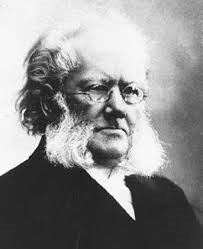 (he was nicknamed “Ibscene”) but make them sound to a twenty-first century audience as if they were written yesterday. I probably read Hedda Gabler as an undergraduate, but this was the first time I had the chance to see it on stage and only the second Ibsen I had ever seen performed; reading in the program notes that the role of Hedda has been described as the “female Hamlet” raised my expectations even further.
Over the past few months I have been immersed in things Norwegian as I read through Jo Nesbø’s mystery series set in Oslo and environs. Nesbø is the hottest writer to come out of Scandinavia since Steig Larsson; I started his ten-volume-and-counting Harry Hole series in early summer and am currently plowing through Phantom, the ninth entry in the series. Were it not for my usual commitment to reading everything an author has written in the order written once I have discovered their work, I might not have made it this far— Nesbø’s incredible popularity has caused him to crank out books at a pace that outstrips consistent quality—but when he’s good, he’s very, very good. As with all of my favorite authors of mystery series, I particularly enjoy how the repeating characters become more real from book to book as I learn incrementally more about their history, their peccadilloes, their shortcomings, their successes, their relationships, their failures, their inner lives—in short, I enjoy observing them become more and more recognizably human. Because Tennessee Williams was right. People are complex.
Nesbø and Ibsen both prefer shadow to light and seldom go far before revealing something dark and sinister lying beneath the surface of even the most banal and pleasant persons and circumstances. Hedda Gabler, a newlywed just returned from her honeymoon with her husband George, a newly minted PhD (philosophy, no less!) expecting a plum appointment at the local university, finds herself situated in a large new house ready to be furnished with whatever furniture she fancies. George is clearly infatuated with his beautiful new wife, who everyone describes (to her increasing annoyance) as “glowing.”  But appearances are deceiving; only a few minutes into the play we find that Hedda is complicated to the core. Another short essay in the program guide reports that Hedda has been described by critics as “sinister, degenerate, repellent, lunatic, a monster in the shape of a woman, with a soul too small even for human sin.” A bit over the top, perhaps, but she actually is just about all of that. But she is also charismatic, has a razor-sharp wit, crackles with energy, and as if by magic causes everyone in the room to dance to her tune.
As I watched the play unfold on the stage fifteen feet away, I realized that Hedda is not necessarily a bad person bent on the destruction of everything she touches. In this performance she was brilliantly played with the energy of trapped animal, like a tiger or lion in a zoo cage pacing back and forth restlessly, looking everywhere for a way to escape, and devouring everything unfortunate enough to fall within her reach. She finds herself in a world in which the only acceptable roles for a woman are roles that she not only would reject if given the opportunity but that she also knows she is completely unsuited for.  In a twisted version of Socrates’ observation that some lives are not worth living, Hedda strikes out more and more desperately as she feels the walls closing in. When there is no more room to move or breathe, she makes the only choice available and dies rather than living under these circumstances.
Two sets of sixteen freshmen and I encountered another trapped human being the next day after I saw Hedda Gabler. These Monday seminars were the culmination of New Testament week, in which the students had already read Mark for a setup lecture; the assignment for seminar was Luke, Acts, and Romans. We spent the bulk of both seminars considering various passages in both Luke and Acts where the very clear requirements of following Jesus set the behavior bar so high that clearly no normal human being could reach it. Iris Murdoch once commented that it would have made sense if in the Sermon on the Mount Jesus had said something like  “Be ye therefore slightly improved,” but he didn’t. Instead he said “Be ye therefore perfect, as your Heavenly Father is perfect.” My mostly parochial school educated freshmen, many of whom had been taught from a young age that the Christian life is about trying to be a good person as often as possible, were shocked and disturbed when they encountered what the texts actually say. Even at eighteen or nineteen years old, each of them had enough life experience with themselves and other human beings to know that the gospel standard is one that is impossible for the flawed creatures that we are to meet.
No one has ever described the human predicament more effectively than Paul at the end of Romans 7—I took the students there toward the end of seminar.
What I do, I do not understand. For I do not do what I want, but I do what I hate . . . For I know that good does not dwell in me, that is, in my flesh. The willing is ready at hand, but doing the good is not. For I do not do the good I want, but I do the evil I do not want . . . Wretched man that I am! Who will rescue me from this body of death?
Hedda found herself trapped in circumstances in which she could not flourish, grow, survive, or even breathe. Paul finds himself in the same situation, but with much greater scope. Knowing what must or should be done and finding myself completely incapable of doing it. Bottom line, this is the human condition. No wonder we often strike out in frustration and anger at whatever is within reach. However we came to be in this predicament, we cannot work or will our way out of it.
Then in a masterful reversal of just a few lines, Paul provides a way out so compelling that it is hardly to be believed, a way whose energy coincides with the hope and promise that is at the heart of Advent that makes its welcome yearly appearance in a couple of weeks.
Now there is no condemnation for those who are in Christ Jesus. For the law of the spirit of life in Christ Jesus has made me free from the law of sin and death. For God has done what the law could not do: by sending his own Son . . .
For me, it is this hope and promise–fulfilled by the incarnation–that both uniquely defines the Christian faith and can keep a flawed, seriously damaged creature from descending into Paul’s despair or Hedda’s destructive rage. For every frustrated “I can’t do this!” there is an “Of course you can’t. But help is on the way.”
Development of Western Civilization
Development of Western Civilization
Previous Post

November 12, 2014
Death Is Nothing Terrible
Next Post
November 19, 2014 Celebrating Life
Browse Our Archives
Select a Category abortion Advent AI Angels Artificial intelligence atheism attention baptism Baptists beauty belief Benedictines Bible bicycling Big Bird books Bovina Camaldoli hermitage Canada Catholicism cats certainty change Christianity Christmas Collegeville Covid-19 creativity Development of Western Civilization dogs doubt Easter Enneagram Epiphany Episcopal ethics Eucharist evil extroverts Facebook faith family fear flowers forgiveness freedom friends God goodness grace happiness heaven hell history Holy Spirit Holy Week hope human nature humility humor idolatry incarnation introverts irreverence Islam Jeanne Jesus Joe Biden joy Judaism justice Kamala Harris knowledge Lent listen literature liturgy love Marsue Memorial Day miracles movies music mystery mythology NPR Old Testament optimism paradox peace Penguins philosophy piano podcast politics power prayer Protestantism Providence College Religion Rhode Island sabbatical sacrament science seeing silence Simone Weil Socrates soul sports St. John's College stories suffering tattoo teaching technology television theology thinking time tolerance transcendence travel trees trust truth Uncategorized Vermont wisdom wonder writing
Select a Month May 2026 April 2026 March 2026 February 2026 January 2026 December 2025 November 2025 October 2025 September 2025 August 2025 July 2025 June 2025 May 2025 April 2025 March 2025 February 2025 January 2025 December 2024 November 2024 October 2024 September 2024 August 2024 July 2024 June 2024 May 2024 April 2024 March 2024 February 2024 January 2024 December 2023 November 2023 October 2023 September 2023 August 2023 July 2023 June 2023 May 2023 April 2023 March 2023 February 2023 January 2023 December 2022 November 2022 October 2022 September 2022 August 2022 July 2022 June 2022 May 2022 April 2022 March 2022 February 2022 January 2022 December 2021 November 2021 October 2021 September 2021 August 2021 July 2021 June 2021 May 2021 April 2021 March 2021 February 2021 January 2021 December 2020 November 2020 October 2020 September 2020 August 2020 July 2020 June 2020 May 2020 April 2020 March 2020 February 2020 January 2020 December 2019 November 2019 October 2019 September 2019 August 2019 July 2019 June 2019 May 2019 April 2019 March 2019 February 2019 January 2019 December 2018 November 2018 October 2018 September 2018 August 2018 July 2018 June 2018 May 2018 April 2018 March 2018 February 2018 January 2018 December 2017 November 2017 October 2017 September 2017 August 2017 July 2017 June 2017 May 2017 April 2017 March 2017 February 2017 January 2017 December 2016 November 2016 October 2016 September 2016 August 2016 July 2016 June 2016 May 2016 April 2016 March 2016 February 2016 January 2016 December 2015 November 2015 October 2015 September 2015 August 2015 July 2015 June 2015 May 2015 April 2015 March 2015 February 2015 January 2015 December 2014 November 2014 October 2014 September 2014 August 2014 July 2014 June 2014 May 2014 April 2014 March 2014 February 2014 January 2014 December 2013 November 2013 October 2013 September 2013 August 2013 July 2013 June 2013 May 2013 April 2013 March 2013 February 2013 January 2013 December 2012 November 2012 October 2012 September 2012
Follow Us!
TAKE THE
Religious Wisdom Quiz
Which parable illustrates God's joy over one sinner who repents?
Select your answer to see how you score.
The Lost Sheep The Two Sons The Sower The Ten Virgins
Books by This Author Books by Vance G. Morgan
Related posts from Freelance Christianity

The Lonely Pawn: On Faith, Doubt, and Meaning


AI and Love: When a Chatbot Becomes a...

TRENDING AT PATHEOS Progressive Christian

What Being a Modern-Day Apostle Means to Me
In my last column, I discussed the ins and outs of modern-day...

Did Ancient China Once Worship the God of...
Across human history, a common thread weaves through the origins of the...

Love Your Neighbor – Including Earth-Kin: Lev. 19,...
God’s command to love your neighbor means acting in an ethical and...

Lead a Church Study of “Jesus and Lao...
Guest writer Jack Thomas (The Irreverent Reverend) reflects on leading his church...

Pastoral Wisdom for Responding to Sermon Pushback
Getting sermon pushback on your social justice sermon? Learn practical, Proverbs-based strategies...

Principles for Understanding the Apostolic Ministry Today
Whenever people discover that my formal ministry title is "apostle," as in...
view all Progressive Christian blogs
Ad-Free & Subscriber Log-In Subscription Support
- About Us
- 2026 Calendar
- Videos
- Podcasts
- Library of World Religions
- Faith In Media Tracker
- Advertise With Us
- Write for Us
- Privacy Policy
- Terms of Service
- Do Not Sell My Data
- Contact Us
- Radiant Digital
- Manage Newsletter Subscriptions
- Unsubscribe From Notifications
- Sitemap
Copyright 2008-2026, Patheos. All rights reserved.
Subscription Support Ad-Free & Subscriber Log-In
Follow Patheos