
BuddhistCatholicContemplativeEvangelicalGeneral ChristianHinduJewishLatter-day SaintMuslimNew VisionsProgressive Christian
Beliefs
- Buddhist
- Catholic
- Contemplative
- Evangelical
- General Christian
- Hindu
- Jewish
- Latter-day Saint
- More Voices
- Muslim
- New Visions
- Pagan
- Progressive Christian
Topics
- Religion News
- Food and Religion
- Sports and Religion
- Religious Art
- Religious Music and Entertainment
- Religious Events
- History and Religion
- Style and Religion
- Politics and Religion
- Women in Religion
- Recreation Outdoors and Religion
- Business Finance and Religion
- Careers Workplace and Religion
- Education and Religion
- Family Parenting and Religion
- Health Fitness and Religion
- Home and Religion
- Relationships and Religion
- Technology and Religion
- Travel and Religion
Columnists
- Buddhist Columnists
- Business Finance and Religion Columnists
- Careers Workplace and Religion Columnists
- Catholic Columnists
- Contemplative Columnists
- Education and Religion Columnists
- Evangelists Columnists
- Family Parenting and Religion Columnists
- General Christian Columnists
- Health Fitness and Religion Columnists
- Hindu Columnists
- History and Religion Columnists
- Home and Religion Columnists
- Jewish Columnists
- More Voices Columnists
- Latter Day Columnists
- Muslim Columnists
- New Visions Columnists
- Nonreligious Columnists
- Pagan Columnists
- Politics and Religion Columnists
- Progressive Columnists
- Recreation Outdoors and Religion Columnists
- Relationships and Religion Columnists
- Religion News Columnists
- Religious Art Columnists
- Religious Events Columnists
- Religious Music and Entertainment Columnists
- Sports and Religion Columnists
- Style and Religion Columnists
- Technology and Religion Columnists
- Travel and Religion Columnists
- Women in Religion Columnists
Resource Library
- 2026 Calendar
- Library of World Religions
- The 100 Most Holy Places on Earth
- Patheos Answers
- Podcasts
- Videos
- Faith Leaders Database
- Anglican Episcopalian
- Bahai
- Baptist
- Buddhism
- Christianity
- Confucianism
- Eastern Orthodoxy
- Hinduism
- Holiness and Pentecostal
- ISKCON
- Islam
- Judaism
- Lutheran
- Methodist
- The Church of Jesus Christ of Latter-day Saints
- New Age
- Paganism
- Presbytarian and Reformed
- Protestantism
- Religion Behind the Scenes
- Roman Catholic
- Scientology
- Shia Islam
- Sikhism
- Sufism
- Sunni Islam
- Taoism
- Zen
- See all religions
Research Tools
 Ad-Free & Subscriber Log-In Subscription Support
Ad-Free & Subscriber Log-In Subscription Support
Follow Patheos 

- Trending:
- Forgiveness
- |
- Marriage
- |
- Consciousness
- |
- Death Penalty
- |
- Election
- |
- Halloween

- Home
- Progressive Christian
- God is Non-Binary
God is Non-Binary
Last updated on: July 29, 2025 at 6:00 am by Vance Morgan
God is Non-Binary 2025-07-28T16:19:35-04:00 Vance Morgan
Patheos Explore the world's faith through different perspectives on religion and spirituality! Patheos has the views of the prevalent religions and spiritualities of the world.
My baseline criterion for whether a particular class has gone well is to answer the question “Did I learn something new today?” in the affirmative. By that standard I had a number of excellent classes in my Montaigne honors colloquium a year ago. Michel de Montaigne frequently writes about how much hubris and pride it requires for mere human beings to claim anything with certainty about the personality traits and preferences of God, as in this passage from one of his essays:
What is more vain than to try to divine God by our analogies and conjectures, to regulate him and the world by our capacity and our laws, and to use at the expense of the Deity this little shred of ability that he was pleased to allot to our natural condition? And, because we cannot stretch our vision as far as his glorious throne, to have brought him here below to our corruption and our miseries?
Later in the same essay he continues in this vein:
It has always seemed to me that for a Christian this sort of talk is full of indiscretion and irreverence: “God cannot die, God cannot go back on his word, God cannot do this or that.” I do not think it is good to confine him thus under the laws of our speech. And the probability that appears to us in these propositions should be expressed more reverently and religiously.
Most of my nine students in this colloquium were from a Catholic background as are the majority of students at my college. Some of them described themselves as committed Catholics while others say they were questioning the faith they were raised in. In the middle of an excellent conversation about the above and related passages from Montaigne, one young woman observed that “it seems a bit inconsistent for Montaigne to argue that we have no basis on which to say anything about God with certainty while at the same time using male pronouns to refer to God as if he knows for sure that God is a dude.”
Boom! My student made an excellent point. Although we might be willing to give 16th century Montaigne a pass for referring to the divine with male pronouns, might not 21st century persons of faith do better? I have sought for years to avoid gender-specific pronouns in my writing, including reference to God; “What is greater than us,” “the Divine,” and simply “God” need not be gender-specific. To press the envelope, I frequently refer to the Holy Spirit as “She,” even more often refer to her as “Big Bird” in honor of Jeanne’s favored moniker for the HS. And I greatly enjoyed William P. Young’s choice in his 2007 book The Shack to portray the Father, Son, and Holy Spirit as a large African-American woman, a middle-eastern guy with brown skin, and an Asian woman.
But old habits are hard to break. Over the past few years the liturgy in the Episcopal church has become less and less gender specific, often changing pronouns that have been in place for centuries. The little internal twinge I experienced the first time the lines late in the Nicene Creed referring to the Holy Spirit changed from
I believe in the Holy Spirit, the Lord, the Giver of Life, who proceeds from the Father and the Son; with the Father and Son He is worshipped and glorified; He has spoken through the prophets . . .
to
I believe in the Holy Spirit, the Lord, the Giver of Life, who proceeds from the Father and the Son; who with the Father and Son is worshipped and glorified; who has spoken through the prophets . . .
When they changed the end of the Sanctus from “Blessed is he who comes in the name of the Lord” to “Blessed is the one who comes in the name of the Lord,” that was going too far! Now I have to actually look at these texts in the bulletin as we say them together rather than mindlessly parroting them as I have for decades! Suffice it to say that pronoun changes can still be an issue for someone who has been working on them for years.
My student’s observation about assuming that God is a dude reminded me of something both striking and shocking that I came across on Facebook a bit over a year ago.
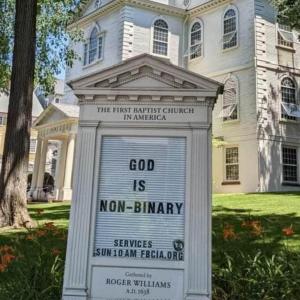
I suppose that “God is Trans” might have been more provocative, but not much. First, note the church in question. Thousands of towns in this country have a “First Baptist Church,” simply the first Baptist church to show up in that town historically (followed frequently by “Second Baptist” and so on). But there is only one “First Baptist Church in America,” and it is located downtown in my city of Providence, Rhode Island.
Notice what the sign says at the bottom: “Gathered by Roger Williams A.D. 1638.” Roger Williams founded the colony of Rhode Island after being thrown out of the Massachusetts Bay Colony to the north as a heretic for believing and preaching such uncomfortable truths as that indigenous people need not convert to Christianity to go to heaven, but need simply to follow their own religious traditions faithfully. The church he founded is the first Baptist church founded in America—hence its name. Providence has been a place for outsiders and rejects ever since its founding.
Persons who identify as “non-binary,” among other things, reject the gender binary that all people are one of two genders, female or male, woman or man. Although there are many pronouns that a non-binary person might prefer others to use when referring to them, one possible way is with the pronouns “they/them/their” rather than the traditional “he/him/his” or “she/her/hers.” The matter of appropriate pronouns is, of course, politically and socially charged—an issue that I do not choose to jump into here other than to clearly state that the appropriate referring pronouns for a person are for that person to choose and specify, not someone else. I might also add that even with this commitment, I find the use of chosen pronouns to be challenging, simply because I am a late baby boomer and old habits die hard.
I am inclined to think that if one cannot avoid referring to what is greater than us with pronouns, “they, them, theirs” is more appropriate than traditional binary options. After all, the sacred texts themselves are not particularly helpful here. God is frequently referred to with plural nouns in the Hebrew scriptures, and some of the names for God are feminine. “They” also seems to catch something important when considering the Trinity.
Our traditional choice to refer to what is greater than us as if God is male is a choice fashioned by patriarchal culture and hierarchy more than by the text. Insisting that God must fit into our traditional and familiar human gender categories is a striking example of what Montaigne is warning against. This example is particularly striking when we come to realize that these gender binary terms don’t even satisfactorily describe the complexities of human experience, let alone what is greater than us.
The marquee sign in front the First Baptist Church in America was both deliberately controversial and an important reminder that when speaking of what is greater than us, we cannot confidently assume that our limited language is ever complete or even partially correct. The next time you are tempted to refer to God within traditional language categories, try something different. Try “Parent, Sibling, and Advocate” for the Trinity. Try “that which is greater than us” or “the Divine.” Or try “They/Them/Theirs.” I dare you.
Previous Post

July 27, 2025
We Are Not Special
Next Post

July 31, 2025 Do My Masculine and Feminine Side Like Each Other?
Recent Comments
"Mary did have a choice. And she was able to make it before the Holy ..."
"i cannot read beyond your recommendations for the books since i like to have a ..."
"AI will never be able to utter with honesty, feeling, or humility, the greeting: "Namaste".It ..."
"They do. I'm sure you could find discussions of the same topic from any of ..."
Browse Our Archives
Select a Category abortion Advent AI Angels Artificial intelligence atheism attention baptism Baptists beauty belief Benedictines Bible bicycling Big Bird books Bovina Camaldoli hermitage Canada Catholicism cats certainty change Christianity Christmas Collegeville Covid-19 creativity Development of Western Civilization dogs doubt Easter Enneagram Epiphany Episcopal ethics Eucharist evil extroverts Facebook faith family fear flowers forgiveness freedom friends God goodness grace happiness heaven hell history Holy Spirit Holy Week hope human nature humility humor idolatry incarnation introverts irreverence Islam Jeanne Jesus Joe Biden joy Judaism justice Kamala Harris knowledge Lent listen literature liturgy love Marsue Memorial Day miracles movies music mystery mythology NPR Old Testament optimism paradox peace Penguins philosophy piano podcast politics power prayer Protestantism Providence College Religion Rhode Island sabbatical sacrament science seeing silence Simone Weil Socrates soul sports St. John's College stories suffering tattoo teaching technology television theology thinking time tolerance transcendence travel trees trust truth Uncategorized Vermont wisdom wonder writing
Select a Month May 2026 April 2026 March 2026 February 2026 January 2026 December 2025 November 2025 October 2025 September 2025 August 2025 July 2025 June 2025 May 2025 April 2025 March 2025 February 2025 January 2025 December 2024 November 2024 October 2024 September 2024 August 2024 July 2024 June 2024 May 2024 April 2024 March 2024 February 2024 January 2024 December 2023 November 2023 October 2023 September 2023 August 2023 July 2023 June 2023 May 2023 April 2023 March 2023 February 2023 January 2023 December 2022 November 2022 October 2022 September 2022 August 2022 July 2022 June 2022 May 2022 April 2022 March 2022 February 2022 January 2022 December 2021 November 2021 October 2021 September 2021 August 2021 July 2021 June 2021 May 2021 April 2021 March 2021 February 2021 January 2021 December 2020 November 2020 October 2020 September 2020 August 2020 July 2020 June 2020 May 2020 April 2020 March 2020 February 2020 January 2020 December 2019 November 2019 October 2019 September 2019 August 2019 July 2019 June 2019 May 2019 April 2019 March 2019 February 2019 January 2019 December 2018 November 2018 October 2018 September 2018 August 2018 July 2018 June 2018 May 2018 April 2018 March 2018 February 2018 January 2018 December 2017 November 2017 October 2017 September 2017 August 2017 July 2017 June 2017 May 2017 April 2017 March 2017 February 2017 January 2017 December 2016 November 2016 October 2016 September 2016 August 2016 July 2016 June 2016 May 2016 April 2016 March 2016 February 2016 January 2016 December 2015 November 2015 October 2015 September 2015 August 2015 July 2015 June 2015 May 2015 April 2015 March 2015 February 2015 January 2015 December 2014 November 2014 October 2014 September 2014 August 2014 July 2014 June 2014 May 2014 April 2014 March 2014 February 2014 January 2014 December 2013 November 2013 October 2013 September 2013 August 2013 July 2013 June 2013 May 2013 April 2013 March 2013 February 2013 January 2013 December 2012 November 2012 October 2012 September 2012
Follow Us!
TAKE THE
Religious Wisdom Quiz
What was the main language spoken by Jews during Jesus’ time?
Select your answer to see how you score.
Aramaic Latin Greek Hebrew
Books by This Author Books by Vance G. Morgan
Related posts from Freelance Christianity

The Lonely Pawn: On Faith, Doubt, and Meaning


AI and Love: When a Chatbot Becomes a...

TRENDING AT PATHEOS Progressive Christian

What Being a Modern-Day Apostle Means to Me
In my last column, I discussed the ins and outs of modern-day...

Did Ancient China Once Worship the God of...
Across human history, a common thread weaves through the origins of the...

Love Your Neighbor – Including Earth-Kin: Lev. 19,...
God’s command to love your neighbor means acting in an ethical and...

Lead a Church Study of “Jesus and Lao...
Guest writer Jack Thomas (The Irreverent Reverend) reflects on leading his church...

Pastoral Wisdom for Responding to Sermon Pushback
Getting sermon pushback on your social justice sermon? Learn practical, Proverbs-based strategies...

Principles for Understanding the Apostolic Ministry Today
Whenever people discover that my formal ministry title is "apostle," as in...
view all Progressive Christian blogs
What Are Your Thoughts?leave a comment
Ad-Free & Subscriber Log-In Subscription Support
- About Us
- 2026 Calendar
- Videos
- Podcasts
- Library of World Religions
- Faith In Media Tracker
- Advertise With Us
- Write for Us
- Privacy Policy
- Terms of Service
- Do Not Sell My Data
- Contact Us
- Radiant Digital
- Manage Newsletter Subscriptions
- Unsubscribe From Notifications
- Sitemap
Copyright 2008-2026, Patheos. All rights reserved.
Subscription Support Ad-Free & Subscriber Log-In
Follow Patheos