
BuddhistCatholicContemplativeEvangelicalGeneral ChristianHinduJewishLatter-day SaintMuslimNew VisionsProgressive Christian
Beliefs
- Buddhist
- Catholic
- Contemplative
- Evangelical
- General Christian
- Hindu
- Jewish
- Latter-day Saint
- More Voices
- Muslim
- New Visions
- Pagan
- Progressive Christian
Topics
- Religion News
- Food and Religion
- Sports and Religion
- Religious Art
- Religious Music and Entertainment
- Religious Events
- History and Religion
- Style and Religion
- Politics and Religion
- Women in Religion
- Recreation Outdoors and Religion
- Business Finance and Religion
- Careers Workplace and Religion
- Education and Religion
- Family Parenting and Religion
- Health Fitness and Religion
- Home and Religion
- Relationships and Religion
- Technology and Religion
- Travel and Religion
Columnists
- Buddhist Columnists
- Business Finance and Religion Columnists
- Careers Workplace and Religion Columnists
- Catholic Columnists
- Contemplative Columnists
- Education and Religion Columnists
- Evangelists Columnists
- Family Parenting and Religion Columnists
- General Christian Columnists
- Health Fitness and Religion Columnists
- Hindu Columnists
- History and Religion Columnists
- Home and Religion Columnists
- Jewish Columnists
- More Voices Columnists
- Latter Day Columnists
- Muslim Columnists
- New Visions Columnists
- Nonreligious Columnists
- Pagan Columnists
- Politics and Religion Columnists
- Progressive Columnists
- Recreation Outdoors and Religion Columnists
- Relationships and Religion Columnists
- Religion News Columnists
- Religious Art Columnists
- Religious Events Columnists
- Religious Music and Entertainment Columnists
- Sports and Religion Columnists
- Style and Religion Columnists
- Technology and Religion Columnists
- Travel and Religion Columnists
- Women in Religion Columnists
Resource Library
- 2026 Calendar
- Library of World Religions
- The 100 Most Holy Places on Earth
- Patheos Answers
- Podcasts
- Videos
- Faith Leaders Database
- Anglican Episcopalian
- Bahai
- Baptist
- Buddhism
- Christianity
- Confucianism
- Eastern Orthodoxy
- Hinduism
- Holiness and Pentecostal
- ISKCON
- Islam
- Judaism
- Lutheran
- Methodist
- The Church of Jesus Christ of Latter-day Saints
- New Age
- Paganism
- Presbytarian and Reformed
- Protestantism
- Religion Behind the Scenes
- Roman Catholic
- Scientology
- Shia Islam
- Sikhism
- Sufism
- Sunni Islam
- Taoism
- Zen
- See all religions
Research Tools
 Ad-Free & Subscriber Log-In Subscription Support
Ad-Free & Subscriber Log-In Subscription Support
Follow Patheos 

- Trending:
- Forgiveness
- |
- Marriage
- |
- Consciousness
- |
- Death Penalty
- |
- Election
- |
- Halloween

- Home
- Progressive Christian
- God Finds Us to be Infinitely Interesting
God Finds Us to be Infinitely Interesting
Last updated on: March 26, 2024 at 6:00 am by Vance Morgan
God Finds Us to be Infinitely Interesting 2024-03-24T16:49:05-04:00 Vance Morgan
Patheos Explore the world's faith through different perspectives on religion and spirituality! Patheos has the views of the prevalent religions and spiritualities of the world.
April is going to be Marilynne Robinson month for me. In the team taught interdisciplinary program I teach in, I will be giving a lecture on two of her essays followed a few days later by a seminar on her Pulitzer Prize winning novel Gilead. A week later I have the privilege of being one of four colleagues involved in a continuing series on campus called “Women in Philosophy.” In past semesters I have presented on Simone Weil and Iris Murdoch; Robinson is my contribution this year. To cap it off, I just found out a couple of days ago I will be teaching one of my favorite courses, “Contemporary Women in Philosophy,” in Spring 2025 for the first time in seven years. Weil, Murdoch, and Robinson are the centerpieces of my syllabus for that course.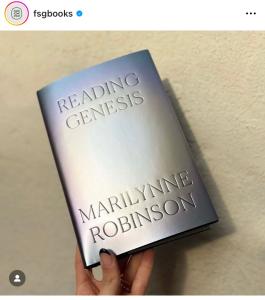
Robinson’s latest book, Reading Genesis, was published this month—I just started reading it a few days ago. As I expected I would, I love it. Robinson’s theology is Protestant to the core, specifically influenced by John Calvin. Calvinism has a reputation for having a low opinion of human beings, considering us to be “totally depraved” by nature and incapable of contributing anything to our salvation. So it is always a pleasant surprise when reading Robinson to discover once again her continuing theme that human beings are far more valuable by nature than certain religious assumptions might indicate. She describes Calvin as someone who everyone criticizes and whom no one has read. In Gilead, her main character Reverand John Ames says this:
Calvin says somewhere that each of us is an actor on a stage and God is the audience. That metaphor has always interested me, because it makes us artists of our behavior, and the reaction of God to us might be thought of as aesthetic rather than morally judgmental in the ordinary sense. How well do we understand our role? With how much assurance do we perform it? . . . We all bring such light to bear on these great matters as we can. I do like Calvin’s image, though, because it suggests how God might actually enjoy us.
I can’t overestimate the influence that this passage had on me the first time I read Gilead many years ago. The notion of a God who enjoys me rather than judges me was a game changer.
In the middle of Holy Week, the following from Robinson’s essay “Limitation” is well worth considering:
So let us say Christ entered the world as essential truth, cosmic truth mediated to us in a form presumably most accessible to us, a human presence, a human life. That he should have done so is an absolute statement of our value, which we have always done so much to obscure.
The traditional Christian story is that the divine choice to become human was a commitment to diminishment, to descent, to degradation in the interest of offering salvation for depraved humanity. Marilynne Robinson’s reading of the gospels leads her to a different insight.
How does such a being live in the world? If his divine nature is granted, what shape and content will it impart to his singular, mortal life? . . . In what human form can the divine be wholly present without violating the conditions of human existence? A very ordinary life, it would seem . . . If God did become a human being, then it seems reasonable to suppose that the word “human” must be understood in the largest sense. Our ancient habit of celebrating the glory of God has tended to obscure the fact that, in the Incarnation, it was not glory he chose, except as it is inherent in all humanity.
And in her essay “Son of Adam, Son of God,” Robinson reflects on what the Incarnation says about the value of humanity.
[Jesus] participates profoundly in human life without any compromise of his divine nature. This is an extraordinary statement about the nature of human life . . . It is surely among the mysteries of Incarnation that Jesus could take on human language as well as human flesh, and that he could find it suited to his uses . . . It is possible to claim a dignity for humankind that is assured because it is bestowed on us, that is, because it is beyond even our formidable powers to besmirch and destroy.
The foundational expression of God’s love for humanity—the Incarnation—is an expression both of divine love and of human worth.
The above is the story of Christianity, but Marilynne Robinson finds the same divine commitment to human value in Reading Genesis, a reflection on the first book of the Jewish scriptures. Robinson opens the book with some comparisons between Genesis and other seminal creation texts from the same time period that reveal various similarities.
One of the significant differences, however, is what we learn about divine attitudes toward human beings in the opening chapters of Genesis. While in other creation myths the gods have specific uses for the new human beings that they have created, the creator in Genesis has no such preconceptions. “The God of Genesis is unique in his having not a use but instead a mysterious benign intention for human beings.” Human beings are created in the divine image, although theologians to this day do not agree on what that means. At the very least, Robinson says, “the centrality of humankind in the creation myth of Genesis is from the beginning an immeasurable elevation of status,” a centrality that continues throughout the text.
Robinson also positions herself in the early pages of Reading Genesis on the fraught issue of authorship. Those raised in more conservative Protestant communities as I was are familiar with claims that “divine inspiration” means that the human authors of scripture were little more than scribes taking divine dictation. Modern textual criticism indicates that the text was compiled by multiple human authors over several centuries. Either way, Robinson observes, the trace of the human serpent is woven throughout the text. “The Bible itself indicates no anxiety about association with human minds, words, lives, and passions. This is a notable instance of our having a lower opinion of ourselves than the Bible justifies.”
I often tell my students that by far the most interesting philosophical topic is human beings. One of the central features of Marilynne Robinson’s thought is that the divine also considers us to be infinitely interesting.
Previous Post

March 24, 2024
Kicking Off Holy Week: "I'll be Jesus"
Next Post

March 28, 2024 Could You Not Watch With Me One Hour?
Recent Comments
"Mary did have a choice. And she was able to make it before the Holy ..."
"i cannot read beyond your recommendations for the books since i like to have a ..."
"AI will never be able to utter with honesty, feeling, or humility, the greeting: "Namaste".It ..."
"They do. I'm sure you could find discussions of the same topic from any of ..."
Browse Our Archives
Select a Category abortion Advent AI Angels Artificial intelligence atheism attention baptism Baptists beauty belief Benedictines Bible bicycling Big Bird books Bovina Camaldoli hermitage Canada Catholicism cats certainty change Christianity Christmas Collegeville Covid-19 creativity Development of Western Civilization dogs doubt Easter Enneagram Epiphany Episcopal ethics Eucharist evil extroverts Facebook faith family fear flowers forgiveness freedom friends God goodness grace happiness heaven hell history Holy Spirit Holy Week hope human nature humility humor idolatry incarnation introverts irreverence Islam Jeanne Jesus Joe Biden joy Judaism justice Kamala Harris knowledge Lent listen literature liturgy love Marsue Memorial Day miracles movies music mystery mythology NPR Old Testament optimism paradox peace Penguins philosophy piano podcast politics power prayer Protestantism Providence College Religion Rhode Island sabbatical sacrament science seeing silence Simone Weil Socrates soul sports St. John's College stories suffering tattoo teaching technology television theology thinking time tolerance transcendence travel trees trust truth Uncategorized Vermont wisdom wonder writing
Select a Month May 2026 April 2026 March 2026 February 2026 January 2026 December 2025 November 2025 October 2025 September 2025 August 2025 July 2025 June 2025 May 2025 April 2025 March 2025 February 2025 January 2025 December 2024 November 2024 October 2024 September 2024 August 2024 July 2024 June 2024 May 2024 April 2024 March 2024 February 2024 January 2024 December 2023 November 2023 October 2023 September 2023 August 2023 July 2023 June 2023 May 2023 April 2023 March 2023 February 2023 January 2023 December 2022 November 2022 October 2022 September 2022 August 2022 July 2022 June 2022 May 2022 April 2022 March 2022 February 2022 January 2022 December 2021 November 2021 October 2021 September 2021 August 2021 July 2021 June 2021 May 2021 April 2021 March 2021 February 2021 January 2021 December 2020 November 2020 October 2020 September 2020 August 2020 July 2020 June 2020 May 2020 April 2020 March 2020 February 2020 January 2020 December 2019 November 2019 October 2019 September 2019 August 2019 July 2019 June 2019 May 2019 April 2019 March 2019 February 2019 January 2019 December 2018 November 2018 October 2018 September 2018 August 2018 July 2018 June 2018 May 2018 April 2018 March 2018 February 2018 January 2018 December 2017 November 2017 October 2017 September 2017 August 2017 July 2017 June 2017 May 2017 April 2017 March 2017 February 2017 January 2017 December 2016 November 2016 October 2016 September 2016 August 2016 July 2016 June 2016 May 2016 April 2016 March 2016 February 2016 January 2016 December 2015 November 2015 October 2015 September 2015 August 2015 July 2015 June 2015 May 2015 April 2015 March 2015 February 2015 January 2015 December 2014 November 2014 October 2014 September 2014 August 2014 July 2014 June 2014 May 2014 April 2014 March 2014 February 2014 January 2014 December 2013 November 2013 October 2013 September 2013 August 2013 July 2013 June 2013 May 2013 April 2013 March 2013 February 2013 January 2013 December 2012 November 2012 October 2012 September 2012
Follow Us!
TAKE THE
Religious Wisdom Quiz
I challenged 450 prophets to call down fire from heaven, and theirs failed while mine consumed everything. Who am I?
Select your answer to see how you score.
Moses Elijah Samuel Elisha
Books by This Author Books by Vance G. Morgan
Related posts from Freelance Christianity

The Lonely Pawn: On Faith, Doubt, and Meaning


AI and Love: When a Chatbot Becomes a...

TRENDING AT PATHEOS Progressive Christian

Why Christians Have a Sacred Duty to Vote:...
The Bible offers strong support for the sacred duty to vote. Here...

What Being a Modern-Day Apostle Means to Me
In my last column, I discussed the ins and outs of modern-day...

Did Ancient China Once Worship the God of...
Across human history, a common thread weaves through the origins of the...

Love Your Neighbor – Including Earth-Kin: Lev. 19,...
God’s command to love your neighbor means acting in an ethical and...

Lead a Church Study of “Jesus and Lao...
Guest writer Jack Thomas (The Irreverent Reverend) reflects on leading his church...

Principles for Understanding the Apostolic Ministry Today
Whenever people discover that my formal ministry title is "apostle," as in...
view all Progressive Christian blogs
What Are Your Thoughts?leave a comment
Ad-Free & Subscriber Log-In Subscription Support
- About Us
- 2026 Calendar
- Videos
- Podcasts
- Library of World Religions
- Faith In Media Tracker
- Advertise With Us
- Write for Us
- Privacy Policy
- Terms of Service
- Do Not Sell My Data
- Contact Us
- Radiant Digital
- Manage Newsletter Subscriptions
- Unsubscribe From Notifications
- Sitemap
Copyright 2008-2026, Patheos. All rights reserved.
Subscription Support Ad-Free & Subscriber Log-In
Follow Patheos