
BuddhistCatholicContemplativeEvangelicalGeneral ChristianHinduJewishLatter-day SaintMuslimNew VisionsProgressive Christian
Beliefs
- Buddhist
- Catholic
- Contemplative
- Evangelical
- General Christian
- Hindu
- Jewish
- Latter-day Saint
- More Voices
- Muslim
- New Visions
- Pagan
- Progressive Christian
Topics
- Religion News
- Food and Religion
- Sports and Religion
- Religious Art
- Religious Music and Entertainment
- Religious Events
- History and Religion
- Style and Religion
- Politics and Religion
- Women in Religion
- Recreation Outdoors and Religion
- Business Finance and Religion
- Careers Workplace and Religion
- Education and Religion
- Family Parenting and Religion
- Health Fitness and Religion
- Home and Religion
- Relationships and Religion
- Technology and Religion
- Travel and Religion
Columnists
- Buddhist Columnists
- Business Finance and Religion Columnists
- Careers Workplace and Religion Columnists
- Catholic Columnists
- Contemplative Columnists
- Education and Religion Columnists
- Evangelists Columnists
- Family Parenting and Religion Columnists
- General Christian Columnists
- Health Fitness and Religion Columnists
- Hindu Columnists
- History and Religion Columnists
- Home and Religion Columnists
- Jewish Columnists
- More Voices Columnists
- Latter Day Columnists
- Muslim Columnists
- New Visions Columnists
- Nonreligious Columnists
- Pagan Columnists
- Politics and Religion Columnists
- Progressive Columnists
- Recreation Outdoors and Religion Columnists
- Relationships and Religion Columnists
- Religion News Columnists
- Religious Art Columnists
- Religious Events Columnists
- Religious Music and Entertainment Columnists
- Sports and Religion Columnists
- Style and Religion Columnists
- Technology and Religion Columnists
- Travel and Religion Columnists
- Women in Religion Columnists
Resource Library
- 2026 Calendar
- Library of World Religions
- The 100 Most Holy Places on Earth
- Patheos Answers
- Podcasts
- Videos
- Faith Leaders Database
- Anglican Episcopalian
- Bahai
- Baptist
- Buddhism
- Christianity
- Confucianism
- Eastern Orthodoxy
- Hinduism
- Holiness and Pentecostal
- ISKCON
- Islam
- Judaism
- Lutheran
- Methodist
- The Church of Jesus Christ of Latter-day Saints
- New Age
- Paganism
- Presbytarian and Reformed
- Protestantism
- Religion Behind the Scenes
- Roman Catholic
- Scientology
- Shia Islam
- Sikhism
- Sufism
- Sunni Islam
- Taoism
- Zen
- See all religions
Research Tools
 Ad-Free & Subscriber Log-In Subscription Support
Ad-Free & Subscriber Log-In Subscription Support
Follow Patheos 

- Trending:
- Forgiveness
- |
- Marriage
- |
- Consciousness
- |
- Death Penalty
- |
- Election
- |
- Halloween

- Home
- Progressive Christian
- Four Things to Remember
Four Things to Remember
Last updated on: June 26, 2017 at 1:35 pm by Vance Morgan
Four Things to Remember 2017-06-26T13:35:19-04:00 Vance Morgan
Patheos Explore the world's faith through different perspectives on religion and spirituality! Patheos has the views of the prevalent religions and spiritualities of the world.
 My past several reading weeks have been spent, for the most part, with Chief Inspector Armand Gamache, head of the homicide division of the Sûreté du Québec, Québec’s provincial police force. He’s just about my age (maybe four or five years younger), loves solving puzzles, poetry, good food, his wife, and the many inspectors and police officers who work for him. I wish I had met Armand before I spent four years directing a large academic program, since I could have learned a lot from him about how to lead people who don’t always think they need direction. I have only known Armand for a couple of months—the amount of time it took me to read the first ten volumes in Louise Penny’s Chief Inspector Gamache mystery series, set in Three Pines, Québec, just a few dozen miles away from where I grew up in northern Vermont.
Gamache takes his position as a mentor for younger and less experienced officers very seriously, often imparting wisdom in a deliberate manner more appropriate to a professor than to a policeman. Penny takes her time filling us in on the back stories of her twenty or so repeating characters—Gamache is no exception. In one of the early books we learn of some unsolicited but crucially important advice that he received in almost mythic fashion from an old fisherman in a northern Québec diner early in his career. Each of Gamache’s protégé’s in turn have received this advice—four statements that every aspiring inspector should take to heart. “Get used to saying each of these on a regular basis and meaning it,” the old fisherman said.
I don’t know
I was wrong
I’m sorry
I need help
I suspect that the old fisherman’s advice is applicable to more than inspectors.
I Don’t Know. Many people believe that college professors think they know everything. I’m here to tell you that there are a few who actually would be surprised to discover that they don’t know everything. But for the most part, the academic life is one guaranteed to let you know on a daily basis just how much you don’t know. Twenty years ago, as a new, untenured assistant professor, I was invited to participate in a panel discussion of Pope John Paul II’s encyclical Fides et Ratio. The format was to begin with two twenty-minute papers—one by a theologian, one by a philosopher—then a discussion of the papers by a panel of four colleagues (two each from philosophy and theology). I got to do the lead twenty-minute philosophy paper. I was mildly (I thought) critical of some aspects of the encyclical, something that did not fly with many of those present, particularly the dozens of parishioners from the Catholic church across the street who were in attendance.
During the question and answer period after the panel discussion, a guy in the front row directed the first question to me. “Dr. Morgan,” the fellow asked, “is there no room in philosophy for humility?” I responded to his question in a way I never had before and never have since—I laughed. “Yes, sir, there is plenty of room for humility in philosophy,” I answered. “The longer I do this, the more I realize on a daily basis how much I don’t know.” For more than twenty-five years, my primary goal in the classroom has been to help my students realize that certainty is highly overrated and that lifetime learning demands a consistent awareness that no one knows everything (or even that much). As Hamlet told his friend, “There are more things in heaven and earth, Horatio, than are dreamed of in your philosophy.”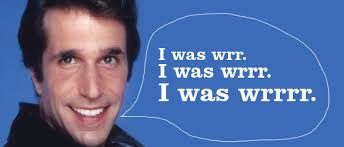
I Was Wrong. For someone whose father, like the Fonz from Happy Days, could hardly even pronounce the worlds “I was wrong,” I do okay with this one. I had great fun when my sons were little trying to convince them that I am always right. This, of course, set them on a quest to catch me being wrong about something—I managed to sustain the illusion of God-like rectitude for a few weeks, but only by practicing my obfuscation and logic-bending skills on a regular basis. I wasn’t that good at it—I have some colleagues in my department who are still convinced of their infallibility in their fifties and sixties, in the face of regular and overwhelming evidence to the contrary. Makes for interesting department meetings.
I’m Sorry. I’m not sure how someone who can’t say “I’m sorry” without having a nervous breakdown can survive a marriage, parenthood, the workplace, friendships, a trip to the supermarket, or getting out of bed in the morning.
I Need Help. My dachshund Frieda, who is about fifteen inches long, has slept with Jeanne and me in bed every night we have been home for the past ten years. The going-to-bed routine is always the same. Frieda does not want to simply be picked up and deposited on the queen-sized bed that she cannot jump on herself. She first stands on her hind legs leaning against the bed hopping on her hind feet (each jump clears the floor by about one inch). She wants to do it herself. When a human grabs her around her portly middle to lift her up,  she makes one final great leap to assist the transfer. I’m sure Frieda is convinced that given enough time she could complete the impossible task of getting into bed by herself. She got that from me.
When I mentioned to Jeanne the topic of this essay (she has also read all of Penny’s Gamache series), I asked her which of the four statements she has the most trouble with. After a bit of thought, she told me; before she could say anything more, I said “my problem statement is ‘I need help.” “Obviously,” she replied. “I deal with your wanting to do everything yourself on a daily basis.” And she does. My general commitment to doing things by myself is not principled in the sense that I go around saying “If you want to get something done right, do it yourself” all the time. I’m not even a big fan of the American individualist stereotype. But somewhere early on, probably from my mother, I developed the habit of accomplishing as many tasks as possible by myself, rather than inviting others to work on the tasks with me.
For this reason, I hated group projects as a student, which is probably why I—in contrast to many of my professor colleagues—assign very few group projects as a teacher. I never wanted to put my grade for any assignment at risk by turning a portion of it over to some random hoi polloi member of my group. The idea of co-writing an article or book is about as attractive to me as root canal without anesthesia.  This resistance to admitting that I can’t do everything myself influenced my day-to-day activities directing a large academic program for four years as well. Several weeks ago I ran into the secretary of the academic program and asked her how things were going with the new director. “Oh, things are fine” she said—“but I had no idea how much you did by yourself when you were director.” Apparently the new director is delegating portions of regular tasks such as scheduling and event planning, tasks that I did by myself when I was director, to the program secretary. Wish I had thought of that.
Incomplete knowledge, imperfect behavior, and a frequent need for the support of others—sounds like a human being to me. Remembering the Chief Inspector’s four statements might help remind us that, above all else, we are human.
Development of Western Civilization
Development of Western Civilization
Previous Post

May 27, 2016
Je me souviens Québec
Next Post
June 3, 2016 A REAL Philosopher
Browse Our Archives
Select a Category abortion Advent AI Angels Artificial intelligence atheism attention baptism Baptists beauty belief Benedictines Bible bicycling Big Bird books Bovina Camaldoli hermitage Canada Catholicism cats certainty change Christianity Christmas Collegeville Covid-19 creativity Development of Western Civilization dogs doubt Easter Enneagram Epiphany Episcopal ethics Eucharist evil extroverts Facebook faith family fear flowers forgiveness freedom friends God goodness grace happiness heaven hell history Holy Spirit Holy Week hope human nature humility humor idolatry incarnation introverts irreverence Islam Jeanne Jesus Joe Biden joy Judaism justice Kamala Harris knowledge Lent listen literature liturgy love Marsue Memorial Day miracles movies music mystery mythology NPR Old Testament optimism paradox peace Penguins philosophy piano podcast politics power prayer Protestantism Providence College Religion Rhode Island sabbatical sacrament science seeing silence Simone Weil Socrates soul sports St. John's College stories suffering tattoo teaching technology television theology thinking time tolerance transcendence travel trees trust truth Uncategorized Vermont wisdom wonder writing
Select a Month May 2026 April 2026 March 2026 February 2026 January 2026 December 2025 November 2025 October 2025 September 2025 August 2025 July 2025 June 2025 May 2025 April 2025 March 2025 February 2025 January 2025 December 2024 November 2024 October 2024 September 2024 August 2024 July 2024 June 2024 May 2024 April 2024 March 2024 February 2024 January 2024 December 2023 November 2023 October 2023 September 2023 August 2023 July 2023 June 2023 May 2023 April 2023 March 2023 February 2023 January 2023 December 2022 November 2022 October 2022 September 2022 August 2022 July 2022 June 2022 May 2022 April 2022 March 2022 February 2022 January 2022 December 2021 November 2021 October 2021 September 2021 August 2021 July 2021 June 2021 May 2021 April 2021 March 2021 February 2021 January 2021 December 2020 November 2020 October 2020 September 2020 August 2020 July 2020 June 2020 May 2020 April 2020 March 2020 February 2020 January 2020 December 2019 November 2019 October 2019 September 2019 August 2019 July 2019 June 2019 May 2019 April 2019 March 2019 February 2019 January 2019 December 2018 November 2018 October 2018 September 2018 August 2018 July 2018 June 2018 May 2018 April 2018 March 2018 February 2018 January 2018 December 2017 November 2017 October 2017 September 2017 August 2017 July 2017 June 2017 May 2017 April 2017 March 2017 February 2017 January 2017 December 2016 November 2016 October 2016 September 2016 August 2016 July 2016 June 2016 May 2016 April 2016 March 2016 February 2016 January 2016 December 2015 November 2015 October 2015 September 2015 August 2015 July 2015 June 2015 May 2015 April 2015 March 2015 February 2015 January 2015 December 2014 November 2014 October 2014 September 2014 August 2014 July 2014 June 2014 May 2014 April 2014 March 2014 February 2014 January 2014 December 2013 November 2013 October 2013 September 2013 August 2013 July 2013 June 2013 May 2013 April 2013 March 2013 February 2013 January 2013 December 2012 November 2012 October 2012 September 2012
Follow Us!
TAKE THE
Religious Wisdom Quiz
I was beautiful and cunning, leading a rebellion against my father by stealing the hearts of Israel. Who am I?
Select your answer to see how you score.
Absalom Adonijah Solomon Amnon
Books by This Author Books by Vance G. Morgan
Related posts from Freelance Christianity

The Lonely Pawn: On Faith, Doubt, and Meaning


AI and Love: When a Chatbot Becomes a...

TRENDING AT PATHEOS Progressive Christian

What Being a Modern-Day Apostle Means to Me
In my last column, I discussed the ins and outs of modern-day...

Did Ancient China Once Worship the God of...
Across human history, a common thread weaves through the origins of the...

Love Your Neighbor – Including Earth-Kin: Lev. 19,...
God’s command to love your neighbor means acting in an ethical and...

Lead a Church Study of “Jesus and Lao...
Guest writer Jack Thomas (The Irreverent Reverend) reflects on leading his church...

Pastoral Wisdom for Responding to Sermon Pushback
Getting sermon pushback on your social justice sermon? Learn practical, Proverbs-based strategies...

Principles for Understanding the Apostolic Ministry Today
Whenever people discover that my formal ministry title is "apostle," as in...
view all Progressive Christian blogs
Ad-Free & Subscriber Log-In Subscription Support
- About Us
- 2026 Calendar
- Videos
- Podcasts
- Library of World Religions
- Faith In Media Tracker
- Advertise With Us
- Write for Us
- Privacy Policy
- Terms of Service
- Do Not Sell My Data
- Contact Us
- Radiant Digital
- Manage Newsletter Subscriptions
- Unsubscribe From Notifications
- Sitemap
Copyright 2008-2026, Patheos. All rights reserved.
Subscription Support Ad-Free & Subscriber Log-In
Follow Patheos