
BuddhistCatholicContemplativeEvangelicalGeneral ChristianHinduJewishLatter-day SaintMuslimNew VisionsProgressive Christian
Beliefs
- Buddhist
- Catholic
- Contemplative
- Evangelical
- General Christian
- Hindu
- Jewish
- Latter-day Saint
- More Voices
- Muslim
- New Visions
- Pagan
- Progressive Christian
Topics
- Religion News
- Food and Religion
- Sports and Religion
- Religious Art
- Religious Music and Entertainment
- Religious Events
- History and Religion
- Style and Religion
- Politics and Religion
- Women in Religion
- Recreation Outdoors and Religion
- Business Finance and Religion
- Careers Workplace and Religion
- Education and Religion
- Family Parenting and Religion
- Health Fitness and Religion
- Home and Religion
- Relationships and Religion
- Technology and Religion
- Travel and Religion
Columnists
- Buddhist Columnists
- Business Finance and Religion Columnists
- Careers Workplace and Religion Columnists
- Catholic Columnists
- Contemplative Columnists
- Education and Religion Columnists
- Evangelists Columnists
- Family Parenting and Religion Columnists
- General Christian Columnists
- Health Fitness and Religion Columnists
- Hindu Columnists
- History and Religion Columnists
- Home and Religion Columnists
- Jewish Columnists
- More Voices Columnists
- Latter Day Columnists
- Muslim Columnists
- New Visions Columnists
- Nonreligious Columnists
- Pagan Columnists
- Politics and Religion Columnists
- Progressive Columnists
- Recreation Outdoors and Religion Columnists
- Relationships and Religion Columnists
- Religion News Columnists
- Religious Art Columnists
- Religious Events Columnists
- Religious Music and Entertainment Columnists
- Sports and Religion Columnists
- Style and Religion Columnists
- Technology and Religion Columnists
- Travel and Religion Columnists
- Women in Religion Columnists
Resource Library
- 2026 Calendar
- Library of World Religions
- The 100 Most Holy Places on Earth
- Patheos Answers
- Podcasts
- Videos
- Faith Leaders Database
- Anglican Episcopalian
- Bahai
- Baptist
- Buddhism
- Christianity
- Confucianism
- Eastern Orthodoxy
- Hinduism
- Holiness and Pentecostal
- ISKCON
- Islam
- Judaism
- Lutheran
- Methodist
- The Church of Jesus Christ of Latter-day Saints
- New Age
- Paganism
- Presbytarian and Reformed
- Protestantism
- Religion Behind the Scenes
- Roman Catholic
- Scientology
- Shia Islam
- Sikhism
- Sufism
- Sunni Islam
- Taoism
- Zen
- See all religions
Research Tools
 Ad-Free & Subscriber Log-In Subscription Support
Ad-Free & Subscriber Log-In Subscription Support
Follow Patheos 

- Trending:
- Forgiveness
- |
- Marriage
- |
- Consciousness
- |
- Death Penalty
- |
- Election
- |
- Halloween

- Home
- Progressive Christian
- Flesh and Blood
Flesh and Blood
Last updated on: September 24, 2017 at 7:19 pm by Vance Morgan
Flesh and Blood 2017-09-24T19:19:58-04:00 Vance Morgan
Patheos Explore the world's faith through different perspectives on religion and spirituality! Patheos has the views of the prevalent religions and spiritualities of the world.
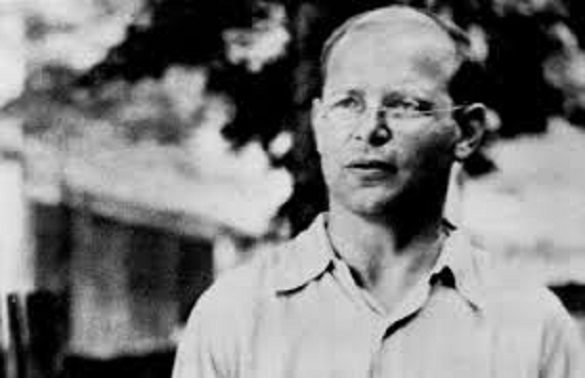
What is bothering me incessantly is the question of what Christianity really is, or indeed who Christ really is, for us today. The time when people could be told everything by means of words, whether theological or pious, is over, and so is the time of inwardness and conscience—and that means the time of religion in general. Dietrich Bonhoeffer, Letters from Prison
One day a couple of springs ago, I spent a day as an outside reviewer for the Liberal Arts Program at a Connecticut state university an hour or so west of Providence. I shared these duties with an assessment-guru administrator from a state university in Massachusetts; we are tasked with jointly producing a report of five or so pages within three weeks. I offered to get the report started by writing a rough draft over the weekend, since I would have a long weekend away from classes from Thursday through Monday. “Why do you have a long weekend?” my envious colleague wanted to know. Ahh, the joys of working on a Catholic college campus—I often forget that not everyone gets Easter Break.
Although I grew up in a world in which Easter was the biggest event of the year, I have never settled into a tradition concerning how to celebrate it. Church, of course, but a familiar space filled with people who only show up once a year is a bit odd. Everything seems forced and unnatural, as if everyone is thinking “we’re supposed to be doing something special for Jesus’ resurrection, but we aren’t sure what it is. So we’ll just do what we usually do, only bit longer and louder.” After going to the 8:00 service on that particular Easter, Jeanne and I celebrated by eating at “Not Your Average Joe’s” (their lettuce wraps and draft beers are outstanding) and went to see “Cinderella” (with Rose from “Downton Abbey” in the title role). Jeanne’s and my spiritual odysseys started at different poles and have evolved in different, perhaps opposite directions over time.
Jeanne was raised Catholic and resonates with many aspects of evangelical and charismatic Christianity, while I was raised evangelical, fundamentalist Baptist and find the vibrations of liturgical worship very attractive. It’s a good thing that our paths have a wide point of intersection, expressed very clearly by the passage at the beginning of this post written by Bonhoeffer in prison mere weeks before his execution by the Nazis. Who is Christ for us today? In less religious terms, what direct impact should our faith commitment have on how we live our lives together and individually?
Two of my courses have recently raised such questions in interesting ways. In “Grace, Truth and Freedom in the Nazi Era,” we studied the story of Le Chambon, an insignificant Protestant village in southeastern France that protected and saved thousands of Jewish refugees during the Nazi occupation in World War II. The spiritual leader and soul of the village, Andre Trocme, taught and exemplified an eminently practical and effective reading of the Gospels—they mean what they say. When asked about his motivations after the war, Trocme said
If Jesus really walked upon this earth, why do we keep treating him as if he were a disembodied, impossibly idealistic ethical theory? If he was a real man, then the Sermon on the Mount was made for people on this earth; and if he existed, God has shown us in flesh and blood what goodness is for flesh-and-blood people.
Around the same time, my “Markets and Morals” colloquium unexpectedly raised the question “How does a person of faith bring her or his values into a market that frequently runs contrary to such values?” Our text was Is the Market Moral?—a series of essays and responses by Rebecca Blank and William McGurn, two highly respected economists who happen to be very serious about their Christian faith but disagree sharply about how it should intersect with a secular market economy.At one point McGurn distinguishes between Christian faith as a guide for an individual life and as a model for social reform, a separation that contemporary Christians frequently make.
A frequent mistake in the social arena is to apply personal virtues to social contexts. To put it another way, our social virtues may complement our personal virtues, but they are not the same. Not least of the weaknesses in so-called “Christian” prescriptions for economic life is the idea that the gospels are somehow a policy platform, as though the Golden Rule can be simply legislated.
I brought these two very different spins on how one’s religious values might apply to one’s practical daily life to my two seminars for small group discussion. One seminar thought that McGurn’s dividing “personal” from “social” virtues is essentially a cop-out, a roadmap for excusing oneself from seeking to bring needed change into the market and other social arenas. The other seminar focused their negative energies on Trocme’s Sermon on the Mount commentary, labelling it as “naïve” and “unrealistic.” I suspect that the range of true possibilities lies somewhere between Trocme and McGurn.
So what’s a person of faith to do? The latest news cycle regularly provides glaring examples of what happens when presumably well-intentioned legislators are unable to tell the difference between protecting religious freedom against perceived threats from the government and opening the door to discrimination in the name of religious values. And about those values—it’s not as if professed Christians have much agreement about what they even are. The Christian faith that the owners of an Indiana pizzeria cite as the basis of their refusing to cater a same-sex wedding is the very Christian faith that many have relied on as they call attention to the resulting discrimination and less-than-Christ-like virtues being exhibited by the pizzeria owners and the advocates of the bill. Never has the separation of church and state looked so attractive from the perspective of both state and church.
Still, Rebecca Blank points out in Is the Market Moral? that a sharp separation between private and public is not an option for “Christians who believe that human beings cannot be whole without their most important institutions tethered in some acknowledgement to transcendent truth.” If my Christian faith is to be something more than a very interesting and complicated private hobby, a sharp separation of secular and sacred cannot be the order of the day. At the very least, Jesus’ annual emergence from the tomb back into the real world should remind the Christian that the Kingdom of Heaven is not a promise of a pleasant and problem-free afterlife, but is what the world, infused with the power of the Spirit and the energy of Christ-infused human beings, should be struggling toward now. Dietrich Bonhoeffer, waiting for his certain execution, captures it well.
Christians, unlike the devotees of the redemption myths, have no last line of escape available from earthly tasks and difficulties into the eternal . . . they must drink the earthly cup to the dregs, and only in their doing so is the crucified and risen Lord with them, and are they crucified and risen with Christ.
Previous Post

September 19, 2017
Chasing the Fog
Next Post
September 27, 2017 Naming Our Demons
Browse Our Archives
Select a Category abortion Advent AI Angels Artificial intelligence atheism attention baptism Baptists beauty belief Benedictines Bible bicycling Big Bird books Bovina Camaldoli hermitage Canada Catholicism cats certainty change Christianity Christmas Collegeville Covid-19 creativity Development of Western Civilization dogs doubt Easter Enneagram Epiphany Episcopal ethics Eucharist evil extroverts Facebook faith family fear flowers forgiveness freedom friends God goodness grace happiness heaven hell history Holy Spirit Holy Week hope human nature humility humor idolatry incarnation introverts irreverence Islam Jeanne Jesus Joe Biden joy Judaism justice Kamala Harris knowledge Lent listen literature liturgy love Marsue Memorial Day miracles movies music mystery mythology NPR Old Testament optimism paradox peace Penguins philosophy piano podcast politics power prayer Protestantism Providence College Religion Rhode Island sabbatical sacrament science seeing silence Simone Weil Socrates soul sports St. John's College stories suffering tattoo teaching technology television theology thinking time tolerance transcendence travel trees trust truth Uncategorized Vermont wisdom wonder writing
Select a Month May 2026 April 2026 March 2026 February 2026 January 2026 December 2025 November 2025 October 2025 September 2025 August 2025 July 2025 June 2025 May 2025 April 2025 March 2025 February 2025 January 2025 December 2024 November 2024 October 2024 September 2024 August 2024 July 2024 June 2024 May 2024 April 2024 March 2024 February 2024 January 2024 December 2023 November 2023 October 2023 September 2023 August 2023 July 2023 June 2023 May 2023 April 2023 March 2023 February 2023 January 2023 December 2022 November 2022 October 2022 September 2022 August 2022 July 2022 June 2022 May 2022 April 2022 March 2022 February 2022 January 2022 December 2021 November 2021 October 2021 September 2021 August 2021 July 2021 June 2021 May 2021 April 2021 March 2021 February 2021 January 2021 December 2020 November 2020 October 2020 September 2020 August 2020 July 2020 June 2020 May 2020 April 2020 March 2020 February 2020 January 2020 December 2019 November 2019 October 2019 September 2019 August 2019 July 2019 June 2019 May 2019 April 2019 March 2019 February 2019 January 2019 December 2018 November 2018 October 2018 September 2018 August 2018 July 2018 June 2018 May 2018 April 2018 March 2018 February 2018 January 2018 December 2017 November 2017 October 2017 September 2017 August 2017 July 2017 June 2017 May 2017 April 2017 March 2017 February 2017 January 2017 December 2016 November 2016 October 2016 September 2016 August 2016 July 2016 June 2016 May 2016 April 2016 March 2016 February 2016 January 2016 December 2015 November 2015 October 2015 September 2015 August 2015 July 2015 June 2015 May 2015 April 2015 March 2015 February 2015 January 2015 December 2014 November 2014 October 2014 September 2014 August 2014 July 2014 June 2014 May 2014 April 2014 March 2014 February 2014 January 2014 December 2013 November 2013 October 2013 September 2013 August 2013 July 2013 June 2013 May 2013 April 2013 March 2013 February 2013 January 2013 December 2012 November 2012 October 2012 September 2012
Follow Us!
TAKE THE
Religious Wisdom Quiz
Who was Jacob's first wife?
Select your answer to see how you score.
Rebekah Dinah Leah Rachel
Books by This Author Books by Vance G. Morgan
Related posts from Freelance Christianity

The Lonely Pawn: On Faith, Doubt, and Meaning


AI and Love: When a Chatbot Becomes a...

TRENDING AT PATHEOS Progressive Christian

What Being a Modern-Day Apostle Means to Me
In my last column, I discussed the ins and outs of modern-day...

Did Ancient China Once Worship the God of...
Across human history, a common thread weaves through the origins of the...

Love Your Neighbor – Including Earth-Kin: Lev. 19,...
God’s command to love your neighbor means acting in an ethical and...

Lead a Church Study of “Jesus and Lao...
Guest writer Jack Thomas (The Irreverent Reverend) reflects on leading his church...

Pastoral Wisdom for Responding to Sermon Pushback
Getting sermon pushback on your social justice sermon? Learn practical, Proverbs-based strategies...

Principles for Understanding the Apostolic Ministry Today
Whenever people discover that my formal ministry title is "apostle," as in...
view all Progressive Christian blogs
Ad-Free & Subscriber Log-In Subscription Support
- About Us
- 2026 Calendar
- Videos
- Podcasts
- Library of World Religions
- Faith In Media Tracker
- Advertise With Us
- Write for Us
- Privacy Policy
- Terms of Service
- Do Not Sell My Data
- Contact Us
- Radiant Digital
- Manage Newsletter Subscriptions
- Unsubscribe From Notifications
- Sitemap
Copyright 2008-2026, Patheos. All rights reserved.
Subscription Support Ad-Free & Subscriber Log-In
Follow Patheos