
BuddhistCatholicContemplativeEvangelicalGeneral ChristianHinduJewishLatter-day SaintMuslimNew VisionsProgressive Christian
Beliefs
- Buddhist
- Catholic
- Contemplative
- Evangelical
- General Christian
- Hindu
- Jewish
- Latter-day Saint
- More Voices
- Muslim
- New Visions
- Pagan
- Progressive Christian
Topics
- Religion News
- Food and Religion
- Sports and Religion
- Religious Art
- Religious Music and Entertainment
- Religious Events
- History and Religion
- Style and Religion
- Politics and Religion
- Women in Religion
- Recreation Outdoors and Religion
- Business Finance and Religion
- Careers Workplace and Religion
- Education and Religion
- Family Parenting and Religion
- Health Fitness and Religion
- Home and Religion
- Relationships and Religion
- Technology and Religion
- Travel and Religion
Columnists
- Buddhist Columnists
- Business Finance and Religion Columnists
- Careers Workplace and Religion Columnists
- Catholic Columnists
- Contemplative Columnists
- Education and Religion Columnists
- Evangelists Columnists
- Family Parenting and Religion Columnists
- General Christian Columnists
- Health Fitness and Religion Columnists
- Hindu Columnists
- History and Religion Columnists
- Home and Religion Columnists
- Jewish Columnists
- More Voices Columnists
- Latter Day Columnists
- Muslim Columnists
- New Visions Columnists
- Nonreligious Columnists
- Pagan Columnists
- Politics and Religion Columnists
- Progressive Columnists
- Recreation Outdoors and Religion Columnists
- Relationships and Religion Columnists
- Religion News Columnists
- Religious Art Columnists
- Religious Events Columnists
- Religious Music and Entertainment Columnists
- Sports and Religion Columnists
- Style and Religion Columnists
- Technology and Religion Columnists
- Travel and Religion Columnists
- Women in Religion Columnists
Resource Library
- 2026 Calendar
- Library of World Religions
- The 100 Most Holy Places on Earth
- Patheos Answers
- Podcasts
- Videos
- Faith Leaders Database
- Anglican Episcopalian
- Bahai
- Baptist
- Buddhism
- Christianity
- Confucianism
- Eastern Orthodoxy
- Hinduism
- Holiness and Pentecostal
- ISKCON
- Islam
- Judaism
- Lutheran
- Methodist
- The Church of Jesus Christ of Latter-day Saints
- New Age
- Paganism
- Presbytarian and Reformed
- Protestantism
- Religion Behind the Scenes
- Roman Catholic
- Scientology
- Shia Islam
- Sikhism
- Sufism
- Sunni Islam
- Taoism
- Zen
- See all religions
Research Tools
 Ad-Free & Subscriber Log-In Subscription Support
Ad-Free & Subscriber Log-In Subscription Support
Follow Patheos 

- Trending:
- Forgiveness
- |
- Marriage
- |
- Consciousness
- |
- Death Penalty
- |
- Election
- |
- Halloween

- Home
- Progressive Christian
- Facts and Faith–Do They Go Together?
Facts and Faith–Do They Go Together?
Last updated on: November 16, 2021 at 7:00 am by Vance Morgan
Facts and Faith–Do They Go Together? 2021-11-13T15:40:11-04:00 Vance Morgan
Patheos Explore the world's faith through different perspectives on religion and spirituality! Patheos has the views of the prevalent religions and spiritualities of the world.
I am always encouraged when I find that various topics and issues that I obsess about are obsessions for others as well. As anyone who reads this blog frequently or even occasionally knows, for instance, I am obsessed with the dangers of certainty. As I regularly argue for the virtues of doubt, I am often accused of being a relativist (which in the world of truth-seeking is close to being accused of being a socialist in politics) and a denier of absolute truth.
Accordingly, I was pleased to find that one of the main concerns of the first half of Wholehearted Faith, Rachel Held Evans’ final book (with Jeff Chu) that was published just a couple of weeks ago, is the importance of rejecting certainty and embracing doubt in the life of faith. I particularly enjoyed this passage: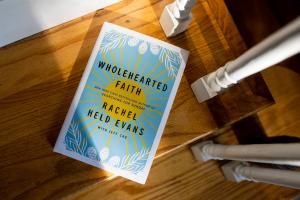
Occasionally people will ask me what I think about absolute truth, which I like to consider an estranged cousin of certainty. They ask me if I believe in absolute truth and what I think absolute truth is, and sometimes they warn me of my apparent relativism and that proverbial slippery slope . . . It’s not that I don’t believe absolute truth exists, but if it does, it would take the mind of God to know it in its fullness . . . If it exists, I imagine it to be more like the wind, gently yet indirectly alerting us to its presence . . . But it’s impossible to bottle or to tame.
Ah, yes—absolute truth. My usual response to the question Rachel was asked is to say that I believe that absolute truth exists, but that I also believe that it is far more difficult to discover and identify that we might imagine. Rachel Held Evans said the same thing much more eloquently.
In what might appear to be a conflicting obsession, I frequently complain about the disappearance of commitment to facts in our contemporary world. Several years ago, the Oxford Dictionary named “post-truth” as its word of the year, an adjective defined as “relating to or denoting circumstances in which objective facts are less influential in shaping public opinion than appeals to emotion and personal belief.” 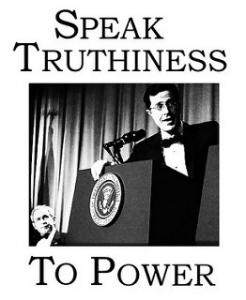 A decade earlier, the Merriam-Webster Dictionary word of the year was truthiness, defined as a quality characterizing a “truth” that a person making an argument or assertion claims to know intuitively “from the gut” or because it “feels right” without regard to evidence, logic, intellectual examination, or facts.
There is little doubt that we find ourselves in a world of truthiness, where fact-checking is an obsolete job description and how one feels is a better guide to what is true than anything an “expert” might have to say. Pilate famously asked Jesus “What is Truth”?—the post-fact world answer is “whatever most aligns with how you feel,” or more simply, “whatever the hell you want it to be.”
Feeling the truth in one’s gut does a nice end run on the inconvenient and often challenging activity, as I regularly challenge my students to do, of earning the right to have one’s opinion. Constructing arguments, supporting one’s premises with facts, and being open to changing one’s views in the face of contrary evidence is just so damned annoying and a waste of time. As philosopher Roger Scruton notes, in the world before post-truth,
People interested in truth seek out those who disagree with them. They look for rival opinions, awkward facts and the grounds that might engender hesitation. Such people have a far more complicated life than most.
But I have a problem. As noted at the beginning of this essay, I have said and written more times than I can count over the years that uncertainty is a good thing, that certainty is vastly overrated, and even that there are some areas of human activity (such as philosophy) where facts and definitive answers are far less important than open-ended inquiry and the conviction that the most important questions are never closed. Isn’t this, in its own way, a push-back against the importance of facts?
Even more importantly, the life of faith seems by its very nature to be immune to fact-checking. During the upcoming Advent and Christmas seasons, for instance, conversations among persons of Christian faith will touch base with the foundational stories of Jesus’ birth in the gospels. Did they really happen in the way the authors claim? Does it matter that the stories are not entirely consistent with each other, that none of them include all of the features of the nativity story that we are so attached to? What if we found out that none of the details really happened in the ways described?
In truth (!), it’s just about guaranteed that none of the “facts” of the nativity story are “true” in a fact-checking sort of way—such is the nature of ancient texts and events that occurred (or didn’t) over two millennia ago. Does this then reduce faith to a “gut feeling” in the same way that “truthiness” reduces truth and facts? On a surface level, perhaps; but on the deepest levels, absolutely not.
I once asked a class a number of years ago, “If you consider yourself to be a Christian, would it make any difference to your faith if it could be definitively proven that Jesus never existed and that none of the stories in the gospel accounts are factually true?” I received a wide range of responses, but one in particular has stuck with me. A young lady, after much thought, said “No, I would still be a Christian because it makes me a much better person than I would be if I wasn’t one.”
There is a great deal of wisdom in her comment. Faith holds the believer to a far more rigorous standard than mere feelings or even facts. Whether or not Jesus was born in a manger or Mary was a virgin when he was born is far less important than what difference the stories and teachings reported in the gospels make in one’s life. I have often said and written that the best evidence for the truth of one’s faith is a changed life. As the blind man who is told by the Pharisee authorities that the man (Jesus) who healed him is a sinner said, “Whether he is a sinner or not I do not know but I know this—I was blind, and now I see.” That takes the issue to whole different level than fact-checking.
Previous Post
November 13, 2021
Do You Want to be Certain, or Do You Want to be Honest?
Next Post

November 18, 2021 Teachers, Guns, and Sacred Spaces
Browse Our Archives
Select a Category abortion Advent AI Angels Artificial intelligence atheism attention baptism Baptists beauty belief Benedictines Bible bicycling Big Bird books Bovina Camaldoli hermitage Canada Catholicism cats certainty change Christianity Christmas Collegeville Covid-19 creativity Development of Western Civilization dogs doubt Easter Enneagram Epiphany Episcopal ethics Eucharist evil extroverts Facebook faith family fear flowers forgiveness freedom friends God goodness grace happiness heaven hell history Holy Spirit Holy Week hope human nature humility humor idolatry incarnation introverts irreverence Islam Jeanne Jesus Joe Biden joy Judaism justice Kamala Harris knowledge Lent listen literature liturgy love Marsue Memorial Day miracles movies music mystery mythology NPR Old Testament optimism paradox peace Penguins philosophy piano podcast politics power prayer Protestantism Providence College Religion Rhode Island sabbatical sacrament science seeing silence Simone Weil Socrates soul sports St. John's College stories suffering tattoo teaching technology television theology thinking time tolerance transcendence travel trees trust truth Uncategorized Vermont wisdom wonder writing
Select a Month May 2026 April 2026 March 2026 February 2026 January 2026 December 2025 November 2025 October 2025 September 2025 August 2025 July 2025 June 2025 May 2025 April 2025 March 2025 February 2025 January 2025 December 2024 November 2024 October 2024 September 2024 August 2024 July 2024 June 2024 May 2024 April 2024 March 2024 February 2024 January 2024 December 2023 November 2023 October 2023 September 2023 August 2023 July 2023 June 2023 May 2023 April 2023 March 2023 February 2023 January 2023 December 2022 November 2022 October 2022 September 2022 August 2022 July 2022 June 2022 May 2022 April 2022 March 2022 February 2022 January 2022 December 2021 November 2021 October 2021 September 2021 August 2021 July 2021 June 2021 May 2021 April 2021 March 2021 February 2021 January 2021 December 2020 November 2020 October 2020 September 2020 August 2020 July 2020 June 2020 May 2020 April 2020 March 2020 February 2020 January 2020 December 2019 November 2019 October 2019 September 2019 August 2019 July 2019 June 2019 May 2019 April 2019 March 2019 February 2019 January 2019 December 2018 November 2018 October 2018 September 2018 August 2018 July 2018 June 2018 May 2018 April 2018 March 2018 February 2018 January 2018 December 2017 November 2017 October 2017 September 2017 August 2017 July 2017 June 2017 May 2017 April 2017 March 2017 February 2017 January 2017 December 2016 November 2016 October 2016 September 2016 August 2016 July 2016 June 2016 May 2016 April 2016 March 2016 February 2016 January 2016 December 2015 November 2015 October 2015 September 2015 August 2015 July 2015 June 2015 May 2015 April 2015 March 2015 February 2015 January 2015 December 2014 November 2014 October 2014 September 2014 August 2014 July 2014 June 2014 May 2014 April 2014 March 2014 February 2014 January 2014 December 2013 November 2013 October 2013 September 2013 August 2013 July 2013 June 2013 May 2013 April 2013 March 2013 February 2013 January 2013 December 2012 November 2012 October 2012 September 2012
Follow Us!
TAKE THE
Religious Wisdom Quiz
What is the Christian teaching about caring for the poor?
Select your answer to see how you score.
Never give Seek only own wealth Help those in need Ignore the poor
Books by This Author Books by Vance G. Morgan
Related posts from Freelance Christianity

The Lonely Pawn: On Faith, Doubt, and Meaning


AI and Love: When a Chatbot Becomes a...

TRENDING AT PATHEOS Progressive Christian

What Being a Modern-Day Apostle Means to Me
In my last column, I discussed the ins and outs of modern-day...

Did Ancient China Once Worship the God of...
Across human history, a common thread weaves through the origins of the...

Love Your Neighbor – Including Earth-Kin: Lev. 19,...
God’s command to love your neighbor means acting in an ethical and...

Lead a Church Study of “Jesus and Lao...
Guest writer Jack Thomas (The Irreverent Reverend) reflects on leading his church...

Pastoral Wisdom for Responding to Sermon Pushback
Getting sermon pushback on your social justice sermon? Learn practical, Proverbs-based strategies...

Principles for Understanding the Apostolic Ministry Today
Whenever people discover that my formal ministry title is "apostle," as in...
view all Progressive Christian blogs
Ad-Free & Subscriber Log-In Subscription Support
- About Us
- 2026 Calendar
- Videos
- Podcasts
- Library of World Religions
- Faith In Media Tracker
- Advertise With Us
- Write for Us
- Privacy Policy
- Terms of Service
- Do Not Sell My Data
- Contact Us
- Radiant Digital
- Manage Newsletter Subscriptions
- Unsubscribe From Notifications
- Sitemap
Copyright 2008-2026, Patheos. All rights reserved.
Subscription Support Ad-Free & Subscriber Log-In
Follow Patheos