
BuddhistCatholicContemplativeEvangelicalGeneral ChristianHinduJewishLatter-day SaintMuslimNew VisionsProgressive Christian
Beliefs
- Buddhist
- Catholic
- Contemplative
- Evangelical
- General Christian
- Hindu
- Jewish
- Latter-day Saint
- More Voices
- Muslim
- New Visions
- Pagan
- Progressive Christian
Topics
- Religion News
- Food and Religion
- Sports and Religion
- Religious Art
- Religious Music and Entertainment
- Religious Events
- History and Religion
- Style and Religion
- Politics and Religion
- Women in Religion
- Recreation Outdoors and Religion
- Business Finance and Religion
- Careers Workplace and Religion
- Education and Religion
- Family Parenting and Religion
- Health Fitness and Religion
- Home and Religion
- Relationships and Religion
- Technology and Religion
- Travel and Religion
Columnists
- Buddhist Columnists
- Business Finance and Religion Columnists
- Careers Workplace and Religion Columnists
- Catholic Columnists
- Contemplative Columnists
- Education and Religion Columnists
- Evangelists Columnists
- Family Parenting and Religion Columnists
- General Christian Columnists
- Health Fitness and Religion Columnists
- Hindu Columnists
- History and Religion Columnists
- Home and Religion Columnists
- Jewish Columnists
- More Voices Columnists
- Latter Day Columnists
- Muslim Columnists
- New Visions Columnists
- Nonreligious Columnists
- Pagan Columnists
- Politics and Religion Columnists
- Progressive Columnists
- Recreation Outdoors and Religion Columnists
- Relationships and Religion Columnists
- Religion News Columnists
- Religious Art Columnists
- Religious Events Columnists
- Religious Music and Entertainment Columnists
- Sports and Religion Columnists
- Style and Religion Columnists
- Technology and Religion Columnists
- Travel and Religion Columnists
- Women in Religion Columnists
Resource Library
- 2026 Calendar
- Library of World Religions
- The 100 Most Holy Places on Earth
- Patheos Answers
- Podcasts
- Videos
- Faith Leaders Database
- Anglican Episcopalian
- Bahai
- Baptist
- Buddhism
- Christianity
- Confucianism
- Eastern Orthodoxy
- Hinduism
- Holiness and Pentecostal
- ISKCON
- Islam
- Judaism
- Lutheran
- Methodist
- The Church of Jesus Christ of Latter-day Saints
- New Age
- Paganism
- Presbytarian and Reformed
- Protestantism
- Religion Behind the Scenes
- Roman Catholic
- Scientology
- Shia Islam
- Sikhism
- Sufism
- Sunni Islam
- Taoism
- Zen
- See all religions
Research Tools
 Ad-Free & Subscriber Log-In Subscription Support
Ad-Free & Subscriber Log-In Subscription Support
Follow Patheos 

- Trending:
- Forgiveness
- |
- Marriage
- |
- Consciousness
- |
- Death Penalty
- |
- Election
- |
- Halloween

- Home
- Progressive Christian
- Evangelical Atheism
Evangelical Atheism
Last updated on: November 13, 2017 at 10:14 pm by Vance Morgan
Evangelical Atheism 2017-11-13T22:14:18-04:00 Vance Morgan
Patheos Explore the world's faith through different perspectives on religion and spirituality! Patheos has the views of the prevalent religions and spiritualities of the world.
I just started a new unit in my General Ethics classes with fifty juniors and seniors: Does ethics have anything to do with God? On a Catholic college campus, where a significant portion of the students are products of many years of parochial school education, this is a big issue. Religious folks have been known to argue that the only possible reliable foundation for moral absolutes is belief in God, implying either implicitly or explicitly that atheistic non-believers lack any reason to be moral. Yet my students know either intuitively or through personal experience that it is entirely possible for a dedicated atheist to be a highly moral person. How does that work?
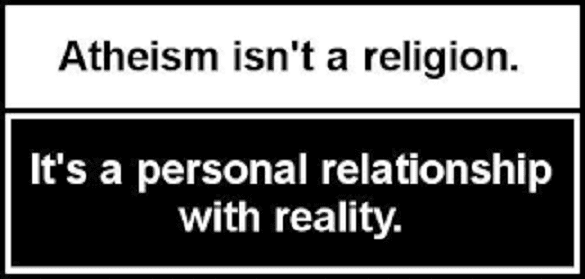
I have been a person of faith, sometimes reluctantly, for my whole life—the very existence of this blog is due to my continuing commitment to grappling with issues of faith in writing. Yet I have always been fascinated by atheism. Four years ago, my second blog post ever used Simone Weil’s comment that “Atheism is a purification” as a jumping off point, imagining how a season of atheism might be a healthy exercise for a person of faith.
Several years ago when I was chair of our philosophy department I was responsible for the two-semester capstone seminar required of all our senior majors. Each year during the summer I would send the rising senior majors a list of three or four possible topics to spend the fall semester working on—one year they chose “Philosophy of Religion,” not surprising since half of the eighteen seniors were Catholic seminarians (required by the diocese to major in philosophy in their undergraduate years).
Some of the seniors, particularly the seminarians, were probably surprised to see texts from avowed atheists such as Sigmund Freud, Daniel Dennett, and Richard Dawkins on the semester syllabus, but as a new professor in the theology department commented at the time, such works are “good for them” (the seminarians) to grapple with. Atheists, after all, struggle with the same issues as theists—they just do it a bit differently.
A recent episode of “On Being” with Krista Tippett on our local NPR station was an hour-long discussion of these very issues. The show was a repeat of a 2012 interview with Alain de Botton. De Botton is trained as a philosopher, but is best known as a sort of Renaissance man whose popular books include The Consolations of Philosophy, How Proust Can Change Your Life, and Religion for Atheists. I knew I was going to enjoy the interview when it began with the following from de Botton: The most boring and unproductive question one can ask of any religion is whether it is true.
Alain de Botton and the School of Life
De Botton was raised in “a devoutly atheist family,” a Jewish family fully aware of the enormous suffering Jews had suffered historically and particularly in the twentieth century, often in the name of religion. De Botton experienced in early adulthood what he described a “crisis of faithlessness,” during which he learned that there were a number of things tangentially associated with religion, including music, art, architecture, and moral guidance, that he found “incredibly interesting, fascinating, beautiful, [and] inspiring.” What’s an atheist to do?
De Botton’s story is a familiar one, regardless of one’s beliefs concerning God. While stories of people who were raised in a religious household and became atheists as adults, as well as of people raised as atheists who became religious believers as adults, are out there, the more common story is of those who are so shaped by their early years that they find it impossible, in spite of good reasons to do so, to radically change that framework as adults. De Botton occasionally implies that he wishes he could become a theist—but if there is something like a “religious gene,” he is lacking it. Knowing that the foundation of religious belief for many people is a feeling or experience, he notes that
I’ve not had this feeling . . . all I can report is that many of these bits of religion do impact me greatly. If I was different, I would be a believer, is all I can say. I can only speak from a non-believing position . . . I really don’t feel a belief in a divine being is something that rings bells with me. I’m happy to be in the atheist box, but it’s a much broader box than we might have allowed for.
The power of how one is raised cannot be overestimated. De Botton has no more natural access to what it is like to be a person of faith than I, raised in an all-encompassing religious atmosphere, can pretend to know what it would be like to frame important issues as an atheist would.
And yet, de Botton continues, atheists and persons of faith have much in common. Neither atheists nor theists are necessarily happy to hear this—each side is taught that the other is the enemy, a phenomenon encouraged by popular writers from the atheist camp such as Daniel Dennett, Richard Dawkins, and Sam Harris. De Botton reports that he is occasionally accused in emails or print of having “betrayed atheism,” professing that “I didn’t know that’s what atheism was supposed to be about, being mean to religion . . . I think there’s an image of the fierce atheist who has faith in science and ridicules all religious moments and religious impulses. I couldn’t be further from that point of view.” Instead, he argues, religion has offered and continues to offer too much of importance to be rejected out of hand even if one is an atheist.
An awful lot that seems to us intrinsically religious is not; it’s part of the treasury of mankind. These religions at their highest points, at their most complex and subtle moments are far too interesting to be abandoned merely to those who believe in them . . . I think a lot of what’s attractive in religion is that it puts us in a wider perspective both in time and in place because most of our lives are lived right up against the present moment . . . And suddenly, that brings a kind of calm to our inner lives because it’s nice to made to feel small against the backdrop of a vast universe.
Even if one sets arguments about the existence and nature of God as well as speculation about what happens after we die aside, religion has much to offer even to the most secular person. “Religion is this long tradition of deep thinking and wrestling with the complexity of the human condition as much as about the nature of God.” How then should we live? is a human question, not a religious question. We do not come into the world knowing how to navigate the minefield of human existence—de Botton is more than happy to poach on the ideas offered by religion, just as religions have “hoovered up” the best that the secular world has to offer since the beginning.
De Botton’s “School of Life,” now situated in many cities across the globe, “picks up on the idea that we need guidance, that learning how to live is not something we just do spontaneously.” At this thoroughly secular school one will hear sermons, experience what feels all the world like liturgy, and even perhaps sing some hymns, all intended to be in service to human needs that are far deeper than what religion one belongs to (if any). As Krista Tippett says in the interview, “What I see you doing is carving out what has been traditionally, religiously called ‘sacred space’ in secular culture.”
Toward the end of the interview, Tippett also comments that “I do feel that another religious and particularly Christian impulse that you are taking up as an atheist is that of being evangelical, which is about spreading the good news that you’ve discovered.” The good news is that “there’s so much more in common between believers and nonbelievers than we’re sometimes encouraged to think. At the very last moment under the stars we may differ about what’s going on, but we can still have a very nice time together for a long, long part of this journey.”
Just as many other supposedly incompatible binaries—Republican/Democrat, conservative/liberal, and more—atheists and religious folks need not be at permanent odds with each other. Each of us is human, sharing the same needs, hopes, and dreams that all human beings possess, no matter how we package them.
Previous Post

November 8, 2017
I Could Do That
Next Post

November 12, 2017 I'm a Christian, But I Won't Be Saying "Merry Christmas"
Browse Our Archives
Select a Category abortion Advent AI Angels Artificial intelligence atheism attention baptism Baptists beauty belief Benedictines Bible bicycling Big Bird books Bovina Camaldoli hermitage Canada Catholicism cats certainty change Christianity Christmas Collegeville Covid-19 creativity Development of Western Civilization dogs doubt Easter Enneagram Epiphany Episcopal ethics Eucharist evil extroverts Facebook faith family fear flowers forgiveness freedom friends God goodness grace happiness heaven hell history Holy Spirit Holy Week hope human nature humility humor idolatry incarnation introverts irreverence Islam Jeanne Jesus Joe Biden joy Judaism justice Kamala Harris knowledge Lent listen literature liturgy love Marsue Memorial Day miracles movies music mystery mythology NPR Old Testament optimism paradox peace Penguins philosophy piano podcast politics power prayer Protestantism Providence College Religion Rhode Island sabbatical sacrament science seeing silence Simone Weil Socrates soul sports St. John's College stories suffering tattoo teaching technology television theology thinking time tolerance transcendence travel trees trust truth Uncategorized Vermont wisdom wonder writing
Select a Month May 2026 April 2026 March 2026 February 2026 January 2026 December 2025 November 2025 October 2025 September 2025 August 2025 July 2025 June 2025 May 2025 April 2025 March 2025 February 2025 January 2025 December 2024 November 2024 October 2024 September 2024 August 2024 July 2024 June 2024 May 2024 April 2024 March 2024 February 2024 January 2024 December 2023 November 2023 October 2023 September 2023 August 2023 July 2023 June 2023 May 2023 April 2023 March 2023 February 2023 January 2023 December 2022 November 2022 October 2022 September 2022 August 2022 July 2022 June 2022 May 2022 April 2022 March 2022 February 2022 January 2022 December 2021 November 2021 October 2021 September 2021 August 2021 July 2021 June 2021 May 2021 April 2021 March 2021 February 2021 January 2021 December 2020 November 2020 October 2020 September 2020 August 2020 July 2020 June 2020 May 2020 April 2020 March 2020 February 2020 January 2020 December 2019 November 2019 October 2019 September 2019 August 2019 July 2019 June 2019 May 2019 April 2019 March 2019 February 2019 January 2019 December 2018 November 2018 October 2018 September 2018 August 2018 July 2018 June 2018 May 2018 April 2018 March 2018 February 2018 January 2018 December 2017 November 2017 October 2017 September 2017 August 2017 July 2017 June 2017 May 2017 April 2017 March 2017 February 2017 January 2017 December 2016 November 2016 October 2016 September 2016 August 2016 July 2016 June 2016 May 2016 April 2016 March 2016 February 2016 January 2016 December 2015 November 2015 October 2015 September 2015 August 2015 July 2015 June 2015 May 2015 April 2015 March 2015 February 2015 January 2015 December 2014 November 2014 October 2014 September 2014 August 2014 July 2014 June 2014 May 2014 April 2014 March 2014 February 2014 January 2014 December 2013 November 2013 October 2013 September 2013 August 2013 July 2013 June 2013 May 2013 April 2013 March 2013 February 2013 January 2013 December 2012 November 2012 October 2012 September 2012
Follow Us!
TAKE THE
Religious Wisdom Quiz
Who wrote the Book of Acts?
Select your answer to see how you score.
Luke Peter Mark Paul
Books by This Author Books by Vance G. Morgan
Related posts from Freelance Christianity

The Lonely Pawn: On Faith, Doubt, and Meaning


AI and Love: When a Chatbot Becomes a...

TRENDING AT PATHEOS Progressive Christian

What Being a Modern-Day Apostle Means to Me
In my last column, I discussed the ins and outs of modern-day...

Did Ancient China Once Worship the God of...
Across human history, a common thread weaves through the origins of the...

Love Your Neighbor – Including Earth-Kin: Lev. 19,...
God’s command to love your neighbor means acting in an ethical and...

Lead a Church Study of “Jesus and Lao...
Guest writer Jack Thomas (The Irreverent Reverend) reflects on leading his church...

Pastoral Wisdom for Responding to Sermon Pushback
Getting sermon pushback on your social justice sermon? Learn practical, Proverbs-based strategies...

Principles for Understanding the Apostolic Ministry Today
Whenever people discover that my formal ministry title is "apostle," as in...
view all Progressive Christian blogs
Ad-Free & Subscriber Log-In Subscription Support
- About Us
- 2026 Calendar
- Videos
- Podcasts
- Library of World Religions
- Faith In Media Tracker
- Advertise With Us
- Write for Us
- Privacy Policy
- Terms of Service
- Do Not Sell My Data
- Contact Us
- Radiant Digital
- Manage Newsletter Subscriptions
- Unsubscribe From Notifications
- Sitemap
Copyright 2008-2026, Patheos. All rights reserved.
Subscription Support Ad-Free & Subscriber Log-In
Follow Patheos